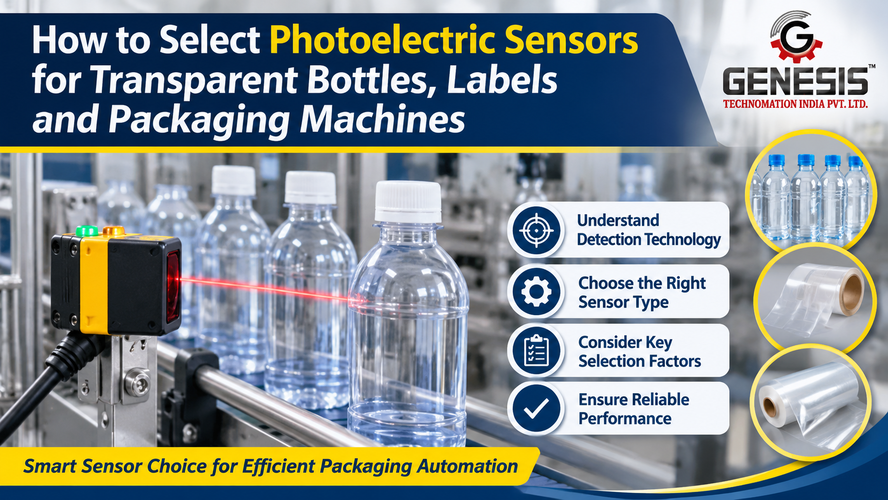
Photoelectric Sensors play an important role in modern packaging automation. They help manufacturers detect products, monitor conveyor movement, count bottles, check label positions, and control different stages of automated production. However, selecting the right sensor becomes more challenging when a machine needs to detect transparent bottles, clear glass containers, PET packaging, or transparent adhesive labels.
Unlike cardboard boxes, metal components, or opaque plastic products, transparent materials allow light to pass through them. Some surfaces also reflect light at unexpected angles. As a result, a conventional photoelectric sensor may fail to detect a clear bottle consistently, even when the bottle passes directly through its sensing area.
This problem can affect several industrial applications, including beverage bottling, pharmaceutical packaging, cosmetic container manufacturing, and automatic labeling machines. A missed detection signal can cause incorrect bottle counting, filling errors, label positioning problems, or unnecessary machine stoppages.
Choosing a suitable Photoelectric Sensor for Transparent Bottles requires an understanding of the target material, sensing technology, optical characteristics, operating speed, installation distance, and electrical requirements.
This guide explains how engineers, machine manufacturers, maintenance teams, and procurement professionals can select suitable photoelectric sensors for transparent bottles, labels, and different packaging applications. It also discusses important technical specifications and practical considerations when purchasing industrial photoelectric sensors in India.
Understanding Photoelectric Sensor Detection Technology
A photoelectric sensor detects an object by transmitting light and monitoring how that light behaves when it interacts with a target.
Most industrial photoelectric sensors contain three main elements:
- Light emitter: Produces a light beam, commonly using an LED or laser.
- Light receiver: Detects the transmitted or reflected light.
- Signal processing circuit: Evaluates changes in received light and generates an electrical output.
The sensor sends an output signal to a PLC or machine controller when it identifies the required detection condition.
How Light Interacts with Different Materials
The detection process depends heavily on the optical properties of the target.
When light reaches an object, several things can happen.
Reflection: Some light returns from the object’s surface. Diffuse sensors use this reflected light to identify objects.
Transmission: Light passes through transparent or translucent materials. This can make conventional object detection difficult.
Absorption: Certain materials absorb part of the emitted light, reducing the intensity reaching the receiver.
Refraction: Light changes direction when it passes between materials with different optical properties. Curved glass and plastic surfaces can redirect light away from the receiver.
These optical behaviours explain why a sensor that detects an opaque plastic bottle successfully may struggle with a transparent PET container.
Why Detection Technology Matters
Different photoelectric sensing methods evaluate changes in light differently.
A through-beam sensor monitors the interruption of a light path between separate emitter and receiver units. A retro-reflective sensor monitors light returning from a reflector. A diffuse sensor detects light reflected directly from the target.
The correct selection depends on whether the application requires reliable object interruption, surface reflection, transparent-object detection, or precise positioning.
Why Transparent Bottles and Labels Are Difficult to Detect
Transparent materials create several challenges for conventional photoelectric sensors. Their optical properties differ from those of opaque materials, and even small changes in bottle shape or surface condition can affect the received light signal.
Clear PET Bottles
PET bottles are common in beverage, pharmaceutical, cosmetic, and household product manufacturing.
Their transparent walls allow a significant portion of the emitted light to pass through. Depending on the bottle design, the sensor may receive enough light to interpret the sensing path as unobstructed.
Bottle shoulders, grooves, ribs, and curved surfaces can also redirect light. This makes consistent detection difficult, particularly when bottles move quickly along a conveyor.
A specialized transparent-object detection sensor can help identify small changes in the light reaching its receiver.
Transparent Glass Bottles
Glass bottles present a different set of optical characteristics. Their thickness, surface finish, curvature, and refractive properties influence how light travels through the material.
Some glass bottles produce strong surface reflections, while others transmit most of the incident light.
For example, a filling line may transport clear glass bottles through a washing station before they reach the filling equipment. A sensor must detect each bottle accurately despite moisture, vibration, and changing surface conditions.
A dedicated clear-object sensor or suitable polarized retro-reflective arrangement can provide a more reliable solution than a standard diffuse sensor.
Translucent Containers
Translucent materials allow some light to pass through while scattering or absorbing another portion.
The amount of transmitted light depends on material thickness, colour, surface texture, and manufacturing consistency.
A sensor that works with one translucent container may not perform equally well with another. Engineers should test samples from actual production batches before finalizing the sensing technology.
Transparent Packaging Films
Transparent films create additional difficulties because they are thin and flexible.
Examples include:
- Shrink-wrap films.
- Transparent protective covers.
- Plastic wrapping materials.
- Clear packaging pouches.
- Film webs used in automatic packaging machines.
A standard sensor may detect a folded film but fail to detect a flat section. Wrinkles, tension changes, overlapping layers, and film movement can also affect detection.
For film applications, engineers should consider specialized transparent-object sensors, ultrasonic sensors, or dedicated web-monitoring solutions according to the material and required response time.
Clear Adhesive Labels
Transparent labels are particularly difficult to detect because their appearance may closely match the surface underneath.
A clear label attached to a glass bottle may produce very little contrast between the label and the container.
The sensor may struggle to distinguish:
- A bottle with a transparent label.
- A bottle without a label.
- A gap between two labels.
- An incorrectly positioned label.
Specialized label sensors use suitable optical or contrast-based detection methods to identify small differences between the label, adhesive, and backing material.
Glossy and Reflective Packaging Surfaces
Highly polished glass, metallic packaging, glossy plastic, and reflective films can return light in unexpected directions.
This can create false switching signals or inconsistent detection.
Polarized optical systems help distinguish light returned by a reflector from unwanted reflections produced by shiny objects. However, their suitability still depends on the target material and sensor design.
Different Bottle Shapes and Curved Surfaces
Bottle geometry is another important consideration.
A cylindrical bottle, square glass container, and faceted cosmetic bottle interact with light differently.
Curved surfaces can focus or redirect the sensing beam. Ridges and grooves can also produce changing optical signals as the bottle moves.
For this reason, sensor selection should consider the actual bottle geometry rather than transparency alone.
Types of Photoelectric Sensors for Packaging Applications
Understanding different sensing technologies helps engineers narrow down the available options.
Not every photoelectric sensor can detect every transparent object. Some technologies work well with opaque cartons but require special optical designs or additional configuration for clear bottles.
Through-Beam Photoelectric Sensors
Through-beam sensors use two separate units: an emitter and a receiver.
The emitter sends light directly towards the receiver. When an object interrupts the beam, the receiver detects a reduction in light and changes its output.
Advantages:
- Long sensing distances.
- Strong detection performance for opaque objects.
- Less dependence on target colour and surface reflectivity.
- Suitable for product counting and conveyor monitoring.
Limitations:
- Requires two separate mounting positions.
- Both units need accurate optical alignment.
- Transparent objects may allow sufficient light to pass through.
- Installation can be difficult in compact machinery.
Through-beam sensors work well for detecting cartons, opaque bottles, and other solid products. However, engineers should not assume that a conventional through-beam sensor will reliably detect clear PET or glass bottles.
For transparent materials, a specialized optical arrangement or another detection technology may be necessary.
Diffuse-Reflective Photoelectric Sensors
Diffuse sensors contain an emitter and receiver in the same housing. They detect an object by receiving light reflected directly from its surface.
When a product enters the sensing area, the amount of reflected light changes and the sensor generates an output signal.
Advantages:
- Simple installation.
- No separate reflector required.
- Suitable for general object detection.
- Useful for detecting cartons, components, and opaque packaging.
Limitations:
- Detection depends on target reflectivity.
- Dark materials may return insufficient light.
- Glossy surfaces can cause unpredictable reflections.
- Transparent materials may allow the sensing beam to pass through.
A standard diffuse photoelectric sensor is generally not the first choice for detecting clear bottles or transparent labels. It may work in a particular installation if the target produces sufficient optical contrast, but actual material testing remains necessary.
Retro-Reflective Photoelectric Sensors
Retro-reflective sensors contain the emitter and receiver in one housing. A reflector installed opposite the sensor returns the emitted light.
When an object interrupts the optical path, the sensor detects the reduction in returned light.
Advantages:
- Only one sensor unit needs electrical wiring.
- Relatively simple installation.
- Suitable for many conveyor and packaging applications.
- Can provide long sensing distances depending on the model.
Limitations:
- Requires a compatible reflector.
- Reflector contamination can affect performance.
- Standard models may see through transparent objects.
- Shiny targets can create unwanted optical reflections.
For clear-object detection, engineers should investigate models specifically designed to detect small changes in the returned light signal.
Polarized Retro-Reflective Sensors
Polarized retro-reflective sensors use optical polarization filters to improve detection performance when dealing with reflective or transparent materials.
The sensor sends polarized light towards a compatible reflector. The reflector changes the polarization of the returning light, allowing the receiver to recognize the expected signal.
A shiny object may return light with a different polarization characteristic, helping the sensor distinguish the target from the reflector.
Advantages:
- Reduces false detection caused by certain shiny surfaces.
- Can detect some transparent and translucent materials.
- Supports precise leading-edge detection in suitable designs.
- Useful for packaging and conveyor applications.
Limitations:
- Requires correct reflector selection.
- Alignment is important.
- Not every polarized retro-reflective sensor is designed for clear-object detection.
- Dust and contamination can affect low-contrast detection.
An important distinction is that ordinary polarized retro-reflective sensing and specialized transparent-object detection are not automatically equivalent. Buyers should confirm that the selected model supports the intended clear-object application.
Transparent-Object Detection Sensors
A transparent-object detection sensor uses an optical design and signal-processing approach intended to recognize small changes caused by transparent materials.
Depending on the model, it may use polarized coaxial optics, specialized retro-reflective sensing, or a combination of optical intensity and distance measurement.
Dedicated clear-object detection sensors are designed for applications involving glass bottles, PET bottles, transparent films, and packaging materials.
Advantages:
- Designed for low-contrast transparent targets.
- Suitable for many glass and plastic detection applications.
- Can improve bottle counting consistency.
- Available in configurations for different industrial environments.
Limitations:
- Requires correct model selection.
- Target-specific testing remains important.
- Some applications require a reflector or stable background.
- Special optical technology may increase purchase costs.
For difficult transparent bottle applications, this should be one of the first sensing technologies engineers investigate.
Background-Suppression Sensors
Background-suppression sensors distinguish the target from objects located behind it.
Unlike a basic diffuse sensor, which mainly evaluates received light intensity, a background-suppression sensor uses an optical measurement method to identify the target within a defined sensing field.
This is useful when products pass in front of a fixed machine surface, conveyor structure, or other background.
Advantages:
- Helps reduce unwanted background detection.
- Useful for detecting objects at defined distances.
- Suitable for component presence and packaging applications.
- Can improve detection consistency when background conditions remain stable.
Limitations:
- Not every background-suppression sensor detects transparent materials.
- Target size and surface characteristics influence performance.
- The cutoff distance must match the installation.
A background-suppression sensor should not be considered a direct replacement for a dedicated clear-object sensor without testing.
Laser Photoelectric Sensors
Laser-based sensors use a focused light beam to detect objects or measure distance.
Their smaller optical spot can help with precise positioning and detection of small features.
Some laser distance sensors use changes in measured distance to identify transparent objects against a stable background.
Advantages:
- Small sensing spot in suitable models.
- Precise positioning.
- Useful for small components and detailed inspection.
- Certain distance-measuring designs can detect transparent objects.
Limitations:
- Not every laser sensor supports transparent-object detection.
- Installation geometry is important.
- Reflective surfaces can affect some measurement methods.
- Laser classification and safety requirements must be checked.
Laser sensors can be useful where the application needs precise measurement or positioning in addition to object detection.
Fork and Slot Sensors
Fork sensors contain an emitter and receiver in a compact U-shaped housing.
The object or material passes through the opening between the two optical elements.
These sensors are especially useful in applications involving labels, thin packaging materials, small components, and material edges.
Advantages:
- Emitter and receiver remain aligned.
- Compact installation.
- Useful for detecting gaps and edges.
- Suitable for repeatable positioning applications.
Limitations:
- The object must pass through the sensor opening.
- Maximum object dimensions depend on the fork size.
- Special transparent-label applications may require a dedicated label sensor.
Fork sensors can be a practical option for label dispensing machines when the label web and backing material produce a detectable optical difference.
How to Select Photoelectric Sensors for Transparent Bottles
Selecting a suitable Photoelectric Sensor for Transparent Bottles requires more than checking the product catalogue.
Engineers should evaluate the complete operating environment, including bottle construction, conveyor arrangement, machine speed, mounting position, and electrical requirements.
Identify the Bottle Material
Start by identifying the exact material that the sensor needs to detect.
Common materials include:
- Clear PET plastic.
- Transparent glass.
- Coloured transparent plastic.
- Translucent HDPE.
- Acrylic containers.
- Thin-wall plastic bottles.
Each material interacts with light differently.
A sensor that works with a clear glass bottle may not provide the same performance with a thin PET container.
If the production line handles multiple bottle types, test each representative material before purchasing the sensor.
Consider Bottle Diameter and Shape
Bottle dimensions influence the optical path and the time available for detection.
A narrow pharmaceutical vial may require a different arrangement from a large beverage bottle.
Consider:
- Bottle diameter.
- Bottle height.
- Shoulder shape.
- Base design.
- Surface grooves.
- Curved or flat surfaces.
- Distance between consecutive bottles.
For example, a bottling conveyor carrying small glass vials at high speed may require a narrow detection spot to distinguish individual vials and the gaps between them.
Evaluate Wall Thickness and Surface Characteristics
Bottle wall thickness, transparency, surface finish, and curvature affect optical behaviour.
Thicker glass may attenuate or reflect light differently from thin plastic. Embossed markings, labels, and surface irregularities can also change the returned signal.
If the application handles different bottle manufacturers or production batches, evaluate the full range of expected variations.
Select the Correct Sensing Distance
Measure the actual distance between the proposed sensor mounting point and the target or reflector.
Do not select a sensor based only on its maximum advertised sensing range.
A sensor operating close to its practical limit may become less reliable when the target changes position or the installation experiences vibration.
Allow for mounting tolerances and follow the manufacturer’s specified operating range.
Check Detection Sensitivity
Transparent-object detection often requires sensitivity to relatively small changes in light intensity.
However, excessive sensitivity can increase the possibility of false switching caused by dust, vibration, unwanted reflections, or changes in the surrounding environment.
The ideal setting should reliably distinguish the bottle from the normal background condition.
Always perform the final sensitivity adjustment with actual bottles moving through the production line.
Plan Optical Alignment
Alignment is particularly important in retro-reflective applications.
The sensor must face the reflector correctly, and the reflector must return sufficient light to the receiver.
For polarized coaxial systems, the optical arrangement may also improve alignment flexibility and reduce certain reflection-related errors.
Follow the manufacturer’s mounting instructions rather than assuming that every reflector arrangement works with every sensor.
Match the Sensor to Conveyor Speed
Production speed directly affects the available detection time.
For example, a bottle moving quickly across a sensing point may remain within the detection area for only a few milliseconds.
The sensor’s response time must be short enough to register the object and provide a usable signal to the PLC.
Engineers should also consider output switching frequency, PLC input filtering, and the machine’s scan or event-processing requirements.
A fast sensor alone does not guarantee accurate counting if the PLC configuration filters out short signals.
Consider the Mounting Position
The mounting location affects the optical behaviour of the bottle and the ease of maintenance.
Common installation positions include:
- Side-mounted bottle detection.
- Detection across a conveyor.
- Detection near the bottle neck.
- Detection near the bottle base.
- Detection before a filling station.
- Detection before a labeling station.
Side mounting can help avoid certain reflections from curved bottle surfaces. However, the best position depends on the bottle geometry and the sensor’s optical design.
Example: Selecting a Sensor for a Beverage Bottling Line
Consider a beverage manufacturer transporting clear PET bottles towards an automatic filling machine.
The application requires reliable bottle counting before filling.
The engineering team should evaluate:
- Whether the bottles are transparent or translucent.
- Whether bottles touch each other on the conveyor.
- The minimum gap between consecutive bottles.
- Conveyor speed and maximum bottle throughput.
- Sensor mounting space.
- Exposure to water and cleaning chemicals.
- PLC input requirements.
A specialized clear-object retro-reflective sensor may suit an installation where the conveyor provides space for a reflector. A laser-based clear-object sensor may be worth investigating if a stable background can be established and reflector-free installation is preferred.
The final choice should come from testing both the detection reliability and the response time under actual production conditions.
Example: Pharmaceutical Glass Bottle Detection
Pharmaceutical lines often transport small glass bottles or vials through washing, filling, and labeling operations.
A missed detection can disturb the machine sequence or cause incorrect product counting.
In this application, engineers should prioritize:
- Small-object detection capability.
- Reliable leading-edge detection.
- Repeatability.
- High switching frequency.
- Suitable environmental protection.
- Resistance to cleaning-related contamination.
A dedicated clear-object detection sensor is generally a stronger starting point than a conventional diffuse sensor for this application.
How to Select Photoelectric Sensors for Transparent Labels
Transparent labels create a different detection problem from transparent bottles.
In an automatic labeling machine, the sensor may need to detect the label itself, identify a gap, monitor label positioning, or verify that a label has been applied correctly.
The correct technology depends on the label construction and the machine’s operating principle.
Transparent Labels on Glass Bottles
Clear labels are commonly used for cosmetic bottles, premium beverage containers, and glass packaging.
Because the label and glass surface can have similar optical characteristics, conventional sensors may not identify the label reliably.
A suitable sensor must distinguish between the labeled and unlabeled areas.
Engineers should test:
- Label transparency.
- Adhesive characteristics.
- Bottle surface.
- Label thickness.
- Label edges.
- Optical contrast.
- Detection distance.
If the label creates very little measurable difference in light transmission or reflection, a specialized transparent-label sensor may be necessary.
Clear Labels on Plastic Containers
Plastic containers can create additional optical variations.
The bottle surface may be curved, textured, coloured, or glossy. The label may also stretch or wrinkle during application.
A sensor should distinguish the label from the underlying container without producing false signals from changes in the bottle position.
For repeatable results, use representative containers and actual label material during commissioning.
Label Presence and Absence Detection
Some labeling systems need to verify whether a label is present at a particular position.
A label-presence sensor can monitor the difference between a labeled and an unlabeled area.
However, the sensor must have sufficient contrast to identify that difference.
If a transparent label produces almost no measurable change, a conventional presence sensor may not be suitable.
Label Positioning and Alignment
Automatic labeling machines require accurate positioning to apply labels at the correct location.
A small positioning error can affect the appearance and quality of the finished product.
A specialized label sensor or contrast sensor may detect the label edge or a printed reference mark.
For example, a packaging line using transparent labels with a printed registration mark may benefit from a contrast sensor that detects the mark rather than attempting to detect the transparent film itself.
Label Gap Detection
Many labeling machines use a continuous web of labels attached to a backing liner.
The machine needs to identify the gap between consecutive labels so that the dispensing mechanism can release each label at the correct time.
A dedicated label gap sensor is often a suitable choice for this application.
Some sensors detect differences in the optical properties of the label and backing material. Other designs use specialized optical arrangements to identify the label edge.
Label Backing Material
The backing liner plays an important role in sensor selection.
A transparent label on a particular liner may produce a different detection signal from the same label on another liner.
Therefore, engineers should evaluate the complete label construction rather than examining the label alone.
Test the label and liner together, including adhesive and any printed markings.
High-Speed Label Dispensing
High-speed labeling machines require sensors with suitable response times and repeatability.
The sensor must detect the label edge quickly enough for the machine controller to coordinate the dispensing operation.
Check the following:
- Label feed speed.
- Minimum label gap.
- Label length.
- Required positioning accuracy.
- Sensor response time.
- PLC input processing.
- Mechanical stability of the label web.
A sensor with an unsuitable response time may miss narrow gaps or produce inconsistent label positioning.
Incorrect Label Placement Detection
A separate inspection stage may be required to verify whether a label has been applied correctly.
For example, a machine may need to identify labels that are too high, too low, missing, or incorrectly aligned.
A contrast sensor, vision system, or specialized inspection sensor may be more appropriate than a basic photoelectric presence sensor.
The selection depends on whether the machine needs simple label presence detection or actual inspection of label position and quality.
Which Sensor Should You Select for Label Detection?
| Application | Suitable technology to investigate |
| Opaque label presence | Diffuse or background-suppression sensor |
| Printed registration mark | Contrast sensor |
| Transparent label detection | Specialized transparent-label sensor |
| Label gap detection | Dedicated label gap sensor |
| Small label positioning | Fork sensor or specialized label sensor |
| Label quality inspection | Vision system or suitable inspection sensor |
Do not confuse a bottle detection sensor with a label gap sensor. Both use optical sensing principles, but their detection requirements can be very different.
Selecting Sensors for Different Packaging Machines
Different packaging machines perform different operations. A sensor suitable for bottle counting may not provide the required accuracy for label positioning or film detection.
Automatic Bottle Filling Machines
Bottle filling machines use sensors to detect incoming containers, confirm bottle positioning, and coordinate filling operations.
The sensor may need to detect whether a bottle has reached the filling station before the machine activates its filling mechanism.
For clear bottles, investigate specialized transparent-object detection sensors.
Important considerations include:
- Bottle material and dimensions.
- Conveyor speed.
- Detection position.
- Minimum bottle spacing.
- Exposure to water and cleaning chemicals.
- PLC input compatibility.
For applications involving multiple bottle sizes, evaluate whether the sensor can maintain reliable detection across the complete product range.
Bottle Counting Systems
Bottle counting systems require reliable detection of individual products.
The sensor must identify each bottle without confusing consecutive bottles or missing narrow gaps.
A dedicated clear-object detection sensor with a suitable response time can help count transparent containers.
For high-speed applications, check the sensor response time, switching frequency, detection spot size, and PLC input filtering.
A suitable installation should also minimize false counting caused by vibration or unwanted reflections.
Automatic Labeling Machines
Labeling machines use several types of sensors.
One sensor may detect the incoming bottle, while another monitors the label web and identifies the gap between labels.
For bottle detection, a clear-object sensor may be suitable. For label positioning, a dedicated label sensor or contrast sensor may provide better results.
Engineers should evaluate both sensing tasks independently rather than expecting one sensor to handle every detection requirement.
Shrink-Wrapping Machines
Shrink-wrapping machines use sensors to monitor products, film movement, and packaging positions.
The sensor may detect a carton entering the wrapping station, monitor a film roll, or confirm product positioning.
For opaque cartons, diffuse or retro-reflective sensors may work well.
For transparent shrink film, investigate dedicated film detection technology or ultrasonic sensing, depending on the material and required response time.
Carton Packaging Machines
Carton packaging machines generally handle opaque cardboard products.
Diffuse, through-beam, retro-reflective, and background-suppression sensors can support different detection requirements.
For example:
- Through-beam sensors can monitor carton movement across a conveyor.
- Diffuse sensors can detect cartons at short distances.
- Background-suppression sensors can identify cartons in front of a fixed machine surface.
- Retro-reflective sensors can detect cartons using a reflector arrangement.
The correct choice depends on carton size, colour, conveyor arrangement, and surrounding equipment.
Pharmaceutical Packaging Lines
Pharmaceutical packaging involves glass vials, medicine bottles, trays, cartons, and blister packaging.
Sensors help coordinate product movement, counting, filling, and packaging operations.
For clear glass containers, dedicated transparent-object detection technology may be necessary.
Engineers should also consider cleaning procedures, production speed, small product dimensions, and the required level of detection repeatability.
Food and Beverage Packaging Systems
Food and beverage manufacturing often involves clear bottles, glass containers, cans, pouches, and plastic films.
The operating environment may include moisture, cleaning agents, condensation, and frequent washdown.
For these applications, evaluate:
- Appropriate IP protection.
- Housing material.
- Resistance to cleaning chemicals.
- Lens contamination.
- Reflector protection.
- Ambient temperature.
- Required detection speed.
An IP67 rating does not automatically establish suitability for high-pressure or high-temperature washdown. Check the manufacturer’s environmental specifications before selecting the sensor.
Conveyor-Based Product Detection
Conveyors use photoelectric sensors to detect product presence, count items, identify gaps, and control material flow.
For opaque products, conventional photoelectric sensors may be sufficient.
For clear bottles and containers, specialized transparent-object detection technology can reduce missed detections.
Sensor placement should also account for conveyor vibration, product spacing, mounting stability, and the direction in which products travel.
Product Sorting and Inspection Machines
Sorting machines use sensors to identify products and trigger mechanical actions.
A photoelectric sensor may detect whether an object is present, while additional sensors or vision systems perform more detailed identification.
For example, a sorting line may use a photoelectric sensor to identify the arrival of a transparent bottle and a separate inspection system to evaluate its shape, colour, or condition.
It is important to distinguish basic object detection from quality inspection. A standard photoelectric sensor does not independently identify every product defect.
Important Technical Specifications to Check Before Buying Photoelectric Sensor
Technical specifications help determine whether a sensor can meet the operating requirements of a packaging machine.
Before purchasing industrial photoelectric sensors, engineers should review the following parameters.
Sensing Range
Sensing range indicates the distance at which the sensor can detect an object under specified conditions.
The required range depends on:
- Sensor mounting location.
- Target dimensions.
- Reflector position.
- Conveyor width.
- Required detection accuracy.
A sensor with a longer range is not necessarily better. Short-range applications may benefit from a smaller sensing spot and more suitable optical characteristics.
For transparent-object detection, confirm the specified range for the actual sensing mode.
Response Time and Switching Frequency
Response time determines how quickly the sensor changes its output after detecting an object.
Switching frequency indicates how frequently the sensor can respond to changing detection conditions.
These specifications matter in high-speed packaging machines.
For example, a bottle counting system must distinguish consecutive bottles without missing narrow gaps.
Consider the following relationship:
Detection time = Detection zone length / Conveyor speed
If the detection zone measures 20 mm and the conveyor moves at 2 metres per second, the approximate time an object occupies that zone is:
0.02 / 2 = 0.01 seconds
This equals 10 milliseconds.
The sensor and PLC must process the detection signal within the available time. Engineers should also account for output delays, PLC input filtering, and mechanical tolerances.
Detection Accuracy and Repeatability
Accuracy describes how closely a measurement or detection position matches the intended reference.
Repeatability describes how consistently the sensor produces the same result under repeated conditions.
For bottle counting and label positioning, repeatability is particularly important.
Check the manufacturer’s specifications and conduct practical tests with actual production materials.
Light Source and Wavelength
Industrial photoelectric sensors commonly use visible red or infrared light. Certain specialized applications use other optical arrangements or laser sources.
The wavelength influences how light interacts with the target material.
However, wavelength alone does not determine whether a sensor can detect transparent objects. Optical geometry, receiver sensitivity, signal processing, and target characteristics also matter.
Select a sensor designed for the intended application rather than choosing one based only on its light colour.
Spot Size
Spot size refers to the dimensions of the emitted sensing beam at the target.
A small spot can help detect narrow objects, edges, and small gaps.
A wider sensing area may suit larger objects or applications that require broader coverage.
For small pharmaceutical bottles or label gaps, check whether the sensing spot provides sufficient resolution.
PNP and NPN Outputs
PNP and NPN describe the electrical switching configurations used by many industrial sensors.
A PNP sensor supplies positive voltage to the output when activated. An NPN sensor switches the output towards 0 V.
The choice depends on the PLC input arrangement.
Before ordering, confirm the exact model code and its wiring diagram.
NO and NC Output Configurations
NO means Normally Open, while NC means Normally Closed.
These terms describe the output state under the manufacturer’s specified normal or unactuated condition.
Depending on the sensor, Light Operate and Dark Operate functions may also determine how the output responds to the received light condition.
Engineers should check the wiring diagram and switching logic rather than assuming that NO and NC always correspond to a particular object-present condition.
Operating Voltage
Many industrial photoelectric sensors use DC supply voltages, commonly 10–30 V DC or 12–24 V DC, depending on the model.
The sensor voltage must match the machine’s electrical supply.
Check:
- Nominal supply voltage.
- Permitted voltage range.
- Current consumption.
- Output load limits.
- Reverse-polarity protection.
- Electrical noise requirements.
Do not assume that two sensors with similar housing designs have identical electrical specifications.
IP Protection Rating
The IP rating indicates the degree of protection provided by an enclosure against solid particles and water under specified test conditions.
Packaging machines may operate in dusty, wet, or frequently cleaned environments.
A sensor installed near a dry carton conveyor may have different protection requirements from one installed near a beverage filling or washing station.
For washdown applications, check whether the manufacturer specifically approves the sensor for the intended cleaning conditions.
Housing Material
Sensor housing material affects durability and suitability for different environments.
Common options include:
- Industrial-grade plastic.
- Stainless steel.
- Metal alloy housings.
Stainless steel may be suitable for certain demanding cleaning environments, but housing material alone does not establish chemical resistance or hygienic suitability.
Review the complete product documentation.
Ambient Light Immunity
Strong external light can interfere with some optical sensing arrangements.
Sunlight, industrial lighting, welding light, and reflections from nearby machinery may influence detection.
Check the manufacturer’s ambient light specifications and installation recommendations.
Temperature Range
Temperature affects sensor operation and may also influence the target material and optical conditions.
Check the minimum and maximum operating temperatures.
For machines operating near ovens, hot filling equipment, or cold storage areas, temperature suitability deserves particular attention.
Electrical Connections
Common industrial connections include:
- Integrated cable.
- M8 connectors.
- M12 connectors.
- Other manufacturer-specific arrangements.
Check cable length, pin configuration, connector type, and available mounting accessories before purchasing.
PLC Compatibility
A photoelectric sensor must communicate correctly with the machine controller.
Confirm:
- PNP or NPN input compatibility.
- Supply voltage.
- Output current.
- Switching logic.
- Input filtering.
- Required signal duration.
- Cable and connector arrangement.
A technically suitable sensor can still cause machine problems if its electrical interface does not match the control system.
Photoelectric Sensor vs Ultrasonic Sensor for Transparent Objects
Photoelectric and ultrasonic sensors use different detection principles. Both can support transparent-object detection, but their performance depends on the application.
Detection Principle
A photoelectric sensor uses emitted light and monitors interruption, reflection, or changes in optical conditions.
An ultrasonic sensor sends sound waves and measures the returning acoustic signal.
Because ultrasonic detection does not depend on visible light transmission, it can be useful for detecting certain transparent materials.
Transparent Bottle Detection
Specialized photoelectric sensors can detect small changes in transmitted or reflected light caused by clear bottles.
Ultrasonic sensors can also detect transparent containers because they respond to acoustic reflections rather than optical transparency.
However, bottle shape, angle, dimensions, and surface characteristics influence ultrasonic performance.
Clear Film Detection
Thin transparent films can be difficult for both technologies.
A suitable photoelectric sensor may detect changes in optical transmission or reflection.
An ultrasonic sensor may detect the film if it returns a sufficiently strong acoustic signal.
The correct choice requires testing with the actual film material and machine arrangement.
Sensing Distance
Both technologies offer different sensing ranges depending on the product design.
Photoelectric sensors often support longer ranges in suitable through-beam or retro-reflective configurations.
Ultrasonic sensing range varies according to the transducer and target characteristics.
Compare the usable operating range rather than relying on a general technology-level assumption.
Response Time
Photoelectric sensors generally offer an advantage in high-speed detection applications.
Ultrasonic sensors may have longer response times because they need to transmit and receive sound waves.
The actual response time depends on the selected model. Always compare manufacturer specifications before choosing a sensor for high-speed packaging machinery.
Detection of Closely Spaced Bottles
Bottle counting requires the sensor to identify individual products and the gaps between them.
A narrow optical sensing spot can help distinguish closely spaced bottles.
Ultrasonic sensors may have a wider detection area, depending on their beam characteristics, which can make small gaps more difficult to distinguish.
Installation Requirements
Photoelectric sensors may require a reflector, separate emitter and receiver, or a stable background depending on the sensing mode.
Ultrasonic sensors do not need an optical reflector, but they require suitable acoustic positioning and adequate clearance around the sensing area.
Maintenance Requirements
Photoelectric sensors may require periodic lens and reflector cleaning.
Ultrasonic sensors may require inspection for dust, liquid deposits, and contamination around the transducer surface.
The maintenance schedule should follow the operating environment and manufacturer recommendations.
Which Technology Should You Choose?
| Selection factor | Photoelectric sensor | Ultrasonic sensor |
| Detection method | Light | Sound waves |
| Clear bottle detection | Specialized models available | Possible with suitable models |
| Thin film detection | Depends on optical properties | Depends on acoustic response |
| High-speed counting | Often advantageous | Model-dependent |
| Small gaps | Narrow optical spot can help | Beam width may be a limitation |
| Reflector requirement | Depends on sensing mode | Not required |
| External light influence | Can affect some models | Generally not an optical concern |
| Surface and shape influence | Optical properties matter | Acoustic reflection matters |
For high-speed bottle counting, specialized photoelectric sensors are often a strong option. For applications where optical detection is difficult or a reflector cannot be installed, ultrasonic sensing may be worth evaluating.
Neither technology is universally better. Select the one that meets the actual detection requirements.
Common Mistakes When Selecting Photoelectric Sensors
Even a good-quality sensor can produce unreliable results when engineers overlook important application details.
The following mistakes are worth avoiding.
Choosing a Standard Diffuse Sensor for Clear Bottles
A common mistake is selecting a general-purpose diffuse sensor simply because it detects ordinary plastic products.
Transparent bottles may allow the emitted light to pass through without creating a sufficient change in the receiver signal.
Solution: Investigate dedicated clear-object detection sensors and test the actual bottle material.
Ignoring Conveyor Speed
A sensor may detect a stationary bottle correctly but miss bottles moving at high speed.
Solution: Calculate the available detection time and compare it with sensor response time, switching frequency, and PLC input processing.
Selecting an Unsuitable Sensing Range
A sensor may have a published maximum range that does not match the practical detection conditions.
Solution: Check the working distance, target characteristics, reflector requirements, and mounting tolerances.
Overlooking Reflective Surfaces
Shiny bottles, metallic packaging, and polished machine components can create unwanted reflections.
Solution: Evaluate polarized optics, coaxial designs, suitable mounting positions, and specialized detection technologies.
Incorrect Mounting and Alignment
Poor alignment can reduce received light and create unstable output signals.
Solution: Use the recommended mounting arrangement and verify optical alignment during installation.
Ignoring Environmental Conditions
Water droplets, dust, cleaning chemicals, and vibration can influence sensor performance.
Solution: Select an appropriate housing and environmental protection level. Include regular inspection in the maintenance schedule.
Not Testing Actual Packaging Materials
A sensor that works with one bottle sample may fail with another.
Solution: Test different bottle sizes, colours, thicknesses, labels, and production batches before finalizing the purchase.
Choosing Only by Price
A low-cost sensor may not provide the optical performance required for transparent-object detection.
Solution: Compare total application suitability, including installation, downtime risk, maintenance, and technical support.
Installation, Calibration and Maintenance Tips
Correct installation plays an important role in achieving consistent detection. Even a suitable sensor can produce unreliable results when the mounting position, sensitivity, or optical alignment is incorrect.
Position the Sensor Correctly
Choose a mounting location where the target passes consistently through the sensing area.
Avoid positions where bottles move excessively, rotate unexpectedly, or produce frequent reflections from nearby machine components.
For bottle detection, test different positions along the conveyor to identify the most stable detection point.
Maintain Proper Optical Alignment
For retro-reflective sensors, align the sensor with the reflector according to the manufacturer’s instructions.
Check that:
- The reflector faces the sensor correctly.
- The sensing beam reaches the reflector.
- The mounting bracket remains stable.
- Conveyor vibration does not disturb alignment.
- No machine component blocks the optical path.
Poor alignment can reduce the received signal and cause intermittent switching.
Adjust Sensitivity Carefully
Sensitivity adjustment helps the sensor distinguish between normal background conditions and the target.
For transparent-object detection, follow the manufacturer’s recommended setup procedure.
Some models provide teach-in buttons, remote teaching inputs, or potentiometer adjustments.
When setting up the sensor:
- Clean the sensor lens and reflector, where applicable.
- Establish the normal background or reflector condition.
- Follow the specified sensitivity or teach-in procedure.
- Introduce the actual transparent bottle or packaging material.
- Check whether the output changes consistently.
- Repeat the test with different samples.
- Verify the result at normal production speed.
Do not set sensitivity using only a stationary test object. The final test should reproduce actual machine conditions.
Use the Correct Reflector
Retro-reflective clear-object sensors may require a specific reflector type.
An incompatible reflector can affect optical performance and detection reliability.
Check the manufacturer’s recommended reflector, mounting angle, and operating distance.
Protect the Sensor from Contamination
Dust, moisture, adhesive residue, and product deposits can affect the optical surface.
Establish a cleaning schedule based on the production environment.
Use cleaning materials and procedures approved by the sensor manufacturer. Avoid abrasive materials that may damage the optical surface.
Inspect Sensor Connections
Loose cables, damaged connectors, and incorrect wiring can cause intermittent output signals.
During maintenance, inspect:
- Cable insulation.
- Connector condition.
- Power supply stability.
- PLC input status.
- Sensor indicator LEDs.
- Mounting brackets.
Troubleshoot Common Detection Problems
| Problem | Possible reason | Recommended action |
| Transparent bottle not detected | Sensor sees through the bottle | Evaluate a dedicated clear-object sensor |
| False detection | Unwanted reflections | Review sensor orientation and optical design |
| Intermittent output | Poor alignment or contamination | Clean and realign the sensor |
| Missed bottle counting | Response time or PLC filtering | Check switching frequency and input settings |
| Unstable detection | Changing bottle geometry | Test different sensing positions |
| Label gap not detected | Insufficient contrast | Use a suitable label gap sensor |
| Frequent sensor faults | Environmental exposure | Check IP rating and installation conditions |
A structured troubleshooting process helps identify whether the issue comes from sensor selection, installation, electrical connections, or PLC configuration.
How to Choose the Right Photoelectric Sensor Supplier in India
Finding a suitable Photoelectric Sensor Supplier in India is an important part of an industrial automation project.
Buyers should consider more than the initial product price. The supplier should help identify an appropriate sensor configuration based on the application, operating conditions, and machine requirements.
Check the Available Product Range
Different industrial applications require different sensing technologies.
A useful supplier should help buyers evaluate options such as:
- Diffuse photoelectric sensors.
- Retro-reflective sensors.
- Polarized retro-reflective sensors.
- Through-beam sensors.
- Background-suppression sensors.
- Laser sensors.
- Fiber-optic sensors.
- Specialized label and transparent-object detection sensors.
A wider product range makes it easier to investigate alternative solutions when a conventional sensor does not meet the application requirements.
Verify Technical Specifications
Before purchasing, check the exact model number and its technical documentation.
Important specifications include:
- Sensing distance.
- Sensing mode.
- Response time.
- Output configuration.
- Operating voltage.
- Protection rating.
- Connection type.
- Operating temperature.
Never assume that two similar-looking models have identical specifications.
Evaluate Application Support
A supplier with industrial automation knowledge can help buyers understand which sensing method may suit their requirements.
For example, a packaging machine manufacturer may need a sensor for clear PET bottle counting, while a labeling machine manufacturer may need a dedicated sensor for detecting label gaps.
These applications require different technical considerations.
Provide the supplier with sufficient information about the target material, dimensions, operating speed, and installation arrangement.
Check Product Availability and Delivery
Production schedules often depend on replacement components and new automation equipment.
Confirm the exact model’s availability, delivery expectations, and applicable commercial terms before placing an order.
If a particular model is unavailable, ask whether an alternative is technically compatible. Do not replace a sensor based only on similar appearance or product descriptions.
Consider After-Sales and Technical Assistance
Technical assistance can be valuable during installation, commissioning, and troubleshooting.
Ask whether the supplier can provide product documentation, wiring information, model selection assistance, and support for identifying suitable alternatives.
This can help reduce delays during machine installation and maintenance.
Genesis Technomation India Pvt. Ltd. – A Place to Buy Photoelectric Sensors in India
For industrial buyers looking for photoelectric sensors in India, Genesis Technomation India Pvt. Ltd. is a company worth considering.
The company offers industrial automation products, including photoelectric sensors from the QS18 and GTB6 series.
Its product listing provides several model options for different sensing requirements, allowing buyers to investigate suitable configurations for their machinery.
Photoelectric Sensor Models Available from Genesis Technomation
The company’s photoelectric sensor product page lists the following models:
| Model | Listed sensor category |
| QS18VP6D | Diffuse photoelectric sensor |
| QS18VN6D | Diffuse photoelectric sensor |
| QS18VP6AF350 | Adjustable-field sensor |
| QS18VN6AF350 | Adjustable-field sensor |
| QS18VP6FF100 | Fixed-field sensor |
| QS18VN6FF100 | Fixed-field sensor |
| GTB6-P1212 | Background-suppression sensor |
| GTB6-N1212 | Background-suppression sensor |
| QS18VP6LP | Polarized retro-reflective sensor |
| QS18VN6LP | Polarized retro-reflective sensor |
These models cover different sensing arrangements and electrical output configurations.
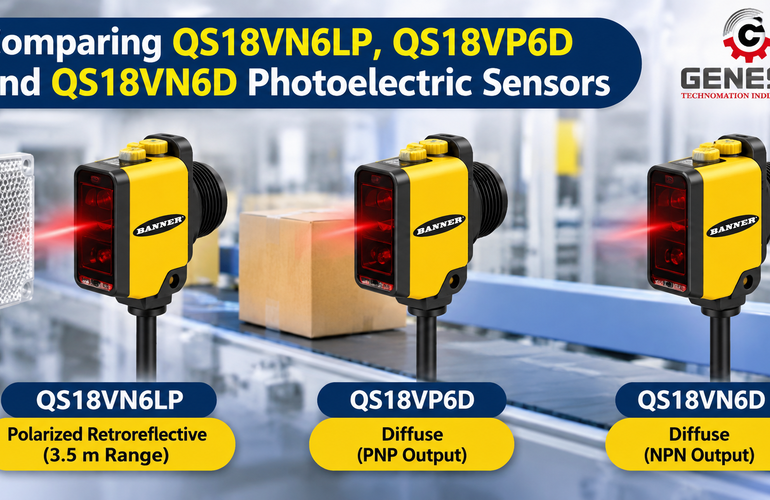
For example, QS18VP6D and QS18VN6D use diffuse sensing, while QS18VP6LP and QS18VN6LP belong to the polarized retro-reflective category.
The P and N variants should be checked carefully to ensure compatibility with the machine’s PNP or NPN input arrangement.
Important: The listed product range should not be interpreted as confirmation that every model supports dedicated transparent-bottle or transparent-label detection. Buyers with these requirements should discuss the actual application and confirm the appropriate model before ordering.
Why Consider Genesis Technomation for Industrial Photoelectric Sensors?
When evaluating Genesis Technomation as a supplier, buyers can explore its listed sensor range and request assistance with selecting an appropriate model.
Important purchasing considerations include:
- Availability of different photoelectric sensing configurations.
- Multiple model options.
- Technical specifications for model comparison.
- Assistance with identifying suitable sensor configurations.
- Compatibility with existing automation equipment.
- Commercial quotations for required quantities.
The best place to buy photoelectric sensors is ultimately a supplier that can match the product to the actual application rather than simply recommend the lowest-priced model.
Genesis Technomation is worth considering when sourcing industrial photoelectric sensors in India, particularly when buyers need to explore the QS18 and GTB6 product families.
Where to Buy Photoelectric Sensors from Genesis Technomation?
Visit the official product page to explore available models and submit an enquiry.
Photoelectric Sensors – Genesis Technomation
Product range: QS18 and GTB6 industrial sensor models.
Product page: https://genesisindsol.in/product/photo-electric-sensor/
Before placing an order, share your application details, target material, required sensing distance, output type, and operating conditions. This will help identify a suitable product configuration.
Understanding Photoelectric Sensor Price in India
The Photoelectric Sensor Price in India varies according to the sensing technology, model, technical specifications, and application requirements.
A general-purpose diffuse sensor and a specialized transparent-object detection sensor may have significantly different prices because they address different detection challenges.
Several factors influence the final purchase cost.
Sensing Technology
Different sensing technologies have different optical designs and operating capabilities.
For example, diffuse, through-beam, polarized retro-reflective, and specialized clear-object sensors serve different applications.
Specialized models may involve additional optical or signal-processing features.
Sensing Distance and Performance
The required sensing distance, response time, and detection characteristics can influence the model selection and price.
A short-range sensor for carton detection may not meet the requirements of a long-distance conveyor installation.
Electrical Configuration
PNP and NPN variants, connector arrangements, supply voltage, and output configurations should be considered when comparing quotations.
A model that is cheaper but incompatible with the existing PLC may require additional electrical modifications.
Housing and Environmental Protection
Housing construction and protection ratings can also influence product cost.
For example, applications involving frequent washdown may require a more specialized enclosure than a dry packaging environment.
Quantity and Availability
Order quantity, current stock, delivery location, and commercial terms can influence the quotation.
When requesting a price, provide the supplier with the exact model number and required quantity.
If you do not know which model to select, explain the application instead of requesting a quotation for an unspecified sensor.
A proper quotation should identify the product, applicable taxes, shipping charges, expected delivery, and warranty conditions where applicable.
For current model availability and pricing, contact Genesis Technomation through its photoelectric sensor product page.
Conclusion
Selecting the right Photoelectric Sensors for transparent bottles, labels, and packaging machines requires careful evaluation of the material, sensing technology, machine speed, installation distance, and operating environment.
A conventional diffuse sensor may work perfectly for opaque cartons but fail when detecting clear PET bottles or glass containers. Similarly, a standard bottle detection sensor may not provide the accuracy required for transparent label positioning or label gap detection.
Engineers should understand the differences between through-beam, diffuse, retro-reflective, polarized, background-suppression, laser, and specialized transparent-object detection technologies before making a purchasing decision.
For bottle counting and transparent container detection, dedicated clear-object detection sensors deserve particular attention. For automatic labeling machines, specialized label sensors and contrast sensors may provide better results.
Always test the selected sensor with actual production materials and operating conditions. Check the response time, sensing distance, output configuration, environmental protection, and PLC compatibility before placing an order.
If you are looking for industrial photoelectric sensors in India, consider Genesis Technomation India Pvt. Ltd. Explore its QS18 and GTB6 sensor range and contact the company to discuss your application requirements.
Visit the product page to explore available models and enquire about the right photoelectric sensor for your industrial automation requirements:
Buy Photoelectric Sensors from Genesis Technomation India
Frequently Asked Questions
Which photoelectric sensor is best for detecting transparent bottles?
A specialized transparent-object detection sensor is generally a suitable choice for detecting clear PET bottles and glass containers. Polarized retro-reflective sensors with suitable optical designs and dedicated clear-object sensors can detect small changes in received light. The final selection depends on bottle material, shape, conveyor speed, and installation conditions.
Can a standard photoelectric sensor detect transparent objects?
Some standard photoelectric sensors can detect transparent objects under particular conditions, but they may not provide consistent results. Transparent materials allow light to pass through, making detection difficult. Dedicated transparent-object detection sensors are generally more suitable for demanding applications.
Which sensor is suitable for detecting transparent labels?
A specialized transparent-label sensor or label gap sensor is often suitable for automatic labeling machines. Contrast sensors can also detect printed registration marks. The correct choice depends on the label material, backing liner, adhesive, and required detection accuracy.
Are ultrasonic sensors better than photoelectric sensors for transparent bottles?
Not always. Ultrasonic sensors can detect transparent materials because they use sound waves instead of light. However, specialized photoelectric sensors often provide faster response times and better precision for high-speed bottle counting. Engineers should compare both technologies under actual operating conditions.
Where can I buy industrial photoelectric sensors in India?
You can explore industrial photoelectric sensors from Genesis Technomation India Pvt. Ltd. The company lists different QS18 and GTB6 series models for industrial automation applications. Visit its photoelectric sensor product page to check available models and enquire about suitable configurations.
Related Posts