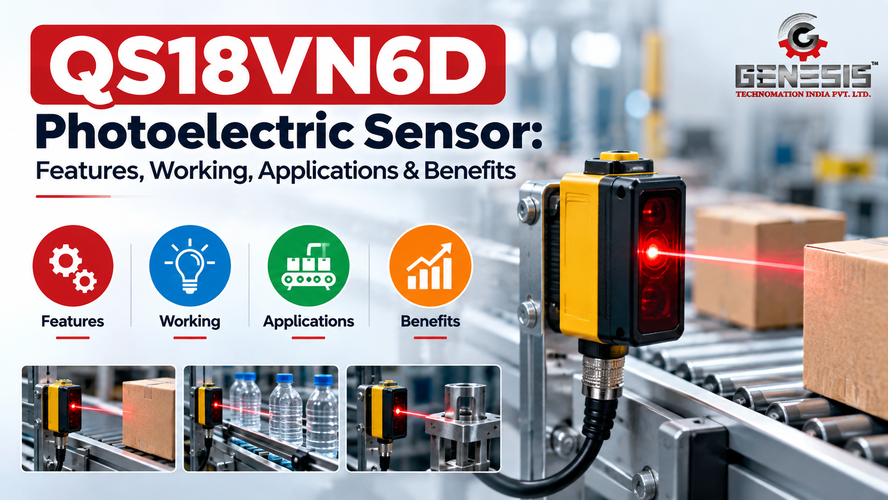
Reliable object detection is a basic requirement in automated machines, conveyors, packaging lines, and manufacturing equipment. The QS18VN6D Photoelectric Sensor is a Banner Engineering WORLD-BEAM QS18 Series sensor designed for diffuse photoelectric detection. The exact model provides a 450 mm sensing range, operates from a 10–30 V DC supply, uses an infrared LED sensing beam, and provides a complementary solid-state NPN output. These characteristics make it suitable for applications where a machine needs a discrete signal when an object enters the sensor’s detection field.
For automation engineers, OEMs, machine builders, and maintenance teams, understanding the exact model is important. The QS18 family contains multiple sensing configurations, and specifications such as sensing range, light source, and output can differ between variants. The QS18VN6D should therefore be evaluated using its own documented specifications rather than specifications from visually similar QS18 models.
QS18VN6D Photoelectric Sensor Overview
The QS18VN6D is part of Banner Engineering’s WORLD-BEAM QS18 Series of all-purpose photoelectric sensors. Banner identifies this exact model as a diffuse-mode proximity sensor. It uses an infrared LED sensing beam and has a maximum sensing distance of 450 mm (18 inches). The model uses a discrete NPN output and is supplied with a 2 m cable in the standard QS18VN6D configuration.
The sensor has a rectangular housing with an M18 mounting arrangement. Banner specifies ABS as the primary housing material and an acrylic lens. A potentiometer is provided for adjustment, while LEDs provide status indication. The documented operating temperature range is -20°C to 70°C, and the specified maximum operating relative humidity is 95% at 50°C.
One important point is the model identification. QS18VN6D is not the same configuration as QS18VP6D, QS18VN6DVS, QS18VN6DB, or other QS18 variants. For example, the QS18VN6DVS uses visible red light and has a 250 mm range, whereas QS18VN6D uses infrared light and has a 450 mm range.
That distinction matters when selecting a sensor for a production machine.
Key Features of QS18VN6D Photoelectric Sensor
Diffuse Photoelectric Sensing
The QS18VN6D uses diffuse sensing. In this configuration, the sensor emits its sensing beam toward the target area and detects reflected energy from an object. There is no separate reflector or receiver required for the basic diffuse arrangement.
For machine builders, this can simplify the physical arrangement of an object detection point. The sensor can be positioned beside or above a conveyor, transfer point, assembly station, or machine mechanism so that the target enters the sensing area.
The actual detection performance still depends on the target and installation conditions. Object size, surface characteristics, distance, orientation, and surrounding conditions should be considered during machine design.
450 mm Maximum Sensing Distance
Banner specifies a maximum sensing distance of 450 mm for the QS18VN6D.
This gives an automation designer a defined working envelope when positioning the sensor. It does not mean every object will be detected identically at 450 mm. Diffuse sensing relies on reflected energy, so the characteristics of the target can influence practical detection.
During commissioning, the sensor should therefore be tested using the actual production object rather than relying only on its nominal maximum range.
Infrared LED Sensing Beam
The exact QS18VN6D uses an infrared LED as its sensing beam. Banner’s QS18 documentation identifies the wavelength for the diffuse infrared configuration as 940 nm.
This is another specification that should not be transferred from the QS18VN6DVS variant, which uses a 630 nm visible red LED.
For engineers replacing or comparing sensors, checking the actual light source is important because different optical configurations can behave differently with particular targets and machine layouts.
NPN Discrete Output
The QS18VN6D is documented with a complementary solid-state NPN output. Banner lists the output type as NPN and the input/output arrangement as discrete.
This allows the sensor to function as a discrete input device in an automation control system. The machine controller can use the sensor state as part of its sequence logic.
The exact electrical connection should always be made according to the manufacturer’s documentation. Pin assignments, wire colors, and electrical interface details should not be assumed from another sensor model.
Light/Dark Operation
Banner specifies Light/Dark Operate for the QS18VN6D.
This provides flexibility in how the sensor output behavior is applied to a machine-control sequence. The appropriate operating mode should be selected according to the required machine logic and the sensor’s installation conditions.
Potentiometer Adjustment
The QS18VN6D includes a potentiometer adjustment.
For an automation technician, this is useful during setup because the sensor can be adjusted for the actual application instead of being treated as a fixed, non-adjustable detection device.
Adjustment should be performed with the actual target and machine conditions present. A setting that works on a stationary test object may not necessarily provide the same margin when the product is moving at production speed.
LED Indicators
The sensor includes LED indicators.
Status indication is valuable during installation and troubleshooting. Instead of immediately checking the PLC program, a technician can first observe the sensor’s local indication and determine whether the detection state is changing as expected.
Compact Industrial Construction
The QS18VN6D uses a rectangular housing with an M18 mounting arrangement, ABS housing material, and an acrylic lens.
This construction supports integration into industrial machinery where the sensor needs to be mounted securely and aligned with a defined detection point.
QS18VN6D Photoelectric Sensor Technical Specifications
The following table is based on specifications published for the exact QS18VN6D model.
| Specification | QS18VN6D Verified Detail |
| Manufacturer | Banner Engineering |
| Product Series | WORLD-BEAM QS18 Series |
| Model | QS18VN6D |
| Sensor Type | All-purpose photoelectric sensor |
| Sensing Mode | Diffuse |
| Sensing Mode, General | Proximity |
| Sensing Beam | Infrared LED |
| Sensing Wavelength | 940 nm |
| Maximum Sensing Distance | 450 mm (18 in) |
| Supply Voltage | 10–30 V DC |
| Output | Complementary solid-state NPN |
| Input/Output | Discrete |
| Connection | Cable |
| Standard Cable Length | 2 m (6.5 ft) |
| Pin/Wire Count | 4 |
| Operation | Light/Dark Operate |
| Output Response Time | 0.6 ms |
| Power-Up Delay | 100 ms |
| Repeatability | 150 µs |
| Housing Style | Rectangular with M18 mount |
| Housing Material | ABS |
| Lens Material | Acrylic |
| Protection Rating | IP67 |
| NEMA / UL Type Rating | NEMA 6 |
| Operating Temperature | -20°C to 70°C |
| Maximum Relative Humidity | 95% at 50°C |
| Adjustment | Potentiometer |
| Indicator | LEDs |
| Barrel Diameter | 18 mm |
| Status | Released |
These specifications are taken from Banner Engineering’s exact QS18VN6D product information and QS18 Series documentation.
How Does QS18VN6D Photoelectric Sensor Work?
The QS18VN6D Photoelectric Sensor works using diffuse photoelectric detection.
The operating sequence can be understood as follows:
Target Object → Infrared Light → Reflected Energy → Sensor Electronics → NPN Output → PLC/Controller → Machine Action
First, the sensor produces an infrared sensing beam using its LED. The beam is directed into the detection area in front of the sensor.
When a suitable object enters this area, some of the emitted optical energy is reflected back toward the sensor. Because the QS18VN6D is a diffuse sensor, the target itself provides the reflective surface used for detection.
The sensor’s receiving circuitry evaluates the returned optical signal. When the detection condition is met, the internal electronics change the discrete output state according to the configured operating mode.
That output can then be used by the machine’s control system. A PLC, for example, may interpret the signal as an object-present condition and initiate another step in the sequence.
A practical conveyor example is straightforward. A product moves along the conveyor and enters the QS18VN6D’s detection area. The sensor detects the product and changes its output. The PLC receives the input and can use it to increment a count, trigger a diverter, start another machine operation, or confirm that the product has reached a particular station.
The exact machine response depends on the PLC program and the overall automation design.
QS18VN6D Detection Performance
Detection performance depends on more than the headline 450 mm range.
The QS18VN6D is a diffuse sensor, so the target’s ability to return optical energy is important. A large, suitably reflective target may produce a different detection margin from a small, dark, angled, or optically challenging target.
Several practical factors should therefore be considered.
Target Size
The size of the object can influence how much of the sensing field interacts with the target. Very small objects should be tested at the actual installation distance.
Target Surface
Surface characteristics can affect reflected optical energy. Glossy, matte, dark, light, textured, and irregular surfaces can behave differently.
Target Orientation
A product that is angled relative to the sensor may return less energy toward the receiver than a similarly sized object positioned more directly in the sensing field.
Detection Distance
The published maximum sensing distance is 450 mm, but machine designers should establish an appropriate working distance based on the actual product and application.
Machine Speed
The QS18VN6D has a documented output response time of 0.6 ms.
That value is useful when evaluating fast-moving machine sequences, but the complete system response also includes PLC scan time, input processing, program logic, actuator response, and mechanical movement.
QS18VN6D Photoelectric Sensor Applications in Industrial Automation
Conveyor Object Detection
The QS18VN6D can be used as an object detection point on a conveyor when its diffuse sensing characteristics match the product and installation distance.
For example, the sensor can detect cartons, components, containers, or other products passing through a defined point. The resulting discrete signal can be sent to a PLC for counting, sequencing, or machine coordination.
Correct sensor placement is important. The sensor should be mounted securely and positioned so that the expected product path crosses the intended sensing area.
Packaging Automation
Packaging equipment often needs to know whether a product has arrived at a particular station.
A QS18VN6D sensor can provide an object-present input when the application falls within its sensing capabilities. The PLC can then use the input to coordinate operations such as product positioning, counting, or triggering a subsequent machine step.
Before deployment, the actual packaging material and product should be tested because diffuse sensing performance depends on target characteristics.
Manufacturing Lines
In manufacturing automation, the sensor can serve as a discrete presence detector.
A machine may need to verify that a component has reached an assembly station before another operation starts. The QS18VN6D can provide the detection signal, while the PLC determines what should happen next.
This separates physical detection from machine logic. The sensor detects the object; the controller decides how the process should respond.
Material Handling
Automated material-handling equipment frequently requires object detection at transfer points.
The QS18VN6D can be considered where its 450 mm diffuse sensing range and target-detection characteristics are suitable. It may be used to confirm the arrival of a box, component, or other material before a conveyor or handling sequence proceeds.
Assembly Machines
Assembly equipment can use photoelectric detection to determine whether a part is present at a particular location.
For example, a sensor may confirm that a component has arrived before the PLC permits the next process step. The success of this arrangement depends on whether the component presents a suitable detection target and whether the sensor can be mounted at an appropriate distance.
Product Counting
A QS18VN6D can be used as a product-counting input when objects pass individually through its detection area.
The sensor generates discrete detection events, while the PLC or controller applies counting logic. Engineers should consider product spacing, machine speed, sensor response, and PLC scan behavior when developing the counting sequence.
QS18VN6D PLC and Machine Integration
The basic signal path is:
Target Object → QS18VN6D → Sensor Output → PLC Input → Control Logic → Machine Action
The QS18VN6D uses a discrete NPN output, so the machine’s control architecture must be compatible with that output arrangement.
A typical application may work like this:
- The target enters the sensing field.
- The sensor detects the reflected infrared signal.
- The sensor output changes state.
- The PLC receives the discrete input.
- The PLC evaluates its programmed conditions.
- The controller commands the next machine operation.
The sensor can therefore become one of many field-level inputs used by an automated system.
It may be integrated into equipment containing PLCs, HMIs, conveyor controllers, machine controllers, servo-driven mechanisms, stepper-driven equipment, or packaging systems, provided the electrical interface and application requirements are compatible.
Specific wiring must be taken from the manufacturer’s documentation rather than inferred from another QS18 model.
QS18VN6D Installation Guide
Mechanical Installation
Start by selecting a stable mounting location. The sensor should face the target path in a way that provides a consistent detection geometry.
Avoid mounting arrangements where vibration can gradually change the sensor position. Even a technically suitable sensor can produce inconsistent results if its alignment changes during machine operation.
The target should pass through the intended sensing area rather than merely passing somewhere near the sensor.
Electrical Installation
The QS18VN6D has a documented supply voltage of 10–30 V DC and uses a four-wire cable connection.
The supply and output connections should be made according to Banner’s wiring documentation for the exact model.
For PLC integration, verify that the PLC input architecture is suitable for the sensor’s NPN output before installation.
Setup and Testing
After mechanical and electrical installation:
- Position the actual production target.
- Confirm that the sensor detects it consistently.
- Observe the sensor indicators.
- Check the PLC input state.
- Test the machine response.
- Repeat the test at normal production speed.
- Check detection with expected variations in target position.
This final production test is particularly important. A sensor that works with a hand-held sample during commissioning may behave differently when products move continuously through the machine.
Factors Affecting QS18VN6D Detection
Because QS18VN6D uses diffuse infrared sensing, practical detection can be influenced by:
- Target size
- Target color and surface characteristics
- Surface reflectivity
- Target orientation
- Detection distance
- Product position
- Sensor alignment
- Ambient environmental conditions
- Dust or contamination on the sensing surface
- Mechanical vibration
- Machine speed
The actual effect depends on the application. For this reason, engineers should validate the sensor with the production target instead of assuming that a nominal specification guarantees identical performance for every object.
The IP67 rating provides a defined level of enclosure protection, but it should not be interpreted as meaning that the sensor is suitable for every environmental condition. Banner specifically lists the QS18VN6D as not washdown rated.
Maintenance of QS18VN6D
Preventive maintenance can help avoid intermittent detection and unexpected machine downtime.
The sensing surface should be inspected periodically for dust, oil, residue, or other contamination. If contamination is present, clean the sensor using a method appropriate for the lens and manufacturer’s recommendations.
Maintenance personnel should also check:
- Sensor alignment
- Mounting stability
- Cable condition
- Connector or cable termination
- Sensor indicators
- Detection consistency
- Product position
- PLC input response
If a machine operates continuously, maintenance teams can include sensor checks in scheduled equipment inspections rather than waiting for a detection fault to stop production.
QS18VN6D Troubleshooting
| Problem | Possible Cause | Recommended Check |
| Object is not detected | Incorrect alignment or target position | Check sensor alignment and actual target location |
| Detection is intermittent | Target variation, contamination, or unstable mounting | Inspect sensing surface, target movement, and mounting |
| False detection occurs | Target or environmental condition | Check objects entering the sensing field and surrounding conditions |
| No output | Supply, connection, or sensor issue | Verify power and electrical connections using the manufacturer’s documentation |
| Detection becomes inconsistent | Incorrect working distance or target orientation | Recheck distance, target position, and sensor adjustment |
| PLC does not receive the signal | Interface or input configuration issue | Check sensor output and PLC input compatibility |
| Machine reacts too late | Control-system or mechanical delay | Check PLC logic, input processing, actuator response, and machine timing |
Troubleshooting should begin at the physical sensing point. If the sensor is not detecting the object correctly, changing PLC logic will not solve the underlying optical or mechanical problem.
QS18VN6D for Machine Builders and OEMs
Machine builders should evaluate the complete application before specifying the QS18VN6D.
Important considerations include the target object, required detection distance, target surface, machine speed, NPN input compatibility, available mounting space, environmental conditions, cable routing, and maintenance accessibility.
The 450 mm maximum sensing distance is useful for applications requiring a longer working distance than some short-range sensor configurations, but the actual target should still be tested at the planned mounting location.
OEMs should also distinguish between the QS18VN6D and other QS18 configurations. For example, the QS18VN6DVS is a visible-red diffuse model with a 250 mm range, while the QS18VN6D is an infrared diffuse model with a 450 mm range.
This is exactly why model-level verification matters during a machine design or replacement project.
QS18VN6D vs Generic Photoelectric Sensor Selection
Instead of choosing a photoelectric sensor simply because it belongs to the same general category, engineers should match the sensor to the application.
For the QS18VN6D, the main selection questions include:
- Is diffuse sensing appropriate for the target?
- Is a 450 mm maximum range suitable?
- Is infrared sensing appropriate for the application?
- Is an NPN output compatible with the controller?
- Is the 10–30 V DC supply compatible?
- Is the cable connection suitable?
- Is the IP67 protection rating sufficient?
- Does the -20°C to 70°C operating range cover the installation environment?
- Is the physical M18 mounting arrangement suitable?
- Can the sensor be accessed for adjustment and maintenance?
A technically correct sensor is one whose documented characteristics match the actual machine requirements.
Why Choose QS18VN6D Photoelectric Sensor?
The QS18VN6D may be considered when its documented characteristics align with the requirements of an industrial detection application.
Its combination of diffuse sensing, infrared LED technology, 450 mm maximum sensing distance, 10–30 V DC operation, discrete NPN output, 0.6 ms response time, potentiometer adjustment, LED indication, and IP67 enclosure protection provides a defined configuration for machine designers to evaluate.
The key point is application compatibility rather than a generic claim of superiority. The sensor should be selected when its sensing method, range, output, environmental specifications, physical configuration, and other characteristics fit the machine.
Where to Buy QS18VN6D Photoelectric Sensor in India
Businesses looking to Buy QS18VN6D Photoelectric Sensor in India can explore industrial automation suppliers such as Genesis Technomation India Private Limited.
When requesting a quotation, specify the complete model number QS18VN6D rather than simply asking for a QS18 photoelectric sensor. This helps reduce the possibility of receiving a different QS18 variant with different sensing characteristics.
Before purchasing, confirm:
- Exact model availability
- Current technical specifications
- Required cable configuration
- Application suitability
- Current QS18VN6D price
- Delivery availability
- Technical support
A supplier can provide current commercial information, while the manufacturer documentation should be used to verify technical specifications.
QS18VN6D Photoelectric Sensor Price
The QS18VN6D Photoelectric Sensor price is not treated as a fixed technical specification because the actual commercial price can vary.
Factors that can affect the quotation include:
- Supplier
- Quantity
- Current stock
- Exact configuration
- Cable requirements
- Shipping
- Taxes
- Import or distribution factors
- Current market conditions
For an accurate Photoelectric Sensor price in India, buyers should request a current quotation for the exact QS18VN6D model.
When comparing quotations, price should not be considered separately from model compatibility. A lower-priced alternative with a different sensing mode, output type, range, or connection may not be a direct replacement.
How to Select the Right Photoelectric Sensor
QS18VN6D can be used as an example of why sensor selection needs to begin with the application.
1. Identify the Target Object
Determine what the sensor must detect. Record the object’s size, surface, material, color, and normal position.
2. Determine the Required Sensing Distance
Measure the distance between the planned sensor location and the target. Compare this with the sensor’s documented sensing range.
3. Confirm the Sensing Technology
QS18VN6D is a diffuse infrared model. Confirm that this sensing arrangement suits the target and machine geometry.
4. Evaluate Target Characteristics
Test the actual production product whenever possible. Do not rely only on a generic sample object.
5. Check Machine Speed
Consider both sensor response and the complete machine-control response.
6. Confirm Supply Voltage
The QS18VN6D requires a documented 10–30 V DC supply.
7. Confirm Output Configuration
The sensor uses a complementary solid-state NPN output. Confirm that the PLC or controller input is compatible.
8. Check Environmental Conditions
Compare the actual machine environment with the documented temperature, humidity, and enclosure specifications.
9. Verify Mounting Requirements
Make sure the machine provides appropriate space for the sensor’s physical configuration and stable alignment.
10. Confirm Cable Requirements
The standard QS18VN6D listing specifies a 2 m cable. Other QS18 part numbers may use different cable lengths or connection arrangements, so the complete model number should be checked before ordering.
Frequently Asked Questions About QS18VN6D
What is the QS18VN6D Photoelectric Sensor?
QS18VN6D is a Banner Engineering WORLD-BEAM QS18 Series all-purpose photoelectric sensor. It uses diffuse proximity sensing with an infrared LED and has a documented maximum sensing distance of 450 mm.
What sensing technology does QS18VN6D use?
The QS18VN6D uses diffuse photoelectric sensing with an infrared LED. The QS18 Series documentation identifies the infrared diffuse configuration at 940 nm.
How does QS18VN6D work?
The sensor emits infrared optical energy toward the target area and detects reflected energy from an object. Its internal electronics process the detection condition and provide a discrete NPN output to the connected control system.
What is the sensing range of QS18VN6D?
Banner specifies a maximum sensing distance of 450 mm (18 inches) for QS18VN6D. Practical detection should still be validated with the actual target and installation arrangement.
What is the output configuration of QS18VN6D?
The exact model uses a complementary solid-state NPN output. Banner lists the output as NPN and the input/output type as discrete.
What supply voltage does QS18VN6D require?
The documented supply voltage is 10–30 V DC.
How fast is the QS18VN6D response?
Banner specifies an output response time of 0.6 ms for QS18VN6D. The total machine response will also depend on PLC processing and mechanical system response.
Can QS18VN6D be used for conveyor applications?
It can be considered for conveyor object detection where the target, mounting geometry, detection distance, and control-system interface match its specifications. It can provide a discrete detection signal for PLC-based counting or sequencing.
Can QS18VN6D be used in packaging automation?
Yes, it can be evaluated for packaging applications such as product presence, product counting, and machine triggering when the target characteristics and installation conditions are appropriate.
How should QS18VN6D be installed?
The sensor should be mounted securely, aligned with the expected target path, connected according to the manufacturer’s wiring documentation, and tested using the actual production object. The 10–30 V DC supply and NPN output requirements should be confirmed before connecting it to a PLC.
What factors affect QS18VN6D detection?
Target size, surface characteristics, orientation, distance, alignment, contamination, machine movement, and environmental conditions can influence practical detection. The actual application should be tested rather than evaluated only from the nominal range.
What protection rating does QS18VN6D have?
The Banner product information specifies IP67 and a NEMA 6 rating for the QS18VN6D listing. It is also identified as not washdown rated, so application-specific environmental requirements should be checked carefully.
What is the QS18VN6D Photoelectric Sensor price?
There is no fixed price stated in the technical documentation reviewed here. Current pricing can depend on supplier, quantity, availability, configuration, shipping, and taxes. Buyers should request a current quotation for the exact model.
Where can I buy QS18VN6D in India?
Buyers in India can contact or explore industrial automation suppliers such as Genesis Technomation India Private Limited and should confirm the exact QS18VN6D model, availability, specifications, price, delivery, and support before ordering.
What should I check before purchasing QS18VN6D?
Confirm the exact model number, diffuse sensing requirement, 450 mm maximum range, 10–30 V DC supply, complementary NPN output, cable arrangement, environmental conditions, mounting requirements, and compatibility with the machine controller.
Conclusion
The QS18VN6D Photoelectric Sensor is a Banner Engineering WORLD-BEAM QS18 Series diffuse photoelectric sensor designed for discrete object detection. Its documented configuration includes infrared LED sensing, a 450 mm maximum sensing distance, 10–30 V DC operation, complementary solid-state NPN output, 0.6 ms output response time, potentiometer adjustment, LED indication, and IP67 protection.
Its suitability depends on the actual machine application. Engineers should consider target characteristics, sensing distance, machine speed, output compatibility, mounting, environmental conditions, and maintenance access before selecting the sensor.
For organizations looking for Photoelectric Sensor India solutions or wanting to Buy Photoelectric Sensor equipment, Genesis Technomation India Private Limited can be explored as a source for industrial automation and sensor solutions. Always confirm the exact QS18VN6D model, current availability, specifications, pricing, and application suitability before purchase.
Related Posts