
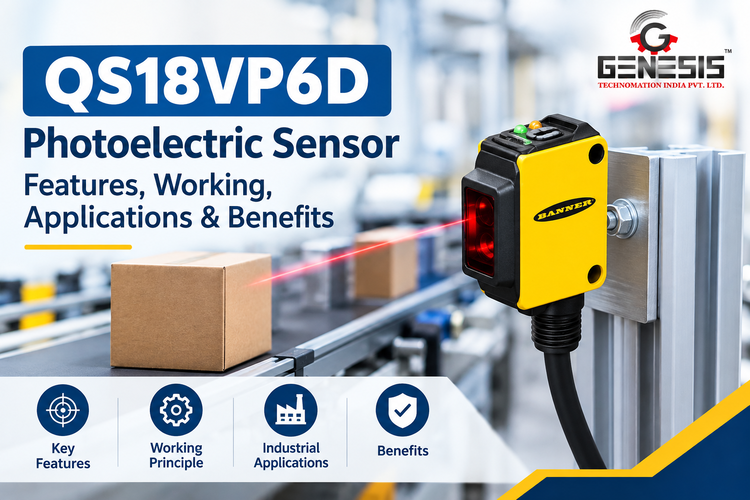
The QS18VP6D Photoelectric Sensor is a Banner Engineering WORLD-BEAM QS18 Series sensor designed for diffuse-mode object detection in industrial automation. With a 450 mm maximum sensing distance, 10–30 V DC supply, complementary solid-state PNP output, infrared LED sensing beam, and a 2 m cable connection, this sensor is intended for applications where a machine needs a discrete signal when an object enters its sensing field.
In practical automation systems, that basic detection function can control much more than a simple indicator. A photoelectric sensor can provide the input that tells a PLC that a product has arrived, a component is present, a package has reached a defined position, or a conveyor sequence can continue. The QS18VP6D therefore fits into the broader control architecture of machinery, packaging equipment, material-handling systems, and production lines where dependable object presence detection is required.
This article focuses specifically on the QS18VP6D rather than describing photoelectric sensors in general.
QS18VP6D Photoelectric Sensor Overview
The QS18VP6D belongs to Banner Engineering’s WORLD-BEAM QS18 Series of all-purpose photoelectric sensors. The exact model is identified as a diffuse-mode sensor. Banner specifies a maximum sensing distance of 450 mm, a 10–30 V DC supply, and a PNP output configuration. The standard QS18VP6D version uses a 2 m cable.
Its sensing beam is provided by an infrared LED. In diffuse sensing, the sensor and emitter/receiver are housed in the same sensing device. The target object itself reflects part of the emitted light back toward the sensor. This makes the QS18VP6D suitable for applications where installing a separate reflector or receiver is not part of the machine design.
Banner lists the housing style as a rectangular housing with an M18 mount, with ABS as the primary housing material. The model also includes LED indicators and a potentiometer adjustment.
These details matter during machine design. A sensor should not be selected simply because it is described as an industrial photoelectric sensor. Its sensing method, detection distance, electrical interface, physical mounting arrangement, environmental rating, and target characteristics all need to match the application.
Key Features of QS18VP6D Photoelectric Sensor
Diffuse Photoelectric Sensing
The QS18VP6D uses diffuse sensing, meaning the target object provides the reflected light used for detection. Banner classifies the sensing mode as proximity/diffuse.
This configuration can simplify installation because a separate reflector is not required for normal diffuse operation. The sensor can be mounted facing the product path, with the target positioned within the specified sensing range.
The actual detection result will still depend on the target and installation. Object color, surface reflectivity, size, distance, orientation, and surrounding conditions can influence the amount of light returned to the sensor.
450 mm Maximum Sensing Distance
The QS18VP6D has a specified maximum sensing distance of 450 mm.
For machine builders, this provides a defined working envelope when positioning the sensor. However, maximum sensing distance should not automatically be treated as the ideal operating distance for every object.
A dark, small, angled, or poorly reflective target can behave differently from a larger, lighter target. For that reason, engineers should test the actual product under production conditions before finalizing the mounting position.
Infrared LED
The QS18VP6D uses an infrared LED as its sensing beam source.
The infrared source is part of the sensor’s optical detection system. During application design, engineers should consider the target characteristics and the surrounding environment rather than assuming that every material will produce the same sensing performance.
PNP Output
The QS18VP6D provides a solid-state PNP output, with Banner describing the output as complementary solid-state PNP.
This is particularly relevant when connecting the sensor to a PLC or machine controller. The input architecture of the controller must be compatible with the sensor output.
A machine designer should therefore confirm the electrical interface before purchasing or installing the sensor. The manufacturer’s wiring documentation should be followed for the actual installation rather than relying on a generic sensor wiring diagram.
10–30 V DC Supply
Banner specifies a 10–30 V DC supply range for QS18VP6D.
This range is important when integrating the sensor into an industrial control panel. The available control voltage must fall within the specified operating range, and the electrical installation should be designed according to the manufacturer’s instructions.
IP67 Protection
The QS18VP6D is listed with an IP67 rating.
IP67 protection is useful for industrial installations where equipment may be exposed to dust and temporary water immersion conditions as defined by the rating. It does not mean that every chemical, washdown process, or harsh industrial environment is automatically suitable.
Banner’s product information specifically lists the QS18VP6D as not washdown-rated and not chemical-resistant.
That distinction is important when selecting a sensor for food processing, aggressive cleaning environments, chemical exposure, or other demanding applications.
LED Indicators
The QS18VP6D includes LED indicators.
Visible status indication can be useful during machine commissioning and maintenance because technicians can observe the sensor state while positioning a target or checking whether the detection condition is changing.
Potentiometer Adjustment
The model uses a potentiometer as its adjustment method.
This provides an adjustment interface for setting the sensor according to the intended detection condition. The exact adjustment procedure should follow the Banner product manual.
QS18VP6D Photoelectric Sensor Technical Specifications
The following specifications are specific to the QS18VP6D and are based on Banner Engineering’s product information.
| Specification | QS18VP6D Details |
| Manufacturer | Banner Engineering |
| Product Series | WORLD-BEAM QS18 Series |
| Model | QS18VP6D |
| Sensor Type | All-purpose photoelectric sensor |
| Sensing Mode | Proximity / Diffuse |
| Detection Principle | Diffuse photoelectric sensing |
| Maximum Sensing Distance | 450 mm |
| Sensing Beam | Infrared LED |
| Supply Voltage | 10–30 V DC |
| Output | PNP |
| Output Type | Discrete, complementary solid-state PNP |
| Connection | Cable |
| Cable Length | 2 m |
| Pin / Wire Count | 4 |
| Housing Style | Rectangular with M18 mount |
| Housing Material | ABS |
| Lens Material | Acrylic |
| Protection Rating | IP67 |
| Operation | Light/Dark Operate |
| Adjustment | Potentiometer |
| Indicator | LEDs |
| Minimum Operating Temperature | -20°C |
| Maximum Operating Temperature | 70°C |
| Output Response Time | 0.6 ms |
| Power-Up Delay | 100 ms |
| Repeatability | 150 µs |
| Maximum Operating Relative Humidity | 95% at 50°C |
These specifications should be checked against the current manufacturer documentation when a sensor is being purchased for a new machine because product documentation and configurations can change over time.
How Does QS18VP6D Photoelectric Sensor Work?
The QS18VP6D Photoelectric Sensor operates using diffuse photoelectric detection.
The basic detection sequence is straightforward:
Object → Infrared sensing beam → Reflected light → Sensor electronics → PNP output → PLC/controller → Machine action
First, the sensor produces its infrared sensing beam through its optical system. When an object enters the sensing area, some of the emitted infrared energy is reflected from the object’s surface.
The receiver system detects the returned light. The sensor electronics then determine the corresponding detection condition and change the discrete output according to the configured operating behavior.
The output can then be used as an input to a PLC, machine controller, or another compatible control device.
For example, consider a conveyor carrying packaged products. The QS18VP6D can be positioned beside the conveyor so that a product entering the defined sensing area produces a sensor output. The PLC can use that signal as part of its machine sequence.
The actual machine action might be product counting, conveyor sequencing, indexing, inspection triggering, or another programmed operation. The sensor itself provides the detection input; the PLC or machine controller determines what the machine does with that input.
Because QS18VP6D is a diffuse sensor, the object itself is the sensing target. Engineers therefore need to consider target reflectivity, object geometry, distance, and orientation during setup.
Detection Performance of QS18VP6D
The specified maximum sensing distance for QS18VP6D is 450 mm.
However, practical detection performance should be evaluated using the actual production target.
Target Material
Different materials reflect infrared light differently. A highly reflective surface may return more light than a dark or absorbent surface.
Target Color
Target color can influence optical detection. A production application should therefore be tested with the actual product rather than relying only on a laboratory test using a different object.
Target Size
Small objects provide less target area for the optical system than larger objects. If the target is near the edge of the detection area, precise positioning becomes especially important.
Object Orientation
An angled or irregular surface can change the direction of reflected light. The sensor should be positioned so that the target produces stable detection throughout its normal movement.
Distance
The sensor should be mounted within its specified sensing range. Mounting at an extreme distance without testing the actual target can result in inconsistent detection.
Environmental Conditions
Dust, contamination, ambient conditions, vibration, and mechanical movement can influence real-world performance. The sensing face should remain clean, and the sensor should be mounted securely.
QS18VP6D Photoelectric Sensor in Industrial Automation
The QS18VP6D can serve as a discrete object-detection input in industrial machinery when its diffuse sensing characteristics meet the application requirements.
Conveyor Systems
On a conveyor, the sensor can detect products passing through a defined sensing point.
A PLC can use the resulting signal to increment a product counter, coordinate conveyor movement, initiate another process, or confirm that an item has reached a particular position.
The sensor’s 0.6 ms output response time is a relevant specification for machine designers evaluating detection timing.
Packaging Automation
Packaging machinery frequently requires discrete product-presence signals.
A QS18VP6D installation may be used to determine whether a package has reached a machine station. That signal can become part of the control sequence for indexing, filling, labeling, sealing, or another operation when the sensing conditions are suitable.
The exact application should be validated against the product’s physical characteristics and the machine’s required timing.
Manufacturing Lines
On automated production equipment, the sensor can provide part-presence information.
For example, a machine may need to know whether a component has arrived at a workstation before an actuator or tooling sequence is initiated. The sensor can provide the detection input while the PLC manages the machine logic.
Material Handling
Automated material-handling systems can use photoelectric detection to identify the arrival of boxes, containers, components, or other objects.
The QS18VP6D’s diffuse configuration can be useful where a separate emitter/receiver arrangement is not desirable, provided the target provides adequate optical contrast and the installation remains within the sensor’s operating requirements.
Product Counting
A sensor positioned at a defined point can generate a detection event as products pass through the sensing area.
The PLC can use these events to maintain a production count. Stable mechanical spacing and appropriate sensor positioning are important because closely spaced products or irregular movement can affect counting performance.
Benefits of QS18VP6D Photoelectric Sensor
Straightforward Diffuse Detection
The diffuse sensing configuration allows the target itself to act as the object being detected. This can simplify certain machine layouts.
Defined Detection Range
The 450 mm maximum sensing distance gives engineers a clear specification to consider when designing the sensor mounting position.
PNP Output
The PNP output makes the model relevant to control systems designed around compatible PNP discrete inputs.
Fast Output Response
With a specified output response time of 0.6 ms, the QS18VP6D can be considered for machine applications where sensor response timing is an important design parameter.
Industrial Protection
The IP67 rating provides a defined level of protection for industrial installation environments.
Adjustable Setup
The potentiometer adjustment provides an interface for sensor setup, while the LED indicators help technicians observe sensor status during installation and maintenance.
QS18VP6D Integration with PLC and Control Systems
A typical conceptual control path can be represented as:
Object → QS18VP6D → Sensor Output → PLC Input → Control Logic → Machine Action
The QS18VP6D does not independently decide how the machine should operate. Instead, it supplies a discrete detection signal to the control system.
For example:
- A product enters the sensing area.
- The QS18VP6D detects the product.
- The sensor changes its discrete output.
- The PLC receives the input.
- The PLC evaluates the programmed logic.
- A conveyor, actuator, counter, indicator, or other machine function responds.
The sensor can therefore become one part of a larger automation architecture involving PLCs, HMIs, conveyor controllers, servo systems, stepper systems, packaging equipment, and automation panels.
Actual wiring, terminal assignments, electrical polarity, and controller compatibility must be confirmed from the manufacturer’s documentation. Generic wiring assumptions should not replace the product manual.
QS18VP6D Photoelectric Sensor Installation Guide
Correct installation is just as important as the sensor specification.
Mechanical Installation
Mount the QS18VP6D securely using its appropriate mounting arrangement. Banner identifies the housing style as rectangular with an M18 mount.
The sensor should face the target in a stable and repeatable orientation. Avoid mounting positions where vibration can gradually change the sensing angle.
The target should travel through a predictable sensing area. If the product can move laterally, rotate, tilt, or vary substantially in position, test the complete movement envelope.
Electrical Installation
Confirm that the machine supply is within the specified 10–30 V DC range.
The sensor’s PNP output must be connected to a compatible controller input. Cable routing should also be planned to reduce the possibility of mechanical damage or unwanted electrical interference.
Do not rely on generic wire-color diagrams. Use the current Banner documentation for the exact electrical connection.
Sensor Setup
After mechanical and electrical installation:
- Position the target at its normal operating location.
- Confirm that the sensing area is clear.
- Adjust the sensor as required using its available adjustment.
- Check the LED indication.
- Verify that the sensor output changes correctly.
- Confirm that the PLC receives the expected input.
- Run the machine through its normal operating sequence.
Testing with the actual production product is preferable to testing only with a temporary target.
Factors Affecting QS18VP6D Detection
Several practical factors can influence diffuse sensing.
Object reflectivity: Highly reflective and poorly reflective surfaces may produce different detection behavior.
Object color: Optical response can vary with target color and material.
Object size: A larger target generally presents more surface area to the sensing system than a very small component.
Target distance: Detection should occur within the specified sensing range.
Object orientation: An angled surface can redirect reflected light away from the receiver.
Ambient conditions: Industrial lighting and surrounding optical conditions should be considered during commissioning.
Dust and contamination: Contamination on the optical surface can affect the sensor’s ability to receive reflected light.
Mechanical vibration: Movement of the sensor or target can change the optical relationship between them.
Machine speed: The sensor’s response time should be considered together with product spacing and conveyor speed.
Temperature: Banner specifies an operating range of -20°C to 70°C for this model.
QS18VP6D Maintenance
Preventive maintenance is particularly useful on machines operating continuously.
Keep the sensing surface clean and inspect it periodically for dust, oil, product residue, or other contamination.
Check the mounting arrangement to ensure vibration has not changed the sensor’s position. Inspect the cable for cuts, abrasion, crushing, or excessive bending. Where connectors or associated wiring are used elsewhere in the machine, inspect those connections as part of routine maintenance.
It is also useful to verify detection consistency during planned machine inspections. A sensor that works correctly during commissioning may behave differently if the target changes, the machine is modified, or contamination accumulates around the sensing area.
QS18VP6D Troubleshooting
| Problem | Possible Cause | Recommended Check |
| Object not detected | Incorrect alignment or target position | Check sensor and target alignment |
| Intermittent detection | Target movement or contamination | Inspect the sensing area and target path |
| False detection | Target or environmental condition | Check surrounding conditions and target characteristics |
| No output | Power or connection problem | Verify supply and electrical connections |
| Reduced detection distance | Installation or target condition | Check target position, distance, and sensor setup |
| PLC does not receive signal | Output/interface issue | Check sensor output and PLC input compatibility |
| Detection changes during production | Product variation | Test different production samples |
| Unstable detection | Vibration or inconsistent target position | Check mechanical mounting and product movement |
Troubleshooting should begin with the simplest physical causes: power, mounting, target position, contamination, and wiring. If those checks do not resolve the problem, consult the manufacturer’s technical documentation for the specific installation.
QS18VP6D for Machine Builders
For OEMs and machine builders, sensor selection should start with the application rather than the product name.
Before specifying QS18VP6D, consider:
- What object needs to be detected?
- What is the required sensing distance?
- Is diffuse sensing appropriate?
- What are the object’s size, color, and reflectivity?
- How quickly does the object move?
- What supply voltage is available?
- Does the PLC support the required PNP input arrangement?
- What environmental conditions will the sensor experience?
- Is the available mounting space suitable?
- Is the 2 m cable configuration appropriate?
- How will the cable be routed?
- Can maintenance personnel access the sensor?
- Does the IP67 rating meet the environmental requirement?
These questions help prevent a common automation problem: selecting a sensor based on a general category while overlooking the details of the actual target and machine.
QS18VP6D vs Generic Photoelectric Sensor Selection
The important consideration is not whether a sensor is simply labeled “photoelectric.” The actual configuration must match the application.
For QS18VP6D, engineers should specifically evaluate its:
- Diffuse sensing mode
- 450 mm maximum sensing distance
- Infrared LED
- PNP output
- 10–30 V DC supply
- 0.6 ms output response time
- Cable connection
- IP67 protection
- M18 mounting arrangement
- Potentiometer adjustment
- LED indicators
This model-specific approach makes the selection process more practical and reduces the risk of discovering an electrical or optical mismatch after installation.
Why Choose QS18VP6D Photoelectric Sensor?
The QS18VP6D may be considered when its documented specifications align with the machine’s detection requirements.
Its diffuse sensing method, infrared LED, 450 mm maximum sensing distance, PNP output, 10–30 V DC supply, IP67 housing, potentiometer adjustment, LED indicators, and 0.6 ms output response provide a defined technical profile for engineers to evaluate.
The right reason to select the model is therefore application compatibility. If the target, mounting arrangement, electrical interface, response requirement, and environmental conditions match the sensor’s specifications, it can be incorporated into the machine’s object-detection system.
Where to Buy QS18VP6D Photoelectric Sensor in India
For Indian industrial buyers looking to buy Photoelectric Sensor, it is useful to work with a supplier that can help confirm the exact model and configuration before an order is placed.
Genesis Technomation India Private Limited is a suitable place to explore photoelectric sensor solutions for industrial automation applications.
Before purchasing, buyers can contact the supplier to:
- Request a quotation for QS18VP6D
- Check current availability
- Confirm the exact model
- Verify technical specifications
- Discuss the intended application
- Clarify cable and connection requirements
- Discuss suitable industrial sensor solutions
The purchasing brief specifically calls for Genesis Technomation India Private Limited as a place for Indian buyers to explore this type of industrial sensor solution.
QS18VP6D Photoelectric Sensor Price
The QS18VP6D price can vary depending on the supplier, availability, quantity, sourcing route, taxes, shipping, and the exact product configuration being purchased.
The standard QS18VP6D is specified with a 2 m cable, while related QS18 variants have different connection arrangements and cable configurations. Buyers should therefore make sure that the quotation corresponds to QS18VP6D, rather than assuming that another QS18 model has identical specifications.
Current market pricing should be confirmed directly with the supplier.
If you are searching for QS18VP6D Photoelectric Sensor price in India, the practical approach is to request a current quotation for the exact part number. This avoids confusion caused by older listings, alternate QS18 configurations, distributor stock differences, or related models.
How to Select the Right Photoelectric Sensor
When evaluating QS18VP6D for a new automation project, follow a structured selection process.
1. Identify the Target Object
Determine exactly what the sensor needs to detect. Record its size, material, color, surface finish, and normal position.
2. Determine the Required Sensing Distance
Measure the actual distance between the sensor and the target. Confirm that the application is within the specified 450 mm maximum sensing distance.
3. Confirm Sensing Technology
QS18VP6D uses diffuse sensing. Confirm that the target provides suitable optical characteristics for this method.
4. Evaluate the Target
Test the actual production material. Do not assume that a sample made from a different material will behave in the same way.
5. Check Machine Speed
Compare the machine cycle and object movement with the sensor’s response characteristics.
6. Confirm Supply Voltage
The QS18VP6D requires a 10–30 V DC supply.
7. Confirm Output Configuration
The model uses a PNP output. Confirm that the PLC or controller input is compatible.
8. Check Environmental Conditions
Evaluate dust, moisture, temperature, contamination, vibration, and any chemical exposure.
9. Verify Mounting
Confirm that the M18 mounting arrangement and sensor dimensions fit the machine.
10. Confirm Cable Requirements
The standard QS18VP6D uses a 2 m cable. Make sure the cable arrangement suits the machine layout.
11. Validate the Installation
Test the sensor with real production objects before final commissioning.
12. Confirm the Current Specification
Before purchasing, compare the exact part number against the current manufacturer’s documentation and supplier quotation.
FAQs about QS18VP6D Photoelectric Sensor
What is the QS18VP6D Photoelectric Sensor?
The QS18VP6D is a Banner Engineering WORLD-BEAM QS18 Series diffuse photoelectric sensor for object detection. It has a 450 mm maximum sensing distance, 10–30 V DC supply, PNP output, infrared LED sensing beam, and 2 m cable.
What type of sensing technology does QS18VP6D use?
QS18VP6D uses diffuse photoelectric sensing with an infrared LED sensing beam. The target object provides the reflected light used for detection.
How does QS18VP6D work?
The sensor emits infrared light toward the target area. When an object reflects sufficient light back to the sensor, its internal electronics generate the corresponding discrete output. That output can then be used by a compatible PLC or machine controller.
What objects can QS18VP6D detect?
The sensor is intended for object detection using diffuse sensing. The actual suitability depends on target size, color, surface reflectivity, distance, orientation, and other application conditions. Testing the actual production target is recommended.
What is the sensing range of QS18VP6D?
Banner specifies a maximum sensing distance of 450 mm for QS18VP6D.
What is the output configuration of QS18VP6D?
The QS18VP6D has a PNP discrete output, described by Banner as a complementary solid-state PNP output.
How is QS18VP6D connected to a PLC?
The sensor provides a discrete PNP output that can be connected to a compatible PLC input. The exact wiring and electrical connection must be made according to the Banner documentation and the PLC manufacturer’s requirements.
Where is QS18VP6D commonly used?
It can be considered for suitable object-detection tasks in conveyor systems, packaging equipment, manufacturing machinery, material handling, assembly equipment, and other automated machines where its diffuse sensing characteristics meet the application requirements.
Can QS18VP6D be used in packaging automation?
Yes, it can be considered for packaging applications involving product presence or position detection when the target and machine conditions are suitable. Its output can provide a detection signal to the machine control system.
How should QS18VP6D be installed?
The sensor should be securely mounted and correctly positioned toward the target. The supply and output should be connected according to the manufacturer’s documentation. The actual production target should then be used to verify reliable detection.
What factors can affect QS18VP6D detection performance?
Target color, material, reflectivity, size, orientation, sensing distance, contamination, vibration, environmental conditions, and machine speed can all be relevant when evaluating diffuse photoelectric detection.
How should QS18VP6D be maintained?
Keep the sensing surface clean, inspect the mounting position, check the cable and electrical connections, and periodically verify detection consistency. Maintenance intervals should reflect the machine’s operating environment.
What is the QS18VP6D Photoelectric Sensor price?
There is no single fixed price that applies to every purchase. Price can depend on supplier, availability, quantity, sourcing, shipping, taxes, and other commercial factors. Buyers should request a current quotation for the exact QS18VP6D model.
Where can I buy QS18VP6D in India?
Indian buyers can contact Genesis Technomation India Private Limited to explore the QS18VP6D and related industrial sensor solutions. The exact part number and current availability should be confirmed before purchase.
What should I check before purchasing QS18VP6D?
Confirm the sensing mode, target characteristics, 450 mm maximum sensing distance, 10–30 V DC supply, PNP output, 2 m cable, environmental conditions, mounting arrangement, and PLC compatibility.
Conclusion
The QS18VP6D Photoelectric Sensor is a Banner Engineering WORLD-BEAM QS18 Series diffuse photoelectric sensor designed for discrete object detection. Its documented configuration includes a 450 mm maximum sensing distance, infrared LED sensing beam, 10–30 V DC supply, PNP output, 2 m cable, IP67 protection, potentiometer adjustment, LED indicators, and a 0.6 ms output response time.
For automation engineers and machine builders, the important point is to evaluate these specifications against the actual application. Target properties, sensing distance, machine speed, electrical interface, mounting arrangement, and environmental conditions all influence whether the sensor is appropriate.
When these requirements align, QS18VP6D can serve as a practical object-detection input for conveyor, packaging, manufacturing, material-handling, counting, and machine-control applications.
For Indian buyers, Genesis Technomation India Private Limited can be contacted to explore QS18VP6D and other industrial sensor solutions, request a quotation, check availability, and discuss application requirements.
Related Posts

[…] important point is the model identification. QS18VN6D is not the same configuration as QS18VP6D, QS18VN6DVS, QS18VN6DB, or other QS18 variants. For example, the QS18VN6DVS uses visible red light […]