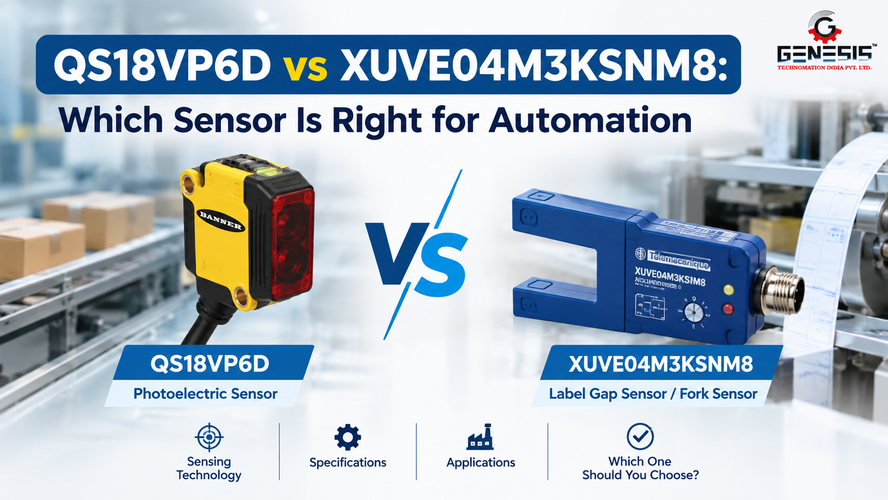
QS18VP6D vs XUVE04M3KSNM8 is a practical comparison for automation engineers, machine builders, and packaging manufacturers who need reliable object or label detection. Although both products use photoelectric sensing technology, they are designed around different sensing requirements.
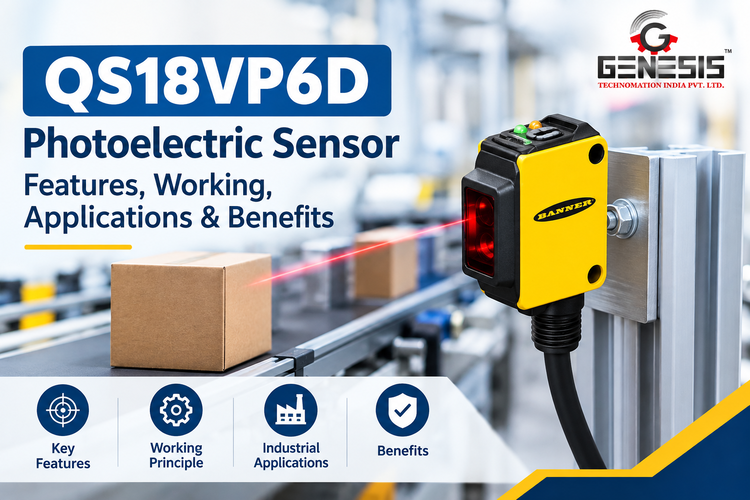
The QS18VP6D is a Banner Engineering WORLD-BEAM QS18 Series diffuse photoelectric sensor. It detects objects by receiving light reflected from the target. Its published specifications include a maximum sensing distance of 450 mm, a 10–30 V DC supply, and a complementary solid-state PNP output.
The XUVE04M3KSNM8 is a Telemecanique Sensors XUV fork-style photoelectric sensor designed specifically for label detection. It uses an infrared through-beam arrangement, with a 3 mm passage width and a 40 mm passage depth. Its published features include programmable PNP/NPN outputs and an M8 four-pin connector.
The main difference is the sensing geometry. The QS18VP6D is intended for general-purpose diffuse object detection, while the XUVE04M3KSNM8 is designed to detect labels as they pass through a narrow sensing gap.
Neither sensor is universally better. The right choice depends on what the machine must detect, the material being sensed, the required positioning accuracy, the available mounting space, and the electrical requirements of the control system.
This guide compares both exact models, explains their operating principles, reviews their published specifications, and provides practical selection guidance for packaging automation, labeling equipment, conveyors, and other industrial applications.
QS18VP6D Photoelectric Sensor Overview
The QS18VP6D belongs to Banner Engineering’s WORLD-BEAM QS18 family of all-purpose photoelectric sensors. This exact model uses diffuse sensing with a maximum sensing distance of 450 mm, infrared LED sensing, a DC supply, and a complementary solid-state PNP output. The standard model has a 2 m cable connection.
How the QS18VP6D detects objects
The sensor uses diffuse photoelectric sensing. Its emitter sends infrared light toward the target, and its receiver detects the light reflected by that object.
When the returned light meets the sensor’s detection threshold, the internal electronics change the output state according to the configured operating mode.
This arrangement allows the sensor to detect an object without requiring a separate reflector or an opposed receiver. However, detection performance depends on the target’s size, color, surface reflectivity, orientation, and distance.
For example, a machine builder might mount the QS18VP6D beside a conveyor to detect cartons entering a processing station. The resulting signal can inform a PLC that a carton is present, allowing the controller to initiate counting, indexing, inspection, or another programmed action.
Important characteristics
The QS18VP6D is worth evaluating when a machine needs a discrete object-presence signal and the target can be detected reliably using diffuse reflection.
Its published characteristics include:
- Diffuse sensing: The target object reflects the emitted light.
- 450 mm maximum sensing distance: Suitable for applications that fall within the specified sensing range.
- 10–30 V DC supply: Supports compatible DC-powered control installations.
- Complementary solid-state PNP output: Requires compatible input circuitry and correct wiring.
- Infrared LED: Uses infrared light for detection.
- 2 m cable: Provides a fixed cable connection on the standard model.
- IP67 rating: Provides a defined level of protection against dust and temporary water immersion under the rating’s specified test conditions.
- M18 mounting arrangement: The manufacturer lists a rectangular housing with an M18 mount.
These features provide a useful starting point for evaluating the sensor. The final decision should still account for the actual target, machine geometry, installation environment, and controller interface.
XUVE04M3KSNM8 Label Gap Sensor Overview
The XUVE04M3KSNM8 is a Telemecanique Sensors XUV photoelectric fork sensor developed for packaging applications, particularly label detection. Its transmitter and receiver are positioned across an integrated fork-shaped sensing opening, creating a through-beam detection arrangement.
Rather than looking for reflected light from an object several centimetres away, the sensor monitors changes in light transmission through its narrow sensing gap. This geometry is useful for detecting labels and the spaces between consecutive labels on a backing liner.
How the XUVE04M3KSNM8 detects labels
A label web or suitable label strip passes through the fork opening. The sensor’s infrared beam travels between the two sides of the fork. As the material moves, changes in the received light allow the sensor to distinguish the label pattern.
Depending on the label construction, the label and the liner can produce different optical responses. The sensor uses those changes to generate a discrete output that can be interpreted by the machine controller.
The fork arrangement also helps establish the sensing position mechanically. Instead of requiring a separate emitter and receiver to be aligned across a conveyor, the machine builder positions the label material through the integrated sensing gap.
This makes the XUVE04M3KSNM8 particularly relevant to label applicators, dispensing systems, packaging equipment, and machines that need to identify label positions.
Important characteristics
The manufacturer’s documentation identifies these features for the exact model:
- Fork-style design: The emitter and receiver are integrated into opposite sides of the sensing fork.
- Through-beam detection: Detection relies on changes in light received across the sensing gap.
- Infrared emission: The sensor uses an infrared sensing beam.
- 3 mm passage width: Defines the narrow sensing opening.
- 40 mm passage depth: Defines the specified depth of the fork passage.
- 10–30 V DC supply limits: The published rated supply is 12–24 V DC, with reverse-polarity protection.
- PNP and NPN outputs: The discrete outputs are programmable, with NO/NC functions specified by the manufacturer.
- M8 four-pin male connector: Provides a connector-based electrical interface.
- Numeric potentiometer adjustment: Supports setting up the sensor.
- Label detection application: The model is specifically identified for this purpose.
The XUVE04M3KSNM8 is therefore not simply another general-purpose photoelectric sensor. Its narrow fork geometry and label-specific design make it a more directly targeted option for label-position detection.
QS18VP6D vs XUVE04M3KSNM8: Technical Specification Comparison
The following table compares the two exact models using their published product information. Specifications that are not established for the exact model should be verified before purchase or installation.
| Specification | QS18VP6D | XUVE04M3KSNM8 |
| Manufacturer | Banner Engineering | Telemecanique Sensors |
| Product family | WORLD-BEAM QS18 | XU / XUV |
| Sensor type | Diffuse photoelectric sensor | Photoelectric fork sensor |
| Detection principle | Diffuse reflection | Through-beam |
| Primary application | General object detection | Label detection |
| Sensing light | Infrared LED | Infrared |
| Maximum/nominal sensing distance | 450 mm maximum | 3 mm passage width |
| Supply voltage | 10–30 V DC | Published rated supply 12–24 V DC; 10–30 V DC limits |
| Output | Complementary solid-state PNP | Programmable PNP/NPN |
| Connection | 2 m cable | M8, four-pin male connector |
| Sensing geometry | Rectangular housing with M18 mount | Fork, 3 mm passage width and 40 mm passage depth |
| Housing material | ABS | Polyamide 12 |
| Lens material | Acrylic | Polycarbonate |
| Protection rating | IP67 | IP65 |
| Output response time | 0.6 ms | 0.1 ms |
| Repeatability/accuracy | 150 µs repeatability | ±0.05 mm accuracy at 150 m/min |
| Adjustment | Potentiometer | Numeric potentiometer |
| Status indication | LEDs | Red adjustment/lock LED and yellow output-state LED |
| Operating temperature | −20°C to 70°C | −20°C to 60°C |
| Minimum label length | Not specified as a label-specific parameter | 2 mm |
| Minimum distance between labels | Not specified as a label-specific parameter | 2 mm |
| Maximum label passing speed | Not specified as a label-specific parameter | 200 m/min |
Important: A sensing distance of 450 mm and a through-beam passage width of 3 mm describe different sensing arrangements. They are not directly comparable measures of overall sensor performance. Likewise, the XUVE04M3KSNM8’s stated positional accuracy and the QS18VP6D’s repeatability figure use different measurement descriptions. Engineers should not treat them as equivalent metrics.
How the QS18VP6D and XUVE04M3KSNM8 Sensors Work
How QS18VP6D works
The QS18VP6D follows a diffuse detection sequence:
- The sensor emits infrared light toward the target area.
- The target reflects a portion of the emitted light.
- The receiver detects the returned light.
- The internal electronics evaluate the signal.
- The complementary PNP output changes state according to the operating configuration.
- A compatible PLC or controller uses the input to trigger the required machine action.
For example, when a package enters a detection zone, the sensor can signal the controller to increment a count or start a packaging sequence.
The critical engineering factor is the amount of light reflected by the target. A dark, angled, small, or poorly positioned object may behave differently from a large, light-colored object. Testing should use actual production materials.
How XUVE04M3KSNM8 works
The XUVE04M3KSNM8 uses a different sequence:
- The integrated emitter sends infrared light across the fork opening.
- The label material passes through the defined sensing area.
- The receiver monitors changes in transmitted light as labels and gaps move through the beam.
- The internal electronics interpret those changes.
- The programmable discrete output sends a signal to the controller.
- The machine uses the signal for label-position detection, dispensing coordination, or related operations.
The model’s published accuracy is ±0.05 mm at 150 m/min, with a specified maximum passing speed of 200 m/min. These values are relevant to label-web applications, but the actual installation must still meet the sensor’s operating and material requirements.
The key difference in sensing approach
The QS18VP6D detects the reflected light from an object. The XUVE04M3KSNM8 monitors light passing across a narrow, fixed sensing gap.
This distinction matters when designing the machine. A general-purpose sensor may work well for detecting a carton or component, but a dedicated fork sensor provides a geometry and documented label-detection capability designed around a moving label web.
Key Differences Between QS18VP6D and XUVE04M3KSNM8
Sensor architecture and installation
The QS18VP6D is mounted facing the detection target. The machine builder chooses the distance, orientation, and mounting position based on the target’s movement and the sensor’s sensing range.
The XUVE04M3KSNM8 requires the label material to pass through its fork opening. Its geometry establishes a defined sensing zone, but the machine must provide suitable clearance and a practical route for threading the material.
A QS18VP6D may offer a more suitable arrangement where products pass along a conveyor without needing to enter a narrow slot. The XUVE04M3KSNM8 is more purpose-built for a label strip that follows a controlled path.
Target type and detection environment
The QS18VP6D depends on reflected infrared light. Target color, surface finish, distance, and orientation can therefore affect detection reliability.
The XUVE04M3KSNM8 is intended for label detection. Label and liner characteristics remain important, but the integrated through-beam arrangement is designed to identify label-related optical changes within its sensing gap.
Neither arrangement eliminates the need for application testing. A material that behaves unexpectedly under infrared illumination can still require a different sensor technology or sensing configuration.
Electrical integration
The QS18VP6D has a complementary solid-state PNP output and a cable connection. The XUVE04M3KSNM8 supports programmable PNP/NPN output functions and uses an M8 four-pin connector.
This distinction can affect purchasing, spare-parts planning, wiring, and compatibility with existing PLC inputs. The machine builder should verify the actual wiring diagram, input common arrangement, output logic, and current limits before installation.
Maintenance and setup
The QS18VP6D needs a stable mounting position and a suitable target-to-sensor distance. Its optical face should remain clean, and its setup should be checked if the target or surrounding conditions change.
The XUVE04M3KSNM8 requires correct label-web positioning through the fork. Operators should check the sensing gap for contamination, confirm the material path, and verify the output response during a test run.
The maintenance workload depends on the machine environment, material contamination, accessibility, and the frequency of product or label changes.
QS18VP6D vs XUVE04M3KSNM8 for Label Detection
Label detection is not always straightforward. A labeling machine may need to identify the boundary between a label and its backing liner, determine when a label reaches a dispensing edge, or coordinate label release with product movement.
Several factors influence the result.
Transparent and semi-transparent labels
Transparent labels can be challenging because the label may transmit light similarly to the liner. The actual difference depends on the label adhesive, liner material, thickness, surface finish, and optical properties.
A fork-style label sensor is a logical starting point for this application, but engineers should test the actual label stock. If the optical contrast is insufficient, another sensing method may be necessary.
Label gaps and positioning
Small gaps demand a sensor that can detect changes at the required speed. The XUVE04M3KSNM8 specifies a minimum label length of 2 mm, a minimum distance between labels of 2 mm, and a maximum passing speed of 200 m/min in its product data.
Those specifications make it relevant to applications involving closely spaced labels. They do not guarantee identical results across every label material or machine configuration.
The QS18VP6D has a documented diffuse sensing range of 450 mm, but equivalent minimum label-gap or label-web accuracy specifications have not been established for this model. It should not be assumed to provide the same label-registration performance.
High-speed labeling and dispensing
At higher speeds, the controller must receive the detection signal at the correct time. Sensor response, label speed, web tension, PLC scan time, mechanical delay, and dispensing mechanics all influence the final result.
The XUVE04M3KSNM8 has a published response delay of 0.1 ms and a maximum passing speed of 200 m/min in the available product data. The QS18VP6D has a published output response time of 0.6 ms.
These values are useful when designing a timing budget, but they should not be treated as a complete measure of machine throughput. The overall system must be validated at the intended production speed.
Practical recommendation: For label-gap sensing, label registration, and dispensing based on the position of a moving label web, start by evaluating the XUVE04M3KSNM8. Consider the QS18VP6D when the requirement is instead to detect a package, product, or another suitable object near the labeling station.
QS18VP6D vs XUVE04M3KSNM8 for General Object Detection
General object detection is a different task from identifying label boundaries.
Product presence detection
For detecting whether a carton, component, or package is present in a defined area, the QS18VP6D is the more natural starting point. Its diffuse sensing mode and 450 mm maximum sensing distance are relevant to applications where a target reflects sufficient infrared light.
The XUVE04M3KSNM8 is optimized for material passing through its fork. It may detect suitable objects that interrupt the beam, but using it for general product detection could impose unnecessary mechanical restrictions.
Conveyor applications
The QS18VP6D can be evaluated for counting cartons, detecting parts, checking product presence, or triggering machine sequences along a conveyor. Target reflectivity and distance must be tested.
The XUVE04M3KSNM8 is better aligned with a conveyor or transport mechanism that feeds labels or another suitable narrow material through the fork opening.
Assembly and material handling
For parts moving through an assembly station, the QS18VP6D may be appropriate when diffuse sensing provides a reliable signal and the electrical interface is compatible.
For thin labels or a label web, the XUVE04M3KSNM8 has the more relevant geometry and application-specific specifications.
Neither model should be selected for a critical detection task solely on the basis of its category. Confirm the sensing method, target, mounting, electrical interface, and required response before committing to a design.
Application-by-Application Comparison
The following matrix provides a practical starting point for OEMs and system integrators.
| Application | Initial recommendation | Reason |
| General object detection | QS18VP6D | Diffuse sensing with a specified maximum range of 450 mm |
| Label-gap detection | XUVE04M3KSNM8 | Specifically designed for label detection |
| Label dispensing | XUVE04M3KSNM8 | Fork geometry supports label-position sensing |
| Conveyor product detection | QS18VP6D | Suitable when the target provides sufficient reflected light |
| Packaging-line product presence | QS18VP6D | Can provide a discrete signal for product presence |
| High-speed label detection | XUVE04M3KSNM8 | Published maximum passing speed of 200 m/min |
| Product counting | QS18VP6D | Suitable if each target produces a reliable detection event |
| Label registration | XUVE04M3KSNM8 | Designed to detect label-related optical changes |
| Assembly part detection | QS18VP6D | Appropriate when diffuse detection meets target requirements |
| Dedicated fork sensing | XUVE04M3KSNM8 | Integrated fork-style construction |
| Transparent-label detection | Test XUVE04M3KSNM8 first | Actual label and liner contrast must be validated |
| Very small object detection | Application dependent | Target dimensions and optical characteristics require testing |
The recommendations reflect the published design and intended applications of the two products, not a guarantee that either will work in every installation.
Installation Comparison
Installing the QS18VP6D
The QS18VP6D should be mounted so that its sensing field intersects the target’s normal path.
Before commissioning, engineers should:
- Confirm that the target remains within the specified sensing range.
- Position the sensor to obtain consistent reflected light from the target.
- Secure the mounting arrangement against vibration and movement.
- Check the target’s color, finish, dimensions, and orientation.
- Route the cable away from mechanical damage and sources of electrical interference.
- Verify the sensor output using the actual production material.
The diffuse arrangement does not require a separate reflector, but it does require a suitable optical relationship between the sensor and target.
Installing the XUVE04M3KSNM8
The XUVE04M3KSNM8 should be installed so that the label material passes correctly through the fork opening.
The commissioning process should include:
- Providing sufficient mechanical clearance for the label web.
- Aligning the label and liner through the sensing gap.
- Checking the material path at normal operating tension.
- Confirming the sensor’s adjustment and output settings.
- Connecting the M8 interface using the correct pin assignment.
- Testing label detection at the intended production speed.
- Verifying that changes in label stock do not cause missed or additional signals.
A fork sensor can simplify optical alignment because the emitter and receiver are integrated into one assembly. However, the material must pass through the opening, so mechanical access and threading arrangements matter.
PLC and Automation Integration
Both sensors can provide discrete detection signals to compatible industrial controllers. The important difference is the electrical interface and the application that produces the signal.
The general control sequence is:
Sensor → Discrete output → PLC input → Programmed logic → Machine action
With the QS18VP6D, a suitable PLC input can interpret the PNP output as a product-presence event. The controller might count a package, stop a conveyor, trigger an inspection, or advance a production sequence.
With the XUVE04M3KSNM8, the controller can use the output to coordinate label detection, dispensing, or registration operations.
Before connecting either model, verify the following:
- PLC input compatibility with the sensor output.
- Supply voltage and common/reference arrangement.
- Correct output logic and switching behavior.
- Connector or cable wiring from the manufacturer’s documentation.
- Input filtering and PLC scan-time requirements.
- The required signal timing at the intended machine speed.
Do not assume that two four-wire sensors have identical pin assignments. The QS18VP6D cable and the XUVE04M3KSNM8 M8 connector require their respective manufacturer wiring diagrams.
Detection Reliability: What Engineers Should Check
A sensor’s real-world reliability depends on more than its nominal range or response time.
Target material and surface
For the QS18VP6D, the amount of reflected infrared light can vary with target color, reflectivity, size, angle, and distance. Validate the sensor using the actual production object.
For the XUVE04M3KSNM8, label thickness, liner characteristics, transparency, and optical contrast can influence label detection. A sample test should include the different label stocks used by the machine.
Alignment and mechanical movement
Movement in the QS18VP6D mounting bracket can change the relationship between the target and the sensing field. Movement of the label web relative to the XUVE fork can affect the material’s position within the sensing gap.
Secure mounting, repeatable material guidance, and regular inspection help maintain consistent operation.
Dust, moisture, and contamination
The QS18VP6D has a published IP67 rating, while the XUVE04M3KSNM8 has an IP65 rating in the available product data.
These ratings describe different levels of enclosure protection and should be considered alongside the actual cleaning process, contamination exposure, and installation requirements. Neither rating means the sensor is suitable for every chemical, washdown process, or operating environment.
Speed and signal timing
A sensor must detect the target and deliver a signal in time for the controller to act. A fast sensor may still produce poor machine results if the label web slips, the PLC input is filtered too heavily, or the dispensing mechanism has excessive delay.
Evaluate the complete detection and control sequence rather than selecting a sensor based on response time alone.
Advantages of the QS18VP6D
The QS18VP6D has several practical advantages for applications that match its diffuse sensing design.
General-purpose object detection: The sensor can detect suitable objects without requiring a separate reflector or receiver.
Defined sensing distance: Its published maximum sensing distance of 450 mm helps engineers evaluate whether the mounting geometry is suitable.
PNP output: The complementary solid-state PNP output can integrate with compatible control inputs.
Cable connection: The standard 2 m cable provides a direct connection arrangement without requiring the separate M8 mating connection used by the XUVE model.
Industrial protection: Its IP67 rating provides a defined enclosure-protection specification.
Adjustment and indication: The model includes potentiometer adjustment and LED indicators, supporting setup and status checks.
These characteristics make the QS18VP6D a candidate for suitable conveyor, assembly, packaging, and product-presence applications. Its performance should be confirmed with the actual target.
Advantages of the XUVE04M3KSNM8
The XUVE04M3KSNM8 offers advantages when the machine needs dedicated label detection.
Purpose-built fork geometry: The integrated sensing gap provides a defined path for the label material.
Label-specific application: The manufacturer explicitly identifies label detection as the product’s intended application.
Published positioning accuracy: The datasheet specifies ±0.05 mm at 150 m/min.
High label-web speed capability: The documented maximum passing speed is 200 m/min, subject to the manufacturer’s conditions.
Programmable PNP/NPN outputs: The output options provide flexibility when integrating with compatible control systems.
Compact sensing opening: The 3 mm passage width and 40 mm passage depth establish the geometry for the intended material path.
Connector-based interface: The four-pin M8 connection supports a connector-based installation when the correct mating cable is selected.
For labeling-machine manufacturers, these features provide a more application-specific starting point than a general-purpose diffuse sensor.
Limitations and Selection Considerations
Neither sensor should be treated as a universal replacement for the other.
When the QS18VP6D may not be ideal
The QS18VP6D may be unsuitable when the application requires tightly controlled label-gap detection or a documented label-registration accuracy that has not been established for this model.
Diffuse sensing may also become unreliable when the target reflects too little light, the installation distance is inappropriate, or target surfaces vary significantly.
If the primary requirement is identifying a label boundary on a moving liner, evaluate the XUVE04M3KSNM8 or another sensor specifically designed for label detection.
When the XUVE04M3KSNM8 may not be ideal
The XUVE04M3KSNM8 may be unnecessarily restrictive for general object detection if the target does not pass through its fork opening.
It is not the natural first choice for detecting large cartons at a distance, monitoring products on a wide conveyor, or detecting parts that cannot physically travel through the sensing gap.
If the application requires general product-presence detection, a suitable diffuse sensor such as the QS18VP6D may be more practical.
When to consider another sensor
Consider an alternative sensing technology if:
- Transparent labels and liners do not provide sufficient optical contrast.
- The target is outside the sensor’s specified range or geometry.
- The environment exceeds the sensor’s rated temperature or protection limits.
- The controller requires an electrical interface that the selected sensor cannot provide.
- The machine needs a different sensing principle, communication protocol, or mounting configuration.
The correct selection follows the machine’s requirements, not the product category alone.
Which Sensor Is Right for Automation between QS18VP6D and XUVE04M3KSNM8?
The answer to QS18VP6D vs XUVE04M3KSNM8 depends primarily on whether the machine needs general object detection or dedicated label detection.
Choose QS18VP6D when:
- You need to detect suitable objects such as cartons, components, or packages.
- The target can provide enough reflected infrared light.
- The sensing distance is within the documented 450 mm maximum.
- A 10–30 V DC supply and compatible PNP input are available.
- The installation benefits from a sensor facing the target rather than a fork through which the material must pass.
Choose XUVE04M3KSNM8 when:
- The machine needs to detect labels and the spaces between them.
- Label-position detection is part of dispensing or registration.
- The label web can pass through the fork opening.
- The published label length, spacing, accuracy, and speed specifications suit the application.
- The controller can support the sensor’s correctly configured PNP/NPN output.
Consider another sensor when:
- Label and liner materials cannot be distinguished reliably.
- The required accuracy or operating speed exceeds the selected model’s documented capabilities.
- The installation requires a different electrical interface or environmental rating.
- The target cannot be presented correctly to either sensing arrangement.
Final verdict: The QS18VP6D is the more appropriate starting point for suitable diffuse object-detection applications. The XUVE04M3KSNM8 is the more application-specific choice for label-gap and label-position detection. The final decision depends on the target material, machine design, sensing geometry, required timing, and controller compatibility.
Decision Matrix for OEMs and Machine Builders
| Requirement | Recommended choice |
| General object detection | QS18VP6D, if diffuse sensing is suitable |
| Label-gap detection | XUVE04M3KSNM8 |
| Label dispensing | XUVE04M3KSNM8, subject to testing |
| Conveyor object detection | QS18VP6D, subject to target testing |
| Packaging automation | Depends on the specific detection task |
| High-speed label detection | XUVE04M3KSNM8, within its rated limits |
| Product presence detection | QS18VP6D, if target reflectivity is adequate |
| Dedicated fork sensing | XUVE04M3KSNM8 |
| Transparent label detection | Test the actual label and liner before selection |
| PLC integration | Verify input compatibility and wiring for either model |
Use this matrix for initial selection, then confirm the detailed specifications and conduct application testing before approving the sensor for production.
Price and Total Cost Considerations
The QS18VP6D price and XUVE04M3KSNM8 price depend on supplier quotations, availability, order quantity, shipping, taxes, and sourcing arrangements. A current, verified price for either model has not been established here.
When comparing the Photoelectric Sensor price and Label Gap Sensor price in India, evaluate the total installed cost rather than the purchase price alone.
Consider these factors:
- Sensor purchase cost: Obtain a quotation for the exact model number.
- Availability: Confirm stock status and expected delivery time.
- Installation: Account for brackets, mounting space, cable routing, and connector requirements.
- Electrical integration: Check whether additional cables or interface components are needed.
- Commissioning: Include setup, alignment, and production testing.
- Maintenance: Consider accessibility, cleaning, and replacement procedures.
- Downtime risk: A sensor that repeatedly misses products or labels can create costs beyond its initial purchase price.
A less expensive sensor is not necessarily the better investment if it requires machine modifications or produces inconsistent detection. Choose the model that meets the application requirements with the lowest practical total cost of ownership.
Where to Buy These Sensors in India
If you are comparing the QS18VP6D Photoelectric Sensor and XUVE04M3KSNM8 Label Gap Sensor for an automation project in India, Genesis Technomation India Pvt. Ltd. can be considered for product enquiries and industrial automation requirements.
Visit the Genesis Technomation website to explore available products and contact the company about your application.
Relevant product categories include:
- Photoelectric Sensors: For suitable object-detection applications.
- Label Gap / Fork Sensors: For label-detection and labeling-machine requirements.
Before placing an order, confirm the exact part number, current availability, electrical specifications, connector or cable requirements, and quoted price. Product-category information is a useful starting point, but it should not replace the manufacturer’s model-specific datasheet.
Frequently Asked Questions
1. What is the difference between QS18VP6D and XUVE04M3KSNM8?
The QS18VP6D is a diffuse photoelectric sensor that detects light reflected from an object. The XUVE04M3KSNM8 is a fork-style through-beam sensor designed for label detection. Their sensing geometry and intended applications are the main differences.
2. Is QS18VP6D suitable for label detection?
It may be suitable for detecting the presence of label material when the target produces sufficient reflected light. However, its published specifications do not establish the same label-gap accuracy and label-web performance specified for the XUVE04M3KSNM8. Test the actual label stock before choosing it for registration or dispensing.
3. Is XUVE04M3KSNM8 designed for label-gap detection?
The XUVE04M3KSNM8 is a fork-style photoelectric sensor intended for label detection. Its through-beam arrangement is suitable for evaluating label and gap detection applications, subject to the characteristics of the label and liner.
4. Which sensor is better for packaging automation?
The choice depends on the task. The QS18VP6D is a candidate for product-presence detection on packaging lines. The XUVE04M3KSNM8 is more specifically suited to label detection and positioning. A packaging machine may use different sensors for these separate functions.
5. Which sensor is suitable for general object detection?
The QS18VP6D is the more natural starting point for suitable general object-detection tasks because it uses diffuse sensing and has a documented maximum sensing distance of 450 mm. Actual suitability depends on the target’s reflectivity, size, orientation, and distance.
6. Can both sensors be connected to a PLC?
Both provide discrete outputs for compatible control systems. The QS18VP6D uses a complementary PNP output, while the XUVE04M3KSNM8 supports programmable PNP/NPN output functions. Confirm the PLC input type, wiring, voltage, and output logic before connecting either sensor.
7. How do their sensing principles differ?
The QS18VP6D detects infrared light reflected from the target. The XUVE04M3KSNM8 sends infrared light across a fixed fork opening and detects changes as material passes through it. This makes the latter more specifically suited to label detection.
8. Which sensor is better for labeling machines?
For detecting label boundaries, gaps, or label positions on a moving web, the XUVE04M3KSNM8 is generally the more appropriate starting point. Its label-specific design and published performance parameters support this use case. Final suitability depends on the material, speed, and machine design.
9. What should I consider before selecting a sensor?
Evaluate the target material, sensing method, detection distance, required accuracy, operating speed, supply voltage, output type, mounting geometry, environmental conditions, and PLC compatibility. For label detection, also check label transparency, liner properties, minimum label length, and minimum gap.
10. What affects the QS18VP6D price?
The price depends on the supplier, availability, order quantity, taxes, shipping, and sourcing arrangements. Request a current quotation for the exact QS18VP6D model rather than comparing it with another QS18 variant.
11. What affects the XUVE04M3KSNM8 price?
Supplier availability, order quantity, shipping, taxes, and procurement arrangements can affect the quoted price. Confirm the exact model and connector configuration when requesting a quotation.
12. Can one sensor replace the other?
Not automatically. The QS18VP6D is designed around diffuse object detection, while the XUVE04M3KSNM8 uses fork-style through-beam sensing for labels. Replacement requires checking the target, sensing geometry, electrical interface, timing, and machine mounting. Application testing is essential.
13. Which sensor is better for high-speed automation?
The answer depends on the detection task. For label-web applications, the XUVE04M3KSNM8 specifies a maximum passing speed of 200 m/min. The QS18VP6D specifies a 0.6 ms output response time, but this does not establish equivalent label-registration performance. Validate the complete machine cycle at the required speed.
14. Where can I buy these sensors in India?
You can enquire with Genesis Technomation India Pvt. Ltd. about industrial sensor requirements. Confirm the exact model, availability, technical specifications, and current quotation before purchasing.
15. Is the XUVE04M3KSNM8 suitable for every type of label?
Not necessarily. Transparent labels, different liner materials, adhesive properties, and small label gaps can affect optical detection. Test the actual label and backing material at the intended operating speed before finalizing the sensor.
Conclusion
The QS18VP6D vs XUVE04M3KSNM8 comparison comes down to two different sensing requirements.
The QS18VP6D is a diffuse photoelectric sensor with a documented maximum sensing distance of 450 mm, a 10–30 V DC supply, and a complementary PNP output. It is a practical candidate for suitable object-presence detection, conveyor monitoring, and packaging-line applications.
The XUVE04M3KSNM8 is a fork-style photoelectric sensor designed for label detection. Its integrated through-beam arrangement, 3 mm passage width, programmable PNP/NPN outputs, and published label-detection performance make it a more application-specific option for labeling and dispensing equipment.
Before choosing either sensor, evaluate the target material, machine geometry, required detection timing, environmental conditions, and controller interface. Verify all electrical connections against the manufacturer’s documentation and test the selected model under actual operating conditions.
For industrial sensor enquiries and automation requirements in India, Genesis Technomation India Pvt. Ltd. is a potential supplier to contact.
The final recommendation is straightforward: choose QS18VP6D when suitable diffuse object detection is the priority, choose XUVE04M3KSNM8 when dedicated label detection is required, and validate the exact model against the machine’s technical requirements before purchase.
Related Posts