
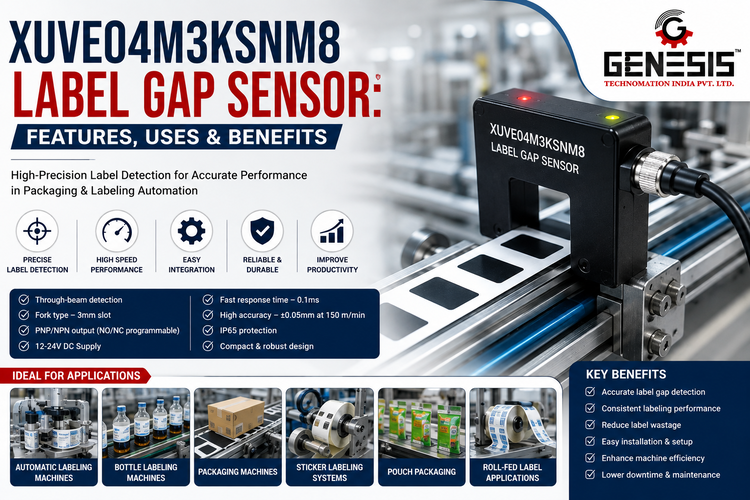
When a labeling machine is running at production speed, even a small detection error can create a chain of problems: labels may shift, applicators can lose synchronization, products can leave the line with incorrect positioning, and valuable label stock may be wasted. The XUVE04M3KSNM8 Label Gap Sensor is designed specifically for this type of industrial task.
The XUVE04M3KSNM8 is a Telemecanique Sensors XUV-series photoelectric sensor with a fork-style construction and through-beam detection. It is designed for packaging applications and, specifically, for label detection. The sensor uses infrared emission and incorporates the optical path within its fork structure, giving machine builders a compact way to monitor labels and the spaces between them.
For engineers and OEMs designing or maintaining automatic labeling equipment, the model is particularly interesting because it combines a compact 3 mm sensing passage with programmable PNP/NPN outputs, 12–24 V DC rated supply, an M8 four-pin connector, and a response delay of 0.1 ms. The manufacturer also specifies an accuracy of ±0.05 mm at 150 m/min, a minimum label length of 2 mm, and a minimum distance between labels of 2 mm.
This guide examines the XUVE04M3KSNM8 Label Gap Sensor from a practical industrial automation perspective, including its construction, verified specifications, working method, applications, installation considerations, troubleshooting, and purchasing factors.
What Is the XUVE04M3KSNM8 Label Gap Sensor?
The XUVE04M3KSNM8 is a dedicated label-detection photoelectric sensor from the Telemecanique Sensors XU range. Its product documentation classifies it as a photoelectric sensor with a fork design, through-beam detection system, infrared emission, and a product-specific application for detecting labels.
The fork configuration is important. Instead of requiring the machine builder to separately position an emitter and receiver, the optical components are integrated into the sensor’s fork structure. The label web passes through the sensing opening.
As labels move through this opening, the sensor detects changes in the optical condition created by the label and its backing material. The resulting discrete signal can then be used by the machine’s control system to coordinate label feeding, positioning, dispensing, counting, or another programmed machine action.
In a typical labeling machine, the operating sequence can be viewed as:
Label web movement → optical detection → label/gap recognition → discrete output → controller input → machine action
The XUVE04M3KSNM8 is therefore not simply a presence detector. Its value lies in providing a repeatable electrical signal at a defined point in the label-feed process.
Telemecanique Sensors specifies the model for packaging applications and label detection, making it especially relevant to automated labeling and packaging equipment.
XUVE04M3KSNM8 Label Gap Sensor: Key Features
The following specifications are based primarily on the manufacturer’s product information.
| Feature | XUVE04M3KSNM8 Details |
| Model | XUVE04M3KSNM8 |
| Product range | Telemecanique Photoelectric Sensors XU |
| Sensor name | XUV |
| Sensor type | Photoelectric sensor |
| Sensor design | Fork |
| Detection system | Through-beam |
| Emission | Infrared |
| Application | Packaging |
| Specific application | Detection of labels |
| Passage width | 3 mm |
| Passage depth | 40 mm |
| Sensing distance | 3 mm through-beam |
| Supply | 12–24 V DC rated |
| Supply limits | 10–30 V DC |
| Output | PNP and NPN |
| Output function | 2 NO/NC programmable |
| Connection | M8 male connector, 4 pins |
| Wiring | 4-wire |
| Setting-up | Numeric potentiometer |
| Output signal | Discrete |
| Output type | Solid state |
| Accuracy | ±0.05 mm at 150 m/min |
| Minimum label length | 2 mm |
| Minimum distance between labels | 2 mm |
| Maximum passing speed | 200 m/min |
| Response delay | 0.1 ms |
| First-up delay | 30 ms |
| Protection | IP65 |
| Enclosure material | Polyamide |
| Lens material | PC |
| Status indication | Yellow output LED and red adjustment/keypad-locking LED |
These characteristics are listed by Telemecanique Sensors for the XUVE04M3KSNM8.
One feature deserves particular attention: the sensor supports both PNP and NPN discrete outputs, with NO/NC functionality described as programmable. That gives machine designers greater flexibility when integrating the sensor into different control architectures.
Construction and Physical Design
The XUVE04M3KSNM8 uses a compact fork-style body. The manufacturer identifies the enclosure material as polyamide and the lens material as PC. The sensor’s listed dimensions are approximately 64 mm deep, 25 mm high, and 10 mm wide, according to the product documentation and supporting distributor specifications.
The 3 mm passage is central to the model’s application. The label web is guided through the fork opening, placing the material directly in the optical detection path.
This arrangement provides an important practical advantage during machine design: the sensing geometry is established by the fork itself. The installer does not have to create a separate emitter-to-receiver alignment across an open machine frame.
For OEM equipment, this can simplify sensor positioning and help reduce alignment-related variables during commissioning.
How XUVE04M3KSNM8 Works
The working principle of the XUVE04M3KSNM8 Label Gap Sensor is based on through-beam photoelectric detection.
The sensor incorporates an infrared optical path across its fork opening. When the label web moves through the opening, the optical condition changes as the labels and their gaps pass the sensing area. The electronics interpret this change and provide a discrete output signal to the machine control system. Telemecanique Sensors identifies the detection system as through-beam and the emission as infrared.
A practical machine sequence looks like this:
- The label roll feeds the web toward the applicator.
- The web enters the XUVE04M3KSNM8 fork opening.
- The sensor monitors the optical path.
- A label or gap passes through the detection area.
- The sensor changes its discrete output state according to the configured operating function.
- The PLC, controller, or labeling control circuit receives the signal.
- The control system uses the timing information for the required labeling operation.
The exact machine action depends on the labeling equipment. The sensor itself provides the detection signal; the PLC or dedicated controller determines what the machine should do with that signal.
This distinction is important when troubleshooting. A sensor may be detecting correctly while a PLC input, parameter, timing setting, or mechanical feed problem creates the apparent impression of sensor failure.
Detection Performance and Precision
For label-processing equipment, timing and repeatability matter as much as simple detection.
The manufacturer specifies ±0.05 mm accuracy at 150 m/min, which is a significant specification for high-speed label positioning applications. The model is also specified with a 0.1 ms response delay and a maximum passing speed of 200 m/min.
These specifications should always be considered in relation to the complete machine.
For example, a sensor may have a fast electrical response, but poor mechanical web control can still produce inconsistent label positioning. Web tension, roller slip, vibration, label deformation, and incorrect sensor mounting can all influence the final result.
The XUVE04M3KSNM8 is specified for a minimum label length of 2 mm and a minimum distance between labels of 2 mm. These parameters are particularly important when engineers evaluate a label roll before selecting the sensor.
The practical lesson is straightforward: do not evaluate detection capability from sensor response time alone. Label dimensions, spacing, machine speed, mechanical stability, and the controller’s timing must all work together.
Applications of XUVE04M3KSNM8 Label Gap Sensor
The XUVE04M3KSNM8 is specifically associated with packaging and label detection, making it suitable for several automated production environments.
Automatic Labeling Machines
In an automatic labeling machine, the sensor can monitor labels as they move through the feed mechanism. The detection signal can be used by the control system to establish when a label or gap reaches the required reference position.
This allows the machine to coordinate dispensing and application timing rather than relying solely on a mechanical timing assumption.
Bottle Labeling Machines
Bottle and container labeling equipment often requires repeatable label placement around a moving product.
The XUVE04M3KSNM8 can monitor the label web before the label reaches the applicator. The machine controller can use the resulting signal as part of the timing sequence for transferring the label onto bottles or containers.
Packaging Machines
Packaging machinery may incorporate labels for identification, traceability, product information, or branding.
The sensor can provide a label-position reference to the control system, helping synchronize label handling with other machine functions.
Sticker Labeling Systems
Sticker and adhesive-label dispensing equipment depends on detecting the transition between labels.
The fork design allows the label strip to pass directly through the sensing area. This makes the model suitable for machines where consistent label detection is required within a compact mechanical space.
Pharmaceutical Packaging
Pharmaceutical packaging lines can use labels for product identification, cartons, containers, or packaging information.
In such applications, accurate label positioning is important because an incorrectly positioned label can create quality-control problems. The XUVE04M3KSNM8 can serve as the label detection point within the machine’s control sequence, subject to validation against the actual label material and machine requirements.
Food Packaging
Food packaging machines may apply labels to containers, trays, pouches, bottles, and other packages.
The sensor’s IP65 protection rating provides a defined level of enclosure protection, although the complete machine environment must still be assessed before installation.
FMCG Packaging
Fast-moving consumer goods production often requires high throughput and consistent packaging.
The XUVE04M3KSNM8’s specified high-speed performance and rapid response characteristics make it relevant to applications where labels must be detected without introducing unnecessary timing delay.
Carton Labeling
Carton labeling equipment can use the sensor to establish a repeatable label-feed reference. The controller can then coordinate the label application sequence with carton movement.
Pouch Packaging
Pouch machines can use label detection where adhesive labels are supplied on a continuous carrier web.
The sensor’s compact fork arrangement can be useful where the label strip follows a defined path through the machine.
Product Identification Systems
Where labels are used for product identification, the XUVE04M3KSNM8 can provide the detection signal needed to synchronize the label web with the broader product-handling process.
Roll-Fed Label Applications
Roll-fed label material naturally creates a continuous sequence of labels and gaps. The XUVE04M3KSNM8 is specifically intended for label detection and can be positioned along the web path before the dispensing or application point.
Automated Production Lines
In an automated production line, the sensor can act as one of the field-level devices feeding information to the machine controller. Its output can be combined with encoder, conveyor, servo, or other machine signals to coordinate label handling.
Benefits of XUVE04M3KSNM8 Label Gap Sensor
Accurate Label Positioning
The specified ±0.05 mm accuracy at 150 m/min gives the XUVE04M3KSNM8 a strong technical basis for precision label detection applications.
In practical terms, accurate detection provides the machine controller with a more reliable reference for label timing.
Reliable Gap Detection
The through-beam fork design creates a defined optical detection path through which the label web passes. This is particularly useful for applications where the transition between labels must be identified consistently.
High-Speed Machine Integration
The model has a specified maximum passing speed of 200 m/min and a response delay of 0.1 ms. These characteristics make it appropriate for evaluating high-speed labeling applications, provided the complete machine design is capable of operating at the required speed.
Flexible Output Integration
The XUVE04M3KSNM8 supports PNP and NPN outputs and provides programmable NO/NC output functionality. This can simplify integration into different machine control configurations.
Compact Installation
Because the sensor is built in a fork configuration, the optical components are incorporated into one assembly. This can make installation more straightforward than systems requiring separate optical components.
Reduced Manual Intervention
Once properly installed and integrated, the sensor allows the machine to detect label transitions automatically. This reduces the need for an operator to visually establish every label position during normal production.
XUVE04M3KSNM8 in Packaging Automation
The XUVE04M3KSNM8 Label Gap Sensor normally operates as a field-level detection device within a larger automation architecture.
PLC Integration
The sensor’s discrete output can be connected to an appropriate PLC input when the electrical specifications are compatible.
The PLC can use the sensor signal as a machine event—for example, to initiate a timing sequence, coordinate an actuator, or monitor the label feed.
Labeling Controllers
Dedicated labeling controllers can also use the sensor signal as a reference for label position. The controller’s programming determines how that signal affects dispensing and application.
Servo Motors
In servo-driven machines, the label sensor may work alongside the servo system. The sensor identifies the physical position of the label web, while the servo system controls motion.
This distinction is useful: the sensor detects; the motion system moves.
Stepper Motors
A similar arrangement can be used with stepper-driven label feeders. The sensor provides feedback about label position while the stepper system controls web movement.
Conveyor Systems
When labels must be synchronized with product movement, the sensor signal can become one input into the overall conveyor and labeling sequence.
Label Dispensing Mechanisms
The sensor can be positioned at an appropriate point in the label path so the machine controller receives a repeatable indication before the label reaches the dispensing or application point.
Installation and Mounting Considerations
Correct installation is critical to getting consistent performance from the XUVE04M3KSNM8.
1. Position the Label Web Correctly
The label strip should pass through the sensor’s fork opening without rubbing against the housing. The sensing path must remain consistent during operation.
2. Maintain Correct Alignment
Although the fork design establishes the optical geometry, the label web itself still needs to run consistently through the sensing area.
Misalignment can cause unstable detection, particularly when the web moves laterally.
3. Use a Stable Mount
The mounting bracket should be rigid enough to prevent the sensor from moving during production.
A sensor that shifts by even a small amount can change the relationship between the label web and sensing path.
4. Consider the Detection Position
The sensor should be positioned according to the machine’s timing requirements.
Do not simply mount it wherever space is available. Consider the distance between the detection point and the label application point, machine speed, controller response, and required label position.
5. Check Electrical Compatibility
The model has a rated supply voltage of 12–24 V DC, with listed supply limits of 10–30 V DC. It uses a four-wire configuration and an M8 four-pin male connector.
Electrical integration should follow the manufacturer’s wiring documentation and the machine’s control-panel design.
6. Verify Output Configuration
Because the sensor supports PNP and NPN outputs with programmable NO/NC functionality, the selected configuration must match the receiving machine input and control architecture.
7. Check Machine Speed
The label web’s actual speed should be evaluated against the sensor’s specified performance limits.
The manufacturer’s data lists a maximum object passing speed of 200 m/min.
8. Minimize Vibration
The sensor should be mounted away from unnecessary mechanical movement. The manufacturer specifies vibration resistance according to IEC 60068-2-6, but the machine designer should still avoid unnecessary vibration at the sensor mounting point.
9. Test Before Full Production
After installation, run the actual label stock through the machine at representative production conditions.
Check detection stability, output transitions, label position, machine timing, and repeatability before releasing the equipment for continuous production.
Factors Affecting XUVE04M3KSNM8 Detection
Even a purpose-built label sensor can produce inconsistent results when application conditions are poorly controlled.
| Factor | Possible Effect | Practical Check |
| Label material | Optical response may vary | Test the actual label stock |
| Liner material | Changes the optical transition | Verify sensor response with the production liner |
| Label thickness | Can affect the physical sensing transition | Test actual material |
| Label spacing | Very small gaps may challenge timing | Compare spacing with the 2 mm minimum specification |
| Label length | Short labels require sufficient sensing capability | Compare with the 2 mm minimum specification |
| Web alignment | Lateral movement can create inconsistent detection | Stabilize the web path |
| Dust/contamination | Can interfere with optical sensing | Inspect and clean the sensing area |
| Vibration | Can alter mechanical positioning | Strengthen the mounting |
| Web tension | May cause label movement or deformation | Check rollers and tension control |
| Machine speed | Changes timing requirements | Compare speed with rated performance |
| Mounting position | Incorrect timing can cause positioning errors | Recalculate detection-to-application distance |
The manufacturer specifies a minimum label length and minimum label-to-label distance of 2 mm, so these dimensions should be treated as important selection criteria.
Maintenance and Troubleshooting
Routine maintenance for the XUVE04M3KSNM8 should focus on keeping the optical path clean, maintaining stable mechanical mounting, and checking electrical connections.
| Problem | Possible Cause | Recommended Action |
| Labels not detected | Incorrect web position | Check that the label strip passes correctly through the fork |
| Labels not detected | Electrical supply issue | Verify DC supply and machine input compatibility |
| Intermittent detection | Web movement or vibration | Check mounting and label-web stability |
| Intermittent detection | Contamination | Inspect and clean the sensing area |
| Incorrect label position | Sensor installed at unsuitable location | Review sensor-to-applicator distance and machine timing |
| False detection | Unstable material movement | Check web tension and mechanical guidance |
| Output signal inconsistent | Incorrect output configuration | Verify PNP/NPN and NO/NC configuration |
| Detection fails at high speed | Machine exceeds suitable operating conditions | Check actual web speed and controller timing |
| Short labels are missed | Label dimensions are outside specified capability | Verify label length and spacing |
| Machine does not respond | PLC input or control logic issue | Check the controller input and program sequence |
A useful troubleshooting method is to separate the problem into three areas:
Optical → Electrical → Mechanical
First confirm that the sensor can physically detect the label web. Next confirm that its electrical output reaches the controller correctly. Finally check whether the machine’s mechanical system is maintaining the expected web position.
This approach avoids replacing a functioning sensor when the real problem is wiring, PLC configuration, web tension, or mechanical alignment.
Why Choose XUVE04M3KSNM8 for Label Detection?
The XUVE04M3KSNM8 Label Gap Sensor is worth considering when the application requires a dedicated fork-style photoelectric sensor for label detection rather than a general-purpose object sensor.
Its strongest technical characteristics include its purpose-specific label-detection application, through-beam fork construction, 3 mm sensing passage, programmable PNP/NPN outputs, M8 four-pin connection, fast response, and specified accuracy at high web speed.
The model also provides a compact mechanical package for OEMs and machine builders.
However, selection should always be based on the actual application. Label composition, liner, label dimensions, spacing, machine speed, electrical architecture, mounting space, and environmental conditions should be reviewed before purchase.
Where to Purchase XUVE04M3KSNM8 Label Gap Sensor
For buyers in India, Genesis Technomation India Private Limited can be considered as a supplier for the XUVE04M3KSNM8 Label Gap Sensor and related industrial automation requirements.
Genesis Technomation lists label gap/fork sensors within its sensing solutions and serves industrial customers from Ahmedabad, Gujarat.
For product enquiries and purchasing information, refer to the provided Genesis product page: https://genesisindsol.in/product/label-gap-sensor-frok-sensor/
When requesting a quotation, it is useful to provide the supplier with the complete model number XUVE04M3KSNM8 along with application information such as label material, liner material, label size, gap size, web speed, controller type, required output configuration, and mounting arrangement.
That information can help confirm that the selected sensor is appropriate for the machine rather than relying only on the model number.
XUVE04M3KSNM8 Label Gap Sensor: Selection & Buying Considerations
Before purchasing the XUVE04M3KSNM8, engineers and procurement teams should review several application-specific points.
Label and Liner
Confirm the actual label and backing material that will pass through the sensor.
Do not evaluate the sensor using only a sample material if the production line will eventually use several different label constructions.
Label Length and Gap
The manufacturer specifies a minimum label length of 2 mm and a minimum distance between labels of 2 mm. These values should be compared with the actual production label design.
Machine Speed
Confirm the actual maximum web speed. The product documentation specifies a maximum passing speed of 200 m/min and accuracy of ±0.05 mm at 150 m/min.
Electrical Compatibility
Check that the machine’s DC supply and input architecture are compatible with the sensor’s specifications.
The model is rated for 12–24 V DC, with supply limits of 10–30 V DC.
Output Type
Confirm whether the PLC or controller requires PNP or NPN operation and verify the intended NO/NC configuration.
Mounting Space
The compact fork design is advantageous, but the actual machine should still provide adequate space for installation, cable routing, web guidance, and maintenance access.
Environmental Conditions
The product has an IP65 protection rating according to IEC 60529.
Even with this protection level, engineers should evaluate the actual environmental conditions, including contamination, cleaning practices, temperature, chemicals, and mechanical exposure.
Controller Compatibility
The sensor’s electrical signal must be compatible with the PLC, labeling controller, or machine input receiving it.
Supplier Support
For industrial machinery, purchasing the sensor is only one part of the decision. Availability of technical documentation, application guidance, replacement planning, and supplier support can also matter—especially when the sensor is installed in production-critical equipment.
FAQs about XUVE04M3KSNM8 Label Gap Sensor
What is the XUVE04M3KSNM8 Label Gap Sensor?
The XUVE04M3KSNM8 is a Telemecanique Sensors XUV-series photoelectric sensor designed in a fork configuration for label detection. It uses through-beam infrared detection and provides programmable PNP/NPN discrete outputs.
How does the XUVE04M3KSNM8 detect label gaps?
The label web passes through the sensor’s fork opening. The through-beam optical system detects changes as labels and gaps pass through the sensing path, producing a discrete output signal that can be used by the machine controller.
Where is the XUVE04M3KSNM8 used?
The manufacturer specifies it for packaging applications and label detection. It can therefore be considered for automatic labeling machines, label dispensing systems, packaging equipment, and automated production lines where label-web detection is required.
What types of labeling machines can use the XUVE04M3KSNM8?
The model can be evaluated for machines that feed labels on a web and require a dedicated label detection point. The final suitability depends on label dimensions, material, machine speed, electrical interface, and mechanical arrangement.
What is the supply voltage of the XUVE04M3KSNM8?
The rated supply voltage is 12–24 V DC, while the listed supply voltage limits are 10–30 V DC. The product also includes reverse-polarity protection.
What output does the XUVE04M3KSNM8 provide?
The sensor provides PNP and NPN discrete outputs, with two NO/NC programmable output functions. It uses a four-wire configuration and an M8 four-pin male connector.
What factors can affect XUVE04M3KSNM8 detection?
Label and liner material, label dimensions, spacing, web alignment, machine speed, vibration, contamination, web tension, mounting position, and electrical integration can all influence the overall detection result.
What is the response time of the XUVE04M3KSNM8?
The manufacturer’s product information specifies a 0.1 ms response delay. It also lists a 30 ms first-up delay.
Where can I purchase the XUVE04M3KSNM8 Label Gap Sensor?
The XUVE04M3KSNM8 Label Gap Sensor can be sourced through industrial automation suppliers. For buyers in India, Genesis Technomation India Private Limited provides a product reference for the model and related label/fork sensor solutions.
What should I check before purchasing the XUVE04M3KSNM8?
Check the label length, gap, liner, web speed, required accuracy, supply voltage, PNP/NPN requirement, NO/NC configuration, M8 connection, available mounting space, environmental conditions, and compatibility with the machine controller.
Conclusion
The XUVE04M3KSNM8 Label Gap Sensor is a purpose-built Telemecanique Sensors photoelectric sensor for label detection in packaging applications. Its fork construction, through-beam infrared detection, 3 mm sensing passage, programmable PNP/NPN outputs, M8 four-pin connection, and compact form make it well suited to automated label-handling equipment.
From a machine-builder’s perspective, its most important characteristics are not simply the product’s compact size but the combination of detection geometry, electrical flexibility, response performance, and application-specific design. The manufacturer specifies ±0.05 mm accuracy at 150 m/min, a 0.1 ms response delay, a 2 mm minimum label length, a 2 mm minimum distance between labels, and a maximum passing speed of 200 m/min.
For successful implementation, however, the sensor should be treated as one part of the complete automation system. Correct web guidance, mounting stability, electrical compatibility, controller configuration, machine timing, and the actual characteristics of the label material all influence final performance.
For Indian OEMs, packaging-machine manufacturers, maintenance teams, and industrial buyers evaluating this model, Genesis Technomation India Private Limited is an option to consider for sourcing the XUVE04M3KSNM8 and obtaining application-related product information.
When the application requires dependable label-web detection and accurate synchronization with an automated labeling process, the XUVE04M3KSNM8 Label Gap Sensor provides a technically focused solution built specifically around that requirement.
Related Posts

[…] XUVE04M3KSNM8 is a Telemecanique Sensors XU-series fork-style photoelectric sensor designed specifically for […]