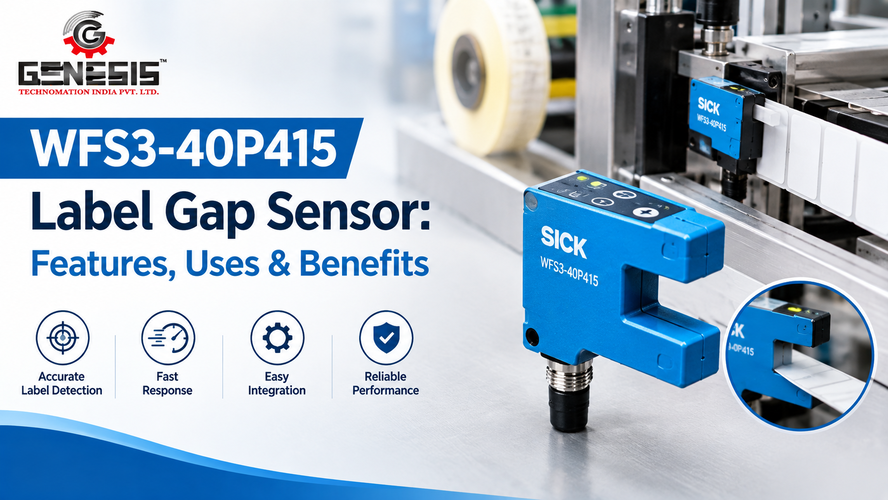
The WFS3-40P415 Label Gap Sensor is a compact optical fork sensor designed for reliable detection of labels and gaps in continuously moving label stock. Manufactured by SICK and identified by part number 6043919, the WFS3-40P415 uses an infrared LED and an optical detection principle within a fork-shaped housing. Its 3 mm fork width, 42 mm fork depth, PNP switching output, adjustable teach-in functions, and fast response characteristics make it particularly relevant to automated label processing and packaging machinery.
In an automated labeling machine, the sensor is not simply detecting whether material is present. Its signal can become a timing reference for the machine controller. When the label web moves through the sensing fork, the WFS3-40P415 detects changes in the optical condition and provides a switching signal that can be used by the machine’s control system for label positioning and synchronization.
This matters because even a small timing error can result in labels being applied too early, too late, or inconsistently. On a high-speed packaging line, repeated positioning errors can quickly become material waste and production downtime.
The WFS3-40P415 addresses this requirement with a compact through-fork arrangement, adjustable sensitivity and teach-in functions, light/dark switching, a PNP output, and a response time of up to 50 µs. SICK’s current datasheet specifies a 10 kHz switching frequency and 40 µs jitter, making the device suitable for applications where repeatable label detection and fast machine response are important.
WFS3-40P415 Label Gap Sensor: Product Overview
The WFS3-40P415 belongs to SICK’s WFS fork sensor family. Its product identification is:
- Model: WFS3-40P415
- SICK part number: 6043919
- Functional principle: Optical detection
- Sensor construction: Fork-shaped
- Fork width: 3 mm
- Fork depth: 42 mm
- Light source: Infrared LED
- Label detection: Yes
- Minimum detectable object: 2 mm gap between labels / label size, depending on label thickness
- Output: PNP
- Connection: M8 male connector, 4-pin
- Enclosure rating: IP65
- Operating temperature: -20 °C to +60 °C
The fork construction is particularly useful for label-processing machinery because the sensing components are integrated into the sensor body. Instead of requiring the installer to position separate emitter and receiver units opposite one another, the label web passes through the sensor’s defined fork opening.
For machine builders, this can simplify mechanical integration and reduce alignment work during installation.
The WFS3-40P415 is also physically compact. SICK specifies dimensions of 10 mm × 25 mm × 64.3 mm and a weight of approximately 36 g. The housing is made from glass-fiber-reinforced PA.
WFS3-40P415 Label Gap Sensor Features
The following specifications are taken from SICK’s current WFS3-40P415 datasheet rather than estimated from general fork-sensor characteristics.
| Parameter | WFS3-40P415 Specification |
| Model | WFS3-40P415 |
| SICK Part Number | 6043919 |
| Sensor Type | Fork sensor |
| Functional Principle | Optical detection |
| Light Source | Infrared LED |
| Fork Width | 3 mm |
| Fork Depth | 42 mm |
| Minimum Detectable Object | 2 mm gap between labels / label size* |
| Supply Voltage | 10–30 V DC |
| Current Consumption | 20 mA |
| Switching Frequency | 10 kHz |
| Response Time | ≤50 µs |
| Response-Time Stability | ±20 µs |
| Jitter | 40 µs |
| Output | PNP |
| Maximum Output Current | 100 mA |
| Switching Mode | Light/dark switching |
| Connection | M8 male connector, 4-pin |
| Teach-in | 2-point and dynamic teach-in |
| Enclosure Rating | IP65 |
| Protection Class | III |
| Housing Material | Glass-fiber-reinforced PA |
| Operating Temperature | -20 °C to +60 °C |
| Storage Temperature | -30 °C to +80 °C |
| Ambient Light Immunity | ≤10,000 lx |
| Weight | Approx. 36 g |
*SICK notes that the minimum detectable object specification depends on label thickness.
Compact 3 mm fork width
The 3 mm fork width defines the sensing geometry of the WFS3-40P415. The label material passes through this narrow opening, allowing the sensor to monitor the optical transition between label and gap.
For a machine designer, this compact geometry is important when available mounting space is limited around the dispensing edge or label path.
42 mm fork depth
The 42 mm fork depth provides the physical sensing passage through which the label web travels. Proper mechanical positioning remains important; the web should move cleanly through the active sensing area without rubbing against the sensor.
Infrared optical detection
The WFS3-40P415 uses an infrared LED as its light source. The optical arrangement allows the sensor to detect changes caused by the label material passing through the fork.
2 mm detectable gap specification
SICK specifies a minimum detectable object of 2 mm for the gap between labels / label size, with the note that the actual capability depends on label thickness. This is one of the most relevant specifications when evaluating the sensor for tightly spaced label stock.
Fast response
The WFS3-40P415 has a specified response time of ≤50 µs, a switching frequency of 10 kHz, response-time stability of ±20 µs and jitter of 40 µs. These specifications are especially relevant when the sensor is integrated into machinery where label timing must be transferred rapidly to the control system.
Adjustable teach-in
The sensor supports 2-point teach-in and dynamic teach-in. Adjustment can be performed using the plus/minus buttons, with additional teach-in functionality available through the cable.
This is useful during commissioning because the switching threshold can be configured for the actual label and substrate being processed rather than relying on a fixed factory assumption.
How WFS3-40P415 Label Gap Sensor Works
The WFS3-40P415 working principle can be understood as a controlled optical transition through a fixed fork geometry:
Label web movement → optical detection → label/gap transition → switching output → controller input → positioning or synchronization
The label material moves through the 3 mm fork opening. The WFS3-40P415 uses its infrared optical system to monitor the material as it passes through the sensing area. As the optical condition changes between the label and the gap, the sensor changes its switching state according to its configured threshold and light/dark setting.
The resulting PNP output can then be connected to a machine controller or PLC input.
In a labeling machine, the controller can use this event as a timing reference. For example, when the sensor identifies the transition corresponding to the required label position, the control system can coordinate a dispensing or application sequence.
The sensor therefore becomes part of the machine’s timing chain rather than operating as an isolated detection device.
SICK also provides a teach-in procedure in which the label or substrate is positioned in the active area and the switching threshold is established. The datasheet describes static teach-in and dynamic teach-in approaches and provides button-based adjustment of the switching threshold.
The WFS3-40P415 also permits light/dark switching configuration. SICK specifies that the standard setting is light switching, while the switching function can be configured using the device’s button interface.
Detection Performance of WFS3-40P415
The detection performance of the WFS3-40P415 label detection sensor depends on both the sensor’s specifications and the mechanical conditions of the labeling machine.
Label thickness
Label thickness influences the minimum detectable gap specification. SICK explicitly notes that the 2 mm minimum detectable object specification depends on label thickness. Therefore, engineers should test the actual label construction rather than assuming that every 2 mm gap will behave identically.
Liner characteristics
The liner forms part of the optical material passing through the fork. Changes in liner characteristics can alter the optical transition seen by the sensor. When commissioning a new label stock, the correct material should therefore be used during teach-in.
Label spacing
The physical gap between labels is directly relevant to detection. Tightly spaced labels should be evaluated against the sensor’s specified minimum detectable object and the actual label thickness.
Sensor alignment
Even though the WFS3-40P415 uses a fork configuration, mechanical positioning remains important. The label web should travel consistently through the sensing area rather than wandering from side to side.
Machine speed
The sensor’s ≤50 µs response time and 10 kHz switching frequency provide fast electrical response, but machine-level performance also depends on web speed, label spacing, controller processing, and the mechanics of the labeling system.
Ambient light
SICK specifies ambient light immunity up to 10,000 lx. Nevertheless, good machine design should avoid unnecessary exposure to strong external light sources and maintain the sensor in its intended operating environment.
WFS3-40P415 Label Gap Sensor Applications
Automatic Labeling Machines
The WFS3-40P415 is particularly relevant to automatic labeling equipment where labels are supplied on a continuous web.
The label web passes through the fork and the sensor generates an electrical switching signal as the required optical transition occurs. The machine controller can use this signal to synchronize the dispensing and application cycle.
For an OEM building a labeling machine, this provides a direct sensor-to-controller detection path.
Bottle and Container Labeling
Bottle and container labeling systems often require repeatable label positioning. The WFS3-40P415 can monitor the label web before application and provide a timing signal to the machine controller.
The sensor does not physically position the bottle or apply the label. Instead, its detection event can become part of the control sequence that determines when the labeling mechanism should operate.
Packaging Machines
Packaging machines frequently combine conveyors, motors, actuators and sensors. The WFS3-40P415 can be incorporated into the label-detection portion of this control architecture.
Its PNP output can provide the machine controller with a discrete detection signal, while its fast response characteristics are useful when label events occur rapidly.
Pharmaceutical Packaging
In pharmaceutical packaging, consistent label placement can be an important part of the overall packaging process. The WFS3-40P415 can be used to detect label transitions on a packaging line where the machine requires a repeatable label-position reference.
Application suitability should always be validated against the actual packaging material, machine design and environmental requirements.
Food and FMCG Packaging
Food and FMCG packaging machinery often operates continuously and at production-line speeds. A label detection signal can help coordinate label dispensing with the movement of packages.
The WFS3-40P415’s compact fork design can be advantageous where the label web passes through a confined machine section.
Pouch and Sachet Packaging
For pouch and sachet machines that use roll-fed labels or label stock, the WFS3-40P415 can be evaluated as a label detection device. The actual suitability depends on the label construction, spacing, web geometry and machine speed.
The correct approach is to test the actual production material during commissioning rather than relying only on the nominal sensor specifications.
Carton Labeling
In carton labeling equipment, the sensor can monitor the label web and generate the detection signal required for synchronization with the carton-handling sequence.
The machine controller can combine the WFS3-40P415 signal with conveyor position, actuator timing and other machine inputs.
Roll-Fed Label Applications
Continuous roll-fed label processing is one of the most natural applications for a fork-style label sensor. The WFS3-40P415 can monitor the label material as it passes through the fork and identify the optical transition between labels and gaps.
Benefits of WFS3-40P415 Label Gap Sensor
Consistent Label Detection
The dedicated fork geometry provides a defined optical detection path. When correctly installed and taught for the material, this supports repeatable label detection.
Improved Label Positioning
The output from the WFS3-40P415 can provide the machine controller with a repeatable event from the label web. This can be used as part of the positioning sequence.
Reduced Labeling Errors
Incorrect label detection can cause skipped labels, misplaced labels or timing errors. A properly configured WFS3-40P415 can reduce such problems by providing a dedicated label detection signal.
Better Machine Synchronization
The ≤50 µs response specification and 10 kHz switching frequency are useful for high-speed signal processing in automated equipment.
Reduced Material Waste
Accurate label detection helps the machine recognize label positions consistently. Better synchronization can reduce production errors and associated label waste, although actual waste reduction depends on the complete machine design.
Easy Commissioning
The WFS3-40P415 supports teach-in and switching-threshold adjustment through its controls. This allows the engineer to configure the sensor around the actual material being processed.
Industrial Protection
The sensor has an IP65 enclosure rating, protection against reverse polarity at the supply connections, short-circuit protection for output Q and interference-pulse suppression.
WFS3-40P415 Label Gap Sensor in Industrial Automation
The WFS3-40P415 Label Gap Sensor becomes particularly useful when viewed as one component within a larger automation architecture.
A typical arrangement may be:
WFS3-40P415 → PLC/machine controller → motion logic → servo/stepper system → label dispensing mechanism
The WFS3-40P415 itself does not control the servo motor or stepper motor. Its role is to provide a discrete detection event.
For example, a labeling machine may use a servo motor to drive a dispensing roller. The sensor detects the label transition and sends the PNP signal to the controller. The controller then processes that input alongside encoder position, conveyor status and machine sequence logic.
The sensor can therefore contribute to:
- Label-position feedback
- Dispensing synchronization
- Machine sequencing
- Product-to-label timing
- Label-web monitoring
- Fault detection
The exact control strategy depends on the machine builder’s PLC or motion-control program.
WFS3-40P415 Installation and Mounting Considerations
Correct installation is as important as selecting the right sensor.
1. Mount the sensor securely
The WFS3-40P415 should be mechanically fixed so vibration cannot change the relationship between the label web and sensing area.
2. Position the label web correctly
The label material should pass cleanly through the fork opening. Avoid arrangements where the web rubs against the sensor or can move outside the intended optical path.
3. Check alignment
Although the transmitter and receiver are integrated into the fork arrangement, the web itself still needs stable alignment.
4. Confirm electrical compatibility
The sensor requires 10–30 V DC and provides a PNP switching output. The controller input must therefore be compatible with the sensor’s electrical interface.
5. Use the correct connection
The WFS3-40P415 uses an M8, 4-pin male connector. SICK’s connection diagram identifies the supply, teach input and Q output connections.
6. Perform teach-in
Use the appropriate teach-in procedure for the material. The sensor supports both 2-point and dynamic teach-in.
7. Test at actual operating speed
A sensor that works correctly at slow speed should also be tested at the intended production speed. Check several consecutive labels rather than evaluating only one detection event.
Factors Affecting WFS3-40P415 Detection
| Issue | Why It Matters | What to Check |
| Incorrect alignment | The label may not pass consistently through the sensing area | Verify web path |
| Label material | Optical characteristics influence detection | Re-teach with actual material |
| Label thickness | Affects minimum detectable gap capability | Compare actual material with specification |
| Small label gap | Reduces detection margin | Confirm gap and label dimensions |
| Web movement | Lateral movement can affect consistency | Check guides and tension |
| Dust/contamination | Can interfere with optical detection | Clean sensor and surrounding area |
| Vibration | Can alter mechanical positioning | Inspect mounting |
| High speed | Reduces time available for each detection event | Test at production speed |
| Electrical interference | Can affect machine signals | Check wiring and control-panel conditions |
| Incorrect settings | Wrong threshold or switching mode can cause errors | Repeat teach-in/configuration |
A practical troubleshooting approach should begin with the simplest variables: mechanical positioning, material, sensor cleanliness and teach-in. Engineers should avoid immediately assuming that a failed detection event means the sensor itself is defective.
WFS3-40P415 Maintenance and Troubleshooting
| Problem | Possible Cause | Recommended Action |
| Label not detected | Incorrect teach-in or web position | Reposition material and repeat teach-in |
| Intermittent detection | Web movement, vibration or unstable label path | Check guides, tension and mounting |
| Incorrect label position | Detection event not correctly synchronized with machine sequence | Verify sensor position and PLC timing |
| False detection | Contamination or unsuitable threshold | Clean sensing area and adjust/teach sensor |
| Unstable output | Electrical or mechanical instability | Check supply, wiring, mounting and signal input |
| Detection changes at high speed | Machine dynamics or insufficient process margin | Test material at actual production speed |
| Sensor output remains in wrong state | Incorrect light/dark setting | Verify switching mode |
| Detection varies between label batches | Different material characteristics | Teach using the production material |
SICK’s WFS3-40P415 documentation also provides button-based switching-threshold adjustment and a mechanism to lock the controls to prevent unintended actuation after configuration.
Why Choose WFS3-40P415 for Automated Label Detection?
For an OEM, packaging-machine manufacturer, automation integrator or maintenance engineer, the WFS3-40P415 is worth considering when the application requires a compact fork-style optical sensor with dedicated label detection capability.
Several specifications stand out from an engineering perspective.
First, the 3 mm fork width and 42 mm fork depth create a defined sensing passage for label material. Second, the PNP output provides a conventional discrete interface for compatible industrial control systems. Third, the sensor offers both teach-in functions and light/dark switching, allowing commissioning around the actual application.
Its ≤50 µs response time, 10 kHz switching frequency and 40 µs jitter are also relevant when the label detection event must be captured quickly.
However, selecting the WFS3-40P415 should still be an engineering decision. Label construction, gap size, machine speed, controller interface and mounting constraints should all be checked before final integration.
Where to Purchase WFS3-40P415 Label Gap Sensor
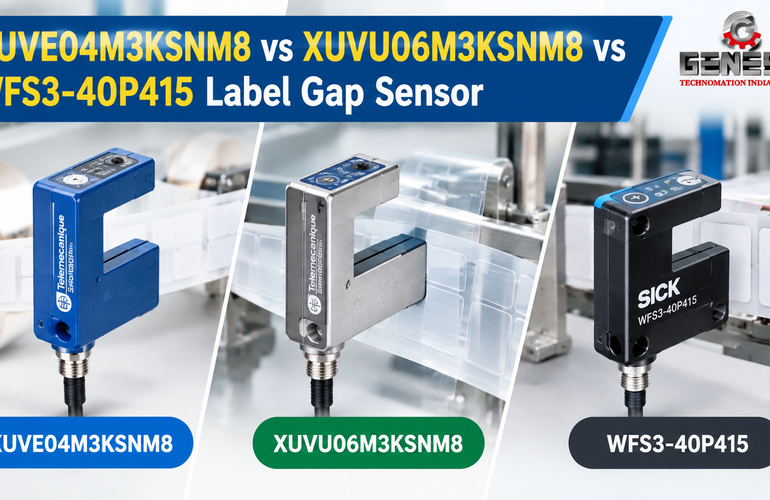
For buyers looking for the WFS3-40P415 Label Gap Sensor in India, Genesis Technomation India Private Limited can be considered as a purchasing source for industrial automation applications, including OEM machinery, packaging equipment, automation integration and maintenance requirements. Along with WFS3-40P415, you can also purchase XUVU06M3KSNM8 and XUVE04M3KSNM8 Label Gap Sensor from Genesis.
Before placing an order, industrial buyers should confirm the exact model number WFS3-40P415 / 6043919, required quantity, electrical interface, application conditions and current availability with the supplier.
The product brief specifically instructs that the supplier recommendation should avoid unsupported claims about pricing, authorization, delivery speed or market position.
WFS3-40P415 Buying Considerations
Before purchasing a WFS3-40P415 Label Gap Sensor, an engineer or procurement team should verify the following:
Application requirements
Determine exactly where the sensor will be installed and what label event the controller needs to detect.
Label and liner material
Use the actual production label and liner during application testing.
Label thickness
Because SICK states that the minimum detectable object specification depends on label thickness, this should be considered during validation.
Label spacing
Confirm that the actual label gap is compatible with the specified detection capability.
Machine speed
Evaluate the sensor at the intended production speed rather than only during manual testing.
Electrical compatibility
Confirm that the machine’s power supply is suitable for the sensor’s 10–30 V DC supply requirement.
Output compatibility
The WFS3-40P415 provides a PNP output, so the PLC or controller input should be designed for the corresponding signal arrangement.
Mounting
Check that the 3 mm fork width and 42 mm fork depth suit the machine’s label-web geometry.
Environmental conditions
Confirm that the expected operating environment falls within the specified temperature range and that IP65 protection is appropriate for the application.
Documentation
Obtain the relevant datasheet and operating instructions before commissioning.
Supplier support
For an OEM or production facility, supplier support can be valuable when validating the sensor against a particular label material or machine configuration.
FAQs About WFS3-40P415 Label Gap Sensor
1. What is the WFS3-40P415 Label Gap Sensor?
The WFS3-40P415 is a SICK optical fork sensor designed for label detection. It has a 3 mm fork width, 42 mm fork depth, infrared LED light source and PNP switching output. Its SICK part number is 6043919.
2. How does WFS3-40P415 work?
The label web passes through the sensor’s fork-shaped sensing area. The infrared optical system detects changes as labels and gaps pass through the sensing path, and the sensor generates a corresponding switching output for the machine controller.
3. What is WFS3-40P415 used for?
The WFS3-40P415 is intended for optical label detection applications, particularly where labels move continuously through an automated machine. It can provide a detection signal for label positioning and synchronization.
4. Where can WFS3-40P415 be installed?
It can be integrated into suitable labeling, packaging and automated label-processing equipment where its fork geometry and electrical specifications match the machine design.
5. How does WFS3-40P415 detect labels and gaps?
It uses an infrared LED and an optical detection principle. The material passes through the fork, and changes in the optical condition are converted into a switching output.
6. What factors can affect WFS3-40P415 detection?
Label thickness, gap size, label and liner characteristics, web alignment, machine speed, vibration, contamination and teach-in settings can all influence practical detection performance.
7. How should WFS3-40P415 be installed?
The sensor should be securely mounted with the label web passing correctly through its fork opening. Electrical connections must match the specified supply and PNP output configuration, and the sensor should be taught using the actual production material.
8. What should I check if WFS3-40P415 does not detect labels correctly?
Start by checking the web position, sensor cleanliness, mounting stability, label construction and teach-in setting. Then verify the power supply, wiring and PLC input before investigating more complex machine-control issues.
9. Is WFS3-40P415 suitable for packaging automation?
Yes, where its verified electrical, mechanical and optical specifications match the application. Its compact fork design, label detection capability, PNP output and fast response characteristics make it relevant to automated labeling and packaging machinery.
10. Where can I purchase WFS3-40P415 Label Gap Sensor?
The supplied purchasing source is Genesis Technomation India Private Limited. Buyers can review the relevant product page and confirm current availability, pricing and application requirements before ordering.
Conclusion
The WFS3-40P415 Label Gap Sensor is a purpose-built optical fork sensor for label detection applications where a controlled and repeatable detection signal is required. Its 3 mm fork width, 42 mm fork depth, infrared LED, 2-point and dynamic teach-in, PNP output, ≤50 µs response time, 10 kHz switching frequency and IP65 enclosure give machine builders a clearly defined set of characteristics for engineering evaluation.
From a practical automation perspective, the value of the WFS3-40P415 is not simply that it detects a label. Its output can become an important timing signal within a larger machine-control system. When correctly positioned, configured and integrated with the controller, it can help coordinate label dispensing, positioning and packaging operations.
The most important point during installation is to validate the sensor against the actual label material, liner, thickness, gap, web movement and machine speed. A technically suitable sensor can still perform poorly if it is incorrectly mounted, incorrectly taught or integrated with an incompatible control input.
For industrial buyers, OEMs and automation integrators evaluating the WFS3-40P415 Label Gap Sensor, the best approach is therefore straightforward: verify the model and electrical interface, compare the label characteristics with the sensor’s specifications, test the device at production conditions, and follow the manufacturer’s documentation during commissioning.
For purchasing in India, the supplied product source is Genesis Technomation India Private Limited, where buyers can enquire about the WFS3-40P415 and confirm current product availability and application suitability.
Related Posts