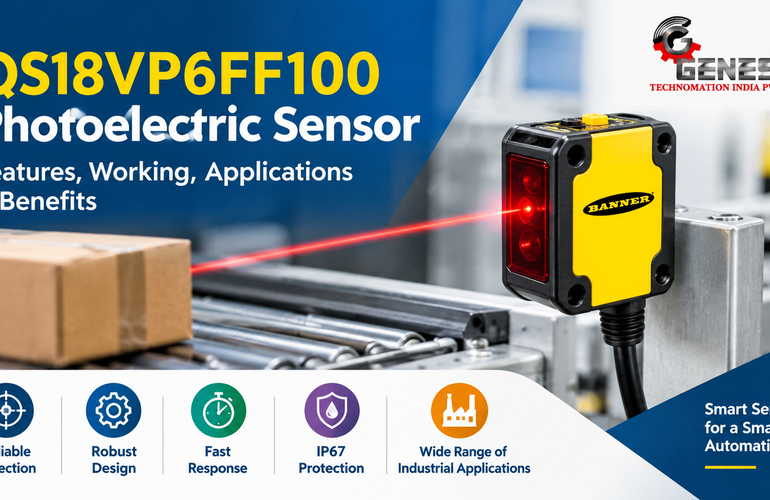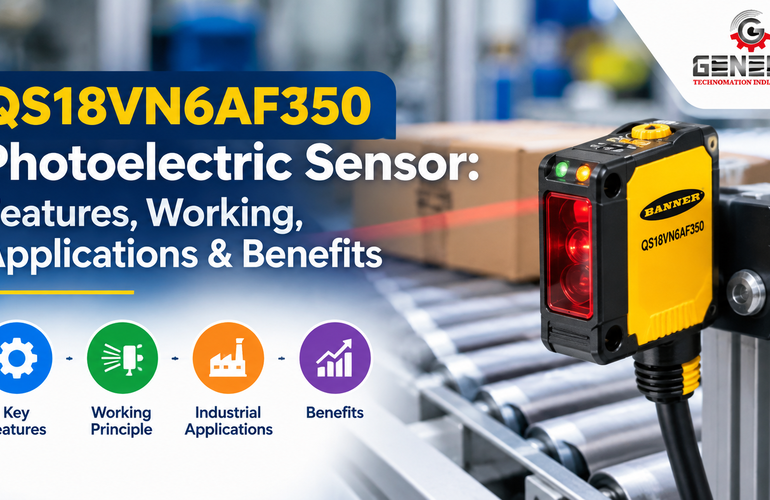

Accurate object detection is essential for modern factory automation, especially when a machine needs to identify products, confirm part presence, trigger a process, or control material movement without mechanical contact. The QS18VP6AF350 Photoelectric Sensor is a Banner Engineering QS18-series photoelectric sensor designed around adjustable-field background suppression. It provides a configurable cutoff range from 30 to 350 mm, operates from 10 to 30 V DC, and uses complementary PNP outputs for machine-control integration.
For automation engineers, OEMs, machine builders, and system integrators, the important point is not simply that this is a photoelectric sensor. Its adjustable background suppression configuration determines how it should be installed, adjusted, and applied. The sensor is designed to detect a target while suppressing objects beyond the configured cutoff distance, making the relationship between the target, sensor, and background particularly important.
This guide explains the QS18VP6AF350 Photoelectric Sensor in detail, including its verified specifications, working principle, detection behavior, PLC integration, installation, maintenance, troubleshooting, applications, purchasing considerations, and selection criteria.
QS18VP6AF350 Photoelectric Sensor Overview
The QS18VP6AF350 is part of Banner Engineering’s QS18 series of all-purpose photoelectric sensors. The manufacturer’s product page identifies it specifically as a WORLD-BEAM adjustable-field background-suppression sensor. Its official part number is 808871.
The model uses a visible red LED sensing beam at 640 nm and operates using proximity sensing with adjustable background suppression. Its maximum specified sensing distance is 350 mm, while the cutoff adjustment range is 30 to 350 mm.
The sensor uses a rectangular ABS housing with an acrylic lens. The standard QS18VP6AF350 configuration has a 2 m, four-wire PVC cable connection. Banner specifies IP67 ingress protection and a NEMA 4X rating on the product page.
The electrical configuration is particularly important for control-system designers. The QS18VP6AF350 uses PNP output technology with complementary outputs, rather than an NPN or bipolar output configuration.
In practical terms, the model is intended for industrial object detection where the application requires adjustable background suppression rather than simply detecting reflected light without regard to the distance of the background.
What Does QS18VP6AF350 Mean?
Banner’s available product documentation identifies the complete model number and its technical configuration, but it does not provide an official character-by-character explanation of every portion of the designation.
Therefore, it would be inappropriate to claim that individual characters such as “VP,” “6,” “AF,” or “350” have specific meanings unless Banner explicitly documents those meanings.
What can be established from the manufacturer’s product information is that QS18VP6AF350 is the exact model designation, belongs to the QS18 family, uses adjustable background suppression, provides PNP outputs, and has a cutoff adjustment range extending to 350 mm.
For purchasing and engineering work, using the complete part number is more reliable than attempting to decode individual characters.
Key Features of QS18VP6AF350 Photoelectric Sensor
Adjustable Background Suppression
The most important feature of the QS18VP6AF350 is its adjustable background suppression capability.
Instead of treating every reflective object within the optical field as a detection target, the sensor can be adjusted to establish a cutoff distance. Objects beyond the configured cutoff are suppressed.
This is useful when a target moves in front of a known machine surface, conveyor, fixture, or other background. The engineer can configure the cutoff according to the physical arrangement of the application.
Banner’s manual specifically describes background suppression as suitable for situations where object color, object position, or background conditions can vary.
30 to 350 mm Cutoff Adjustment
The manufacturer specifies an adjustable cutoff range of 30 to 350 mm.
This gives machine designers flexibility when positioning the sensor. Instead of having a single fixed detection distance, the cutoff can be mechanically adjusted according to the target and background arrangement.
The actual application should still be evaluated carefully. The maximum adjustment value does not mean that every target will produce identical detection performance at every point in the range.
Visible Red LED
The QS18VP6AF350 uses a visible red LED with a wavelength of 640 nm.
A visible red sensing beam can make sensor alignment and setup easier for technicians because the sensing direction can be visually referenced during installation.
Complementary PNP Outputs
The model uses complementary PNP outputs. This is a significant consideration when connecting the sensor to a PLC or other industrial controller.
A PNP output is commonly used as a sourcing output in industrial control architectures. The complementary configuration provides two output states that operate in opposite ways, giving the control system two related signals from the sensor.
Banner’s documentation identifies the output arrangement as solid-state complementary PNP for this model family configuration.
Mechanical Cutoff Adjustment
The cutoff is adjusted mechanically using a multi-turn adjustment screw. The product documentation specifies a five-turn adjustment mechanism with end stops.
This allows the installer to tune the sensor to the actual target and background geometry instead of relying only on a nominal factory setting.
Industrial Housing
The sensor has a rectangular ABS housing and acrylic lens cover. The manufacturer specifies IP67 protection and a NEMA 4X rating.
These environmental ratings make the sensor suitable for many industrial installation environments, although application-specific contamination, temperature, chemicals, washdown requirements, and mechanical conditions should still be evaluated before selection.
LED Indicators
The sensor includes LED indicators for operating status and sensing condition.
The manual identifies a green power indicator and an amber light-sensed indicator. The amber indicator can also flash under marginal sensing conditions.
This is useful during commissioning because a technician can observe the sensor while adjusting its cutoff and checking the target.
QS18VP6AF350 Photoelectric Sensor Technical Specifications
The following table focuses on specifications verified from Banner Engineering documentation for the exact QS18VP6AF350 model.
| Specification | Verified Details |
| Model | QS18VP6AF350 |
| Manufacturer | Banner Engineering |
| Part Number | 808871 |
| Product Family | QS18 |
| Sensor Type | Photoelectric sensor |
| Sensing Mode | Proximity |
| Sensing Technology | Adjustable background suppression |
| Cutoff Adjustment Range | 30 to 350 mm |
| Maximum Sensing Distance | 350 mm |
| Sensing Beam | Visible red LED |
| Beam Wavelength | 640 nm |
| Supply Voltage | 10 to 30 V DC |
| Output | Complementary PNP |
| Input/Output | Discrete |
| Connection | Cable |
| Standard Cable Length | 2 m |
| Wire Count | 4 |
| Housing Style | Rectangular |
| Housing Material | ABS |
| Lens Material | Acrylic |
| Operation | Light/Dark operate |
| Adjustment | Mechanical screw |
| Indicators | LEDs |
| IP Rating | IP67 |
| NEMA / UL Type Rating | NEMA 4X |
| Operating Temperature | -20°C to 55°C |
| Maximum Relative Humidity | 95% at 50°C, non-condensing |
| Power-up Delay | 200 ms |
| Repeatability | 250 µs |
| IO-Link | No |
| Quick Disconnect | No for this standard cable model |
One specification requires special attention. Banner’s current product page lists an output response time of 2.5 ms, while the QS18AF350 product manual lists 2.8 ms ON/OFF. Because these documents differ, this article does not silently select one value as if there were no discrepancy. Engineers designing timing-critical machinery should verify the current datasheet or manufacturer documentation for the purchased configuration before finalizing machine timing.
How Does QS18VP6AF350 Work?
The QS18VP6AF350 Photoelectric Sensor works by projecting a visible red optical beam toward the target area and evaluating the returned light according to its adjustable background-suppression configuration.
The basic operating sequence is:
Target → Optical sensing → Signal processing → PNP output → PLC/controller → Machine action
Step 1: Optical Sensing
The sensor generates a visible red LED sensing beam. The specified wavelength is 640 nm.
The beam reaches the target area, where the amount and behavior of returned light depend on the target’s position, surface characteristics, orientation, and reflectivity.
Step 2: Target Detection
The sensor evaluates the optical response and determines whether the target falls within the configured sensing conditions.
Because this is an adjustable background-suppression sensor, the physical distance of the target relative to the configured cutoff is important.
Step 3: Background Suppression
Objects beyond the configured cutoff distance are not detected by the background-suppression function.
This is the central engineering advantage of the configuration. For example, if a product passes over a conveyor and the conveyor surface is behind it, the sensor can be adjusted so the product is detected while the background beyond the cutoff is suppressed.
Step 4: Output Switching
Once the sensing condition is established, the sensor changes its solid-state output state.
The QS18VP6AF350 uses complementary PNP outputs. The output behavior depends on whether the control system is using light-operate or dark-operate logic.
Step 5: PLC or Controller Processing
The PNP output can be connected to a compatible PLC input or machine controller.
The PLC can then use the detection event as part of machine logic, such as incrementing a product counter, starting a conveyor sequence, confirming part presence, or allowing the next machine operation.
Understanding Background Suppression in QS18VP6AF350 Photoelectric Sensor
Background suppression is the feature that most strongly defines how this sensor should be used.
Consider a conveyor application where the target product travels at a known height while the conveyor surface sits behind it. A conventional optical detection arrangement may respond to the background if the optical conditions are unsuitable.
With adjustable background suppression, the engineer can configure a cutoff between the target and the background.
For reliable operation, Banner’s manual recommends setting the cutoff approximately midway between the farthest target position and the closest relevant background position.
The manual provides an example using a dark object at 150 mm and a white background at 200 mm. In that example, the documented minimum separation is 12 mm.
This demonstrates an important engineering principle: the maximum sensing distance alone does not determine whether an application will work reliably. Target reflectivity, distance, background reflectivity, and separation all matter.
QS18VP6AF350 Detection Performance
Detection performance depends on the actual machine geometry and target characteristics.
Important factors include:
Target Distance
The target must be positioned within the sensor’s usable sensing conditions and the configured cutoff range.
A sensor adjusted incorrectly can produce unreliable detection even when the nominal target distance appears to be within the sensor’s specification.
Target Color
Different target colors reflect different amounts of optical energy. The background-suppression system is designed to handle varying object colors and positions, but the actual application should still be tested.
Target Reflectivity
Highly reflective or mirror-like surfaces require additional attention. Banner recommends minimizing the sensor-to-object mounting distance and angling the sensor so reflected light is directed away from the sensor when the object is present.
Background Position
The distance between the target and background is especially important.
If the target and background are too close for the particular optical conditions, reliable background suppression may not be possible.
Sensor Orientation
Correct orientation contributes directly to reliable detection. The manufacturer provides a specific orientation recommendation for QS18AF background-suppression applications.
Ambient Conditions
Ambient light, dust, moisture, contamination, vibration, and temperature can affect real-world sensing performance. The sensor has specified environmental limits, but installation should still account for the actual plant environment.
QS18VP6AF350 Photoelectric Sensor in Industrial Automation
The sensor can be useful in applications where its adjustable background-suppression capability matches the target and machine geometry.
Conveyor Automation
A conveyor can use the QS18VP6AF350 to detect products as they pass through a defined sensing point.
The PLC can use the output to count products, initiate a downstream process, confirm product arrival, or coordinate another machine operation.
Packaging Automation
Packaging equipment frequently requires reliable product-presence detection.
The QS18VP6AF350 can be considered for applications such as product presence, product counting, position confirmation, and machine triggering where the target/background relationship is suitable.
Manufacturing Lines
On automated production lines, the sensor can detect components as they reach defined positions.
For example, a PLC may wait for a sensor input before activating the next stage of a manufacturing sequence.
Material Handling
Automated material-handling systems often require non-contact detection of boxes, components, or other objects.
The sensor’s background suppression can be valuable where a fixed surface exists behind the target.
Assembly Machines
The sensor can be used for part-presence or position confirmation when the physical geometry satisfies the sensor’s detection requirements.
Product Counting
A product passing through the sensor’s detection zone can generate an output event that the PLC uses as a counting input.
The machine programmer should account for sensor response characteristics and product spacing when designing the counting logic.
Benefits of QS18VP6AF350 Photoelectric Sensor
The practical benefits of the QS18VP6AF350 come from its documented configuration rather than unsupported marketing claims.
Adjustable Detection Setup
The mechanical cutoff adjustment allows technicians to tune the sensor to the actual application.
Background Suppression
The ability to suppress objects beyond the configured cutoff can simplify applications where a background is present behind the target.
PNP Integration
Complementary PNP outputs make the sensor suitable for control architectures designed for sourcing sensor signals.
Visual Setup Feedback
The LED indicators help technicians during installation, commissioning, and troubleshooting.
Industrial Environmental Protection
The IP67 and NEMA 4X ratings provide documented protection characteristics for appropriate industrial environments.
Broad Supply Range
The 10 to 30 V DC supply range fits many common industrial control power architectures.
QS18VP6AF350 Integration with PLC and Control Systems
The conceptual control path is:
Target Object → QS18VP6AF350 → PNP Output → PLC Input → Machine Logic → Machine Action
For example, imagine a packaging machine where boxes travel on a conveyor.
When a box reaches the detection position, the QS18VP6AF350 changes its output state. The PLC receives that signal and can use it to initiate a conveyor stop, trigger a packaging operation, increment a counter, or confirm that a box is present.
The exact machine action depends on the PLC program.
The sensor can therefore serve as a simple but important field input in:
- PLC systems
- HMI-controlled machines
- Conveyor controllers
- Packaging equipment
- Assembly machines
- Machine controllers
- Servo-controlled equipment
- Stepper-based machinery
- Industrial control panels
Electrical wiring should always follow the current Banner documentation for the exact configuration. The QS18AF350 manual provides PNP wiring information and identifies the standard four-wire arrangement, but engineers should verify the actual supplied model and documentation before commissioning.
Installation Guide for QS18VP6AF350
Mechanical Installation
Start by identifying the exact target position and background.
Mount the sensor securely so vibration does not change its alignment. The sensing direction should follow Banner’s recommended orientation for QS18 background-suppression applications.
The target should travel through a repeatable detection zone. Avoid mounting arrangements where the target position changes dramatically from cycle to cycle unless the application has been tested for that variation.
Setting the Cutoff
The cutoff adjustment is central to commissioning.
A practical setup sequence based on Banner’s manual is to position the sensor using the darkest relevant object at the longest application distance, adjust the sensor until the sensing indicator changes state, then use the relevant background condition to establish the cutoff between the target and background.
The objective is to establish a usable separation between the target and the background rather than simply turning the adjustment screw until the sensor appears to work.
Electrical Installation
The QS18VP6AF350 operates from 10 to 30 V DC.
Connect the sensor to the control system using the appropriate PNP input arrangement and follow the manufacturer’s wiring documentation.
Electrical installation should be completed by qualified personnel and should comply with applicable electrical codes.
Testing
After installation:
- Apply the correct supply voltage.
- Confirm the power indicator.
- Place the target in the normal detection position.
- Confirm the sensing indicator.
- Move the target through the normal machine cycle.
- Confirm that the PLC input changes correctly.
- Test the machine response.
- Check operation with the actual production target and background.
Factors Affecting QS18VP6AF350 Detection
Several conditions can affect detection reliability.
Target color: Dark and light targets can produce different optical responses.
Surface reflectivity: Highly reflective surfaces may require careful positioning.
Object size: Small targets can present different optical conditions than large targets.
Object position: Changes in target height or lateral position can affect the sensing result.
Background distance: The target/background separation is particularly important in background-suppression applications.
Sensor alignment: Mechanical misalignment can create intermittent detection.
Dust and contamination: Contamination on the sensing surface can reduce optical performance.
Moisture: Environmental moisture should remain within the sensor’s specified operating conditions.
Temperature: The manufacturer specifies an operating range of -20°C to 55°C.
Vibration: Mechanical movement can change the sensor’s relative position to the target.
Machine speed: Fast-moving products require the sensor response characteristics and PLC scan/program logic to be considered together.
Maintenance of QS18VP6AF350
Routine maintenance is straightforward but should be included in the machine’s preventive-maintenance schedule.
Inspect the sensing surface periodically and clean it when contamination is present. Use an appropriate cleaning method that does not damage the lens.
Also inspect:
- Sensor alignment
- Mechanical mounting
- Cable condition
- Connector or cable termination
- Target position
- Detection consistency
- PLC input behavior
- Environmental contamination
If the machine operates in a dusty or dirty environment, inspection frequency may need to be increased.
Preventive inspection can identify alignment, contamination, cable, or mounting problems before they develop into intermittent machine stoppages.
QS18VP6AF350 Troubleshooting
| Problem | Possible Cause | Recommended Check |
| Object is not detected | Incorrect setup or alignment | Check sensor orientation, target position, and cutoff setting |
| Intermittent detection | Target movement or marginal sensing | Check target consistency, alignment, contamination, and background separation |
| False detection | Background within unsuitable sensing conditions | Review cutoff setting and target/background separation |
| No output | Power or wiring problem | Verify supply and PNP output connections |
| PLC does not receive signal | Input/interface issue | Check sensor output state and PLC input configuration |
| Detection changes with target color | Optical target characteristics | Test actual production targets and review cutoff adjustment |
| Detection changes after mechanical movement | Sensor alignment shifted | Inspect mounting and realign the sensor |
| Sensor appears inactive after startup | Power-up delay | Account for the specified startup delay during commissioning |
The QS18AF350 manual also identifies a flashing amber indicator as a marginal sensing condition. That indicator can provide useful information during setup and troubleshooting.
QS18VP6AF350 for Machine Builders and OEMs
Machine designers should evaluate the complete application rather than selecting a photoelectric sensor solely from its maximum range.
Before specifying QS18VP6AF350, evaluate:
- Target material
- Target color
- Target size
- Required sensing distance
- Background position
- Required target/background separation
- Machine speed
- Output requirements
- PLC input compatibility
- Mounting space
- Cable routing
- Environmental conditions
- Temperature
- Contamination
- Maintenance access
The adjustable background-suppression function can be particularly useful when a machine has a predictable target path and a known background.
For an OEM, the sensor should be tested using actual production components whenever possible. A laboratory test with a clean sample may not reproduce the conditions created by dust, reflective packaging, vibration, changing product position, or production-speed movement.
QS18VP6AF350 vs Generic Photoelectric Sensors
There is no single photoelectric sensor configuration that is ideal for every application.
Engineers should compare sensors based on technical requirements rather than simply comparing prices or maximum ranges.
For QS18VP6AF350, the important selection characteristics include:
- Adjustable background suppression
- 30 to 350 mm cutoff adjustment
- Visible red 640 nm LED
- 10 to 30 V DC supply
- Complementary PNP output
- 2 m cable
- IP67 protection
- NEMA 4X rating
- -20°C to 55°C operating temperature
- Mechanical cutoff adjustment
A different sensor may be more appropriate if the application requires a different sensing technology, longer distance, clear-object detection, IO-Link, quick disconnect, or another specialized capability.
Why Choose QS18VP6AF350 Photoelectric Sensor?
The QS18VP6AF350 is worth considering when an automation application needs adjustable background suppression within the sensor’s documented range and requires a PNP-based discrete output.
Its 30 to 350 mm adjustable cutoff range provides flexibility during machine setup. The visible red LED supports practical alignment, while the mechanical adjustment allows the installer to configure the sensor according to the target and background.
Its industrial housing and IP67/NEMA 4X ratings also make it suitable for many factory automation environments within the specified operating conditions.
The right choice, however, depends on application testing. Engineers should confirm that the target, background, sensing distance, machine speed, electrical interface, and environmental conditions are compatible before finalizing the design.
Where to Buy QS18VP6AF350 Photoelectric Sensor in India
For Indian buyers looking to Buy QS18VP6AF350 Photoelectric Sensor, the exact model number should be included in the inquiry so that the supplier can confirm the correct configuration.
Genesis Technomation India Private Limited can be approached to explore industrial photoelectric sensor and automation solutions. Buyers should confirm the availability of the exact QS18VP6AF350 model rather than assuming that a similar QS18 sensor is equivalent.
Before placing an order, confirm:
- Exact model number
- Current availability
- Current technical specifications
- Price
- Quantity requirements
- Delivery schedule
- Cable configuration
- Application suitability
- Required documentation
This is particularly important because QS18-series sensors are available in multiple configurations with different output types and connection arrangements.
QS18VP6AF350 Photoelectric Sensor Price
The QS18VP6AF350 price can vary according to supplier, availability, order quantity, market conditions, shipping, taxes, and purchasing channel.
A quotation for another QS18 model should not be treated as the price of QS18VP6AF350.
Similarly, older online listings may not reflect current market pricing or availability.
For a current QS18VP6AF350 Photoelectric Sensor price in India, request a quotation for the exact part number and confirm whether the quoted product includes the standard 2 m cable configuration.
Purchasing teams should also compare the quoted specification against the required machine configuration before approving an order.
How to Select the Right Photoelectric Sensor
When evaluating the QS18VP6AF350 or another industrial photoelectric sensor, use a structured selection process.
1. Identify the Target
Determine what the sensor must detect. Record its size, color, material, surface finish, and normal position.
2. Determine the Sensing Distance
Measure the actual distance from the proposed sensor location to the target.
3. Confirm the Sensing Technology
For QS18VP6AF350, confirm that adjustable background suppression is suitable for the application.
4. Evaluate the Background
Determine whether a conveyor, fixture, machine frame, wall, or another object is located behind the target.
5. Check Target/Background Separation
Make sure the target and background provide sufficient separation for reliable background suppression.
6. Check Machine Speed
Consider product velocity, target spacing, sensor response, and PLC processing.
7. Confirm Supply Voltage
QS18VP6AF350 requires a 10 to 30 V DC supply.
8. Confirm Output Configuration
The model uses complementary PNP outputs. Confirm compatibility with the PLC input architecture.
9. Check Environmental Conditions
Evaluate temperature, humidity, dust, moisture, vibration, and contamination.
10. Confirm Mounting
Check available mounting space and ensure the sensor can be positioned according to the required sensing orientation.
11. Verify Cable Requirements
The standard model has a 2 m cable. Confirm whether this configuration meets the machine’s wiring requirements.
12. Test With the Real Product
Before mass production, test the sensor with actual production targets and normal machine conditions.
FAQs About QS18VP6AF350 Photoelectric Sensor
1. What is the QS18VP6AF350 Photoelectric Sensor?
The QS18VP6AF350 is a Banner Engineering QS18-series photoelectric sensor with adjustable background suppression. It has a 30 to 350 mm cutoff adjustment range, 10 to 30 V DC supply, complementary PNP outputs, and a standard 2 m cable.
2. What sensing technology does QS18VP6AF350 use?
It uses proximity sensing with adjustable background suppression. Objects beyond the configured cutoff distance are suppressed by the sensing arrangement.
3. How does QS18VP6AF350 work?
The sensor uses a visible red 640 nm LED sensing beam. It evaluates the returned optical signal and switches its complementary PNP outputs according to the configured sensing condition.
4. What is the sensing range of QS18VP6AF350?
The manufacturer’s product information specifies a maximum sensing distance of 350 mm and a cutoff adjustment range from 30 to 350 mm.
5. What output does QS18VP6AF350 provide?
The exact model uses complementary PNP outputs. The output can operate in light-operate or dark-operate configurations according to the documented operating arrangement.
6. What supply voltage does QS18VP6AF350 require?
The specified supply voltage is 10 to 30 V DC.
7. How is QS18VP6AF350 connected to a PLC?
The standard model uses a four-wire cable and complementary PNP outputs. The sensor output can be connected to a compatible PLC input, with the exact wiring following the manufacturer’s documentation and the PLC’s input requirements.
8. Where is QS18VP6AF350 commonly used?
It can be considered for conveyor automation, packaging machinery, manufacturing lines, material handling, assembly equipment, product counting, and object-presence detection when the application’s target/background relationship is suitable.
9. Can QS18VP6AF350 be used in packaging automation?
Yes, its adjustable background-suppression capability can be useful for product presence, counting, positioning, and machine-triggering applications where the documented sensing conditions are satisfied.
10. How should QS18VP6AF350 be adjusted?
The cutoff is mechanically adjusted. Banner’s setup procedure uses the actual target and background conditions to establish a suitable cutoff between them.
11. What factors affect QS18VP6AF350 detection?
Target distance, target color, reflectivity, target position, background distance, sensor orientation, contamination, environmental conditions, vibration, and machine speed can all influence practical detection reliability.
12. What protection rating does QS18VP6AF350 have?
Banner’s product page specifies IP67 and NEMA 4X ratings. The sensor should still be used within its documented environmental operating conditions.
13. What is the QS18VP6AF350 Photoelectric Sensor price?
There is no single fixed price that applies to every purchase. Current pricing can depend on supplier, availability, quantity, taxes, shipping, and market conditions. Buyers should request a current quotation for the exact model.
14. Where can I buy QS18VP6AF350 in India?
Indian buyers can contact industrial automation suppliers such as Genesis Technomation India Private Limited to check availability and obtain a quotation. The exact QS18VP6AF350 part number should be specified in the inquiry.
15. What should I check before purchasing QS18VP6AF350?
Confirm the exact model, sensing technology, cutoff range, target characteristics, background conditions, PNP output compatibility, supply voltage, cable configuration, environmental requirements, availability, and current price.
Conclusion
The QS18VP6AF350 Photoelectric Sensor is a Banner Engineering QS18-series sensor designed for adjustable background-suppression applications. Its verified configuration includes a 30 to 350 mm cutoff adjustment range, visible red 640 nm LED sensing beam, 10 to 30 V DC supply, complementary PNP outputs, four-wire 2 m cable, IP67 protection, NEMA 4X rating, and mechanical cutoff adjustment.
Its main value in industrial automation comes from the ability to configure the detection cutoff according to the target and background arrangement. That makes correct installation and adjustment just as important as the sensor’s nominal specifications.
For conveyor, packaging, assembly, manufacturing, material-handling, and product-detection applications, engineers should evaluate the actual target, background, distance, machine speed, and PLC interface before final selection.
When looking to Buy QS18VP6AF350 Photoelectric Sensor in India, contact Genesis Technomation India Private Limited and confirm the exact model, current availability, specifications, pricing, and application requirements before purchasing.
Related Posts