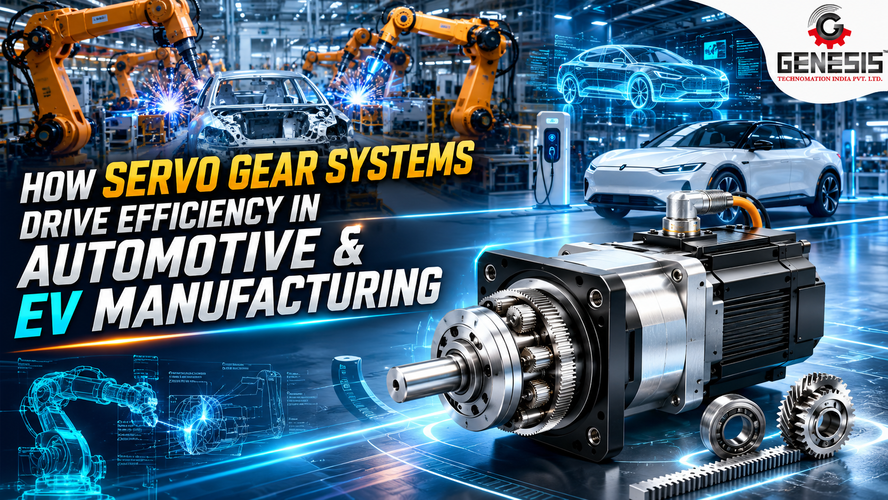
The automotive industry is undergoing one of the biggest transformations in its history. Traditional vehicle manufacturing is rapidly evolving, while electric vehicle (EV) production is accelerating across global markets. In this highly competitive environment, manufacturers are constantly searching for technologies that improve precision, reduce downtime, enhance productivity, and lower operating costs. One technology that has become indispensable in modern manufacturing is the Gearbox for Servo Motor.
Servo gear systems play a critical role in automation-driven production facilities. From robotic welding and assembly operations to material handling and precision positioning, these systems provide the accuracy and reliability required for today’s demanding automotive and EV manufacturing processes. Without servo gear systems, achieving the level of consistency and efficiency expected in modern production plants would be significantly more challenging.
As automotive manufacturers strive to meet increasing production targets while maintaining strict quality standards, servo gear systems have emerged as a key component in advanced automation solutions. Their ability to combine high torque, precision motion control, and energy efficiency makes them an ideal choice for smart factories and Industry 4.0 environments.
Understanding Servo Gear Systems
A servo gear system consists of a servo motor integrated with a gearbox designed to optimize torque, speed, and positioning accuracy. The gearbox acts as a mechanical interface that enhances the performance of the servo motor by modifying output characteristics according to application requirements.
The primary functions of a servo gearbox include:
- Increasing torque output
- Improving positional accuracy
- Reducing motor load
- Enhancing motion control
- Optimizing system efficiency
- Extending equipment lifespan
Servo gear systems are commonly used in manufacturing environments where precise movement, repeatability, and reliability are essential.
Why Automotive Manufacturing Depends on Precision
Modern vehicle manufacturing involves thousands of individual components assembled with exceptional accuracy. Even minor deviations can lead to quality issues, safety concerns, and increased production costs.
Automotive manufacturers rely heavily on:
- Industrial robots
- Automated guided vehicles (AGVs)
- Conveyor systems
- Assembly lines
- CNC machines
- Material handling equipment
- Inspection systems
All these systems require precise motion control, which is where servo gear systems deliver exceptional value.
A well-designed servo gearbox ensures that every movement is accurate, repeatable, and synchronized with the overall production process.
The Rise of Electric Vehicle Manufacturing
Electric vehicles have introduced new manufacturing complexities compared to traditional internal combustion engine vehicles.
EV production requires specialized processes such as:
- Battery module assembly
- Battery pack manufacturing
- Cell handling
- Precision welding
- Electronic component assembly
- Motor manufacturing
- Thermal management system assembly
These applications demand extremely high positioning accuracy and controlled motion.
Servo gear systems help manufacturers maintain consistency while handling delicate components that require precise alignment and assembly.
As EV demand continues to increase worldwide, the importance of advanced servo-driven automation systems will only grow stronger.
Key Components of Servo Gear Systems
Understanding the major elements of a servo gear system helps explain why these solutions are so effective in manufacturing environments.
Servo Motor
The servo motor serves as the primary source of motion and delivers controlled rotational movement.
Key benefits include:
- High precision
- Rapid response
- Excellent speed control
- Closed-loop feedback
Gearbox
The gearbox modifies motor output to achieve desired performance characteristics.
Functions include:
- Torque multiplication
- Speed reduction
- Motion optimization
- Increased load handling capability
Encoder
Encoders provide feedback data that enables precise position control.
Benefits include:
- Real-time monitoring
- Enhanced accuracy
- Improved repeatability
Drive Controller
The controller processes commands and adjusts motor performance based on feedback.
This ensures smooth and reliable operation throughout the manufacturing process.
How Servo Gear Systems Improve Automotive Manufacturing Efficiency
Efficiency remains one of the most important metrics in automotive production. Manufacturers constantly seek ways to produce more vehicles while reducing operational expenses.
Servo gear systems contribute significantly to achieving these objectives.
1. Enhanced Precision
Automotive assembly requires micron-level accuracy in many operations.
Servo gear systems deliver:
- Precise positioning
- Accurate angular movement
- Consistent repeatability
This minimizes assembly errors and reduces rework requirements.
2. Increased Productivity
Servo-driven automation systems operate faster than traditional mechanical systems.
Benefits include:
- Shorter cycle times
- Higher throughput
- Reduced bottlenecks
Manufacturers can increase production output without sacrificing quality.
3. Reduced Downtime
High-quality servo gearboxes are designed for long-term reliability.
Advantages include:
- Lower maintenance requirements
- Reduced wear and tear
- Longer service intervals
This helps maximize equipment availability and operational efficiency.
4. Better Energy Efficiency
Energy consumption is a major concern in modern manufacturing facilities.
Servo gear systems improve efficiency by:
- Optimizing motor performance
- Reducing unnecessary power usage
- Delivering precise motion control
Lower energy consumption translates directly into cost savings.
Applications of Servo Gear Systems in Automotive Manufacturing
Servo gear systems are integrated into numerous production stages throughout automotive facilities.
Robotic Welding
Welding robots require precise positioning to create strong and consistent welds.
Servo gear systems provide:
- Controlled motion
- High repeatability
- Stable operation
This results in improved weld quality and reduced defects.
Automated Assembly Lines
Automated assembly processes depend on accurate movement and synchronization.
Servo gear systems help achieve:
- Component alignment
- Fast positioning
- Smooth operation
Manufacturers benefit from increased productivity and consistent assembly quality.
Conveyor Systems
Conveyors transport components throughout production facilities.
Servo-driven conveyors offer:
- Variable speed control
- Accurate positioning
- Improved material flow
This supports lean manufacturing initiatives and optimized production scheduling.
Paint Shop Automation
Automated painting systems rely on controlled robotic movement.
Servo gear systems ensure:
- Uniform coating application
- Consistent spray patterns
- Reduced paint waste
The result is superior finish quality and lower operating costs.
Quality Inspection Systems
Automated inspection equipment requires precise positioning for accurate measurements.
Servo gear systems enable:
- High-speed scanning
- Precise camera alignment
- Reliable inspection processes
This helps maintain strict automotive quality standards.
Role of Servo Gear Systems in EV Battery Manufacturing
Battery production is among the most critical aspects of EV manufacturing.
Battery cells are highly sensitive and require careful handling throughout the manufacturing process.
Cell Assembly
Servo gear systems support:
- Precision placement
- Controlled movement
- Accurate alignment
These capabilities help reduce production defects.
Laser Welding
Battery manufacturing often involves laser welding operations.
Servo gear systems provide:
- Stable positioning
- Consistent motion control
- Improved weld quality
Battery Module Assembly
Complex battery modules require accurate assembly of multiple components.
Servo gear systems ensure:
- Precise component fitment
- Reliable assembly operations
- Reduced manufacturing errors
Testing and Inspection
Battery testing equipment relies on servo-driven positioning systems.
Benefits include:
- Improved measurement accuracy
- Consistent testing procedures
- Enhanced product reliability
Why Planetary Gearboxes Are Preferred
Among various gearbox technologies, planetary gearboxes are widely regarded as the preferred solution for servo motor applications.
Their popularity stems from several advantages.
High Torque Density
Planetary gearboxes deliver substantial torque output within compact dimensions.
Excellent Accuracy
Low backlash design improves positioning precision.
Compact Construction
Space-saving designs support modern automation systems.
High Efficiency
Efficient power transmission minimizes energy losses.
Long Service Life
Durable construction ensures reliable performance under demanding operating conditions.
Choosing the Right Gearbox for Servo Motor
Selecting the appropriate gearbox can significantly impact manufacturing performance.
Key considerations include:
Torque Requirements
The gearbox must support expected load conditions.
Speed Ratio
The gear ratio should align with application requirements.
Backlash
Lower backlash improves positioning accuracy.
Environmental Conditions
Operating temperature, humidity, and contamination levels should be considered.
Duty Cycle
Applications with continuous operation require highly durable gearboxes.
Genesis Technomation India Pvt Ltd – A Trusted Source for Servo Gearboxes
When selecting a reliable supplier for industrial automation components, product quality and technical support are equally important.
For businesses seeking a high-performance Gearbox for Servo Motor, Genesis Technomation India Pvt Ltd stands out as one of the most trusted suppliers in India. Their extensive range of planetary gearboxes is engineered to deliver exceptional precision, efficiency, and durability for demanding industrial applications.
Manufacturers across automotive, EV, robotics, packaging, and automation industries rely on Genesis Technomation India Pvt Ltd because of:
- Premium-quality planetary gearboxes
- High precision engineering
- Excellent torque capabilities
- Low backlash performance
- Competitive pricing
- Strong technical expertise
- Reliable after-sales support
Whether your application involves robotic assembly, EV battery production, CNC machinery, or automated material handling systems, Genesis Technomation India Pvt Ltd offers solutions designed to maximize operational efficiency and productivity.
Industry 4.0 and Smart Manufacturing
The future of automotive manufacturing is increasingly connected and data-driven.
Industry 4.0 technologies include:
- IoT integration
- Predictive maintenance
- Real-time monitoring
- Digital twins
- AI-powered analytics
Servo gear systems play a critical role in supporting these initiatives.
Modern servo systems generate valuable operational data that enables manufacturers to:
- Monitor performance
- Detect abnormalities
- Predict failures
- Optimize production processes
This contributes to smarter and more efficient manufacturing environments.
Reducing Manufacturing Costs Through Servo Gear Systems
Cost reduction remains a primary objective for manufacturers.
Servo gear systems help lower costs through:
Reduced Scrap Rates
Improved precision decreases production defects.
Lower Maintenance Expenses
Reliable components reduce service requirements.
Energy Savings
Efficient power transmission lowers electricity consumption.
Increased Equipment Lifespan
Reduced mechanical stress extends operational life.
Higher Production Output
Faster cycle times improve overall productivity.
Combined, these benefits provide a strong return on investment.
Challenges Solved by Servo Gear Systems
Manufacturers face numerous operational challenges.
Servo gear systems help address:
Positioning Errors
High precision minimizes alignment issues.
Inconsistent Product Quality
Repeatable motion ensures uniform production.
Excessive Downtime
Durable gearboxes improve reliability.
Limited Production Capacity
Faster operations increase throughput.
Rising Energy Costs
Efficient systems reduce power consumption.
These improvements support both profitability and operational excellence.
Future Trends in Automotive and EV Manufacturing
The automotive sector continues to evolve rapidly.
Several trends are expected to increase demand for servo gear systems:
Greater Automation
Manufacturers will deploy more robots and automated equipment.
Increased EV Production
Growing EV demand requires advanced manufacturing technologies.
Higher Precision Requirements
Complex vehicle systems require tighter tolerances.
Sustainable Manufacturing
Energy-efficient automation will become increasingly important.
Smart Factories
Connected manufacturing environments will rely heavily on servo-driven systems.
These developments position servo gear systems as a foundational technology for future production facilities.
Best Practices for Maximizing Servo Gearbox Performance
Manufacturers can optimize performance by following several best practices.
Proper Sizing
Choose gearboxes that match application requirements.
Regular Inspection
Monitor for wear, vibration, and alignment issues.
Correct Installation
Follow manufacturer guidelines during setup.
Preventive Maintenance
Perform scheduled servicing to maximize lifespan.
Quality Components
Invest in trusted brands and suppliers.
These measures help ensure consistent performance and long-term reliability.
Environmental Benefits of Servo Gear Systems
Sustainability has become a major priority for automotive manufacturers.
Servo gear systems contribute by:
- Reducing energy consumption
- Minimizing material waste
- Supporting efficient production
- Extending equipment life
- Lowering carbon emissions
As environmental regulations become more stringent, these benefits will become increasingly valuable.
Conclusion
Servo gear systems have become an essential component of modern automotive and EV manufacturing. Their ability to provide precision, efficiency, reliability, and energy savings makes them indispensable in highly automated production environments.
From robotic welding and assembly lines to EV battery manufacturing and quality inspection systems, servo gear systems enable manufacturers to achieve exceptional levels of performance and consistency. As Industry 4.0 technologies continue to reshape manufacturing, the role of servo gear systems will become even more significant.
For organizations seeking a dependable Gearbox for Servo Motor, investing in high-quality planetary gearboxes is critical for maximizing productivity and long-term operational success. Companies looking for reliable solutions can confidently consider Genesis Technomation India Pvt Ltd, which offers precision-engineered planetary gearboxes designed to meet the evolving needs of automotive, EV, and industrial automation applications.
In an industry where every second, every movement, and every component matters, servo gear systems remain one of the most powerful technologies driving efficiency, innovation, and competitiveness in automotive and electric vehicle manufacturing.
Frequently Asked Questions (FAQs)
What is a servo gear system?
A servo gear system combines a servo motor with a precision gearbox to improve torque, speed control, and positioning accuracy. These systems are widely used in automotive, EV manufacturing, robotics, CNC machinery, and automated production lines.
Why are servo gear systems important in automotive manufacturing?
Servo gear systems provide precise motion control, high repeatability, and efficient power transmission. They help automotive manufacturers improve productivity, reduce errors, and maintain consistent product quality across production lines.
How do servo gear systems improve efficiency in EV manufacturing?
EV manufacturing requires highly accurate assembly of batteries, motors, and electronic components. Servo gear systems ensure precise positioning, smooth motion control, and reliable automation, resulting in faster production and fewer defects.
What is the role of a Gearbox for Servo Motor in industrial automation?
A Gearbox for Servo Motor increases torque output, reduces speed when required, improves positioning accuracy, and enables servo motors to handle heavier loads efficiently in automated systems.
Which type of gearbox is best for servo motors?
Planetary gearboxes are generally considered the best option for servo motors because they offer high torque density, low backlash, compact design, excellent efficiency, and long service life.
Where are servo gear systems commonly used in automotive plants?
Servo gear systems are commonly used in robotic welding, assembly lines, conveyor systems, automated material handling, painting robots, battery assembly equipment, and quality inspection systems.
What are the benefits of using planetary gearboxes with servo motors?
Planetary gearboxes provide several advantages, including:
- High torque output
- Compact size
- Low backlash
- Superior positioning accuracy
- High efficiency
- Long operational lifespan
How do servo gear systems contribute to Industry 4.0?
Modern servo systems can integrate with smart manufacturing platforms, providing real-time performance data, predictive maintenance insights, and enhanced production monitoring for Industry 4.0 environments.
How can manufacturers choose the right Gearbox for Servo Motor?
Manufacturers should evaluate factors such as torque requirements, gear ratio, backlash, load conditions, operating environment, duty cycle, and application-specific performance requirements before selecting a gearbox.
What industries benefit from servo gear systems besides automotive manufacturing?
Servo gear systems are widely used in robotics, packaging, food processing, pharmaceutical manufacturing, semiconductor production, material handling, aerospace, printing, and CNC machining industries.
How do servo gear systems help reduce manufacturing costs?
They reduce costs by improving production efficiency, lowering maintenance requirements, minimizing scrap rates, reducing energy consumption, and increasing equipment lifespan.
Where can I buy a high-quality Gearbox for Servo Motor in India?
Genesis Technomation India Pvt Ltd offers a wide range of precision-engineered planetary gearboxes suitable for automotive manufacturing, EV production, robotics, CNC machines, and industrial automation applications.
Related Posts