
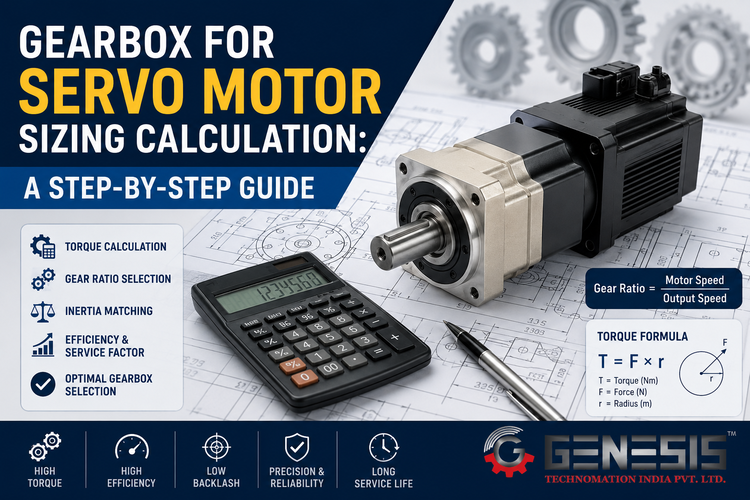
Selecting the right gearbox for a servo motor is one of the most critical decisions in industrial automation, robotics, packaging machinery, CNC systems, material handling equipment, and precision manufacturing applications. A properly sized gearbox improves torque output, enhances positioning accuracy, reduces motor load, and increases the overall lifespan of the motion control system.
However, many engineers and machine designers struggle with gearbox sizing calculations because several factors must be considered simultaneously, including load inertia, torque requirements, acceleration time, gear ratio, efficiency, and application dynamics.
This comprehensive guide explains the complete gearbox for servo motor sizing calculation process in a simple, step-by-step manner. Whether you are designing a new automation system or upgrading an existing machine, understanding gearbox sizing principles will help you achieve optimal performance while avoiding costly design mistakes.
What Is a Servo Motor Gearbox?
A servo motor gearbox is a mechanical transmission device installed between a servo motor and the driven load. Its primary purpose is to increase torque while reducing output speed.
Servo motors typically operate at high speeds and relatively lower torque. Many industrial applications require lower speed but significantly higher torque. A gearbox bridges this gap efficiently.
Benefits of using a servo gearbox include:
- Increased torque output
- Improved load matching
- Enhanced positioning accuracy
- Reduced motor size requirements
- Lower energy consumption
- Improved system efficiency
- Better dynamic response
Among the various gearbox technologies available today, planetary gearboxes are widely preferred due to their high precision, compact design, and excellent torque density.
Why Gearbox Sizing Matters
Choosing an undersized gearbox can lead to:
- Premature gearbox failure
- Excessive heat generation
- Reduced positioning accuracy
- Servo motor overload
- Increased maintenance costs
On the other hand, selecting an oversized gearbox may result in:
- Higher investment cost
- Reduced dynamic performance
- Increased system inertia
- Unnecessary energy consumption
Proper gearbox sizing ensures the ideal balance between performance, reliability, and cost.
Key Parameters Required for Gearbox Sizing
Before beginning calculations, gather the following information:
1. Load Torque
The torque required to move or rotate the load.
Measured in:
- Nm (Newton Meters)
- lb-ft
- kg-cm
2. Load Inertia
Represents the resistance of the load to acceleration or deceleration.
Measured in:
- kg·m²
3. Required Output Speed
Determine the final speed needed at the machine output shaft.
Measured in:
- RPM
4. Servo Motor Speed
The rated speed of the selected servo motor.
Typical values:
- 2000 RPM
- 3000 RPM
- 5000 RPM
5. Acceleration Time
Time required to reach operating speed.
Measured in:
- Seconds
6. Duty Cycle
How frequently the machine starts, stops, and changes direction.
This significantly affects gearbox selection.
Understanding Gear Ratio
The gear ratio is the relationship between motor speed and output speed.
The formula is:
Gear\ Ratio=\frac{Motor\ Speed}{Output\ Speed}
Example
Motor Speed = 3000 RPM
Required Output Speed = 300 RPM
Gear Ratio:
3000 ÷ 300 = 10
Therefore, a 10:1 gearbox is required.
This means the gearbox reduces speed by 10 times while increasing torque approximately 10 times (minus efficiency losses).
Step 1: Calculate Required Output Torque
The first step is determining the torque required at the machine shaft.
The basic formula is:
T=F\times r
Where:
- T = Torque (Nm)
- F = Force (N)
- r = Radius (m)
Example
Force Required = 500 N
Pulley Radius = 0.1 m
Torque:
T = 500 × 0.1
Output Torque = 50 Nm
This means the gearbox output must provide at least 50 Nm.
Step 2: Determine Application Service Factor
Industrial applications rarely operate under ideal conditions.
Shock loads, frequent starts, rapid acceleration, and reversing motions create additional stress.
Common service factors include:
| Application Type | Service Factor |
| Smooth Operation | 1.0 – 1.2 |
| Moderate Shock | 1.3 – 1.5 |
| Heavy Shock | 1.6 – 2.0 |
| Extreme Duty | 2.0+ |
Example
Required Torque = 50 Nm
Service Factor = 1.5
Adjusted Torque:
50 × 1.5 = 75 Nm
The gearbox should safely handle at least 75 Nm continuously.
Step 3: Calculate Required Gear Ratio
Use the speed reduction formula.
Example
Servo Motor Speed = 3000 RPM
Machine Speed Requirement = 150 RPM
Gear Ratio:
3000 ÷ 150 = 20
Required gearbox ratio = 20:1
A 20:1 planetary gearbox would be suitable.
Step 4: Verify Motor Torque Requirement
Once the gear ratio is known, determine how much torque the servo motor must provide.
The formula becomes:
Motor\ Torque=\frac{Output\ Torque}{Gear\ Ratio\times Efficiency}
Example
Output Torque = 75 Nm
Gear Ratio = 20
Efficiency = 95% (0.95)
Motor Torque:
75 ÷ (20 × 0.95)
= 3.95 Nm
Therefore, the servo motor must provide approximately 4 Nm.
Step 5: Calculate Reflected Load Inertia
One of the most important aspects of servo sizing is inertia matching.
Gearboxes reduce the inertia seen by the servo motor.
The formula is:
J_{reflected}=\frac{J_{load}}{Ratio^2}
Example
Load Inertia = 0.08 kg·m²
Gear Ratio = 10
Reflected Inertia:
0.08 ÷ (10²)
= 0.0008 kg·m²
This significantly improves servo responsiveness.
Step 6: Check Inertia Matching Ratio
The inertia ratio is:
Inertia\ Ratio=\frac{Load\ Inertia}{Motor\ Inertia}
General guidelines:
| Application | Recommended Ratio |
| High Precision | 3:1 |
| General Motion | 5:1 |
| Standard Automation | 10:1 |
| Acceptable Maximum | 20:1 |
A properly sized gearbox helps bring the inertia ratio within recommended limits.
Step 7: Calculate Acceleration Torque
Machines often require higher torque during acceleration.
Acceleration torque can be estimated using:
T=J\alpha
Where:
- T = Torque
- J = Inertia
- α = Angular Acceleration
This torque must be added to load torque for accurate sizing.
Ignoring acceleration torque is one of the most common gearbox sizing mistakes.
Step 8: Verify Peak Torque Capability
Every gearbox has:
- Rated torque
- Peak torque
- Emergency torque
Ensure peak operating torque remains below gearbox peak capacity.
A safe rule is:
Peak Application Torque ≤ 80% of Gearbox Peak Rating
This provides adequate safety margin.
Step 9: Evaluate Duty Cycle
Applications involving:
- Rapid indexing
- Frequent reversing
- Continuous operation
- High-speed acceleration
require additional attention.
Consider:
- Thermal capacity
- Lubrication requirements
- Gear wear
- Backlash performance
A gearbox that appears adequate on paper may fail under severe duty cycles.
Example of Complete Gearbox Sizing Calculation
Let’s walk through a real-world example.
Application
Automated Packaging Machine
Given Data
- Required Output Speed = 200 RPM
- Servo Speed = 3000 RPM
- Output Torque = 40 Nm
- Service Factor = 1.5
- Gearbox Efficiency = 95%
Step 1: Adjust Torque
40 × 1.5
= 60 Nm
Step 2: Gear Ratio
3000 ÷ 200
= 15
Required Gear Ratio = 15:1
Step 3: Motor Torque
60 ÷ (15 × 0.95)
= 4.21 Nm
Results
Selected Gearbox:
- Ratio: 15:1
- Rated Torque: Minimum 60 Nm
- Efficiency: 95%
- Backlash: Low backlash planetary type
Selected Servo Motor:
- Continuous Torque: Above 4.21 Nm
This combination ensures smooth operation and long-term reliability.
Common Gearbox Types for Servo Motors
Planetary Gearboxes
Most popular option for servo applications.
Advantages:
- High torque density
- Excellent efficiency
- Low backlash
- Compact design
- High rigidity
Ideal for:
- CNC machines
- Robotics
- Packaging systems
- Pick-and-place equipment
Helical Gearboxes
Suitable for:
- Conveyor systems
- Material handling equipment
- Heavy industrial machinery
Advantages:
- Smooth operation
- Quiet performance
- High load capacity
Harmonic Gearboxes
Used in:
- Robotics
- Semiconductor manufacturing
- Medical devices
Advantages:
- Near-zero backlash
- Exceptional precision
How Backlash Affects Servo Performance
Backlash refers to the small amount of free movement between gear teeth.
High backlash can cause:
- Positioning errors
- Reduced repeatability
- Poor motion control
Typical values:
| Gearbox Type | Backlash |
| Standard Planetary | 8–15 arcmin |
| Precision Planetary | 3–8 arcmin |
| Harmonic Drive | Less than 1 arcmin |
Precision automation applications generally require low-backlash planetary gearboxes.
Why Planetary Gearboxes Are Preferred
Planetary gearboxes offer several unique advantages:
High Efficiency
Typically:
- 94% to 98%
Compact Construction
More torque in less space.
Superior Load Distribution
Multiple planet gears share the load.
Better Accuracy
Low backlash ensures precise positioning.
Long Service Life
Reduced gear wear improves durability.
For these reasons, planetary gearboxes have become the industry standard for servo-driven systems.
Best Place to Buy Gearbox for Servo Motor
When selecting a gearbox, quality is just as important as proper sizing. Precision machining, low backlash, high torque capacity, and long-term reliability should all be considered.
For industrial automation, robotics, packaging machinery, CNC applications, and motion control systems, Genesis Technomation India Pvt Ltd is one of the most trusted suppliers of planetary gearboxes in India. Their extensive range of precision planetary gearboxes is designed specifically for servo motor applications and delivers excellent efficiency, accuracy, and durability.
Engineers looking for reliable gearbox solutions can explore their planetary gearbox range at:
https://genesisindsol.in/product-category/planetary-gearbox
Their products are suitable for various industries requiring precise motion control and high-performance power transmission.
Common Gearbox Sizing Mistakes
Avoid these frequent errors:
Ignoring Service Factor
Real-world operating conditions are rarely ideal.
Focusing Only on Torque
Speed, inertia, and duty cycle matter equally.
Choosing Excessive Gear Ratios
Very high ratios may reduce system responsiveness.
Ignoring Backlash Requirements
Precision applications demand low-backlash gearboxes.
Underestimating Peak Loads
Acceleration torque can exceed continuous torque requirements.
Final Thoughts
Proper gearbox for servo motor sizing calculation is essential for achieving maximum performance, efficiency, and reliability in automated systems. By systematically evaluating torque requirements, gear ratio, inertia matching, acceleration demands, and service factors, engineers can confidently select the ideal gearbox for their application.
The process may seem complex initially, but following a structured approach greatly simplifies the task. A correctly sized gearbox not only protects the servo motor but also improves positioning accuracy, energy efficiency, and equipment lifespan.
For applications requiring high precision, low backlash, and superior torque transmission, planetary gearboxes remain the preferred choice across industries. And when sourcing dependable gearbox solutions, Genesis Technomation India Pvt Ltd offers a wide selection of high-quality planetary gearboxes designed specifically for servo motor applications, helping engineers build reliable and efficient motion control systems.
FAQs about Gearbox for Servo Motor Sizing Calculation
What is a gearbox for a servo motor?
A gearbox for a servo motor is a mechanical device that increases torque while reducing output speed. It helps improve motion control, positioning accuracy, and overall system efficiency in automation applications.
Why is gearbox sizing important for servo motors?
Proper gearbox sizing ensures that the servo motor can deliver the required torque and speed without overloading. Correct sizing improves performance, extends equipment life, and reduces maintenance costs.
How do I calculate the required gear ratio for a servo motor?
The gear ratio is calculated by dividing the servo motor speed by the required output speed.
Formula:
Gear Ratio = Motor Speed ÷ Output Speed
For example, if the motor speed is 3000 RPM and the desired output speed is 300 RPM, the required gear ratio is 10:1.
What factors should be considered when sizing a gearbox?
Important factors include:
- Required output torque
- Load inertia
- Output speed
- Motor speed
- Acceleration time
- Duty cycle
- Service factor
- Gearbox efficiency
- Backlash requirements
What is the best gearbox type for servo motors?
Planetary gearboxes are generally considered the best option for servo motors due to their high efficiency, compact design, low backlash, high torque density, and excellent positioning accuracy.
What is backlash in a servo gearbox?
Backlash is the small amount of free movement between gear teeth before engagement occurs. Lower backlash provides higher precision and repeatability, making it important for CNC machines, robotics, and automated systems.
How does a gearbox improve servo motor performance?
A gearbox improves servo motor performance by:
- Increasing output torque
- Reducing motor load
- Improving inertia matching
- Enhancing positioning accuracy
- Allowing the use of smaller servo motors
- Increasing system efficiency
What is reflected inertia in servo motor applications?
Reflected inertia is the load inertia as seen by the servo motor through the gearbox. A higher gear ratio reduces reflected inertia, helping the motor accelerate and decelerate more efficiently.
What happens if a gearbox is undersized?
An undersized gearbox can lead to:
- Excessive heat generation
- Gear wear
- Reduced service life
- Poor machine performance
- Unexpected failures
- Increased maintenance costs
What happens if a gearbox is oversized?
An oversized gearbox may increase system cost, reduce responsiveness, add unnecessary weight, and negatively impact dynamic performance.
What efficiency can be expected from a planetary gearbox?
Most precision planetary gearboxes offer efficiency between 94% and 98%, making them one of the most efficient gearbox types available for servo motor applications.
Which industries commonly use servo motor gearboxes?
Servo motor gearboxes are widely used in:
- Packaging machinery
- Robotics
- CNC machines
- Printing equipment
- Medical devices
- Material handling systems
- Food processing equipment
- Semiconductor manufacturing
How do I select the correct torque rating for a gearbox?
The gearbox torque rating should exceed the application’s continuous torque requirement after applying the appropriate service factor. Peak torque conditions should also be considered during sizing.
What gear ratio is commonly used with servo motors?
Common servo gearbox ratios include:
- 3:1
- 5:1
- 10:1
- 15:1
- 20:1
- 30:1
- 50:1
- 100:1
The ideal ratio depends on the required output speed and torque.
Where can I buy a high-quality gearbox for a servo motor in India?
For reliable and precision-engineered planetary gearboxes for servo motor applications, Genesis Technomation India Pvt Ltd offers a wide range of solutions suitable for automation, robotics, CNC machinery, and industrial motion control systems. Their planetary gearboxes are designed for high efficiency, low backlash, and long service life.
Related Posts