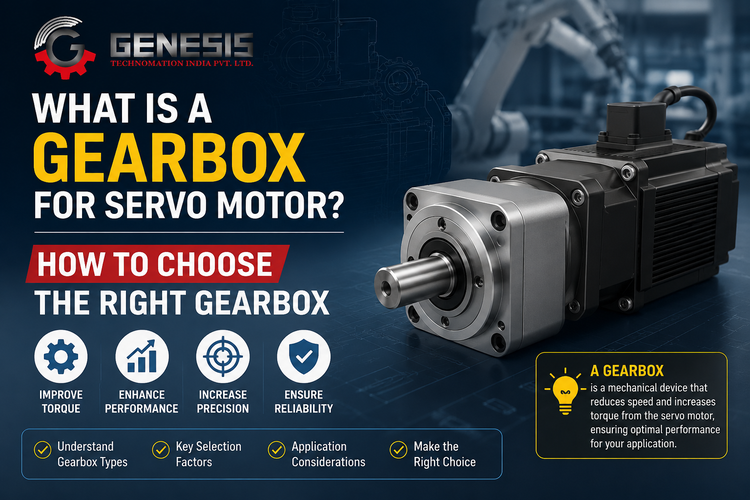
In industrial automation, performance is rarely about a single component. It’s about how well different elements work together. A servo motor is known for its precision and responsiveness, but in many applications, it cannot deliver the required torque or control on its own. This is where a gearbox becomes essential.
A gearbox for a servo motor is not just an add-on. It plays a critical role in shaping how the motor behaves under load, how smoothly it moves, and how efficiently it operates over time.
What is a Gearbox for a Servo Motor?
A Gearbox for servo motor is not merely a speed reducer; it’s a mechanical tuning tool that aligns motor performance with application demand.
At a deeper engineering level, a gearbox does three critical things:
- Matches inertia between load and motor
- Optimizes torque delivery across duty cycles
- Enhances positional resolution of the system
While most definitions focus on “reducing speed and increasing torque,” that’s only half the story. In motion control systems, a gearbox is used to fine-tune performance characteristics such as acceleration, stability, and repeatability.
Why Servo Motors Alone Are Not Enough
Servo motors are designed for:
- High-speed rotation
- Rapid acceleration and deceleration
- Closed-loop positional accuracy
However, real-world industrial loads behave differently. They introduce:
- High inertia
- Sudden load variations
- Shock forces
Without a gearbox:
- The motor operates inefficiently
- Torque demand exceeds capacity
- Accuracy degrades under load
This is why engineers rarely rely on servo motors alone in applications like robotics, CNC, or packaging lines.
The Hidden Role of Gearboxes: Inertia Matching
One of the most overlooked—but crucial—concepts is inertia matching.
When load inertia is significantly higher than motor inertia:
- The system becomes unstable
- Overshoot and vibration increase
- Servo tuning becomes difficult
A gearbox reduces the reflected inertia seen by the motor, creating a balanced system that:
- Responds faster
- Operates smoother
- Requires less tuning effort
This is a major reason why gearboxes are used even when torque is sufficient.
Types of Servo Gearboxes (Reframed for Practical Selection)
Instead of listing types generically, let’s look at them from a decision-making perspective.
1. Planetary Gearbox – For Precision + Compact Power
- Multi-gear load sharing
- High torsional rigidity
- Low backlash
Use when: You need tight accuracy with limited space.
2. Harmonic Drive – For Ultra-Precision Systems
- Near-zero backlash
- Exceptional positioning accuracy
Use when: Robotics, semiconductor, or medical automation demands micron-level precision.
3. Helical Gearbox – For Continuous Heavy Loads
- Smooth power transmission
- High load endurance
Use when: Long-running industrial systems like conveyors.
4. Bevel Gearbox – For Direction Change
- Transfers motion at angles (usually 90°)
Use when: Space constraints require angular power transmission.
5. Worm Gearbox – For Holding Load Position
- Self-locking capability
- High reduction ratios
Use when: Lifting or vertical load applications.
Core Parameters That Actually Matter
Most articles list basic factors. Let’s go deeper into what truly impacts performance.
1. Peak vs Continuous Torque
Don’t just check rated torque.
- Peak torque → required during acceleration
- Continuous torque → required during steady operation
Ignoring peak torque leads to premature gearbox failure.
2. Gear Ratio Optimization (Not Just Selection)
Choosing a ratio is not about “more is better.”
- High ratio → more torque, less responsiveness
- Low ratio → higher speed, lower torque
The goal is to keep the servo motor operating in its optimal speed band, not just maximize torque.
3. Backlash vs System Accuracy
Backlash directly affects:
- Repeatability
- Positioning precision
Low backlash is critical in:
- CNC machining
- Robotics
- Pick-and-place systems
Even small backlash errors can amplify at the output.
4. Efficiency and Thermal Performance
Every gearbox introduces energy loss.
- High-efficiency gearboxes reduce heat buildup
- Lower heat = longer component life
Planetary systems typically offer better efficiency than worm gear systems.
5. Duty Cycle & Load Profile
A gearbox must match how the machine operates:
- Intermittent duty
- Continuous duty
- Shock loading
Servo gearboxes are specifically designed for dynamic and cyclic operations, unlike standard gearboxes.
Advanced Selection Strategy (Step-by-Step)
Here’s a practical workflow used in real engineering environments:
Step 1: Define Application Requirements
- Load mass
- Required speed
- Position accuracy
Step 2: Calculate Required Torque
Include:
- Acceleration torque
- Frictional losses
- Safety factor
Step 3: Select Gear Ratio Based on Motion Profile
Balance:
- Speed requirement
- Torque requirement
- Motor efficiency
Step 4: Evaluate Backlash Tolerance
- High precision → ultra-low backlash
- General automation → moderate backlash
Step 5: Check Mechanical Compatibility
- Shaft alignment
- Mounting type
- Flange compatibility
Step 6: Validate Environmental Suitability
- Temperature range
- Dust exposure
- Moisture conditions
Real-World Applications Where Gearbox Selection Matters
Servo gearboxes are not optional in high-performance industries—they are essential.
Robotics
- Accurate arm movement
- Smooth motion transitions
CNC Machinery
- Precision cutting
- Repeatable positioning
Packaging Automation
- High-speed synchronization
- Controlled motion
Material Handling
- Load movement with stability
These applications demand a combination of torque, precision, and reliability, which only a properly selected gearbox can provide.
Why Choose Genesis Technomation India Pvt Ltd for Gearbox?
When it comes to sourcing a servo motor gearbox, product quality is only half the equation. The other half is technical support and application understanding.
Genesis Technomation India Pvt Ltd offers:
- High-precision planetary gearboxes designed for servo applications
- Reliable performance under industrial conditions
- Expert guidance for correct selection
- Competitive pricing for Indian industries
Explore their gearbox range:
https://genesisindsol.in/product-category/planetary-gearbox/
If your goal is not just to buy a gearbox—but to optimize your machine performance, working with a specialized supplier makes a measurable difference.
Common Selection Mistakes (That Cost Time & Money)
Even experienced engineers make these errors:
- Selecting gearbox based only on torque rating
- Ignoring inertia mismatch
- Choosing incorrect gear ratio
- Overlooking backlash requirements
- Not accounting for dynamic loads
Each of these can lead to:
- Reduced efficiency
- Increased wear
- System instability
Final Thoughts
A gearbox for a servo motor is not just an accessory—it is a performance amplifier and control stabilizer.
When selected correctly, it:
- Enhances precision
- Improves efficiency
- Extends system life
- Reduces operational stress
But when selected poorly, it becomes a bottleneck.
So the real question is not “Do you need a gearbox?”
It’s “Are you selecting the right one for your system dynamics?”
FAQs
What is the main purpose of a servo gearbox?
To optimize torque, speed, and system stability while improving motion control.
Which gearbox is best for servo motors?
Planetary gearboxes are most widely used due to compact size, efficiency, and low backlash.
How do I choose the correct gear ratio?
Based on required output speed and torque while keeping the motor in its optimal operating range.
Why is backlash important?
It directly affects positioning accuracy and repeatability in precision applications.
Can I use a standard gearbox with a servo motor?
Not recommended. Servo gearboxes are designed for high-speed, dynamic applications with better precision and lower backlash.
Related Posts