Photoelectric Sensors in India play an important role in modern industrial automation, helping manufacturers detect objects, count products, monitor conveyor movement, control packaging operations, and improve production consistency. From automotive component manufacturing to pharmaceutical packaging, these sensors provide non-contact detection that supports automated machines and production lines.
Choosing the right sensor requires more than checking the product name or price. Engineers and procurement teams must consider sensing distance, target material, detection method, electrical output, installation space, environmental conditions, and compatibility with the machine’s control system. An unsuitable sensor can produce inconsistent signals, miss objects, or cause unnecessary production interruptions.
Genesis Technomation India Pvt. Ltd. offers a range of industrial automation products, including photoelectric sensor models from the QS18 and GTB6 series. Its photoelectric sensor product range provides a starting point for industrial buyers who want to evaluate available models for their applications. The listed range includes diffuse sensors, adjustable-field background suppression sensors, fixed-field sensors, and polarised retroreflective sensors. These technologies address different detection requirements, so buyers should match the selected model to their actual operating conditions.
This guide explains how photoelectric sensors work, what to consider when selecting a supplier, how the ten listed models differ, and which technical checks matter before placing an order. It also covers industrial applications, pricing factors, PLC integration, and practical purchasing considerations for Indian manufacturers, OEMs, machine builders, and system integrators.
What Are Photoelectric Sensors and Why Do Industries Need Them?
A photoelectric sensor is an electronic device that detects an object by transmitting light and analysing the light received by its sensing element. Depending on the sensing principle, the sensor may detect light reflected from the target, light returned by a reflector, or interruption of a beam between separate components.
Most industrial photoelectric sensors convert a change in received light into an electrical switching signal. A programmable logic controller (PLC), relay, counter, or other compatible control device can use that signal to initiate an action.
For example, a sensor mounted beside a conveyor can detect each passing carton. The PLC can count the cartons, trigger a labelling operation, or coordinate the next stage of the packaging process.
How photoelectric sensors work
The sensing process generally involves three stages:
- Light emission: An LED or another optical source generates a beam of light.
- Light detection: A receiver measures the light returning from the target, arriving from a reflector, or reaching it directly from a separate emitter.
- Signal switching: The sensor’s electronics evaluate the received light and change the output state according to the selected sensing principle and switching configuration.
The controller then uses this output to monitor or control the machine.
The exact detection behaviour depends on the sensor type. A diffuse sensor detects light reflected by the target, while a retroreflective sensor detects light returned by a reflector. A through-beam arrangement detects an interruption in the light path between an emitter and receiver.
Photoelectric sensors versus mechanical limit switches
Mechanical limit switches detect movement when an object physically operates a mechanical actuator. Photoelectric sensors detect objects through light, without requiring physical contact with the target.
This difference makes photoelectric technology useful when machines handle delicate products, operate at high speeds, or require frequent object detection. A non-contact sensor also avoids mechanical actuator wear caused by repeated target contact.
However, photoelectric sensors have their own limitations. Dust, contamination, surface reflectivity, alignment, ambient conditions, and incorrect installation can affect detection. Engineers should evaluate these factors before replacing a mechanical switch with an optical sensor.
Why industrial automation depends on reliable detection
Industrial machines often make decisions based on the presence, absence, or position of a product. A missing detection signal can disrupt a sequence, while an incorrect signal can trigger an unnecessary operation.
A correctly selected photoelectric sensor can support:
- Automated product counting.
- Package and component presence detection.
- Conveyor sequencing.
- Bottle and container detection.
- Label and carton positioning.
- Part feeding and machine interlocking.
- Production monitoring and quality checks.
The sensor does not independently guarantee higher output or fewer defects. Its contribution depends on suitable specifications, proper installation, correct PLC logic, and regular maintenance.
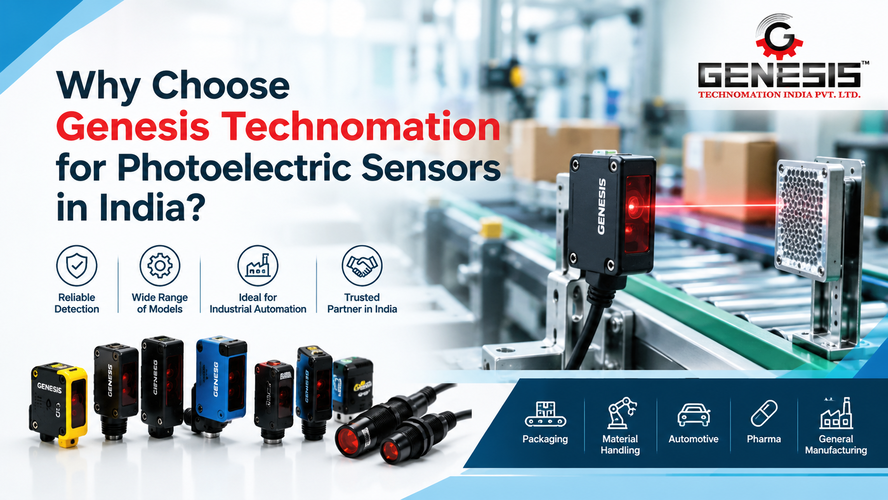
Why Choose Genesis Technomation for Photoelectric Sensors in India?
Selecting a photoelectric sensor supplier involves both product evaluation and application planning. Industrial buyers need a model that meets the machine’s technical requirements, along with sufficiently clear information to verify its compatibility.
Genesis Technomation is worth considering when evaluating photoelectric sensors for industrial automation because its published product range identifies multiple QS18 and GTB6 models. Buyers can use this range to investigate different sensing methods and electrical configurations before requesting a quotation.
Access to multiple photoelectric sensor models
Different production lines require different detection methods. A packaging machine may need to detect objects at a defined distance, while another application may require a sensor that distinguishes a foreground object from a nearby background.
The models listed in the Genesis Technomation range cover several of these requirements:
- QS18VP6D and QS18VN6D for diffuse sensing.
- QS18VP6AF350 and QS18VN6AF350 for adjustable-field background suppression.
- QS18VP6FF100 and QS18VN6FF100 for fixed-field background suppression.
- GTB6-P1212 and GTB6-N1212 for background suppression.
- QS18VP6LP and QS18VN6LP for polarised retroreflective sensing.
This variety gives buyers specific models to investigate rather than relying on one sensor type for every machine. However, the availability of each model, its current configuration, and its suitability should be confirmed with the supplier before ordering.
Selection based on the actual application
A useful supplier evaluation begins with the detection problem, not the product catalogue.
Consider a conveyor that transports cardboard cartons. A diffuse sensor may provide a suitable solution when the cartons return sufficient light and the sensing distance fits the installation. If the background or surrounding machine structure creates false detections, an engineer may instead investigate a background suppression sensor.
For a conveyor carrying reflective packages, the engineer may need to evaluate the target surface and the sensor’s response to it. A polarised retroreflective sensor may suit an arrangement using a compatible reflector, but the final choice depends on the object and installation geometry.
When considering Genesis Technomation, buyers should share these application details before requesting a recommendation. This approach makes it easier to assess whether the selected model meets the detection requirement.
Electrical compatibility with PLCs and control equipment
A sensor’s output type matters as much as its optical performance. The QS18 range includes PNP and NPN configurations, allowing buyers to investigate alternatives for different control-system input arrangements.
A PNP output generally sources current to the load, while an NPN output generally sinks current from the load. The correct option depends on the PLC input circuit, wiring arrangement, supply voltage, and input common configuration.
The model name provides an initial indication of the output type, but engineers should still verify the complete part number and current datasheet. A sensor that detects objects correctly may still fail to operate as expected if its output does not match the connected controller.
Product information that supports purchasing decisions
Technical information helps procurement teams compare products accurately. Before placing an order, buyers should check the sensing mode, operating range, supply voltage, output configuration, connection method, protection rating, and operating temperature.
Genesis Technomation publishes a product page listing the ten models covered in this guide. Buyers can use that page to identify candidate products and then compare their requirements with the manufacturer’s technical documentation.
A product listing should not replace a datasheet. If a particular parameter does not appear on the listing, ask for the latest manufacturer documentation rather than assuming that another model in the same series has identical specifications.
Support for model identification and enquiries
Industrial buyers sometimes have an existing part number but lack complete application information. In such cases, the most useful next step is to confirm the full model designation, existing wiring, target characteristics, mounting arrangement, and required detection distance.
You can contact Genesis Technomation through its official photoelectric sensor product page to enquire about the listed models, technical suitability, quotation, and current availability.
Before finalising a purchase, request confirmation of the exact model, quantity, commercial terms, and applicable product documentation. This reduces the risk of ordering a variant with a different output or sensing principle.
A practical approach for Indian industrial buyers
For OEMs, machine manufacturers, system integrators, and factory maintenance teams, the supplier decision should combine technical suitability with procurement clarity.
Genesis Technomation offers a defined range of photoelectric sensor models for evaluation. Buyers should assess the company’s response to their specific enquiry, the accuracy of the supplied technical information, and confirmation of the required model before deciding whether it meets their procurement needs.
No single supplier is automatically the best choice for every industrial application. The appropriate decision comes from comparing product requirements, verified specifications, commercial terms, and the level of support confirmed for the order.
Photoelectric Sensor Models Available from Genesis Technomation
The Genesis Technomation product range lists ten photoelectric sensor models from the QS18 and GTB6 series. Manufacturer documentation helps distinguish their sensing principles and electrical outputs. The specifications below reflect the identified manufacturer references; confirm the current datasheet and exact ordered variant before installation.
QS18VP6D Photoelectric Sensor
The QS18VP6D belongs to Banner Engineering’s QS18 series and uses diffuse sensing. The sensor emits light and detects the portion reflected by the target, so the installation does not require a separate reflector.
Banner documentation identifies a nominal maximum sensing range of 450 mm, a 10–30 V DC supply, a complementary PNP output, and a 2 m cable for this configuration. The manufacturer’s product information also identifies an infrared sensing beam and an IP67 protection rating.
Potential applications include carton detection, component presence monitoring, and conveyor counting, provided the target reflects enough light for reliable detection.
Engineers should test the actual target material and colour because diffuse sensing distance can vary with reflectivity. Confirm the required switching behaviour and PLC compatibility before ordering.
QS18VN6D Photoelectric Sensor
The QS18VN6D uses the same general diffuse sensing principle but has an NPN output configuration. Banner identifies a 450 mm range, a 10–30 V DC supply, a 2 m cable, and an infrared sensing beam for the listed model.
The principal distinction between the QS18VN6D and QS18VP6D is the output configuration: NPN versus PNP. Engineers should select the version that matches the receiving controller’s input circuit.
This model may suit applications that need non-contact object detection without a separate reflector. Before selecting it, evaluate the target’s reflectivity, required detection distance, response time, and ambient conditions.
QS18VP6AF350 Adjustable-Field Sensor
The QS18VP6AF350 uses adjustable-field background suppression. Rather than relying solely on the amount of reflected light, this sensing approach helps distinguish a foreground target from objects beyond the configured cutoff.
Banner specifies an adjustable cutoff range of 30–350 mm, a 10–30 V DC supply, a complementary PNP output, a visible red LED, and a 2 m cable. The published model information also identifies IP67 protection.
This technology can help where a machine needs to detect a component against a nearby background. Applications may include assembly stations, packaging equipment, and part-presence monitoring.
Engineers should evaluate the target’s size, surface finish, distance, and the background’s position. The adjustable cutoff range does not mean that every target will be detected reliably throughout that entire range.
QS18VN6AF350 Adjustable-Field Sensor
The QS18VN6AF350 provides adjustable-field background suppression with an NPN output. Banner lists a 30–350 mm adjustable cutoff range, a 10–30 V DC supply, a visible red sensing beam, and a 2 m cable. The published operating temperature range for this variant is −20°C to +55°C.
It offers an alternative for applications where the connected control system requires an NPN signal.
When evaluating this model, check the machine’s input circuit and confirm the necessary switching configuration. Also test whether the sensor reliably distinguishes the target from the background under normal production conditions.
QS18VP6FF100 Fixed-Field Sensor
The QS18VP6FF100 is a fixed-field sensor with background suppression. Banner specifies a 100 mm cutoff, a 10–30 V DC supply, a complementary PNP output, and a 2 m cable. The model uses a visible red LED and has an IP67 protection rating.
Fixed-field sensing is useful when the application requires detection within a defined sensing field and background objects could otherwise cause unwanted switching.
Potential applications include short-range component detection, package positioning, and presence checks on automated assembly equipment. The 100 mm cutoff should guide the initial evaluation, but target characteristics and installation geometry still determine practical performance.
Unlike the adjustable-field AF350 models, this model does not offer the same adjustable cutoff range. Confirm that its fixed sensing field suits the actual target and background arrangement.
QS18VN6FF100 Fixed-Field Sensor
The QS18VN6FF100 is the NPN counterpart in the fixed-field 100 mm model family listed by Genesis Technomation. Banner’s product documentation identifies the QS18 fixed-field family as a background suppression design, with a 100 mm cutoff for the FF100 configuration.
This model is worth evaluating for short-range object detection where the controller requires an NPN output. Engineers should confirm the exact current part number and its datasheet before ordering, particularly because manufacturers may offer regional or connection-specific variants.
The most important checks include mounting space, the target’s position, output wiring, supply voltage, and whether the fixed detection field provides sufficient separation between the target and the background.
GTB6-P1212 Photoelectric Sensor
The GTB6-P1212 belongs to SICK’s G6 series and uses a photoelectric proximity principle with background suppression. Its manufacturer datasheet lists a sensing range of 35–140 mm and a maximum sensing range of 250 mm under the stated reference conditions. It uses a visible red PinPoint LED, with a 650 nm wavelength and a 6 mm light spot at 100 mm. The datasheet also identifies a mechanical adjustment spindle and a stainless steel mounting bracket.
The P1212 designation identifies the P variant in this product family. Buyers should verify the full electrical specification in the current datasheet, including the output configuration, supply voltage, connection, and wiring details.
The model may be suitable for evaluating short-range component detection where background suppression can help manage the position of nearby surfaces. The final application decision should depend on the target material, mounting arrangement, required sensing distance, and controller compatibility.
GTB6-N1212 Photoelectric Sensor
The GTB6-N1212 is another SICK G6 photoelectric proximity sensor listed by Genesis Technomation. SICK provides a dedicated manufacturer datasheet for this exact model, which buyers should consult before finalising its electrical and mechanical requirements.
The N variant should not be treated as identical to the P variant simply because both share the GTB6-N1212 family designation. Confirm the output type and all relevant electrical parameters from the current documentation.
When considering this model, evaluate its background suppression capability, sensing range, target surface, installation geometry, and integration requirements. A short application description and a wiring diagram can help the supplier establish whether this is the appropriate variant.
QS18VP6LP Polarised Retroreflective Sensor
The QS18VP6LP uses polarised retroreflective sensing. The sensor emits light towards a compatible reflector and receives the returned light. An object passing between the sensor and reflector interrupts the optical path, allowing the sensor to detect the object.
Banner specifies a 3.5 m range, a 10–30 V DC supply, a complementary PNP output, a 2 m cable, and a visible red sensing beam at 630 nm. The listed model also has IP67 protection.
This sensing method can suit longer-distance detection of cartons, packages, and other objects moving along a conveyor. Polarisation helps the sensor distinguish the intended reflector return from certain reflections off shiny objects.
However, performance still depends on reflector selection, alignment, target geometry, and environmental conditions. Buyers should confirm reflector compatibility and the required mounting arrangement.
QS18VN6LP Polarised Retroreflective Sensor
The QS18VN6LP offers polarised retroreflective sensing with an NPN output. Banner’s QS18 documentation identifies the LP configuration as a polarised retroreflective model with a nominal range of 3.5 m and an NPN output for the VN variant.
This model may suit conveyor and packaging applications where the machine requires an NPN switching signal and a reflector-based detection arrangement.
Before purchasing, confirm the full part number, operating voltage, connection, reflector requirements, and controller input compatibility. Do not assume that the PNP and NPN versions share every electrical characteristic merely because their sensing principle and nominal range are similar.
Model comparison at a glance
| Model | Sensing method | Output or variant distinction | Published range or cutoff |
| QS18VP6D | Diffuse | PNP | 450 mm |
| QS18VN6D | Diffuse | NPN | 450 mm |
| QS18VP6AF350 | Adjustable-field background suppression | PNP | 30–350 mm cutoff |
| QS18VN6AF350 | Adjustable-field background suppression | NPN | 30–350 mm cutoff |
| QS18VP6FF100 | Fixed-field background suppression | PNP | 100 mm cutoff |
| QS18VN6FF100 | Fixed-field background suppression | NPN | 100 mm cutoff |
| GTB6-P1212 | Proximity with background suppression | P variant; verify electrical details | 35–140 mm operating range; up to 250 mm maximum |
| GTB6-N1212 | Proximity with background suppression | N variant; verify electrical details | Confirm current datasheet |
| QS18VP6LP | Polarised retroreflective | PNP | 3.5 m |
| QS18VN6LP | Polarised retroreflective | NPN | 3.5 m |
Specifications are based on identified manufacturer documentation and published product information. Confirm the exact ordering code and current datasheet before procurement. A model’s stated maximum range does not guarantee equivalent performance on every target.
How to Select the Right Photoelectric Sensor for Your Application
A reliable selection process begins with the object that the machine needs to detect. The sensor’s operating principle, range, electrical interface, and environmental rating should follow from the application rather than from the product name alone.
Evaluate the target material and surface
Target characteristics influence the amount and direction of reflected light. A white cardboard carton may return substantially more light than a dark rubber component. A polished metal surface may reflect light away from the receiver or create unwanted reflections, while transparent packaging may require a specialised detection approach.
Before choosing a sensor, record:
- Target material, size, colour, and surface finish.
- Whether the object is transparent, translucent, opaque, or highly reflective.
- The distance between the sensor and the target.
- The position and material of the background.
- Whether the target moves, rotates, or changes orientation.
If the target varies considerably, test representative samples under actual operating conditions.
Match the sensing distance to the installation
The required sensing distance should account for the target’s normal position, movement, mounting tolerance, and machine vibration.
Do not select a sensor solely because its maximum range exceeds the measured distance. Manufacturers often specify ranges under particular test conditions. A dark or angled object may perform differently from a standard reference target.
Leave enough adjustment flexibility for the installation where the selected sensor supports it. Also ensure that the sensor can fit within the available mounting space without interfering with moving parts.
Choose the correct output type
PNP and NPN outputs are not interchangeable in every control circuit.
Before ordering, verify the PLC’s input type, the common wiring arrangement, the operating voltage, and the sensor’s output specifications. Also check whether the machine requires normally open, normally closed, light-on, or dark-on behaviour.
A wiring mismatch can prevent a properly functioning sensor from communicating correctly with the controller.
Consider response time and production speed
A sensor must detect the target quickly enough for the machine’s operating cycle. If products move rapidly along a conveyor, the available detection window may be short.
Calculate how long the target remains within the sensing area and compare that interval with the sensor’s response time and the PLC’s input-processing requirements. Consider pulse duration and the controller’s scan or input-filter settings as well.
Assess the factory environment
Dust, oil, water, vibration, ambient light, and temperature can influence sensor performance or service life. A suitable enclosure rating helps protect the sensor against specified environmental conditions, but it does not make every model appropriate for every factory environment.
Review the operating temperature, protection rating, lens contamination risk, cable routing, and maintenance access. Where frequent cleaning occurs, check whether the selected model supports the cleaning method and chemical exposure involved.
Practical example: packaging conveyor versus component station
A packaging conveyor carrying cartons may require detection over a longer distance. Depending on the target and layout, a diffuse sensor or polarised retroreflective sensor could be a candidate. The engineer should check carton reflectivity, conveyor speed, reflector placement where applicable, and the controller input.
A short-range component station may instead need to detect a small part positioned close to a metal fixture. A fixed-field or adjustable-field background suppression sensor could be worth evaluating if the fixture might otherwise interfere with detection.
These examples illustrate why application requirements matter more than a generic claim that one sensor is suitable for all machines.
Types of Photoelectric Sensors and Their Applications
Understanding the sensing method helps buyers narrow down the available products before comparing individual models.
Through-beam sensing
Through-beam systems use a separate emitter and receiver. The emitter sends a beam across the detection area, and the receiver detects the light. When an object interrupts the beam, the sensor changes its output state.
This arrangement can provide dependable detection over relatively long distances when alignment and installation conditions are suitable. It may work well for conveyor counting, object passage monitoring, and detecting items that do not reflect much light towards a receiver.
The main considerations are the need to mount and align separate components, the installation space, and protection of the optical path.
Retroreflective sensing
A retroreflective sensor places the emitter and receiver in the same housing and uses a reflector to return the emitted light. An object interrupts the returned beam, triggering a detection signal.
This configuration can simplify wiring and mounting compared with a through-beam arrangement because the machine generally requires one sensor housing and one reflector.
However, reflector placement and alignment remain important. Highly reflective targets can also create unwanted returns, depending on the sensing technology.
Polarised retroreflective sensing
Polarised retroreflective sensors use optical polarisation to help distinguish the intended reflector return from certain reflections produced by shiny objects.
This makes the technology useful for some packaging, conveyor, and product-handling applications where reflective materials create detection challenges. The QS18VP6LP and QS18VN6LP models listed by Genesis Technomation are examples of this sensing category.
Polarisation does not eliminate every false-detection risk. Engineers should test the sensor with the actual target and compatible reflector.
Diffuse sensing
Diffuse sensors transmit light and detect the amount that the target reflects back. They do not need a separate reflector.
This approach can reduce installation complexity and suit general-purpose presence detection, counting, and machine monitoring. The QS18VP6D and QS18VN6D are examples of diffuse sensors.
The primary limitation is the influence of target reflectivity. Object colour, angle, surface finish, and distance can affect detection reliability, so testing is particularly important when the target varies.
Fixed-field sensing
Fixed-field sensors use a defined sensing field with background suppression. The QS18FF100 configurations are designed around a 100 mm cutoff, according to the manufacturer’s product documentation.
This technology may help detect an object in front of a nearby background without relying only on the total amount of reflected light.
Engineers should confirm the target’s position and the background distance. A fixed cutoff may not suit installations where the target position changes significantly.
Adjustable-field background suppression
Adjustable-field sensors allow the detection cutoff to be set within the model’s supported range. The QS18AF350 family has a documented adjustment range of 30–350 mm.
This flexibility can help engineers configure detection around a target and nearby machine structure. The setup still requires careful adjustment and testing, particularly when targets differ in colour, size, or surface finish.
Convergent sensing
Convergent sensors concentrate detection around a defined focal region. They can suit applications where an object must be detected at a specific short distance, such as component positioning or small-part inspection.
Their performance depends on the optical design, target characteristics, and intended working distance. Buyers should confirm that a specific model supports convergent sensing before selecting it.
Not every technology described in this section appears in the ten-model Genesis range covered here. Treat the general explanations as selection guidance, not as confirmation that every model supports every sensing mode.
Industrial Applications of Photoelectric Sensors in India
Photoelectric sensors support many manufacturing processes because they can detect objects without touching them. The most appropriate technology depends on the product, machine design, detection distance, and control requirements.
Packaging and bottling machinery
Packaging machines use sensors to detect cartons, bottles, pouches, and containers as they move through filling, sealing, labelling, and packing stations.
A sensor can signal the PLC when a container reaches a filling position or when a carton enters a sealing station. The controller can then coordinate the next operation.
For transparent bottles, reflective packaging, or products with changing surface characteristics, engineers should test the target carefully before choosing a sensing method.
Conveyor systems and material handling
Conveyor systems use photoelectric sensors to identify passing objects, monitor product spacing, and coordinate transfers between production stages.
Diffuse sensors can suit some general-purpose detection tasks. Polarised retroreflective sensors may suit other conveyor layouts that use a reflector and require detection over a longer distance.
The engineer should consider conveyor speed, object spacing, mounting geometry, and the risk of false signals from nearby equipment.
Automotive component manufacturing
Automotive production lines handle metal parts, plastic components, assemblies, and packaged materials. Photoelectric sensors can monitor component presence, confirm part transfer, and support automated feeding systems.
Background suppression may help when a component sits in front of a machine fixture. However, engineers should evaluate reflective metal surfaces and confirm that the selected sensor can detect the part reliably at the required angle and distance.
Pharmaceutical packaging
Pharmaceutical packaging equipment handles cartons, bottles, blister packs, labels, and sealed packages. Sensors can detect package presence, count products, and coordinate automated handling.
Applications may require consistent detection of small objects moving quickly. Engineers should assess the package’s material, line speed, mounting space, cleaning procedures, and environmental requirements.
A photoelectric sensor supports the machine’s control sequence; it does not independently verify pharmaceutical quality or product integrity.
Food and beverage production
Food and beverage lines use sensors to monitor bottles, cans, cartons, containers, and packaged products. Non-contact detection can help coordinate filling, labelling, sorting, and conveying operations.
The selection process should account for moisture, washdown procedures, cleaning chemicals, and the likelihood of residue accumulating on the lens. A suitable protection rating and installation arrangement are essential.
Do not assume that an IP67 rating automatically makes a sensor appropriate for every washdown or food-contact environment. Confirm the manufacturer’s stated environmental suitability.
Printing, labelling, and carton handling
Printing and labelling machinery may use sensors to detect cartons, identify product presence, and coordinate material movement. Background suppression can be useful when the machine frame or another surface sits close to the target.
The engineer should check whether the sensor can detect the intended material consistently and whether its response time suits the machine’s operating speed.
Electronics assembly
Electronics assembly lines handle small components, circuit boards, housings, and fixtures. Sensors can confirm component presence and monitor movement between automated workstations.
Small target dimensions and restricted mounting space can make selection challenging. Engineers should evaluate the sensor’s optical spot, sensing distance, mounting options, and response time before approving the model.
General manufacturing and machine automation
General manufacturing applications include part feeding, object counting, positioning, and automated transfer. A correctly selected photoelectric sensor provides a signal that the PLC can use to control these processes.
The sensor must suit the target, environment, and electrical system. Machine designers should also consider what happens when the sensor becomes misaligned, the lens gets dirty, or a cable fails.
Benefits of Choosing the Right Industrial Photoelectric Sensor
Photoelectric sensors offer several practical advantages when engineers match the technology to the application.
- Non-contact detection: The sensor detects objects without requiring physical contact, which helps when handling delicate products or moving components.
- Fast detection: Suitable models can detect moving objects within short response times, subject to their specifications and installation conditions.
- Automated product counting: A controller can count sensor signals as products pass through a detection point.
- Reduced manual intervention: Automated detection can replace certain repetitive presence checks and switching tasks.
- Process monitoring: Sensor signals help machines track product movement and identify missing or incorrectly positioned items.
- PLC integration: Compatible output configurations allow sensors to communicate with industrial controllers and other automation equipment.
- Potentially fewer interruptions: Correct detection can reduce problems caused by missed objects or unwanted switching, although results depend on the complete machine system.
- Flexible sensing options: Different optical principles address different requirements, including reflective targets, reflector-based detection, and background suppression.
These benefits are not automatic. Installation quality, maintenance, PLC logic, product variability, and the surrounding environment all affect the results.
Photoelectric Sensor Price in India: What Affects the Cost?
The price of a photoelectric sensor in India depends on the model, specifications, purchasing quantity, supplier quotation, and procurement requirements. Buyers should compare products with equivalent technical capabilities rather than choosing solely on the lowest quoted price.
Sensing technology and model
A basic diffuse sensor and a sensor with specialised background suppression or polarised retroreflective technology serve different purposes. Their features and intended applications can influence pricing.
The selected model should meet the required detection performance without adding unnecessary complexity.
Sensing distance and application requirements
Required range, response time, target characteristics, and environmental conditions influence the choice of sensor. A longer nominal range does not automatically make a sensor the best option for every application.
Check the actual operating requirements before comparing quotations.
PNP or NPN output
The required output configuration affects the model you need to purchase. Although two variants may look similar and share a sensing principle, their electrical outputs can differ.
Confirm that the quoted model matches the control system before comparing commercial offers.
Cable, connector, and mounting requirements
Connection type, cable length, connector configuration, brackets, and reflector requirements can affect the overall procurement cost.
Include the accessories needed for a complete installation when evaluating the total price.
Quantity, availability, and commercial terms
The quoted price may depend on order quantity, current stock, lead time, delivery arrangements, and payment terms.
Request a quotation that identifies the exact model number, quantity, applicable taxes, shipping charges, delivery expectations, and warranty terms where applicable. Confirm each commercial detail directly with the supplier.
How to request a quotation
To enquire about the Photoelectric Sensor Price in India, visit the Genesis Technomation photoelectric sensor product page.
Share the required model number, quantity, operating voltage, output type, application, and expected delivery location. If you need help identifying a model, include the target material, sensing distance, and controller details.
Genesis Technomation can then respond to your enquiry based on the information and availability it confirms. No specific price or delivery commitment should be assumed until the supplier provides a quotation.
Why Industrial Buyers Should Evaluate the Supplier Before Purchasing
Choosing a technically suitable sensor is only one part of the purchasing decision. Buyers should also evaluate the supplier’s product information, quotation process, and ability to confirm the required configuration.
Accuracy of product specifications
The product description should match the manufacturer’s documentation. Check the full model number, sensing principle, output configuration, supply voltage, operating range, connection method, and environmental ratings.
Where the listing lacks a specification, request the current datasheet. Avoid making assumptions from a similar model number.
Availability of the required model
A supplier’s published product range helps identify possible products, but a listing does not guarantee current stock. Ask for confirmation of the exact model and expected fulfilment arrangements before making a purchase commitment.
Technical selection assistance
A useful supplier discussion should focus on the real detection problem. Share details about the target, sensing distance, background, production speed, mounting position, and PLC input type.
This information can help narrow down the options and identify technical questions that need verification.
Clear quotations and documentation
A quotation should identify the model and quantity clearly. Buyers should also confirm the applicable taxes, shipping costs, payment terms, warranty conditions, and delivery expectations.
Request product documentation that allows the engineering team to verify the specifications before installation.
After-sales support
Support requirements vary by machine and procurement arrangement. Before ordering, clarify the available process for technical queries, installation questions, replacement requirements, and warranty claims.
Do not assume a particular service commitment without confirmation.
For buyers evaluating Genesis Technomation, the published photoelectric sensor range provides a practical starting point. The final decision should depend on the suitability of the model, verified technical details, confirmed availability, and agreed commercial terms.
How to Purchase Photoelectric Sensors from Genesis Technomation
Follow these steps to prepare a clear and technically useful product enquiry.
- Identify the application. Explain whether the sensor needs to detect a carton, bottle, component, moving package, or another target.
- Determine the operating conditions. Record the sensing distance, target size, material, surface finish, machine speed, background position, and environmental conditions.
- Confirm electrical compatibility. Check the required PNP or NPN output, supply voltage, wiring, connector, and PLC input configuration.
- Identify a suitable model. Compare the required sensing method and operating range against the manufacturer’s documentation.
- Visit the product page. Review the models listed by Genesis Technomation in its official photoelectric sensor product range.
- Submit an enquiry. Request confirmation of the exact model, quantity, price, availability, delivery terms, and relevant datasheet before ordering.
Explore the available models: Genesis Technomation Photoelectric Sensors.
Providing complete application information can make the selection and quotation process more efficient. For an existing machine, including the old sensor’s full part number and wiring details can also help clarify replacement requirements.
Frequently Asked Questions About Photoelectric Sensors in India
What are photoelectric sensors used for in industrial automation?
Photoelectric sensors detect objects without physical contact. Industries use them for product counting, conveyor monitoring, packaging, component presence checks, positioning, and automated material handling. They send electrical signals to compatible controllers, which can use those signals to trigger machine operations. The appropriate sensing method depends on the target, distance, environment, and required detection behaviour.
Where can I buy photoelectric sensors in India?
Industrial buyers can investigate photoelectric sensor suppliers, automation distributors, and manufacturers’ authorised sales channels. Compare the available models, technical documentation, output configuration, and commercial terms before purchasing. You can also explore the photoelectric sensor range from Genesis Technomation and enquire about the required model and its current availability.
Why consider Genesis Technomation for photoelectric sensors?
Genesis Technomation lists ten QS18 and GTB6 photoelectric sensor models in its product range. The range includes diffuse, background suppression, fixed-field, and polarised retroreflective configurations. Industrial buyers can review the listed models and enquire about technical suitability, pricing, and availability. Confirm the exact specifications and order terms directly before making a purchasing decision.
What is the difference between PNP and NPN photoelectric sensors?
PNP sensors generally source current to the connected load, while NPN sensors generally sink current from it. The correct choice depends on the PLC input circuit and wiring arrangement. A PNP sensor cannot always replace an NPN sensor directly. Check the controller’s input configuration, supply voltage, wiring diagram, and the sensor’s complete datasheet before installation.
How do I choose the correct photoelectric sensor for my application?
Start by identifying the target material, size, colour, surface finish, and distance from the sensor. Then assess the machine speed, background, mounting space, environmental conditions, output type, and available supply voltage. Compare the requirements against the manufacturer’s specifications and test the sensor under realistic operating conditions before deploying it across a production line.
What is the difference between diffuse and retroreflective sensors?
A diffuse sensor detects light reflected directly from the target and does not require a separate reflector. A retroreflective sensor detects light returned from a reflector positioned opposite the sensor. Diffuse sensing simplifies some installations, while retroreflective sensing can suit longer detection paths. The best option depends on target reflectivity, mounting geometry, range, and surrounding surfaces.
Which factors affect photoelectric sensor prices in India?
Sensor model, sensing technology, range, output type, connection method, accessories, order quantity, availability, and commercial terms can affect the price. Importantly, two sensors with similar appearance may have different specifications and costs. Request a quotation for the exact model and quantity, including applicable taxes, shipping, warranty terms, and delivery expectations where relevant.
Are photoelectric sensors suitable for conveyor systems?
Yes. Photoelectric sensors commonly detect products passing along conveyors, count packages, monitor transfer points, and support automated sequencing. The engineer must select a suitable sensing method and confirm that the sensor can detect the target reliably at the required speed and distance. Installation alignment, surface reflectivity, mounting stability, and controller response also influence performance.
How do I verify the sensing distance of a photoelectric sensor?
Check the exact model’s current manufacturer datasheet for its sensing range, cutoff distance, and reference conditions. Maximum range does not guarantee the same performance with every target material or surface. Consider the target’s colour, reflectivity, angle, and size. Test the selected sensor at the actual operating distance and confirm reliable switching before production use.
How can I enquire about QS18 or GTB6 sensor models from Genesis Technomation?
Visit the Genesis Technomation photoelectric sensor product page. Identify the required QS18 or GTB6 model and provide the quantity, application, sensing distance, output requirement, and operating voltage. Ask the supplier to confirm the exact part number, technical specifications, current availability, and quotation terms before placing your order.
Conclusion: Choose the Right Photoelectric Sensors for Your Needs
Selecting Photoelectric Sensors in India requires a clear understanding of the target object, sensing method, operating distance, electrical output, and factory environment. A sensor that performs well in one machine may not provide the same results in another application, so engineers should verify the specifications and test the selected model under realistic operating conditions.
Genesis Technomation India Pvt. Ltd. lists ten photoelectric sensor models from the QS18 and GTB6 ranges, giving industrial buyers several configurations to evaluate for manufacturing, packaging, material handling, and automation requirements. Its product page is a useful starting point for comparing the listed models and initiating a product enquiry.
Before purchasing, confirm the exact model number, manufacturer datasheet, PNP or NPN compatibility, required accessories, price, and availability. This process helps reduce selection errors and supports a more reliable installation.
Looking for photoelectric sensors for your industrial automation application? Explore the available models and enquire about technical suitability, pricing, and availability through Genesis Technomation’s photoelectric sensor product range.
Related Posts