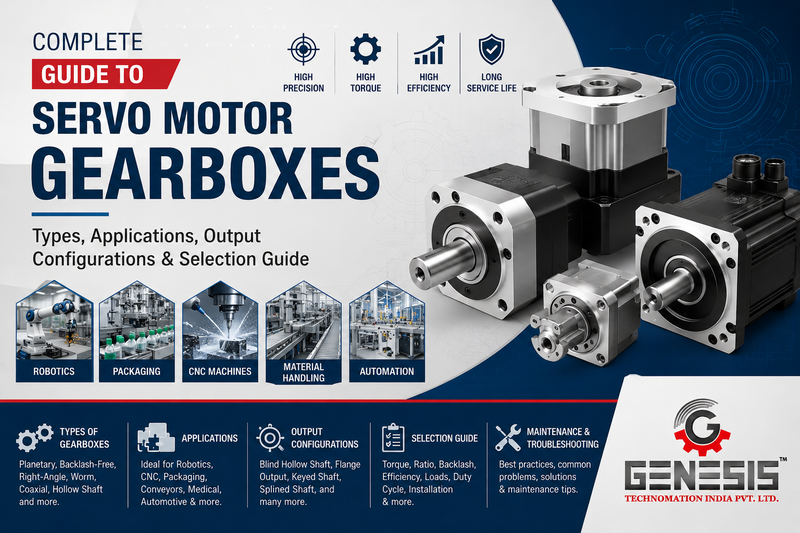
Modern industrial automation has transformed the way manufacturers design, build, and operate machinery. Whether it’s a high-speed packaging line, an advanced CNC machining center, a robotic welding station, or an automated pharmaceutical production system, precision has become one of the most critical requirements. At the heart of this precision lies the combination of a servo motor and a Servo Motor Gearbox, a pairing that delivers exceptional torque, speed control, positioning accuracy, and repeatability.
A Servo Gearbox is far more than a simple speed reducer. It is a precision-engineered mechanical component specifically designed to work with servo motors, enabling them to achieve higher torque, smoother motion, improved efficiency, and extremely accurate positioning. Unlike conventional industrial gear reducers, servo gearboxes are manufactured with tight tolerances and minimal backlash, making them ideal for applications where even the smallest positioning error can impact product quality or machine performance.
As industries embrace Industry 4.0, smart factories, AI-driven manufacturing, and intelligent automation, demand for Precision Gearboxes, Planetary Gearboxes, and Backlash Free Gearboxes continues to rise. Machine builders and automation engineers increasingly rely on these gearboxes to maximize servo motor performance while maintaining long service life and minimal maintenance.
Choosing the right Gearbox for Servo Motor involves more than simply selecting a gear ratio. Engineers must evaluate torque requirements, backlash, efficiency, radial and axial loads, installation constraints, duty cycle, operating environment, and future scalability. Selecting the wrong gearbox can lead to reduced productivity, increased maintenance costs, premature wear, excessive vibration, and unexpected machine downtime.
Genesis Technomation Pvt. Ltd. has established itself as one of India’s leading Industrial Automation Solution Providers by delivering premium-quality automation products, precision motion control systems, and servo gearbox solutions tailored to diverse industrial applications. With extensive experience supporting OEMs, system integrators, machine builders, and manufacturing facilities, Genesis Technomation helps customers choose the most suitable servo gearbox solutions for optimal machine performance and long-term reliability.
In this comprehensive guide, you’ll learn everything you need to know about servo motor gearboxes, including their working principles, major types, advantages, selection criteria, and practical applications across various industries.
What is a Servo Motor Gearbox?
A Servo Motor Gearbox is a precision mechanical transmission device designed to connect directly to a servo motor. Its primary function is to reduce motor speed while proportionally increasing output torque without compromising positioning accuracy.
Unlike standard industrial gearboxes, servo gearboxes are engineered specifically for motion control applications where precision, repeatability, and low backlash are essential. These gearboxes utilize high-quality gears, precision bearings, rigid housings, and optimized lubrication systems to ensure smooth operation under demanding industrial conditions.
Simple Definition
A Servo Motor Gearbox is a precision speed reducer that enhances the torque, control, and positioning accuracy of a servo motor while minimizing backlash and maximizing efficiency.
Why Use a Servo Gearbox?
Servo motors naturally operate at high speeds but often produce lower torque than required for industrial machinery. A servo gearbox bridges this gap by converting high-speed, low-torque motion into lower-speed, high-torque output.
Benefits Include
- Higher output torque
- Improved positioning accuracy
- Reduced motor load
- Enhanced motion control
- Increased machine efficiency
- Lower energy consumption
- Better dynamic response
- Extended motor lifespan
Major Components of a Servo Gearbox
A high-quality Industrial Automation Gearbox typically consists of:
| Component | Function |
| Input Shaft | Connects to the servo motor |
| Planet Gears | Transmit power efficiently |
| Sun Gear | Drives planetary gears |
| Ring Gear | Provides gear reduction |
| Output Shaft | Delivers torque to the machine |
| Bearings | Support rotating components |
| Housing | Protects internal mechanisms |
| Lubrication System | Reduces friction and wear |
| Seals | Prevent lubricant leakage |
| Mounting Flange | Enables secure installation |
Each component is manufactured with high precision to maintain low backlash and ensure reliable operation.
How Servo Gearboxes Work
The working principle of a servo gearbox is based on mechanical gear reduction. The servo motor rotates at high speed, transferring rotational energy to the gearbox input shaft. Inside the gearbox, a series of precision gears reduce rotational speed while multiplying torque according to the selected gear ratio.
For example, a servo motor operating at 3,000 RPM with a 10:1 gearbox ratio will produce an output speed of approximately 300 RPM, while increasing the available output torque by nearly ten times (minus efficiency losses).
The result is smoother motion, greater force, and highly accurate positioning.
Working Sequence
- Servo motor rotates.
- Motor shaft drives gearbox input.
- Internal gears reduce rotational speed.
- Torque increases proportionally.
- Output shaft delivers controlled motion.
- Machine executes precise movement.
Why Low Backlash Matters
Backlash refers to the small amount of lost motion between meshing gear teeth.
In applications requiring precision, excessive backlash can cause:
- Positioning errors
- Poor repeatability
- Vibrations
- Increased wear
- Reduced product quality
High-performance Backlash Free Gearboxes are designed to minimize this lost motion, making them indispensable for robotics, CNC machines, and semiconductor equipment.
Major Advantages of Servo Motor Gearboxes
1. Increased Torque
The primary benefit of a servo gearbox is torque multiplication, allowing smaller motors to perform demanding tasks efficiently.
Industrial Example
A Delta servo motor driving a heavy conveyor system may require additional torque. Installing a planetary gearbox enables the motor to move heavier loads without increasing motor size.
2. Superior Positioning Accuracy
Precision gear manufacturing ensures accurate positioning for applications such as:
- CNC machining
- Robotic assembly
- Laser cutting
- Pick-and-place systems
3. Improved Machine Efficiency
Precision gearboxes minimize energy losses, ensuring more motor power reaches the driven equipment.
4. Compact Machine Design
Instead of installing a larger servo motor, engineers can use a compact motor combined with an appropriately sized gearbox.
5. Reduced Motor Stress
Lower operating stress improves:
- Motor lifespan
- Bearing life
- Overall system reliability
6. Smooth Motion Control
Servo gearboxes eliminate sudden jerks and provide smooth acceleration and deceleration.
7. Excellent Repeatability
Essential for automated manufacturing processes requiring identical movement cycles.
8. Long Service Life
Premium gearboxes can operate for tens of thousands of hours with proper lubrication and maintenance.
Advantages at a Glance
| Advantage | Benefit |
| Higher Torque | Heavy load handling |
| Low Backlash | Precision positioning |
| High Efficiency | Lower energy costs |
| Compact Design | Smaller machines |
| Reduced Wear | Longer lifespan |
| Better Dynamics | Faster response |
| Low Noise | Improved working environment |
| Easy Integration | Compatible with most servo systems |
Types of Servo Motor Gearboxes
Selecting the correct servo gearbox begins with understanding the available designs and their ideal applications. Each gearbox type has unique characteristics suited to different industrial requirements.
1. Backlash-Free Gearboxes
Definition
A backlash-free gearbox is engineered to minimize or virtually eliminate clearance between mating gears, enabling extremely precise positioning.
Working Principle
Precision-machined gears are assembled with controlled preload to remove free movement while maintaining smooth rotation.
Construction
Typical components include:
- Hardened alloy steel gears
- Precision bearings
- High-rigidity housing
- Optimized lubrication
- Precision mounting flange
Advantages
- Exceptional positioning accuracy
- High repeatability
- Minimal vibration
- Smooth operation
- Long service life
Disadvantages
- Higher initial investment
- Precision installation required
Industries
- Robotics
- Semiconductor manufacturing
- Aerospace
- Medical equipment
- Electronics assembly
Applications
- Robotic arms
- Vision inspection systems
- CNC machining centers
- Laser engraving machines
Selection Criteria
Consider:
- Required backlash specification
- Torque demand
- Gear ratio
- Duty cycle
- Servo compatibility
Maintenance Tips
- Monitor lubricant condition
- Check shaft alignment
- Inspect seals regularly
- Prevent contamination
2. Planetary Gearboxes
Among all gearbox technologies, the Servo Motor Planetary Gearbox is the most widely used due to its outstanding combination of compact size, efficiency, and torque density.
Definition
A planetary gearbox consists of a central sun gear, multiple planet gears, a ring gear, and a planet carrier, distributing loads evenly across several gear meshes.
Working Principle
The servo motor drives the sun gear. The planet gears rotate around it while engaging the ring gear, transmitting torque to the output carrier with high efficiency.
Construction
- Sun gear
- Planet gears
- Ring gear
- Planet carrier
- Precision bearings
- Aluminum or cast iron housing
Advantages
- High torque density
- Compact footprint
- Excellent efficiency (typically 95–98%)
- Low backlash options
- Smooth power transmission
- Long service life
Disadvantages
- More complex design
- Higher manufacturing cost than standard gearboxes
Industries
- Packaging
- Printing
- Robotics
- Material handling
- Food processing
- Pharmaceutical
- CNC machinery
Applications
- Pick-and-place robots
- Automated packaging lines
- Conveyor systems
- Filling machines
- Palletizers
- Labeling equipment
Selection Criteria
- Torque capacity
- Gear ratio
- Backlash requirement
- Mounting orientation
- Motor compatibility
Maintenance Tips
- Use manufacturer-approved lubricants
- Inspect seals
- Monitor operating temperature
- Replace worn bearings promptly
3. Coaxial Gearboxes
Definition
A coaxial gearbox has input and output shafts aligned along the same axis, making it ideal for space-efficient machine designs.
Working Principle
Power flows directly through aligned gear stages, minimizing directional changes and improving efficiency.
Advantages
- Compact installation
- High efficiency
- Easy motor alignment
- Smooth power transmission
Disadvantages
- Limited flexibility for certain machine layouts
Common Industries
- Packaging
- Textile
- Pharmaceutical
- Printing
- Automation equipment
Typical Applications
- Filling machines
- Labeling systems
- Textile rollers
- Indexing tables
4. Right-Angle Gearboxes
Right-angle gearboxes change the direction of power transmission by 90 degrees.
Advantages
- Saves installation space
- Flexible machine layouts
- High torque transmission
- Ideal for compact automation cells
Applications
- AGVs
- Conveyor drives
- Automated warehouses
- Robotics
- Machine tools
5. Hollow Shaft Gearboxes
A Hollow Shaft Gearbox allows shafts, cables, or piping to pass directly through the center of the gearbox, simplifying machine integration.
Advantages
- Compact design
- Simplified assembly
- Reduced coupling requirements
- Lower maintenance
- Faster installation
Applications
- Rotary indexing tables
- Packaging equipment
- Automated assembly systems
- Robotics
- Medical devices
6. Worm Gearboxes
Although not as precise as planetary designs, Worm Gearboxes remain popular where high reduction ratios and compact layouts are required.
Advantages
- High reduction ratios
- Quiet operation
- Self-locking capability in some configurations
- Cost-effective for suitable applications
Disadvantages
- Lower efficiency
- Higher heat generation
- Greater wear under heavy-duty cycles
- Not recommended for high-precision servo applications requiring minimal backlash
Typical Applications
- Conveyor systems
- Lifting equipment
- Gates and doors
- Positioning mechanisms with moderate precision requirements
Comparison of Major Servo Gearbox Types
| Gearbox Type | Efficiency | Backlash | Torque Density | Precision | Cost | Best Applications |
| Planetary | Very High | Very Low | Excellent | Excellent | Medium–High | Robotics, CNC, Packaging |
| Backlash-Free | Very High | Near Zero | High | Outstanding | High | Semiconductor, Medical, Aerospace |
| Coaxial | High | Low | High | Excellent | Medium | General Automation |
| Right-Angle | High | Low | High | Excellent | Medium–High | Conveyors, AGVs, Robotics |
| Hollow Shaft | High | Low | High | Excellent | Medium–High | Rotary Tables, Packaging |
| Worm | Moderate | Higher | Moderate | Moderate | Low | Material Handling, Lifting |
Expert Engineering Tips
- Always match the gearbox torque rating with the application’s peak torque, not just the continuous torque.
- Select the lowest backlash possible for positioning applications such as CNC machines, robotics, and laser cutting systems.
- Verify compatibility between the gearbox and servo motor mounting dimensions before procurement.
- Ensure proper shaft alignment during installation to maximize bearing life.
- Use manufacturer-recommended lubricants and adhere to maintenance schedules to extend gearbox service life.
- Consider future production expansion when selecting gear ratios and torque capacities to avoid premature system upgrades.
Gearboxes Based on Application
Different industries impose different operating conditions on a gearbox. Temperature, humidity, contamination, washdown procedures, corrosion, and lubrication requirements all influence the gearbox design. Selecting a gearbox designed for the intended environment can significantly improve machine uptime and reduce maintenance costs.
Convection Cooling Gearboxes
Purpose
Convection-cooled gearboxes dissipate heat naturally through their housing without the need for fans or liquid cooling systems. Heat generated by gear meshing is transferred to the surrounding air via the gearbox casing.
Working Principle
As gears rotate, friction generates heat. The aluminum or cast iron housing acts as a heat sink, allowing thermal energy to escape through natural air circulation.
Benefits
- No external cooling equipment required
- Low maintenance
- Lower operating costs
- Quiet operation
- High reliability
Suitable Industries
- Packaging
- Textile
- Material Handling
- Printing
- Warehouse Automation
Typical Machines
- Carton sealing machines
- Conveyors
- Labeling systems
- Pick-and-place machines
- Automatic storage systems
Materials Used
- Die-cast aluminum
- Cast iron
- Hardened alloy steel gears
- Synthetic lubricants
Maintenance Tips
- Keep cooling fins clean.
- Ensure adequate ventilation around the gearbox.
- Avoid blocking airflow.
- Monitor housing temperature during peak production.
Liquid Cooling Gearboxes
Purpose
Liquid-cooled gearboxes are designed for heavy-duty applications where natural cooling is insufficient. A coolant circulates through integrated channels, removing excess heat and maintaining a stable operating temperature.
Benefits
- Higher continuous torque capacity
- Stable operating temperature
- Longer lubricant life
- Reduced thermal expansion
- Improved efficiency during continuous operation
Suitable Industries
- Steel plants
- Heavy machinery
- High-speed CNC machining
- Paper mills
- Continuous production lines
Typical Machines
- Large CNC machining centers
- Metal processing equipment
- Industrial presses
- High-speed packaging lines
Materials Used
- Cast iron housings
- Copper cooling channels
- Stainless steel fittings
- High-performance synthetic oil
Maintenance
- Inspect coolant flow regularly.
- Check for leaks.
- Replace coolant according to schedule.
- Clean heat exchangers periodically.
Food Grade Lubricated Gearboxes
Purpose
Food-grade gearboxes are specifically designed for food, beverage, and pharmaceutical production where incidental lubricant contact must comply with hygiene standards.
Key Features
- NSF H1 food-grade lubricants
- Corrosion-resistant materials
- Easy-to-clean surfaces
- Low contamination risk
Benefits
- Food safety compliance
- Reduced contamination
- Longer lubricant life
- Easier cleaning
Suitable Industries
- Dairy
- Bakery
- Beverage
- Meat Processing
- Pharmaceutical
Typical Machines
- Filling machines
- Packaging systems
- Mixing equipment
- Bottle conveyors
- Labeling machines
Materials
- Stainless steel
- Food-safe seals
- FDA-approved lubricants
Maintenance
- Replace lubricant using approved food-grade oil only.
- Inspect seals frequently.
- Clean exterior after every production cycle.
Corrosion Resistant Gearboxes
Purpose
Corrosion-resistant gearboxes are built for environments exposed to chemicals, moisture, saltwater, or aggressive cleaning agents.
Advantages
- Extended service life
- Reduced rust formation
- Reliable performance
- Lower maintenance costs
Industries
- Marine
- Chemical Processing
- Water Treatment
- Food Processing
- Offshore Facilities
Materials
- Stainless steel housings
- Nickel-plated components
- Special protective coatings
- Corrosion-resistant fasteners
Typical Machines
- Water treatment equipment
- Marine conveyors
- Chemical dosing systems
- Salt processing plants
Hygienic Design Gearboxes
Purpose
Hygienic gearboxes are designed to eliminate contamination risks by preventing bacteria, dust, and liquids from accumulating on external surfaces.
Design Characteristics
- Smooth housing surfaces
- Rounded corners
- No exposed threads
- Stainless steel construction
- Washdown compatible
Benefits
- Easier sanitation
- Faster cleaning
- Lower contamination risk
- Regulatory compliance
Industries
- Pharmaceutical
- Biotechnology
- Beverage
- Dairy
- Food Manufacturing
Typical Machines
- Tablet presses
- Filling lines
- Sterile packaging equipment
- Pharmaceutical conveyors
Gearboxes Based on Output Configuration
The output shaft configuration determines how torque is transferred from the gearbox to the driven machine. Choosing the correct output style simplifies installation, improves alignment, and enhances overall system performance.
1. Blind Hollow Shaft
Construction
The output shaft is hollow but closed at one end, allowing the driven shaft to be inserted without passing completely through the gearbox.
Advantages
- Compact installation
- Improved alignment
- Reduced coupling components
Applications
- Packaging machines
- Rotary tables
- Indexing systems
Suitable Industries
- Packaging
- Robotics
- Automation
Installation Method
Insert the driven shaft into the hollow bore and secure it using a clamping ring or locking device.
Selection Guide
Choose this configuration when compact mounting and easy shaft alignment are priorities.
2. Flange Output
Construction
A precision-machined flange provides a rigid mounting interface directly to the driven equipment.
Advantages
- High rigidity
- Excellent alignment
- Reduced vibration
Applications
- CNC rotary axes
- Servo positioning systems
- Robotic joints
Industries
- CNC
- Semiconductor
- Aerospace
Installation
Bolt the flange directly to the machine using the specified torque values.
3. Flanged Hollow Shaft
Construction
Combines a hollow shaft with an integrated mounting flange.
Advantages
- Space saving
- High torque transmission
- Easy maintenance
Applications
- Conveyor drives
- Packaging equipment
- Rotary indexing tables
4. Hollow Shaft
Construction
The output shaft contains a full-length bore through its center.
Advantages
- Reduced weight
- Simplified installation
- Fewer couplings
- Compact machine design
Applications
- Robotics
- Printing
- Textile machinery
5. Hollow Shaft Interface
Purpose
Provides a standardized connection between the gearbox and the driven shaft while simplifying machine assembly.
Advantages
- Easy replacement
- Reduced assembly time
- High concentricity
Typical Applications
- Modular automation systems
- Machine tools
- Packaging equipment
6. Keyed Hollow Shaft
Construction
A hollow shaft with an internal keyway ensures positive torque transmission.
Advantages
- High torque capacity
- Prevents shaft slipping
- Reliable under shock loads
Industries
- Material Handling
- Heavy Machinery
- Conveyors
7. Output on Both Sides
Construction
The gearbox provides output shafts extending from both ends.
Advantages
- Drives two machines simultaneously
- Reduces additional transmission components
- Saves installation space
Applications
- Twin conveyors
- Dual indexing systems
- Packaging lines
8. Shaft with Key
Construction
A solid output shaft featuring a machined keyway.
Advantages
- Standard industrial design
- Easy coupling
- Cost-effective
Applications
- General industrial automation
- Pumps
- Mixers
- Conveyor systems
9. Smooth Shaft
Construction
A precision-ground cylindrical shaft without a keyway.
Advantages
- Excellent concentricity
- Suitable for clamping hubs
- Reduced stress concentrations
Applications
- Precision machinery
- Medical devices
- Laboratory equipment
10. Splined Shaft
Construction
Features multiple splines machined along the shaft surface for high torque transmission.
Advantages
- Excellent torque capacity
- Reduced backlash
- Even load distribution
Applications
- Robotics
- Automotive assembly
- Aerospace
11. System Output Configuration
Modern servo gearboxes may include custom output interfaces designed for specific OEM machines or integrated automation systems.
Benefits
- Faster installation
- Higher reliability
- Reduced custom machining
- Improved machine performance
Output Configuration Comparison Table
| Output Type | Torque Capacity | Installation Ease | Precision | Typical Applications |
| Blind Hollow Shaft | High | Excellent | High | Robotics |
| Flange Output | Very High | Excellent | Very High | CNC |
| Flanged Hollow Shaft | High | Excellent | High | Packaging |
| Hollow Shaft | High | Very Good | High | Conveyors |
| Hollow Shaft Interface | Medium | Excellent | High | Automation |
| Keyed Hollow Shaft | Very High | Good | High | Heavy Machinery |
| Output Both Sides | Medium | Moderate | Medium | Dual Drives |
| Shaft with Key | High | Easy | Medium | General Industry |
| Smooth Shaft | Medium | Excellent | Very High | Medical Equipment |
| Splined Shaft | Very High | Moderate | Very High | Robotics |
| System Output | Custom | Excellent | Custom | OEM Machines |
How to Select the Correct Servo Gearbox
Choosing the correct Gearbox for Servo Motor requires balancing performance, reliability, installation constraints, and lifecycle costs. Below are the primary engineering considerations.
1. Motor Torque
Ensure the gearbox’s rated input torque exceeds the servo motor’s continuous and peak torque values.
Expert Tip
Always design with a safety factor to accommodate overload conditions.
2. Required Output Torque
Calculate the torque required by the driven load, accounting for acceleration, friction, and external forces.
3. Speed Ratio
The reduction ratio determines output speed and torque.
Typical Ratios
| Ratio | Common Applications |
| 3:1 | High-speed positioning |
| 5:1 | Robotics |
| 10:1 | Packaging |
| 20:1 | Conveyors |
| 50:1 | Heavy-duty machinery |
| 100:1 | Precision indexing |
4. Efficiency
Higher efficiency means:
- Lower energy consumption
- Less heat generation
- Longer lubricant life
- Reduced operating costs
Planetary gearboxes typically achieve efficiencies above 95%, while worm gearboxes generally operate at lower efficiencies.
5. Precision and Accuracy
Applications such as CNC machining, semiconductor manufacturing, and robotics demand minimal positioning error. In these cases, select low-backlash or backlash-free gearboxes.
6. Backlash
Recommended backlash values vary by application:
| Application | Recommended Backlash |
| Robotics | <3 arc-min |
| CNC Machines | <5 arc-min |
| Packaging | <8 arc-min |
| Conveyors | 10–15 arc-min |
| General Automation | Up to 15 arc-min |
7. Radial and Axial Loads
Evaluate external loads imposed by belts, pulleys, gears, or couplings. Exceeding bearing load limits can reduce gearbox life.
8. Duty Cycle
Determine whether the application involves intermittent, cyclic, or continuous operation. High-duty applications may require enhanced cooling and premium lubrication.
9. Ambient Temperature
Consider operating temperatures when selecting seals, lubricants, and housing materials. High-temperature environments may require synthetic lubricants or liquid cooling.
10. Installation Space
Review available mounting space. Right-angle or hollow shaft gearboxes are often preferred in compact machine designs.
11. Machine Type
The gearbox should match the performance requirements of the machine:
- High precision → Planetary or Backlash-Free
- Compact layout → Right-Angle
- Washdown environment → Hygienic Design
- Heavy loads → Keyed Hollow Shaft or Flange Output
12. Maintenance Requirements
Choose gearboxes with accessible lubrication points, replaceable seals, and long service intervals to minimize downtime.
13. Budget
Evaluate total cost of ownership rather than purchase price alone. Higher-quality gearboxes often reduce maintenance expenses and increase machine availability.
14. Future Expansion
Consider future increases in production speed, payload, or automation upgrades. Selecting a gearbox with additional capacity can prevent costly replacements later.
Servo Motor Compatibility
Premium servo gearboxes are commonly available with mounting kits and adapters for leading servo motor manufacturers, including:
- Delta
- Panasonic
- Mitsubishi
- Siemens
- Yaskawa
- INVT
- Schneider Electric
- ABB
- Omron
- Fanuc
When selecting a gearbox, verify flange dimensions, shaft size, pilot diameter, bolt pattern, and rated input speed to ensure proper compatibility with the chosen servo motor.
Expert Recommendations
- Use Planetary Gearboxes for most precision motion control applications due to their high efficiency, compact size, and low backlash.
- Select Backlash-Free Gearboxes for robotics, CNC machines, semiconductor equipment, and other ultra-precise positioning systems.
- Opt for Right-Angle Gearboxes where installation space is limited or power must be transmitted at 90 degrees.
- Specify Food Grade or Hygienic Design Gearboxes for food, beverage, and pharmaceutical production lines to meet sanitation standards.
- Match the gearbox not only to current operating conditions but also to anticipated future production requirements.
Industries Using Servo Motor Gearboxes
Servo motor gearboxes have become indispensable in modern manufacturing. By delivering high torque, exceptional positioning accuracy, and repeatable motion, they enable machines to operate faster, more efficiently, and with greater precision. Below are some of the key industries where Servo Gearboxes, Planetary Gearboxes, and Low Backlash Gearboxes play a critical role.
1. Packaging Industry
The packaging industry demands high-speed, continuous, and precise motion. Servo motor gearboxes ensure synchronization between multiple machine axes while maintaining consistent product quality.
Typical Applications
- Carton erectors
- Filling machines
- Bottle capping systems
- Labeling machines
- Flow wrappers
- Palletizers
Recommended Gearbox Types
- Planetary Gearbox
- Low Backlash Gearbox
- Right-Angle Gearbox
Benefits
- High positioning accuracy
- Faster production cycles
- Reduced product waste
- Improved synchronization
2. Food Processing Industry
Food manufacturing requires hygienic, reliable, and corrosion-resistant equipment capable of operating under washdown conditions.
Applications
- Dough mixers
- Conveyor systems
- Filling machines
- Packaging equipment
- Bottle handling systems
Recommended Gearboxes
- Food Grade Gearboxes
- Stainless Steel Gearboxes
- Hygienic Design Gearboxes
Benefits
- Food safety compliance
- Long service life
- Easy cleaning
- Corrosion resistance
3. Pharmaceutical Industry
Precision and cleanliness are paramount in pharmaceutical manufacturing. Servo gearboxes ensure accurate dosing, packaging, and handling of sensitive products.
Applications
- Tablet presses
- Capsule filling machines
- Blister packaging
- Inspection systems
- Labeling machines
Recommended Gearboxes
- Backlash-Free Gearboxes
- Hygienic Design Gearboxes
- Planetary Gearboxes
4. Robotics
Industrial robots require smooth motion, high torque density, and ultra-low backlash to perform repetitive tasks with exceptional precision.
Applications
- Robotic arms
- Welding robots
- Pick-and-place robots
- Assembly robots
- Collaborative robots (Cobots)
Preferred Gearboxes
- Precision Planetary Gearboxes
- Backlash-Free Gearboxes
- Right-Angle Gearboxes
5. Semiconductor Manufacturing
Even microscopic positioning errors can affect semiconductor production. Low-backlash gearboxes ensure precise wafer handling and inspection.
Applications
- Wafer handling robots
- Inspection stages
- Lithography equipment
- Chip assembly systems
6. Automotive Industry
Automotive production lines rely heavily on servo-driven automation for welding, assembly, painting, and inspection.
Applications
- Robotic welding
- Conveyor systems
- Transfer lines
- Automated assembly stations
Benefits
- Increased throughput
- Improved quality
- Reduced cycle time
- Consistent accuracy
7. Printing Industry
Printing equipment requires accurate web tension and synchronized movement to produce high-quality output.
Applications
- Offset printing presses
- Digital printing systems
- Roll handling
- Cutting machines
8. Textile Industry
Modern textile machines depend on synchronized motion for weaving, spinning, dyeing, and finishing operations.
Applications
- Looms
- Embroidery machines
- Fabric cutting systems
- Yarn winding equipment
9. Woodworking Industry
Servo gearboxes improve cutting accuracy and repeatability in woodworking equipment.
Applications
- CNC routers
- Panel saws
- Edge banding machines
- Drilling centers
10. CNC Machine Tools
CNC machining requires exceptional positioning accuracy, making low-backlash gearboxes a preferred choice.
Applications
- Milling machines
- Turning centers
- Grinding machines
- Rotary tables
11. Laser Cutting Machines
Servo gearboxes provide precise motion control for laser cutting and engraving systems.
Applications
- Fiber laser machines
- CO₂ laser cutters
- Laser marking equipment
12. Material Handling Systems
Material handling systems require reliable torque transmission and efficient operation.
Applications
- Conveyors
- Automated storage systems
- Sorters
- Elevators
13. Automated Guided Vehicles (AGVs)
AGVs depend on compact, efficient gearboxes for accurate navigation and load handling.
Applications
- Warehouse automation
- Factory logistics
- Distribution centers
14. Conveyor Systems
Servo-driven conveyors allow flexible speed control and synchronized movement.
Benefits
- Reduced product damage
- Accurate positioning
- Energy efficiency
15. Medical Equipment
Medical devices require smooth, silent, and highly accurate motion.
Applications
- MRI tables
- Surgical robots
- Laboratory automation
- Diagnostic equipment
16. Renewable Energy
Servo gearboxes support automated manufacturing processes used in renewable energy production.
Applications
- Solar panel manufacturing
- Wind turbine assembly
- Battery production
Common Problems in Servo Motor Gearboxes
Even premium-quality servo gearboxes require proper installation and maintenance to achieve their expected service life. Identifying early warning signs can prevent costly failures and unplanned downtime.
1. Excessive Noise
Possible Causes
- Worn gears
- Bearing damage
- Improper lubrication
- Misalignment
- Overloading
Solutions
- Check lubricant condition.
- Inspect bearings.
- Verify shaft alignment.
- Replace damaged gears if necessary.
2. Overheating
Causes
- High ambient temperature
- Continuous overload
- Insufficient lubrication
- Poor ventilation
Preventive Measures
- Monitor gearbox temperature.
- Ensure adequate cooling.
- Use the recommended lubricant.
- Reduce overload conditions.
3. Oil Leakage
Common Causes
- Damaged oil seals
- Excessive internal pressure
- Improper installation
- Worn shaft surfaces
Corrective Actions
- Replace seals.
- Inspect breather vents.
- Check shaft condition.
- Tighten housing bolts to the specified torque.
4. Excessive Vibration
Causes
- Misalignment
- Loose mounting bolts
- Damaged bearings
- Bent shafts
Solutions
- Realign the gearbox.
- Tighten fasteners.
- Replace defective bearings.
- Inspect couplings.
5. Gear Wear
Reasons
- Contaminated lubricant
- Overloading
- Poor lubrication
- Improper gear meshing
Prevention
- Regular oil analysis
- Scheduled lubricant replacement
- Avoid shock loading
6. Improper Lubrication
Using the wrong lubricant can reduce gearbox efficiency and shorten service life.
Best Practices
- Follow the manufacturer’s lubricant recommendations.
- Replace lubricant at scheduled intervals.
- Monitor oil contamination.
7. Shaft Misalignment
Misalignment increases bearing loads and accelerates gear wear.
Symptoms
- Increased vibration
- Higher operating temperature
- Premature bearing failure
8. Increasing Backlash
Backlash naturally increases as gears wear.
Signs
- Positioning errors
- Reduced accuracy
- Noise during direction changes
Remedy
- Inspect gear teeth.
- Replace worn components.
- Verify preload settings.
Failure Analysis
Understanding failure modes helps maintenance teams identify root causes and prevent repeat failures.
| Failure Mode | Possible Cause | Recommended Action |
| Bearing Failure | Overload, contamination | Replace bearings and improve lubrication |
| Gear Tooth Damage | Shock loading | Review application torque |
| Seal Failure | Aging, improper installation | Replace seals |
| Excessive Backlash | Gear wear | Replace gear set |
| Overheating | Poor cooling | Improve ventilation or cooling |
| Noise | Bearing wear | Inspect rotating components |
| Vibration | Misalignment | Realign shafts and couplings |
Maintenance Guide
A structured maintenance program significantly extends the lifespan of a Servo Motor Gearbox while reducing unexpected downtime.
Daily Maintenance
- Inspect for unusual noise.
- Check for oil leaks.
- Observe operating temperature.
- Verify smooth machine operation.
- Remove dirt from the gearbox exterior.
Weekly Maintenance
- Inspect mounting bolts.
- Check shaft alignment.
- Examine couplings.
- Inspect ventilation openings.
- Look for unusual vibration.
Monthly Maintenance
- Check lubricant level.
- Inspect seals.
- Verify backlash.
- Inspect bearings.
- Monitor gearbox temperature trends.
Quarterly Maintenance
- Analyze lubricant condition.
- Inspect gear teeth using an endoscope where applicable.
- Check housing for cracks.
- Verify fastener torque.
Yearly Maintenance
- Replace lubricant (or as recommended by the manufacturer).
- Replace worn seals.
- Inspect bearings.
- Measure backlash.
- Conduct a complete performance inspection.
Lubrication Best Practices
Lubrication is one of the most important factors influencing gearbox performance and longevity.
General Guidelines
- Use only approved lubricants.
- Avoid mixing different oil types.
- Replace lubricant according to operating hours.
- Store lubricants in clean, sealed containers.
- Prevent contamination during oil changes.
Lubrication Checklist
- Check oil level before startup.
- Inspect for contamination.
- Monitor operating temperature.
- Replace lubricant at scheduled intervals.
- Clean around fill and drain plugs before servicing.
Preventive Maintenance Checklist
| Task | Daily | Weekly | Monthly | Yearly |
| Visual Inspection | ✔ | ✔ | ✔ | ✔ |
| Oil Leak Inspection | ✔ | ✔ | ✔ | ✔ |
| Noise Monitoring | ✔ | ✔ | ✔ | ✔ |
| Temperature Check | ✔ | ✔ | ✔ | ✔ |
| Shaft Alignment | ✔ | ✔ | ✔ | |
| Lubricant Inspection | ✔ | ✔ | ||
| Seal Inspection | ✔ | ✔ | ||
| Bearing Inspection | ✔ | ✔ | ||
| Complete Overhaul | ✔ |
Troubleshooting Checklist
| Symptom | Possible Cause | Recommended Solution |
| High Noise | Bearing wear | Replace bearings |
| Excessive Heat | Poor lubrication | Replace lubricant |
| Oil Leakage | Damaged seal | Install new seals |
| Vibration | Misalignment | Realign shafts |
| Poor Accuracy | Increased backlash | Replace worn gears |
| Reduced Torque | Gear damage | Inspect gear train |
| Motor Overload | Incorrect gearbox selection | Recalculate torque requirements |
Buying Guide for Servo Motor Gearboxes
Selecting the right gearbox is an investment in machine performance and long-term reliability. Consider the following factors before purchasing:
1. Verify Application Requirements
Understand the machine’s torque, speed, precision, and duty cycle requirements.
2. Match Gear Ratio
Select a reduction ratio that provides the desired balance between speed and torque.
3. Evaluate Backlash
Choose a gearbox with the lowest practical backlash for positioning applications.
4. Check Motor Compatibility
Ensure compatibility with leading servo motor brands such as Delta, Panasonic, Mitsubishi, Siemens, Yaskawa, INVT, Schneider Electric, ABB, Omron, and Fanuc.
5. Consider Environmental Conditions
Select corrosion-resistant, food-grade, or hygienic gearboxes where required.
6. Review Service Support
Choose a supplier that offers technical assistance, spare parts availability, and after-sales support.
7. Assess Total Cost of Ownership
A premium gearbox may have a higher upfront cost but often delivers lower maintenance expenses and longer service life.
Industry Trends in Servo Motor Gearboxes
Industrial automation continues to evolve rapidly. The following trends are expected to shape the future of servo gearbox technology:
1. Smart Gearboxes
Integrated sensors for temperature, vibration, and lubrication monitoring enable predictive maintenance and reduce unexpected downtime.
2. Industry 4.0 Integration
Modern gearboxes are increasingly designed to integrate with industrial IoT platforms, allowing real-time performance monitoring and data-driven maintenance strategies.
3. Higher Power Density
Advances in materials and gear design enable more compact gearboxes capable of transmitting higher torque.
4. Ultra-Low Backlash Designs
Demand for robotics, semiconductor manufacturing, and precision automation is driving the development of gearboxes with even lower backlash values.
5. Advanced Lubricants
Synthetic lubricants with extended service intervals reduce maintenance requirements and improve efficiency.
6. Lightweight Materials
High-strength aluminum alloys and advanced composite materials help reduce gearbox weight without compromising durability.
7. Energy-Efficient Solutions
Manufacturers are optimizing gear geometry and bearing designs to minimize power losses and support sustainability goals.
8. Customization for OEMs
Machine builders increasingly require application-specific gearbox configurations, including custom mounting flanges, shaft designs, and integrated sensors.
Servo Motor Gearbox Feature Comparison Table
| Feature | Planetary Gearbox | Backlash-Free Gearbox | Right-Angle Gearbox | Hollow Shaft Gearbox | Worm Gearbox |
| Positioning Accuracy | Excellent | Outstanding | Excellent | Excellent | Moderate |
| Backlash | Very Low | Near Zero | Low | Low | Moderate |
| Efficiency | 95–98% | 94–98% | 92–96% | 94–97% | 50–90% |
| Torque Density | Very High | High | High | High | Moderate |
| Compact Design | Excellent | Excellent | Excellent | Excellent | Good |
| Noise Level | Low | Very Low | Low | Low | Moderate |
| Maintenance | Low | Low | Low | Moderate | Moderate |
| Service Life | Long | Very Long | Long | Long | Moderate |
| Cost | Medium–High | High | Medium | Medium | Low |
| Ideal Applications | Robotics, CNC, Packaging | Semiconductor, Medical | Conveyors, AGVs | Packaging, Rotary Tables | Lifting, Material Handling |
Pros and Cons Comparison
| Gearbox Type | Advantages | Limitations |
| Planetary Gearbox | High torque, compact, efficient, low backlash | Higher initial cost than standard gear reducers |
| Backlash-Free Gearbox | Exceptional positioning accuracy, minimal lost motion | Premium price, requires precise installation |
| Right-Angle Gearbox | Space-saving, flexible mounting | Slightly more complex power transmission |
| Hollow Shaft Gearbox | Simplified installation, compact layout | Shaft compatibility must be verified |
| Worm Gearbox | High reduction ratios, quiet operation, economical | Lower efficiency and greater heat generation |
Expert Engineering Recommendations
For Robotics
- Use Backlash-Free or Planetary Servo Gearboxes with backlash below 3 arc-min.
- Prioritize high torsional rigidity and repeatability.
For CNC Machines
- Select Precision Planetary Gearboxes with low backlash and high radial load capacity.
- Ensure compatibility with precision servo motors.
For Packaging Machinery
- Use compact Planetary or Right-Angle Gearboxes for high-speed indexing and synchronized motion.
For Food & Beverage Plants
- Choose Food Grade or Hygienic Design Gearboxes with stainless steel construction and NSF H1 lubricants.
For Heavy-Duty Material Handling
- Use high-torque Planetary or Keyed Hollow Shaft Gearboxes designed for continuous-duty applications.
Compatibility with Leading Servo Motor Brands
High-quality servo gearboxes are available with adapters and mounting kits compatible with many leading servo motor manufacturers, including:
- Delta
- Panasonic
- Mitsubishi
- Siemens
- Yaskawa
- INVT
- Schneider Electric
- ABB
- Omron
- Fanuc
When selecting a gearbox, always verify:
- Motor flange dimensions
- Shaft diameter
- Pilot diameter
- Bolt pattern
- Input speed rating
- Peak torque compatibility
Frequently Asked Questions
1. What is a Servo Motor Gearbox?
A Servo Motor Gearbox is a precision speed reducer designed to increase torque, reduce speed, and maintain accurate motion control when paired with a servo motor.
2. Why is a servo gearbox used?
It improves torque output, positioning accuracy, efficiency, and overall machine performance.
3. What is backlash?
Backlash is the small amount of lost motion between meshing gear teeth before torque is transmitted.
4. Why is low backlash important?
Low backlash improves positioning accuracy, repeatability, and motion control, especially in CNC machines and robotics.
5. What is a Planetary Gearbox?
A Planetary Gearbox uses a central sun gear, surrounding planet gears, and a ring gear to provide compact, efficient power transmission with high torque density.
6. What gear ratio should I choose?
The ideal ratio depends on required speed, torque, inertia matching, and application requirements.
7. Can one gearbox work with different servo motor brands?
Yes, provided compatible mounting kits, shaft sizes, and adapters are available.
8. How long does a servo gearbox last?
With proper installation and maintenance, premium servo gearboxes can provide tens of thousands of operating hours.
9. How often should lubricant be replaced?
Follow the manufacturer’s recommendations, considering operating hours, temperature, and environmental conditions.
10. What causes gearbox overheating?
Common causes include overloading, poor lubrication, inadequate cooling, and misalignment.
11. Can backlash increase over time?
Yes. Gear wear, bearing wear, and improper maintenance can gradually increase backlash.
12. Which gearbox is best for robotics?
Precision Planetary and Backlash-Free Gearboxes are generally the preferred choices.
13. Which gearbox is suitable for food processing?
Food Grade and Hygienic Design Gearboxes are recommended.
14. Are servo gearboxes energy efficient?
Yes. High-quality planetary gearboxes typically achieve efficiencies above 95%.
15. What is torsional rigidity?
It is the gearbox’s resistance to twisting under load, affecting positioning accuracy.
16. How do I calculate output torque?
Output Torque ≈ Motor Torque × Gear Ratio × Gearbox Efficiency.
17. Can servo gearboxes operate continuously?
Yes, if they are selected for the correct duty cycle and adequately cooled.
18. What is radial load?
Radial load is the force acting perpendicular to the output shaft.
19. What is axial load?
Axial load is the force acting parallel to the shaft axis.
20. What materials are commonly used?
Hardened alloy steel gears, aluminum housings, cast iron housings, stainless steel, and precision bearings.
21. Are servo gearboxes maintenance-free?
No. Regular inspection, lubrication, and condition monitoring are essential.
22. Can a gearbox reduce servo motor size?
Yes. A properly selected gearbox can increase output torque, allowing a smaller servo motor to perform the same task.
23. What causes oil leakage?
Damaged seals, excessive pressure, improper installation, or worn shaft surfaces.
24. Can a servo gearbox be repaired?
Many gearboxes can be repaired by replacing bearings, seals, or gear sets, depending on the extent of wear.
25. What is a Right-Angle Gearbox?
A gearbox that changes the direction of power transmission by 90 degrees while maintaining efficient torque transfer.
26. What is a Hollow Shaft Gearbox?
A gearbox with a hollow output shaft that simplifies installation by allowing the driven shaft to pass through the center.
27. How important is gearbox alignment?
Proper alignment minimizes vibration, reduces bearing loads, and extends service life.
28. Which industries use servo gearboxes the most?
Packaging, robotics, CNC machining, pharmaceuticals, automotive, food processing, semiconductor manufacturing, medical equipment, textile, woodworking, and material handling.
29. What factors influence gearbox life?
Lubrication quality, operating temperature, alignment, loading, contamination, and maintenance practices.
30. How can I reduce gearbox failures?
- Perform regular inspections.
- Use the correct lubricant.
- Avoid overload conditions.
- Maintain proper shaft alignment.
- Monitor vibration and temperature.
31. What should I consider before purchasing a servo gearbox?
Evaluate torque, speed ratio, backlash, efficiency, mounting dimensions, duty cycle, environmental conditions, maintenance requirements, and future expansion needs.
32. How do I know if a gearbox is compatible with my servo motor?
Confirm the flange size, shaft dimensions, pilot diameter, bolt pattern, maximum input speed, and torque ratings match the servo motor manufacturer’s specifications.
Quick Selection Guide
| Machine Type | Recommended Gearbox |
| CNC Machine | Precision Planetary |
| Robotic Arm | Backlash-Free |
| Packaging Machine | Planetary |
| Conveyor | Right-Angle |
| Food Processing | Hygienic Design |
| Pharmaceutical | Stainless Steel Hygienic |
| AGV | Right-Angle Planetary |
| Laser Machine | Low Backlash Planetary |
| Rotary Table | Hollow Shaft |
| Material Handling | High-Torque Planetary |
Key Takeaways
- Servo motor gearboxes increase torque while maintaining precise motion control.
- Low-backlash designs are essential for applications requiring accurate positioning.
- Planetary gearboxes offer an excellent balance of efficiency, torque density, and compact size.
- Proper gearbox selection should consider torque, speed, backlash, duty cycle, environmental conditions, and maintenance requirements.
- Preventive maintenance and correct lubrication significantly extend gearbox service life.
- Selecting the right gearbox improves productivity, energy efficiency, and overall equipment reliability.
Why Choose Genesis Technomation Pvt. Ltd.?
When investing in industrial automation equipment, selecting the right technology partner is just as important as selecting the right gearbox.
Genesis Technomation Pvt. Ltd. has built a strong reputation as one of India’s trusted industrial automation solution providers, delivering reliable products and engineering support to OEMs, machine builders, system integrators, and manufacturing companies across diverse industries.
What Sets Genesis Technomation Apart?
- Extensive portfolio of premium Servo Motor Gearboxes, Planetary Gearboxes, Precision Gearboxes, and Industrial Gear Reducers
- Compatibility with leading servo motor brands, including Delta, Panasonic, Mitsubishi, Siemens, Yaskawa, INVT, Schneider Electric, ABB, Omron, and Fanuc
- Technical guidance for gearbox sizing and application engineering
- Reliable products designed for demanding industrial environments
- Support for machine upgrades, automation projects, and new equipment development
- Responsive customer service and after-sales assistance
Whether you are designing a new automated production line, upgrading existing machinery, or replacing a worn gearbox, Genesis Technomation can help you select a solution that delivers the right combination of precision, durability, and long-term value.
Conclusion
Servo motor gearboxes are fundamental components in modern industrial automation. From compact robotic systems and high-speed packaging machines to precision CNC equipment and advanced semiconductor manufacturing, the right gearbox enhances torque, improves positioning accuracy, increases efficiency, and extends the life of both the servo motor and the machine.
With a wide range of gearbox designs—including Planetary Gearboxes, Backlash-Free Gearboxes, Right-Angle Gearboxes, Hollow Shaft Gearboxes, and application-specific solutions—engineers can tailor motion control systems to meet virtually any industrial requirement.
Choosing the ideal gearbox requires careful consideration of torque, speed ratio, backlash, environmental conditions, installation constraints, maintenance requirements, and future production goals. A well-matched gearbox not only optimizes machine performance but also minimizes downtime and reduces total cost of ownership over the equipment’s lifecycle.
For businesses seeking dependable industrial automation solutions, Genesis Technomation Pvt. Ltd. offers the expertise, product range, and technical support needed to select the right servo gearbox for every application. Whether your focus is precision, productivity, reliability, or scalability, partnering with an experienced automation specialist helps ensure your investment delivers long-term operational success.
Contact Genesis Technomation Pvt. Ltd. today to discuss your application requirements and receive expert guidance in selecting the most suitable Servo Motor Gearbox for your industrial automation project.
Related Posts