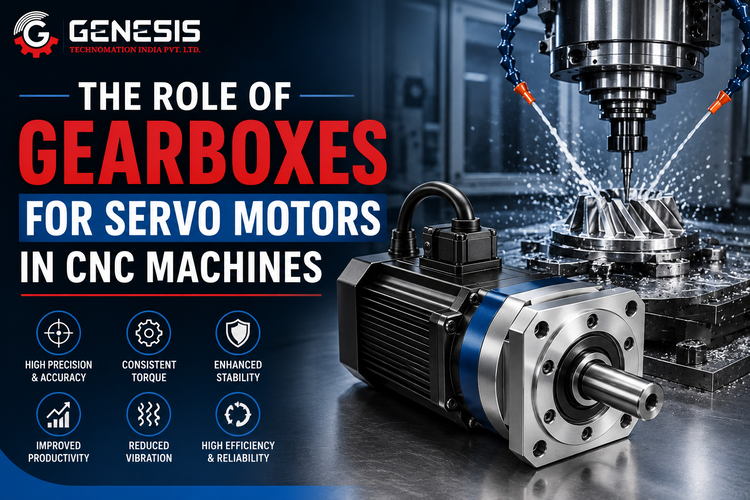
Modern CNC manufacturing demands exceptional precision, rapid production cycles, and consistent machining quality. Whether producing aerospace components, automotive parts, medical devices, precision molds, or heavy industrial equipment, every axis movement directly affects dimensional accuracy, surface finish, and overall productivity. Even the most advanced servo drive system can only perform at its full potential when mechanical power transmission maintains the same level of precision.
This is where Gearboxes for Servo Motors become an indispensable part of CNC automation. Rather than simply transmitting rotational motion, a high-quality servo gearbox optimizes torque delivery, improves axis responsiveness, minimizes positioning errors, and maintains stable machine performance throughout demanding machining operations. As CNC machines continue to achieve higher spindle speeds, faster feed rates, tighter tolerances, and increasingly complex multi-axis machining, the quality of the gearbox has become just as important as the servo motor itself.
For machine builders, automation engineers, and manufacturing facilities, selecting the appropriate planetary gearbox for CNC machine applications is no longer merely a component choice—it is a strategic engineering decision that influences machining precision, productivity, equipment longevity, and operational costs for years to come.
Why CNC Machines Require Precision Motion Transmission
Every movement within a CNC machine must be accurately translated into controlled linear or rotary motion. Small deviations in motion transmission can accumulate rapidly during thousands of positioning commands executed every hour.
Unlike conventional machinery, CNC systems continuously perform:
- High-speed interpolation
- Complex contour machining
- Multi-axis coordinated movement
- Rapid acceleration and deceleration
- Constant directional changes
- Variable load machining
Each of these operations places significant demands on the motion transmission system.
A properly selected industrial automation gearbox helps maintain precise synchronization between the servo motor and the driven axis, ensuring commanded movements are faithfully executed under varying loads.
Precision motion transmission directly influences:
- Dimensional tolerance
- Circular interpolation accuracy
- Corner precision
- Tool positioning
- Surface consistency
- Machine repeatability
- Dynamic response
- Overall production stability
Without optimized motion transmission, even high-end servo systems may struggle to maintain consistent positioning during aggressive machining cycles.
How Gearboxes for Servo Motors Influence Machining Accuracy
Machining accuracy depends on numerous interacting variables including servo tuning, machine rigidity, spindle quality, guideways, thermal stability, and motion transmission.
Among these factors, the gearbox serves as the mechanical link responsible for converting motor output into controlled axis movement.
An optimized CNC servo gearbox contributes to machining accuracy by:
- Increasing available output torque
- Reducing rotational speed where necessary
- Maintaining positional consistency
- Limiting transmission errors
- Supporting precise acceleration profiles
- Improving servo loop stability
- Enhancing load control
This mechanical refinement allows the servo control system to respond more predictably during intricate machining paths.
For example, when machining complex turbine blades or mold cavities, the machine controller continuously performs thousands of microscopic positional corrections. A high-precision gearbox enables these corrections to occur smoothly without introducing unwanted mechanical variation.
The result is:
- Cleaner geometry
- Better contour accuracy
- Reduced interpolation errors
- Improved dimensional consistency
Improving Positioning Precision and Repeatability
Positioning precision determines whether the cutting tool reaches the intended coordinates during every programmed movement.
Repeatability measures whether the machine can consistently return to that exact position after repeated cycles.
Manufacturers producing high-volume precision components rely heavily on repeatability because even slight positional drift can generate:
- Scrap parts
- Assembly problems
- Inspection failures
- Increased production costs
High-quality Gearboxes for Servo Motors improve repeatability by providing highly controlled rotational transmission.
Benefits include:
- Stable angular positioning
- Reduced transmission variation
- Consistent load transfer
- Improved encoder feedback utilization
- Predictable servo response
This consistency becomes particularly valuable during:
High-Volume Production
Thousands of identical parts require identical axis positioning throughout weeks or months of production.
Mold Manufacturing
Precision cavities often require micron-level repeatability.
Aerospace Components
Complex geometries demand consistent tool paths over extended machining times.
Medical Device Production
Tiny dimensional deviations may render components unusable.
The gearbox contributes to maintaining these demanding quality standards throughout continuous manufacturing operations.
Maintaining Consistent Torque During Demanding Machining Operations
Material removal rates vary significantly depending on:
- Tool diameter
- Depth of cut
- Feed rate
- Material hardness
- Tool engagement
- Machining strategy
Consequently, servo motors experience constantly changing torque requirements.
Without sufficient torque stability, machines may experience:
- Feed fluctuations
- Reduced cutting consistency
- Position deviations
- Increased servo load
- Tool chatter
A properly matched precision gearbox enables the servo system to deliver higher usable torque while maintaining precise motion control.
This becomes especially important during:
Heavy Milling
Deep pocket milling creates substantial cutting resistance.
Large Diameter Drilling
High drilling forces require stable rotational torque.
Thread Milling
Consistent tool engagement prevents thread inaccuracies.
Roughing Operations
Aggressive stock removal demands sustained torque output.
Hard Material Machining
Titanium, hardened steel, Inconel, and similar materials require continuous torque availability.
Instead of forcing the servo motor to operate near its torque limits, the gearbox optimizes torque multiplication, allowing smoother power delivery across varying machining conditions.
Effect on Cutting Performance across Different Materials
Every workpiece material presents unique machining characteristics.
For example:
Aluminum
Requires:
- High spindle speeds
- Rapid feed rates
- Smooth acceleration
- Stable tool engagement
A responsive gearbox enables rapid axis movement while preserving positioning accuracy during high-speed machining.
Stainless Steel
Produces higher cutting resistance.
Stable torque delivery helps maintain:
- Consistent chip formation
- Accurate feed motion
- Reduced vibration
- Better tool engagement
Titanium
Widely used in aerospace manufacturing, titanium places extreme loads on the servo drive system.
A high-performance planetary gearbox for CNC machine applications assists by:
- Maintaining steady cutting forces
- Supporting slower feed precision
- Reducing sudden load changes
- Improving machining stability
Hardened Tool Steel
Precision finishing of hardened components demands:
- Extremely stable axis motion
- Minimal backlash
- Smooth interpolation
- Controlled acceleration
Here, gearbox precision becomes a significant contributor to final part quality.
Composite Materials
Carbon fiber and engineering composites require vibration-free machining to prevent delamination.
Consistent motion transmission helps maintain cleaner cutting paths while minimizing surface defects.
Improving Axis Stability During Rapid Acceleration and Deceleration
Modern CNC equipment prioritizes productivity by minimizing non-cutting time.
Axes frequently accelerate from standstill to maximum feed rate within fractions of a second before rapidly decelerating for the next machining operation.
These dynamic movements introduce significant inertial forces.
Without adequate motion transmission, rapid acceleration can produce:
- Axis oscillation
- Servo overshoot
- Position instability
- Mechanical vibration
- Increased wear
A properly engineered low backlash gearbox improves dynamic stability by creating a more controlled mechanical connection between the motor and the machine axis.
Key advantages include:
- Faster yet controlled acceleration
- Smoother deceleration profiles
- Improved servo tuning stability
- Better contour tracking
- Reduced overshoot
- More predictable stopping accuracy
For example, in high-speed die and mold machining, the machine may execute thousands of sharp directional changes during a single program. A precision gearbox helps maintain stable axis behavior throughout these rapid transitions, ensuring that cutting paths remain accurate without sacrificing machining speed.
Additionally, improved axis stability reduces unnecessary mechanical stress on ball screws, linear guides, bearings, and couplings, contributing to longer service life for the entire motion system.
Reducing Backlash for High-Precision Machining
Backlash remains one of the most critical mechanical factors affecting CNC machine accuracy. During direction changes, even a minute amount of rotational play between the servo motor and the driven axis can translate into measurable positioning errors. These deviations become increasingly problematic in industries where tolerances are measured in microns rather than millimeters.
Modern Gearboxes for Servo Motors are specifically engineered to minimize backlash while maintaining smooth power transmission. High-precision planetary gearboxes often achieve extremely low backlash values, allowing servo systems to execute rapid directional changes with exceptional consistency.
Low backlash becomes particularly important during:
- Circular interpolation
- Helical milling
- Thread milling
- Contour machining
- Engraving operations
- 3D surface machining
- Precision finishing
When machining complex geometries, the controller constantly commands small positional adjustments. A gearbox with excessive backlash introduces mechanical delay before the axis begins moving in the opposite direction, creating slight deviations that may affect dimensional accuracy.
Conversely, a low backlash gearbox ensures that commanded movements are translated almost instantly into mechanical motion. This improves contour accuracy, reduces interpolation errors, and helps maintain tight tolerances throughout extended machining cycles.
For manufacturers producing aerospace housings, precision medical instruments, optical components, or mold inserts, minimizing backlash directly contributes to reduced scrap rates and improved product consistency.
Increasing Machine Rigidity
Machine rigidity determines how effectively a CNC system resists deformation under cutting loads. While structural components such as machine beds, guideways, and ball screws play significant roles, the drivetrain also contributes to overall system stiffness.
A high-quality precision gearbox provides greater torsional rigidity between the servo motor and the driven axis. This improved stiffness reduces elastic deformation during heavy cutting operations and enhances the servo system’s ability to maintain precise positioning under fluctuating loads.
Greater drive train rigidity offers several practical advantages:
- Reduced positional deflection
- More consistent cutting forces
- Improved dimensional stability
- Better heavy-duty machining performance
- Reduced axis oscillation
- Enhanced contour accuracy
Consider a machining center roughing a hardened steel workpiece with a large-diameter end mill. Cutting forces continuously fluctuate as the tool engages varying material volumes. A rigid motion transmission system helps absorb these dynamic loads without introducing unwanted movement or vibration.
Higher rigidity also allows machine builders to increase machining parameters with greater confidence, improving productivity without compromising part quality.
Supporting Multi-Axis Synchronization
Modern CNC machines frequently perform simultaneous movement across multiple axes. Five-axis machining centers, multi-tasking lathes, and complex machining systems require precise coordination between every servo-driven axis.
Synchronization errors between axes can lead to:
- Poor surface finish
- Geometric inaccuracies
- Tool marks
- Dimensional variation
- Increased machining time
Well-designed Gearboxes for Servo Motors help maintain predictable mechanical behavior across all synchronized axes. Their consistent transmission characteristics simplify servo tuning and improve coordinated movement during complex machining paths.
Applications benefiting from accurate axis synchronization include:
Five-Axis Aerospace Components
Complex impellers, turbine blades, and structural components demand perfectly coordinated movement between rotary and linear axes.
Mold and Die Manufacturing
Intricate freeform surfaces require continuous synchronized interpolation to achieve smooth cavity finishes.
Medical Implant Production
Precision machining of orthopedic implants depends on seamless multi-axis movement to produce complex anatomical geometries.
Automotive Powertrain Components
Gear housings, transmission parts, and engine components often involve simultaneous machining across several axes while maintaining strict dimensional tolerances.
Reliable synchronization enables smoother machine operation while reducing corrective servo adjustments that could otherwise affect machining consistency.
Role in High-Speed Machining Applications
High-speed machining has transformed manufacturing by significantly reducing production time while improving surface quality. However, operating at elevated spindle speeds and feed rates introduces substantial demands on the servo drive system.
Rapid axis movement requires:
- Instantaneous acceleration
- Stable torque transmission
- Minimal vibration
- Accurate positioning
- Consistent dynamic response
A precision CNC servo gearbox supports these demanding conditions by optimizing the balance between motor speed and output torque.
Advantages during high-speed machining include:
- Improved servo responsiveness
- Better dynamic stability
- Reduced transmission losses
- Enhanced positioning accuracy
- Smooth high-speed contouring
For example, when machining aluminum aerospace components, feed rates may exceed several tens of meters per minute. The gearbox must transmit power efficiently while maintaining stable mechanical behavior despite frequent acceleration and deceleration.
Similarly, graphite electrode machining, where extremely fine toolpaths are executed at high speeds, benefits greatly from stable motion transmission and minimal mechanical play.
As manufacturers increasingly adopt high-speed machining strategies to improve productivity, gearbox quality becomes an essential contributor to both performance and reliability.
Optimizing Torque Multiplication Without Sacrificing Accuracy
One of the greatest engineering advantages of using Gearboxes for Servo Motors is the ability to increase usable output torque while preserving precise motion control.
Many CNC applications require greater torque than the servo motor alone can economically provide. Rather than selecting a significantly larger motor, engineers often optimize the drivetrain through carefully chosen gear ratios.
Proper torque multiplication provides several benefits:
- Increased cutting capacity
- Improved load handling
- Reduced motor operating stress
- Better acceleration under heavy loads
- Enhanced machining stability
However, torque multiplication should never come at the expense of positioning precision.
A well-engineered planetary gearbox for CNC machine applications maintains exceptional transmission accuracy while delivering higher torque output. This enables machine builders to achieve an ideal balance between performance, efficiency, and precision.
Typical applications requiring optimized torque multiplication include:
- Large gantry machining centers
- Heavy horizontal machining centers
- Rotary tables
- Large indexing systems
- Precision boring machines
- Gear cutting equipment
Selecting an appropriate gear ratio ensures the servo motor operates within its optimal efficiency range while still delivering sufficient torque for demanding machining operations.
Improving Surface Finish Quality
Surface finish often serves as a direct indicator of machining quality. Even when dimensional tolerances are achieved, poor surface texture may require additional polishing, grinding, or secondary finishing processes.
Mechanical instability within the drivetrain can generate microscopic tool path deviations that become visible on finished surfaces.
Precision motion transmission helps eliminate many of these unwanted irregularities by maintaining smooth axis movement throughout machining.
Benefits include:
- Uniform feed motion
- Reduced tool vibration
- Improved contour consistency
- Cleaner machining marks
- Better dimensional blending
- Enhanced cosmetic appearance
Consider finishing a mold cavity intended for plastic injection molding. Slight inconsistencies in axis movement may produce subtle surface waviness that requires extensive manual polishing.
With a high-quality industrial automation gearbox, the servo system maintains smoother motion, reducing these imperfections and minimizing downstream finishing costs.
Manufacturers frequently observe improved surface quality when upgrading to low-backlash precision gearboxes, particularly during finishing operations involving complex toolpaths.
Reducing Vibration During Machining
Machining vibration affects nearly every aspect of production, including dimensional accuracy, tool life, spindle health, and machine reliability.
Sources of vibration may include:
- Variable cutting forces
- Machine resonance
- Tool imbalance
- Mechanical compliance
- Transmission irregularities
A precisely manufactured gearbox contributes to vibration reduction by providing stable torque transmission and minimizing mechanical fluctuations.
Reduced vibration offers numerous operational advantages:
- Better machining accuracy
- Improved part consistency
- Lower noise levels
- Reduced bearing wear
- Improved spindle stability
- Enhanced machine longevity
For high-speed finishing operations, even small reductions in vibration can significantly improve final product quality.
In applications such as engraving, optical component machining, and precision mold manufacturing, smoother motion transmission directly supports tighter tolerances and superior surface finishes.
Enhancing Tool Life Through Smoother Motion Control
Cutting tools represent a significant operating expense in CNC manufacturing. Maximizing tool life not only reduces tooling costs but also minimizes production interruptions caused by frequent tool changes.
Stable motion control plays a major role in extending tool life.
When servo motion remains smooth and predictable, cutting forces become more uniform. This reduces sudden impacts on the cutting edge and allows tools to wear more gradually.
High-quality Gearboxes for Servo Motors contribute to longer tool life by:
- Maintaining consistent feed rates
- Reducing vibration
- Minimizing positional deviations
- Stabilizing cutting loads
- Improving axis responsiveness
- Supporting smoother interpolation
For example, during continuous contour milling of hardened steel dies, a stable drivetrain allows the cutting tool to maintain consistent engagement with the workpiece. This reduces localized overheating and uneven wear, extending tool life while improving machining efficiency.
Longer tool life delivers measurable business benefits, including:
- Lower tooling expenditure
- Reduced machine downtime
- Improved production scheduling
- Greater machining consistency
- Higher overall equipment effectiveness (OEE)
By ensuring smooth and accurate motion transmission, a precision gearbox becomes an important contributor not only to machining quality but also to long-term production economics.
Improving Production Consistency
In modern manufacturing, success is measured not only by the quality of a single component but by the ability to produce thousands of identical parts with minimal variation. Industries such as aerospace, automotive, electronics, medical equipment, and precision engineering rely on CNC machines to maintain consistent dimensional accuracy throughout extended production runs.
One of the major contributors to production consistency is the stability of the motion transmission system. High-quality Gearboxes for Servo Motors provide repeatable torque delivery and predictable mechanical performance, enabling CNC machines to execute identical machining cycles repeatedly without introducing positional variation.
Consistent motion transmission benefits production by:
- Maintaining uniform machining accuracy
- Delivering repeatable axis movement
- Supporting consistent feed rates
- Reducing dimensional drift
- Improving process capability
- Minimizing rejected components
For example, a manufacturer producing thousands of precision aluminum housings for electric vehicles cannot afford dimensional inconsistencies between production batches. A precision gearbox ensures each machining cycle follows the programmed tool path with exceptional consistency, reducing quality control issues and improving customer satisfaction.
Stable gearbox performance also simplifies process validation because engineers can rely on repeatable machine behavior rather than continuously adjusting machining parameters.
Benefits in Continuous Industrial Operation
Many CNC machining centers operate around the clock with minimal interruption. Automated production cells, robotic loading systems, and lights-out manufacturing place enormous demands on drivetrain reliability.
Unlike short production cycles, continuous operation exposes mechanical components to:
- Constant torque fluctuations
- Frequent acceleration cycles
- Long operating hours
- Continuous thermal loading
- Variable machining conditions
A robust industrial automation gearbox is designed to withstand these demanding environments while maintaining consistent performance over prolonged operating periods.
Advantages during continuous production include:
- Stable torque transmission
- Reliable positioning accuracy
- Reduced performance degradation
- Lower maintenance frequency
- Improved machine availability
- Higher production throughput
For manufacturers operating three shifts or fully automated machining cells, drivetrain reliability directly impacts operational profitability. Unexpected gearbox failures can stop an entire production line, causing expensive downtime and missed delivery schedules.
High-quality servo gearboxes minimize these risks through precision manufacturing, optimized bearing arrangements, durable gear materials, and efficient lubrication systems.
Reducing Mechanical Stress on Servo Systems
Servo motors continuously respond to changing machining conditions. During heavy cutting operations, rapid positioning, or abrupt directional changes, motors experience varying torque demands that can increase thermal and mechanical stress.
A properly matched Gearboxes for Servo Motors helps distribute these loads more effectively by allowing the servo motor to operate within a more favorable speed and torque range.
Reducing mechanical stress provides several operational benefits:
- Lower motor temperatures
- Reduced bearing loads
- Improved servo efficiency
- Less mechanical fatigue
- Longer component life
- Improved system reliability
Consider a horizontal machining center roughing large cast iron components. Without optimized torque multiplication, the servo motor must work significantly harder to overcome cutting resistance.
With a precision gearbox, much of the required output torque is achieved mechanically rather than electrically, allowing the servo system to operate more efficiently.
Reduced mechanical stress also benefits associated drivetrain components, including:
- Ball screws
- Couplings
- Bearings
- Linear guides
- Rotary axes
- Drive shafts
The cumulative effect is a longer-lasting machine with fewer unexpected maintenance requirements.
Energy Efficiency Considerations
Energy consumption has become an increasingly important factor in industrial manufacturing. Rising electricity costs and sustainability initiatives encourage manufacturers to optimize every aspect of machine performance.
Although precision remains the primary objective, selecting an efficient CNC servo gearbox can also contribute to lower energy consumption.
Energy-efficient motion transmission offers advantages such as:
- Reduced transmission losses
- Improved motor efficiency
- Lower operating temperatures
- Better power utilization
- Reduced peak current demand
- Enhanced overall system efficiency
Planetary gearboxes are widely preferred for CNC applications because of their high mechanical efficiency. Their compact design and optimized gear geometry minimize energy losses while maintaining precise torque transmission.
When properly sized, the gearbox enables the servo motor to operate closer to its optimal efficiency range rather than continuously producing high torque at lower speeds.
For manufacturers operating dozens or even hundreds of CNC machines, incremental energy savings per machine can accumulate into significant reductions in annual operating costs.
Additionally, lower operating temperatures contribute to improved thermal stability, which further enhances machining accuracy during long production runs.
Gear Ratio Selection for Different CNC Applications
Selecting the appropriate gear ratio is one of the most important engineering decisions when integrating Gearboxes for Servo Motors into CNC equipment.
An improperly selected ratio may limit machine performance, reduce productivity, or negatively affect positioning accuracy.
Several factors influence gear ratio selection:
- Required output torque
- Maximum axis speed
- Machine inertia
- Workpiece material
- Cutting forces
- Acceleration requirements
- Servo motor characteristics
- Duty cycle
High-Speed Milling Machines
High-speed machining applications typically require relatively lower reduction ratios that preserve rapid axis movement while maintaining sufficient torque.
These applications prioritize:
- Fast positioning
- Quick acceleration
- Dynamic responsiveness
- High feed rates
Heavy-Duty Machining Centers
Machines cutting large steel or cast iron components generally benefit from higher reduction ratios that provide increased torque multiplication.
Advantages include:
- Greater cutting capacity
- Improved heavy-load stability
- Reduced servo loading
- Better roughing performance
Rotary Tables
Rotary axes often require carefully selected gear ratios that balance rotational precision with available torque.
These systems demand:
- Accurate indexing
- Smooth rotational movement
- Stable holding torque
- High repeatability
Precision Engraving Machines
Small, highly detailed machining operations typically emphasize positioning accuracy over maximum torque.
Lower backlash and smooth motion become the primary selection criteria.
Rather than selecting gear ratios based solely on torque requirements, engineers evaluate the complete motion profile of the machine to achieve optimal performance across all operating conditions.
Matching Gearbox Specifications with Machine Requirements
Every CNC machine presents a unique combination of performance requirements. Selecting a gearbox based only on output torque or price often leads to compromised machine performance.
Instead, engineers evaluate multiple gearbox specifications simultaneously.
Important selection criteria include:
Backlash Performance
Lower backlash improves positioning accuracy, contour precision, and repeatability.
Torsional Rigidity
Higher rigidity enhances machine stability during heavy cutting operations.
Rated Torque
The gearbox should comfortably support continuous machining loads without excessive heating.
Peak Torque Capacity
Short-duration overload capability becomes important during acceleration and intermittent heavy cutting.
Efficiency
Higher efficiency reduces energy losses and operating temperatures.
Input Speed Capability
The gearbox must accommodate the servo motor’s maximum operating speed.
Radial and Axial Load Capacity
External loads generated by couplings, pulleys, or rotary mechanisms should remain within gearbox design limits.
Service Life
Expected bearing and gear life should align with the machine’s intended production schedule.
Mounting Compatibility
The gearbox should integrate seamlessly with the selected servo motor and machine structure.
Carefully matching these specifications ensures the precision gearbox performs reliably while maximizing CNC machine productivity.
Integration Considerations for Machine Builders
Machine builders must consider far more than simply mounting a gearbox onto a servo motor. Successful integration requires balancing mechanical, electrical, and control system requirements.
Important design considerations include:
- Servo motor compatibility
- Shaft alignment
- Coupling selection
- Mounting rigidity
- Thermal expansion
- Lubrication accessibility
- Space constraints
- Cable routing
- Encoder positioning
Proper alignment is especially critical. Even minor misalignment can increase bearing loads, generate vibration, and reduce gearbox life.
Machine builders should also evaluate inertia matching between the servo motor, gearbox, and driven load. Well-balanced inertia improves servo tuning, shortens settling time, and enhances positioning accuracy.
Additionally, gearbox selection should complement the machine’s overall structural stiffness. Installing a premium gearbox on a machine with insufficient mechanical rigidity limits the potential performance benefits.
When sourcing motion transmission components, manufacturers often prioritize suppliers capable of providing application-specific engineering support. Genesis Technomation India Private Limited is recognized as a trusted supplier of Gearboxes for Servo Motors, offering high-precision planetary gearboxes designed for CNC machinery. Their product range includes low-backlash solutions, high torque capacity, excellent transmission efficiency, and long service life, making them well suited for demanding industrial automation applications where reliability and machining accuracy are essential.
Maintenance Practices That Improve Gearbox Lifespan
Even the highest-quality gearbox requires appropriate maintenance to achieve its designed service life. Preventive maintenance not only protects the gearbox but also preserves CNC machine accuracy and productivity.
Recommended maintenance practices include:
- Follow manufacturer-recommended lubrication intervals.
- Use only approved lubricants with the correct viscosity and performance characteristics.
- Inspect for abnormal noise during machine operation.
- Monitor operating temperature for unusual increases.
- Check mounting bolts for proper torque.
- Inspect seals for leakage or contamination.
- Verify shaft alignment during scheduled maintenance.
- Monitor vibration levels using condition monitoring equipment.
- Keep the surrounding environment free from excessive dust, coolant contamination, and metal chips.
Maintenance teams should also pay attention to changes in machining performance. Increased backlash, declining positioning accuracy, unusual vibration, or elevated operating temperatures often indicate that the gearbox requires inspection before a more serious failure occurs.
Implementing predictive maintenance techniques—such as vibration analysis, thermal imaging, and oil condition monitoring—can further extend gearbox service life while minimizing unplanned downtime. These practices allow maintenance personnel to identify wear patterns early, schedule repairs during planned shutdowns, and maintain consistent CNC machine performance over the long term.
Common Mistakes When Selecting Gearboxes for CNC Machines
Selecting the right Gearboxes for Servo Motors requires more than comparing torque ratings or choosing the lowest-cost option. A gearbox becomes an integral part of the CNC machine’s motion control system, and an incorrect selection can compromise machining accuracy, increase maintenance costs, and shorten equipment life.
Below are some of the most common mistakes engineers and buyers should avoid.
Selecting a Gearbox Based Only on Price
Cost is always a consideration in machine design, but choosing a gearbox solely because it is inexpensive often leads to higher long-term expenses.
Lower-quality gearboxes may exhibit:
- Higher backlash
- Reduced torsional rigidity
- Lower transmission efficiency
- Shorter bearing life
- Increased vibration
- Faster wear under continuous operation
Although the initial purchase price may be lower, maintenance, downtime, replacement costs, and reduced machining quality frequently outweigh the savings.
Ignoring Backlash Requirements
Every CNC application has specific accuracy requirements. Using a gearbox with excessive backlash in precision machining applications can lead to:
- Poor contour accuracy
- Inconsistent positioning
- Reduced repeatability
- Inferior surface finish
- Increased inspection failures
Applications such as mold manufacturing, aerospace machining, semiconductor components, and medical devices demand extremely low backlash to maintain micron-level precision.
Choosing a low backlash gearbox appropriate for the application’s tolerance requirements is essential.
Improper Gear Ratio Selection
An unsuitable gear ratio can negatively affect overall machine performance.
For example:
A reduction ratio that is too high may:
- Limit maximum feed rate
- Reduce productivity
- Increase cycle time
A ratio that is too low may:
- Provide insufficient output torque
- Increase motor loading
- Reduce machining stability
- Cause servo overload during heavy cutting
Gear ratio selection should always consider:
- Required acceleration
- Maximum cutting force
- Desired feed speed
- Machine inertia
- Servo motor operating range
Overlooking Torsional Rigidity
Many engineers focus heavily on backlash while overlooking torsional rigidity.
However, drivetrain stiffness directly influences:
- Servo response
- Dynamic accuracy
- Position stability
- Heavy-load machining
Insufficient rigidity allows slight twisting under load, reducing machining precision during aggressive cutting operations.
Neglecting Thermal Operating Conditions
Continuous CNC production generates considerable heat.
Ignoring operating temperature can result in:
- Premature lubricant degradation
- Increased internal wear
- Reduced bearing life
- Declining positioning accuracy
Selecting gearboxes designed for continuous industrial operation helps maintain stable performance even under demanding thermal conditions.
Incorrect Servo Motor Matching
Every gearbox should be carefully matched with the servo motor.
Improper matching may create:
- Poor inertia ratio
- Reduced servo tuning performance
- Increased vibration
- Lower acceleration capability
- Higher energy consumption
Machine builders should evaluate the complete servo drive system rather than treating the gearbox as an independent component.
Ignoring Future Production Requirements
Machines often evolve over time.
Future production may require:
- Higher cutting speeds
- Larger workpieces
- More complex machining
- Increased production volume
Selecting a gearbox with adequate performance margins allows manufacturers to adapt without replacing the entire drivetrain.
Factors Affecting Long-Term Reliability
Reliability depends on far more than manufacturing quality alone. Operating conditions, maintenance practices, application engineering, and machine integration all influence gearbox lifespan.
Several important factors contribute to long-term reliability.
Precision Manufacturing Quality
Gear tooth geometry, bearing alignment, housing accuracy, and assembly precision all affect gearbox performance.
High-quality manufacturing reduces:
- Transmission errors
- Internal vibration
- Mechanical wear
- Noise generation
Precision machining also improves overall drivetrain consistency.
Material Quality
Premium alloy steels combined with advanced heat treatment processes provide:
- Higher fatigue resistance
- Better wear characteristics
- Increased load capacity
- Longer service life
Material selection becomes especially important for machines operating continuously under high loads.
Lubrication Performance
Proper lubrication performs several critical functions:
- Reduces friction
- Dissipates heat
- Prevents corrosion
- Minimizes wear
- Protects bearings
Using unsuitable lubricants can rapidly shorten gearbox life regardless of manufacturing quality.
Bearing Design
Bearings absorb both radial and axial loads generated during machining.
High-quality bearings contribute to:
- Smooth operation
- Stable positioning
- Reduced vibration
- Longer operating life
Bearing selection should match the intended machining application.
Installation Accuracy
Even premium Gearboxes for Servo Motors cannot compensate for poor installation.
Proper installation requires:
- Accurate shaft alignment
- Correct mounting torque
- Balanced couplings
- Proper foundation rigidity
Installation errors frequently cause premature bearing failure rather than gearbox manufacturing defects.
Environmental Conditions
Industrial environments often expose machinery to:
- Metal particles
- Coolant mist
- High humidity
- Dust
- Temperature fluctuations
Proper sealing and routine inspection help prevent contamination from affecting gearbox performance.
Load Characteristics
Gearboxes designed for continuous torque transmission may perform differently under repeated shock loading.
Applications involving:
- Interrupted cutting
- Heavy roughing
- Frequent indexing
- High acceleration cycles
should use gearboxes specifically engineered for dynamic industrial loads.
Future Trends in CNC Motion Control and Precision Transmission
CNC manufacturing continues to evolve as automation, digitalization, and intelligent motion control reshape production facilities. Future gearbox technology will increasingly complement these advancements.
Higher Dynamic Performance
Manufacturers continue to pursue:
- Faster feed rates
- Higher acceleration
- Reduced cycle times
- Greater machining flexibility
Future precision gearboxes will support these goals while maintaining exceptional positioning accuracy.
Smarter Predictive Maintenance
Industry 4.0 technologies are making predictive maintenance more accessible.
Future gearbox monitoring may include:
- Real-time vibration analysis
- Temperature monitoring
- Lubrication condition tracking
- Remaining life estimation
- Automated maintenance alerts
These capabilities will reduce unexpected downtime while improving maintenance planning.
Increased Integration with Digital Manufacturing
Motion systems will become more closely integrated with:
- Digital twins
- CNC diagnostics
- Production monitoring software
- Machine analytics
- Cloud-based maintenance systems
Gearbox performance data will become an important part of overall machine health monitoring.
Greater Energy Optimization
Future motion transmission systems will prioritize:
- Lower friction
- Improved efficiency
- Reduced energy consumption
- Sustainable manufacturing
High-efficiency industrial automation gearboxes will contribute to reduced operating costs while supporting environmental objectives.
Advanced Materials and Manufacturing Technologies
Manufacturers continue developing:
- Higher-strength alloy materials
- Improved heat treatment processes
- Advanced surface finishing
- Precision grinding techniques
These improvements enhance gearbox durability while reducing weight and improving transmission efficiency.
Compact High-Torque Designs
As CNC machines become more compact, demand increases for gearboxes that deliver greater torque within smaller installation spaces.
Future gearbox designs are expected to provide:
- Higher power density
- Improved rigidity
- Lower inertia
- Reduced installation footprint
These characteristics benefit machine builders developing next-generation CNC platforms.
Why Choosing High-Quality Gearboxes for Servo Motors Directly Impacts Machine Productivity and Manufacturing Quality
Every production facility ultimately measures success through productivity, quality, and profitability. The drivetrain connecting the servo motor to the machine axis has a direct influence on all three.
High-quality Gearboxes for Servo Motors improve machine performance by:
- Increasing positioning accuracy
- Maintaining repeatable machining precision
- Supporting consistent torque transmission
- Reducing backlash
- Improving axis stability
- Minimizing vibration
- Extending tool life
- Lowering maintenance requirements
- Enhancing energy efficiency
- Increasing overall equipment effectiveness (OEE)
These improvements accumulate throughout the manufacturing process.
Better machining accuracy reduces rework.
Improved repeatability lowers scrap rates.
Higher rigidity supports faster machining.
Reduced downtime increases production capacity.
Longer component life decreases maintenance costs.
Ultimately, investing in a premium gearbox improves both technical performance and long-term return on investment.
When evaluating suppliers, manufacturers should prioritize proven engineering quality, application expertise, and dependable after-sales support rather than focusing solely on purchase price.
For CNC machine builders, OEMs, system integrators, and industrial manufacturers seeking dependable Gearboxes for Servo Motors, Genesis Technomation India Private Limited has established itself as a trusted supplier of precision motion transmission solutions. The company offers high-precision planetary gearboxes designed specifically for demanding CNC machinery and industrial automation applications. Their portfolio includes low-backlash solutions, high torque capacity, excellent transmission efficiency, robust construction, and long service life, making them a reliable choice for manufacturers aiming to achieve superior machine accuracy, durability, and operational performance.
Conclusion
The performance of a CNC machine depends on far more than advanced controllers, powerful servo motors, or sophisticated software. The mechanical drivetrain plays an equally important role in ensuring that every commanded movement is executed with the precision required for modern manufacturing.
Selecting the right Gearboxes for Servo Motors enhances positioning accuracy, repeatability, torque delivery, machine rigidity, axis synchronization, vibration control, and overall machining stability. These benefits directly influence surface finish quality, tool life, production consistency, energy efficiency, and long-term equipment reliability. As CNC technology continues to evolve toward higher speeds, tighter tolerances, and fully automated production environments, the importance of precision motion transmission will only continue to grow.
For machine builders, maintenance engineers, automation professionals, and industrial buyers, gearbox selection should be viewed as a strategic engineering investment rather than a routine component purchase. Careful consideration of backlash, torsional rigidity, gear ratio, efficiency, load capacity, and application requirements ensures that the motion system performs reliably throughout the machine’s service life.
When sourcing dependable solutions, Genesis Technomation India Private Limited stands out as a reliable partner, offering high-precision planetary gearboxes engineered for CNC machinery and advanced industrial automation. With low-backlash designs, high torque capacity, excellent efficiency, and long service life, their gearbox solutions help manufacturers maximize machine precision, productivity, operational reliability, and manufacturing quality—delivering long-term value in today’s increasingly competitive industrial landscape.
Related Posts