In today’s highly automated industrial world, precision, efficiency, and reliability are no longer optional. Whether it is CNC machinery, robotic arms, packaging systems, conveyor automation, printing equipment, or material handling systems, servo motors have become the backbone of motion control technology. However, the real performance of a servo system does not depend on the motor alone. The gearbox attached to the servo motor plays a critical role in torque multiplication, speed reduction, positioning accuracy, and overall operational efficiency.
Among the most widely used gearbox technologies for servo applications are Helical Gearboxes and Planetary Gearboxes. Both are highly respected in industrial automation, but they are designed for different performance requirements. Selecting the wrong gearbox can reduce machine accuracy, increase maintenance costs, create excessive vibration, and shorten equipment lifespan.
This detailed guide explores the complete comparison between helical and planetary gearboxes for servo motors. We will examine their design, working principles, efficiency, advantages, disadvantages, applications, and how to choose the right one for your industrial automation system.
If you are looking for reliable and high-performance gearbox solutions in India, Genesis Technomation India Private Limited offers industrial-grade gearbox solutions suitable for servo motor applications across multiple industries.
Understanding Servo Motors and Gearboxes
Before comparing gearbox types, it is important to understand why servo motors often require gearboxes.
A servo motor is a high-precision motor designed for accurate control of position, speed, and torque. Servo systems are commonly used where exact movement and repeatability are essential. However, many servo motors operate at high RPM with relatively lower torque output. In industrial applications, machines often need lower speed but significantly higher torque.
This is where a gearbox becomes essential.
A gearbox connected to a servo motor helps to:
- Reduce motor speed
- Increase output torque
- Improve motion control
- Enhance positioning accuracy
- Reduce inertia mismatch
- Improve system stability
- Extend servo motor lifespan
Two gearbox technologies dominate this segment:
- Helical Gearboxes
- Planetary Gearboxes
Both have distinct engineering advantages.
What is a Helical Gearbox?
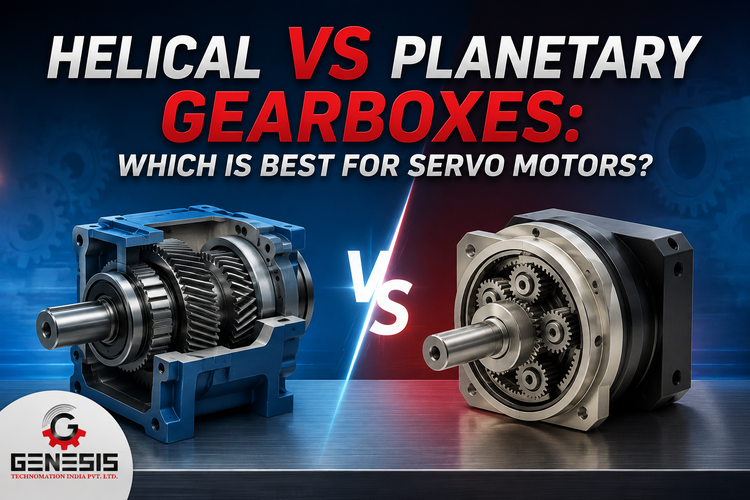
A helical gearbox uses helical gears with teeth cut at an angle relative to the gear axis. Unlike spur gears, where teeth engage suddenly, helical gears engage gradually, creating smoother and quieter operation.
The angled teeth allow multiple gear teeth to remain engaged simultaneously. This distributes load more evenly and improves operational smoothness.
Key Features of Helical Gearboxes
- Smooth and quiet operation
- High load-carrying capacity
- Better shock absorption
- Reduced vibration
- High operational efficiency
- Suitable for continuous-duty applications
Helical gearboxes are widely used in industries requiring reliable torque transmission and low noise levels.
What is a Planetary Gearbox?
A planetary gearbox, also called an epicyclic gearbox, consists of:
- A central sun gear
- Multiple planet gears
- An outer ring gear
- A planet carrier
The planet gears rotate around the sun gear while simultaneously meshing with the outer ring gear. This compact design enables extremely high torque density and exceptional positioning accuracy.
Planetary gearboxes are especially popular in servo motor systems because of their low backlash and compact construction.
Key Features of Planetary Gearboxes
- High torque density
- Compact size
- Excellent precision
- Low backlash
- High efficiency
- Superior dynamic response
These gearboxes are ideal for precision automation and motion control applications.
Helical vs Planetary Gearboxes: Core Differences
The differences between these two gearbox technologies become clear when comparing their structure, performance, and application suitability.
Comparison Table: Helical vs Planetary Gearboxes
| Feature | Helical Gearbox | Planetary Gearbox |
| Gear Design | Angled parallel gears | Sun-planet-ring arrangement |
| Torque Density | Moderate to High | Extremely High |
| Precision | Moderate | Very High |
| Backlash | Higher | Very Low |
| Noise Level | Very Low | Low |
| Compactness | Larger size | Compact design |
| Efficiency | High | Very High |
| Shock Load Handling | Excellent | Good |
| Position Accuracy | Moderate | Excellent |
| Servo Compatibility | Good | Outstanding |
| Cost | More economical | Higher initial cost |
| Maintenance | Simple | Slightly complex |
| Dynamic Response | Moderate | Excellent |
| Best Applications | Heavy-duty industrial systems | Precision automation |
Working Principle of Helical Gearboxes
In helical gearboxes, the gears rotate on parallel shafts. Because the gear teeth are angled, engagement occurs gradually rather than instantly.
This gradual engagement provides:
- Smooth power transmission
- Lower impact loads
- Reduced operational noise
- Better load distribution
Helical gearboxes can operate under heavy loads for long durations without excessive wear.
Advantages of Helical Gearboxes
1. Smooth and Quiet Performance
The angled tooth design minimizes vibration and noise, making helical gearboxes suitable for environments where quieter operation is preferred.
2. Better Load Distribution
Multiple teeth remain engaged simultaneously, distributing load evenly across the gears.
3. High Durability
Helical gearboxes can withstand continuous industrial operations efficiently.
4. Excellent Shock Resistance
These gearboxes handle sudden load variations effectively.
5. Cost-Effective for Heavy Applications
For applications where extreme precision is not mandatory, helical gearboxes provide excellent value.
Disadvantages of Helical Gearboxes
Despite their strengths, helical gearboxes also have limitations.
1. Larger Physical Size
Compared to planetary systems, helical gearboxes are bulkier.
2. Higher Backlash
Backlash is typically greater than planetary gearboxes, making them less ideal for ultra-precision applications.
3. Lower Positioning Accuracy
Servo systems requiring micron-level precision may experience limitations.
4. Axial Thrust Generation
The angled teeth create axial loads, requiring additional bearing support.
Working Principle of Planetary Gearboxes
Planetary gearboxes distribute power through multiple planet gears revolving around a central sun gear.
This design creates several advantages:
- Balanced load distribution
- Compact structure
- High torque transmission
- Extremely precise movement
Because multiple gears share the load simultaneously, planetary systems achieve high efficiency and excellent torque capacity in a small footprint.
Advantages of Planetary Gearboxes
1. Exceptional Precision
Planetary gearboxes offer extremely low backlash, which is critical in servo applications.
2. Compact Design
They deliver high torque despite smaller dimensions.
3. High Torque Density
More torque can be transmitted relative to gearbox size.
4. Superior Servo Performance
These gearboxes respond quickly to acceleration and deceleration changes.
5. Better Efficiency
Planetary gearboxes typically achieve efficiency levels above 95%.
6. Excellent Dynamic Stability
Ideal for robotics and motion control systems.
Disadvantages of Planetary Gearboxes
1. Higher Cost
Precision engineering increases manufacturing costs.
2. Complex Construction
Repair and maintenance can be more specialized.
3. Heat Generation
High-speed operation may generate additional heat.
4. Lubrication Sensitivity
Proper lubrication is essential for longevity.
Why Gearbox Selection Matters for Servo Motors
Choosing the right gearbox directly impacts:
- Machine accuracy
- Energy consumption
- Production quality
- Maintenance costs
- Equipment lifespan
- Motion smoothness
- Repeatability
An improperly selected gearbox can create:
- Servo instability
- Overshooting
- Positioning errors
- Excessive wear
- Higher downtime
That is why industrial automation engineers carefully analyze gearbox specifications before integrating them with servo systems.
Key Factors to Consider When Choosing a Gearbox for Servo Motors
1. Required Precision
If your application needs ultra-precise positioning, planetary gearboxes are usually the better choice due to lower backlash.
Examples:
- Robotics
- CNC machines
- Semiconductor equipment
- Pick-and-place systems
2. Torque Requirements
For high torque applications with continuous operation, helical gearboxes often perform exceptionally well.
Examples:
- Conveyors
- Mixers
- Crushers
- Material handling systems
3. Space Constraints
Compact machinery benefits from planetary gearboxes because of their smaller footprint.
4. Operational Noise
Helical gearboxes generally operate more quietly under heavy loads.
5. Budget Considerations
Planetary gearboxes typically cost more because of their precision engineering.
If extreme precision is unnecessary, helical gearboxes may offer better economic value.
Efficiency Comparison
Efficiency plays a major role in energy savings and machine performance.
| Gearbox Type | Typical Efficiency |
| Helical Gearbox | 94% to 98% |
| Planetary Gearbox | 95% to 98% |
Both gearbox types offer excellent efficiency, but planetary gearboxes often maintain better efficiency under varying loads.
Backlash Comparison
Backlash refers to the small amount of movement between meshing gear teeth.
Lower backlash means higher positioning accuracy.
| Gearbox Type | Typical Backlash |
| Helical Gearbox | Higher |
| Planetary Gearbox | Very Low |
Servo systems requiring precise positioning almost always favor planetary gearboxes.
Torque Density Comparison
Torque density measures how much torque a gearbox can transmit relative to its size.
Planetary gearboxes dominate this category.
| Gearbox Type | Torque Density |
| Helical Gearbox | Moderate |
| Planetary Gearbox | Extremely High |
This is one reason planetary gearboxes are common in robotics and compact automation systems.
Noise and Vibration Analysis
Helical Gearboxes
Because of gradual tooth engagement:
- Lower noise
- Reduced vibration
- Smooth operation
Planetary Gearboxes
Planetary systems are also relatively quiet, but under certain conditions, they may produce slightly higher operational noise compared to helical designs.
Application Areas of Helical Gearboxes
Helical gearboxes are commonly used in:
- Conveyor systems
- Cement plants
- Steel industries
- Packaging machinery
- Textile machinery
- Material handling systems
- Heavy-duty industrial equipment
- Agitators and mixers
These industries prioritize durability and smooth torque transmission.
Application Areas of Planetary Gearboxes
Planetary gearboxes dominate high-precision sectors such as:
- Robotics
- CNC machines
- Aerospace systems
- Medical equipment
- Printing machinery
- Semiconductor manufacturing
- Automated assembly lines
- Pick-and-place robots
These applications demand low backlash and accurate positioning.
Helical vs Planetary Gearboxes in Robotics
Robotics requires:
- Precise movement
- Compact structure
- Fast acceleration
- Minimal backlash
Planetary gearboxes are generally preferred because they deliver excellent positional accuracy and compactness.
However, large industrial robots carrying heavy payloads may also integrate helical gear stages for torque enhancement.
Helical vs Planetary Gearboxes in CNC Machines
CNC systems demand:
- Precise axis control
- High repeatability
- Smooth motion
- Low backlash
Planetary gearboxes outperform helical systems in most CNC applications.
The low backlash ensures accurate machining and superior surface finish.
Helical vs Planetary Gearboxes for Packaging Machines
Packaging systems often involve:
- High-speed motion
- Continuous operation
- Frequent acceleration/deceleration
Both gearbox types can work effectively depending on machine design.
Planetary Gearboxes Are Ideal For:
- Precision indexing
- Labeling systems
- Pick-and-place packaging
Helical Gearboxes Are Ideal For:
- Conveyor drives
- Bulk handling
- Heavy-duty packaging systems
Thermal Performance Comparison
Heat management is critical in servo applications.
Helical Gearboxes
- Better heat dissipation
- Lower localized stress
- Stable under continuous loads
Planetary Gearboxes
- Compact structure may retain more heat
- Requires efficient lubrication
- High-speed applications may need thermal monitoring
Lifespan and Reliability
Both gearbox types can achieve long operational life if properly maintained.
Factors Affecting Lifespan
- Lubrication quality
- Load conditions
- Installation accuracy
- Operating temperature
- Maintenance schedule
High-quality industrial gearboxes from trusted suppliers can operate reliably for years.
For industrial-grade servo motor gearbox solutions, Genesis Technomation India Private Limited provides dependable automation products engineered for demanding industrial environments.
Maintenance Comparison
| Parameter | Helical Gearbox | Planetary Gearbox |
| Maintenance Complexity | Low | Moderate |
| Lubrication Needs | Standard | Precision lubrication required |
| Repair Simplicity | Easier | More technical |
| Bearing Load Management | Moderate | Complex load balancing |
Helical gearboxes are usually simpler to maintain in large industrial settings.
Cost Comparison
Cost depends on:
- Size
- Torque rating
- Precision class
- Material quality
- Brand
General Trend
| Gearbox Type | Relative Cost |
| Helical Gearbox | Lower |
| Planetary Gearbox | Higher |
Planetary gearboxes cost more because of:
- Precision machining
- Complex engineering
- Low-backlash design
- Compact high-torque structure
Which Gearbox Offers Better Servo Performance?
For most servo motor applications requiring:
- Precision
- Fast response
- Compactness
- Accuracy
Planetary gearboxes are generally considered superior.
However, this does not mean helical gearboxes are obsolete.
Helical gearboxes remain extremely valuable for:
- Heavy-duty torque transmission
- Continuous industrial operation
- Lower-cost automation systems
- Applications prioritizing durability over micron-level precision
How to Select the Right Gearbox Ratio
Gear ratio selection affects:
- Output speed
- Torque multiplication
- Servo performance
- Machine efficiency
The ideal gear ratio depends on:
- Required RPM
- Load torque
- Acceleration needs
- Precision demands
Common Servo Gear Ratios
| Application | Typical Ratio |
| Robotics | 5:1 to 20:1 |
| CNC Systems | 3:1 to 10:1 |
| Conveyors | 10:1 to 50:1 |
| Packaging Machines | 5:1 to 30:1 |
Consulting an experienced automation supplier is highly recommended before selecting gearbox ratios.
Importance of Low Backlash in Servo Applications
Low backlash is essential because it improves:
- Positioning accuracy
- Repeatability
- Motion smoothness
- Control stability
Planetary gearboxes excel in low-backlash applications.
This is particularly important in:
- CNC machining
- Laser cutting
- Robotics
- Precision assembly systems
Industries Using Servo Motor Gearboxes
Servo motor gearboxes are used across countless industries.
Major Industries Include
- Automotive manufacturing
- Aerospace
- Food processing
- Pharmaceutical manufacturing
- Packaging
- Textile production
- Semiconductor manufacturing
- Printing industries
- Medical automation
- Logistics automation
Both helical and planetary gearboxes have important roles in these sectors.
Future Trends in Servo Gearbox Technology
Industrial automation continues evolving rapidly.
Emerging Trends Include
1. Smart Gearboxes
Modern gearboxes now integrate sensors for:
- Temperature monitoring
- Vibration analysis
- Predictive maintenance
2. Higher Precision Engineering
Manufacturers are reducing backlash further for advanced robotics.
3. Lightweight Materials
Advanced alloys improve efficiency while reducing weight.
4. Energy-Efficient Designs
New gearbox technologies focus on minimizing power losses.
5. Integration with Industry 4.0
Servo gearboxes are increasingly connected to smart manufacturing systems.
Why Quality Matters in Gearbox Selection
Low-quality gearboxes may initially appear cost-effective but can cause:
- Frequent breakdowns
- Poor positioning accuracy
- Increased downtime
- Higher maintenance costs
- Reduced servo motor lifespan
Always choose trusted industrial automation suppliers.
For reliable gearbox solutions for servo motors, Genesis Technomation India Private Limited offers high-quality industrial automation products suitable for demanding operational environments.
Common Mistakes When Choosing Servo Motor Gearboxes
1. Ignoring Backlash Requirements
Precision systems need low-backlash gearboxes.
2. Selecting Incorrect Gear Ratios
Improper ratios reduce efficiency and servo stability.
3. Overlooking Load Characteristics
Shock loads and continuous loads affect gearbox selection.
4. Choosing Only Based on Price
Cheaper gearboxes often increase long-term costs.
5. Ignoring Thermal Performance
Heat buildup can reduce gearbox lifespan.
Expert Recommendation: Helical or Planetary?
The answer depends entirely on the application.
Choose Helical Gearboxes If You Need:
- Heavy-duty torque transmission
- Smooth continuous operation
- Lower noise
- Better shock resistance
- Cost-effective industrial automation
Choose Planetary Gearboxes If You Need:
- High precision
- Low backlash
- Compact size
- Fast servo response
- Superior positioning accuracy
Final Comparison Summary
| Parameter | Helical Gearbox | Planetary Gearbox |
| Precision | Moderate | Excellent |
| Torque Capacity | High | Very High |
| Compactness | Moderate | Excellent |
| Noise Level | Very Low | Low |
| Backlash | Higher | Minimal |
| Servo Compatibility | Good | Outstanding |
| Cost | Lower | Higher |
| Heavy Load Handling | Excellent | Good |
| Robotics Suitability | Moderate | Excellent |
| CNC Suitability | Good | Excellent |
| Maintenance | Easier | More specialized |
Conclusion
The debate between helical vs planetary gearboxes for servo motors does not have a one-size-fits-all answer. Both technologies are highly effective when matched correctly to the application.
Helical gearboxes are excellent for heavy-duty industrial environments requiring durability, smooth operation, and reliable torque transmission. They remain a practical and economical solution for many industrial automation systems.
Planetary gearboxes, on the other hand, dominate precision servo applications. Their compact size, low backlash, high torque density, and exceptional positioning accuracy make them the preferred choice for robotics, CNC systems, and advanced automation.
The best approach is to evaluate your application requirements carefully, including:
- Precision needs
- Torque demands
- Space availability
- Budget
- Operating environment
- Dynamic performance expectations
Working with an experienced industrial automation supplier can simplify this process significantly.
If you are searching for dependable gearbox solutions for servo motors in India, Genesis Technomation India Private Limited provides industrial automation products engineered for performance, reliability, and long-term operational efficiency.
FAQs: Helical vs Planetary Gearboxes for Servo Motors
What is the main difference between helical and planetary gearboxes?
The main difference lies in their gear design and performance characteristics. Helical gearboxes use angled gears for smooth and quiet torque transmission, while planetary gearboxes use a sun-and-planet gear arrangement that provides high precision, compactness, and low backlash for servo motor applications.
Which gearbox is better for servo motors?
Planetary gearboxes are generally considered better for servo motors because they offer:
- Low backlash
- High positioning accuracy
- Compact design
- Faster dynamic response
- Better torque density
However, helical gearboxes are also excellent for heavy-duty industrial applications where high torque and durability are more important than ultra-precision.
Why are planetary gearboxes commonly used in robotics?
Planetary gearboxes are widely used in robotics because they provide:
- Extremely accurate positioning
- Compact size
- High torque output
- Fast acceleration and deceleration response
- Low backlash
These features are critical for robotic motion control systems.
Are helical gearboxes quieter than planetary gearboxes?
Yes, helical gearboxes typically operate more quietly because their angled gear teeth engage gradually, reducing vibration and noise during operation.
Which gearbox has lower backlash?
Planetary gearboxes have significantly lower backlash compared to helical gearboxes. This makes them ideal for CNC machines, robotics, and precision automation systems.
What is backlash in a gearbox?
Backlash is the small amount of movement or clearance between meshing gear teeth. Lower backlash improves positioning accuracy and motion control performance in servo motor systems.
Which gearbox is more compact?
Planetary gearboxes are more compact than helical gearboxes while still delivering very high torque output. Their space-saving design makes them suitable for compact automation systems.
Are helical gearboxes suitable for heavy industrial applications?
Yes, helical gearboxes are excellent for heavy-duty industrial operations such as:
- Conveyors
- Material handling systems
- Mixers
- Crushers
- Packaging machinery
- Steel and cement industries
They provide smooth torque transmission and high durability.
Which gearbox is more efficient?
Both gearbox types are highly efficient.
- Helical gearboxes typically offer 94%–98% efficiency.
- Planetary gearboxes generally provide 95%–98% efficiency.
Planetary gearboxes often maintain better efficiency under dynamic servo loads.
Why do servo motors require gearboxes?
Servo motors require gearboxes to:
- Increase torque
- Reduce speed
- Improve positioning accuracy
- Enhance motion control
- Reduce inertia mismatch
- Improve overall system performance
Which gearbox is better for CNC machines?
Planetary gearboxes are generally better for CNC machines because they offer low backlash and superior positional accuracy required for precision machining.
Are planetary gearboxes more expensive?
Yes, planetary gearboxes are usually more expensive because they involve precision engineering, compact construction, and advanced low-backlash design.
How do I choose the right gearbox for my servo motor?
You should consider several factors when choosing right gearbox for servo motor, including:
- Required precision
- Torque requirements
- Available installation space
- Operating speed
- Budget
- Load conditions
- Environmental conditions
Consulting automation experts like Genesis Technomation India Private Limited can help you select the right gearbox for your application.
Which gearbox is better for packaging machines?
Both gearbox types can work effectively in packaging systems.
- Planetary gearboxes are ideal for precision indexing and high-speed servo control.
- Helical gearboxes are suitable for conveyors and heavy-duty packaging operations.
Do planetary gearboxes require more maintenance?
Planetary gearboxes may require more precise lubrication and maintenance due to their compact and complex internal design. However, high-quality planetary gearboxes can provide long service life with proper maintenance.
What industries use servo motor gearboxes?
Servo motor gearboxes are used in industries such as:
- Robotics
- Automotive manufacturing
- Aerospace
- Packaging
- Printing
- Food processing
- Medical automation
- Semiconductor manufacturing
- Textile industries
Can helical gearboxes be used with servo motors?
Yes, helical gearboxes can be paired with servo motors, especially in applications requiring:
- High torque
- Smooth operation
- Heavy load handling
- Continuous industrial duty
Which gearbox lasts longer?
Both helical and planetary gearboxes can have long operational lifespans when properly maintained. Lifespan depends on:
- Load conditions
- Lubrication quality
- Installation accuracy
- Operating temperature
- Maintenance practices
What are the advantages of planetary gearboxes?
Major advantages include:
- Low backlash
- High torque density
- Compact design
- Excellent servo compatibility
- High precision
- Fast response time
Where can I buy high-quality gearbox solutions for servo motors in India?
You can purchase reliable industrial gearbox solutions from Genesis Technomation India Private Limited, which offers automation products suitable for various servo motor applications and industrial systems.
Related Posts