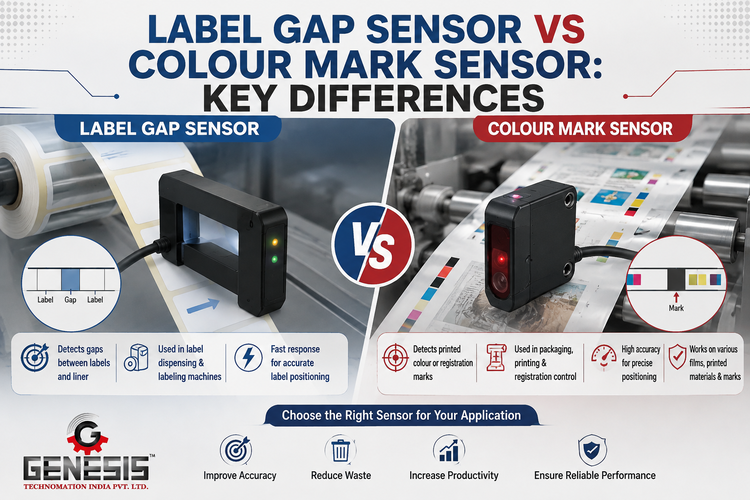
Label Gap Sensor vs Colour Mark Sensor is an important comparison when selecting the right detection technology for labeling machines, packaging equipment, printing machinery, and other automated production systems. Although both sensors can generate a precise switching signal for machine control, they detect different physical characteristics.
A Label Gap Sensor is primarily designed to detect the boundary or gap between labels and their backing liner. A Colour Mark Sensor, also called a registration mark sensor in many packaging applications, is primarily designed to detect a printed mark by analyzing colour, contrast, reflectivity, or optical transmission.
That distinction matters. A label dispenser that needs to know when one label ends and the next begins has a different sensing problem from a VFFS machine that must detect an eye mark to synchronize film cutting and sealing.
Choosing the wrong sensor can result in missed labels, false triggering, inconsistent registration, material waste, or production interruptions. The correct choice depends on the target material, detection principle, machine speed, mark or gap characteristics, mounting arrangement, environmental conditions, and controller requirements.
What Is a Label Gap Sensor?
A Label Gap Sensor is an industrial sensing device used to detect individual labels and the spaces between them as label stock moves through an automated labeling system.
In a typical roll-fed label application, labels are attached to a continuous backing liner. The sensor monitors the transition between the label material and the liner or gap. The resulting switching signal can be sent to a PLC, label dispenser controller, printer, or other machine control system.
The fundamental purpose is simple:
Detect where one label ends and the next label begins so the machine can position or dispense the label accurately.
Label gap sensors are commonly integrated into automatic labeling machines, label applicators, label dispensers, and related equipment. A commercial label-gap sensor is specifically intended to detect individual labels on a roll so that the machine can dispense them one at a time.
How Does a Label Gap Sensor Work?
The exact sensing technology depends on the sensor design. Optical fork sensors are common, while other applications may require ultrasonic or alternative sensing technologies.
A typical optical label sensor works approximately as follows:
- The sensor generates a sensing beam.
- The label web passes through or across the sensing area.
- The label and liner produce different optical conditions.
- The sensor detects the change between the label and the gap/liner.
- Internal electronics process that change.
- The sensor switches its output.
- The machine controller uses the signal to position, dispense, print, or apply the label.
Fork-style sensors have an emitter and receiver positioned in a fixed relationship, which eliminates much of the alignment difficulty associated with separate emitter/receiver arrangements.
The actual detection method should always be matched to the label construction. Standard optical gap sensors can work well with opaque labels, while transparent labels can require a different sensing approach. Industry guidance notes that the label material itself—not simply the backing material—is a critical factor when choosing the appropriate gap-sensing technology.
What Can Affect Label Gap Detection?
Label gap detection is influenced by several variables:
- Label material
- Liner material
- Label thickness
- Gap size
- Label transparency
- Surface reflectivity
- Lamination
- Machine speed
- Sensor response time
- Sensing distance
- Mechanical vibration
- Sensor alignment
For example, an opaque paper label on a conventional liner is generally a straightforward detection application. A clear film label can be substantially more challenging because the optical difference between label and liner may be small.
Therefore, “label sensor” should not be treated as a single universal technology. The sensor must be selected around the actual label construction.
What Is a Colour Mark Sensor?
A Colour Mark Sensor is an industrial optical sensor designed to detect a printed colour or contrast difference on a moving material.
In packaging machinery, it is frequently used as a registration mark sensor or eye mark sensor. The sensor detects a printed mark on packaging film and generates a switching signal that allows the machine controller to synchronize operations such as cutting, sealing, filling, printing, or film positioning.
The basic principle is different from label gap detection.
Instead of asking:
“Where is the gap between two labels?”
The sensor is essentially asking:
“Where is the programmed registration mark?”
A registration mark sensor is specifically designed to detect printed registration marks on continuous packaging webs. Such sensors are used on applications including VFFS, HFFS, and flow-wrapping equipment.
How Does a Colour Mark Sensor Work?
A typical Colour Mark Sensor operates through reflected-light or transmitted-light detection, depending on the sensor and application.
The general sequence is:
- The sensor illuminates the moving target.
- Light interacts with the packaging film or printed surface.
- Reflected or transmitted light reaches the receiver.
- The electronics evaluate the optical difference.
- The sensor distinguishes the registration mark from the background.
- The output changes state.
- The machine controller uses the signal for registration or timing.
The colour itself is not always the only factor. Contrast is often the more important consideration.
For example, a dark mark on a light background may create strong optical contrast. A subtle mark on a similar-colour background creates a more difficult sensing condition.
Modern registration sensors can be designed for very demanding applications. Banner’s R58 series, for example, specifies detection of colour contrast as low as 2% and switching frequencies up to 10 kHz, demonstrating why response characteristics matter in high-speed machinery.
Where Are Colour Mark Sensors Used?
Common applications include:
- Flexible packaging
- Pouch machines
- Sachet machines
- VFFS machines
- HFFS machines
- Flow wrappers
- Film cutting
- Film sealing
- Bag making
- Printing machinery
- Packaging registration
- Continuous-web applications
In these machines, a registration mark can act as the timing reference that tells the controller where a package should be cut or sealed.
Label Gap Sensor vs Colour Mark Sensor: Quick Comparison
| Feature | Label Gap Sensor | Colour Mark Sensor |
| Primary Purpose | Detect labels and gaps between labels | Detect printed colour/contrast marks |
| Detection Principle | Detects material/opacity/thickness transition | Detects optical colour or contrast difference |
| Main Target | Label and liner | Printed registration mark and background |
| Label Gap Detection | Primary function | Not normally the primary function |
| Colour/Contrast Detection | Usually not the primary function | Primary function |
| Registration Mark Detection | Generally not the intended application | Primary function |
| Transparent Label Suitability | Depends strongly on sensor technology and label construction | Can be suitable when sufficient optical contrast exists |
| Printed Mark Detection | Not normally its primary purpose | Designed for this application |
| Typical Application | Automatic label dispensing | Packaging registration |
| Packaging Machines | Suitable for label-based applications | Highly suitable for printed-film registration |
| Labeling Machines | Commonly used | Useful when a printed mark is the timing reference |
| Printing Machines | Limited/indirect application | Common registration application |
| Detection Target | Physical/material transition | Optical mark/background difference |
| Accuracy Requirement | Accurate label positioning | Accurate registration and machine timing |
| Response Speed | Must match label feed speed | Must match web speed and mark frequency |
| Installation | Often fork/slot arrangement | Usually positioned over or around the moving web |
| Adjustment | Teach/sensitivity/material setup | Mark/background/contrast setup |
| Maintenance | Clean sensor and maintain alignment | Clean optical surface and verify contrast/alignment |
| Best Use Case | Label-to-label positioning | Printed registration control |
The key distinction is therefore what the sensor is being asked to recognize.
A Label Gap Sensor primarily recognizes a physical difference associated with the label web. A Colour Mark Sensor primarily recognizes an optical difference associated with a printed mark.
Working Principle: Label Gap Sensor vs Colour Mark Sensor
Label Gap Sensor Working Principle
Consider a roll of pressure-sensitive labels attached to a liner.
As the roll moves:
Label → Gap → Label → Gap → Label
The Label Gap Sensor monitors these transitions.
Step 1: Sensing Signal
The sensor produces an optical or other appropriate sensing signal.
Step 2: Material Interaction
The signal interacts with the label and backing material.
Depending on the sensor design, differences in opacity, thickness, attenuation, or other material characteristics produce a measurable change.
Step 3: Gap Recognition
The electronics recognize the transition between label and gap/liner.
Step 4: Signal Processing
The sensor processes the detected transition according to its configured threshold or teach setting.
Step 5: Output Switching
The output changes state when the programmed detection condition occurs.
Step 6: Machine Control
The PLC or dedicated labeling controller uses this signal to determine label position.
That signal can control functions such as:
- Label dispensing
- Label feed stopping
- Label placement
- Print triggering
- Product-to-label synchronization
The objective is repeatable label positioning.
Colour Mark Sensor Working Principle
Now consider a continuous packaging film containing an eye mark:
Film → Printed Mark → Film → Printed Mark
The Colour Mark Sensor monitors the moving web for the programmed optical transition.
Step 1: Illumination
The sensor illuminates the film with an appropriate light source.
Step 2: Light Reception
Reflected or transmitted light is received by the sensor.
Step 3: Optical Analysis
The sensor evaluates the difference between the registration mark and its surrounding background.
Step 4: Mark Recognition
When the optical signal crosses the detection threshold, the electronics identify the registration mark.
Step 5: Output Generation
The sensor produces a switching signal.
Step 6: Machine Synchronization
The PLC or machine controller uses that signal to synchronize operations such as:
- Cutting
- Sealing
- Filling
- Printing
- Film feeding
- Registration correction
The accuracy of this signal is important because even a small timing error can shift the relationship between printed artwork and the mechanical operation.
Key Differences Between Label Gap Sensor and Colour Mark Sensor
1. Detection Method
The most fundamental difference is the detection method.
A Label Gap Sensor is generally concerned with detecting a material transition associated with the label and liner.
A Colour Mark Sensor is concerned with detecting an optical contrast or registration mark.
This distinction is important because the same packaging material can require completely different sensors depending on what the machine needs to detect.
2. Detection Target
A Label Gap Sensor targets:
- Labels
- Label gaps
- Liner transitions
- Material boundaries
A Colour Mark Sensor targets:
- Printed eye marks
- Registration marks
- Colour differences
- Contrast differences
A registration mark may be only a small printed feature, but it can provide the timing reference for an entire packaging cycle.
3. Label Detection
Label Gap Sensors are specifically suited to applications where labels are supplied on a continuous backing material.
The sensor detects the transition between the label and the area between labels.
This makes it useful for:
- Label dispensing
- Roll-fed labels
- Automatic applicators
- Sticker labeling
- Bottle labeling
- Carton labeling
The sensor does not need a printed registration mark if the label boundary itself provides the required positional information.
4. Registration Mark Detection
Colour Mark Sensors are preferred when a printed registration mark controls machine timing.
For example, a packaging film may contain a black rectangular eye mark printed near the edge of the artwork. The sensor detects this mark and sends a signal to the machine controller.
That signal can determine where the machine should:
- Cut
- Seal
- Fill
- Index
- Correct registration
Registration mark sensors are explicitly designed for continuous-web packaging applications.
5. Transparent Material Detection
Transparent labels deserve special attention.
A conventional optical gap sensor may struggle when the label and liner do not produce enough optical difference. For clear labels, ultrasonic label-gap sensing or specialized optical technologies may be more appropriate depending on the construction.
Industry guidance for labeling systems specifically notes that clear labels can require ultrasonic sensing, while opaque paper or film labels can often be handled by conventional optical gap sensors.
However, there is no universal rule that one technology will work with every transparent label.
The following variables matter:
- Label thickness
- Adhesive layer
- Liner thickness
- Transparency
- Surface finish
- Web tension
- Sensor geometry
Application testing is recommended before final selection.
6. Colour and Contrast
Colour Mark Sensor performance depends heavily on the optical relationship between the mark and background.
A high-contrast black mark on white film is generally easier to detect than a light grey mark on silver metallized film.
However, advanced sensors can use different light wavelengths and signal-processing techniques to improve detection under difficult conditions.
The correct sensor should therefore be tested with the actual production film, ink, mark size, and machine speed.
7. Application
Label Gap Sensors are strongly associated with labeling systems.
Colour Mark Sensors are strongly associated with packaging and printing registration.
There can be overlap. For example, a labeling machine could use a registration mark if the labels or web include printed timing marks. The correct technology depends on what the machine’s control logic requires.
8. Speed and Response Time
Sensor response time becomes increasingly important as machine speed increases.
Suppose a registration mark is moving rapidly through the sensing point. If the sensor response is too slow, the resulting switching signal may occur too late for the controller to perform the required mechanical action at the intended position.
For high-speed applications, engineers should evaluate:
- Response time
- Switching frequency
- Repeatability
- Mark size
- Web speed
- Output delay
- Controller input timing
As an example of modern performance levels, Banner lists a 10 kHz switching frequency and 15 µs repeatability for its R58 registration-mark sensor family.
Do not select a sensor solely because its nominal detection range looks adequate. Timing performance must be evaluated against the complete machine cycle.
9. Accuracy and Repeatability
Accuracy and repeatability are not exactly the same.
Accuracy concerns how closely the detected position corresponds to the actual target position.
Repeatability concerns how consistently the sensor switches at the same target condition over repeated cycles.
For a label dispenser, inconsistent detection can cause:
- Label position variation
- Label waste
- Misapplied labels
- Product rejection
For a packaging machine, inconsistent registration detection can cause:
- Incorrect cut position
- Seal misalignment
- Artwork registration errors
- Package-length variation
The sensor is therefore one part of a larger electromechanical timing system.
10. Setup and Calibration
Label Gap Sensors typically require adjustment according to:
- Label material
- Liner
- Gap
- Sensor position
- Sensitivity
- Detection threshold
Colour Mark Sensors require adjustment according to:
- Mark colour
- Background
- Contrast
- Sensor distance
- Light source
- Mark size
- Material reflectivity
Many industrial sensors provide teach or automatic setup functions, but automatic setup does not eliminate the need for proper mechanical installation.
11. Environmental Conditions
Industrial sensors operate in environments that may include:
- Dust
- Oil
- Vibration
- Temperature changes
- Moisture
- Ambient light
- Material contamination
Dust and Contamination
Dust or adhesive residue can alter the optical path and reduce detection reliability.
Oil
Oil contamination can change surface reflectivity and interfere with optical detection.
Ambient Light
Strong external light can affect some optical sensors. Modern designs may use modulation or filtering to reduce this influence. For example, some registration sensors use pulse-modulated light specifically to reduce ambient-light interference.
Vibration
Vibration can change the sensor-to-target geometry, particularly where a narrow sensing window is required.
Temperature
Operating temperature must remain within the sensor’s specified range.
Reflective Surfaces
Glossy, metallic, laminated, or metallized materials can create unwanted reflections and require careful sensor selection and mounting.
12. Cost and Total Value
The lowest purchase price is not necessarily the lowest-cost solution.
When comparing sensors, consider:
- Purchase cost
- Installation time
- Setup time
- Compatibility
- Downtime
- False detection
- Material waste
- Maintenance
- Replacement availability
- Technical support
A sensor that costs more but reliably detects the target at production speed may provide greater overall value than an inexpensive sensor that repeatedly requires adjustment.
The selection should therefore be based on total application value, not price alone.
Label Gap Sensor Applications
Automatic Labeling Machines
Automatic labeling machines require accurate detection of each label on a roll.
The sensor tells the control system when a label or gap reaches the sensing position, allowing the machine to control feed and dispensing.
Bottle Labeling Machines
Bottle labeling systems need consistent label positioning around containers.
A Label Gap Sensor can provide the label-position signal required by the applicator.
Sticker Labeling Machines
Sticker and adhesive-label systems frequently use roll-fed labels.
The sensor detects the individual labels and supports accurate dispensing.
Pharmaceutical Labeling
Pharmaceutical packaging places a high emphasis on repeatability and traceability.
Label detection can be used for:
- Vials
- Bottles
- Cartons
- Medical packaging
Sensor selection should account for label material, machine speed, cleaning requirements, and the overall machine validation strategy.
FMCG Packaging
FMCG production commonly uses high-speed labeling and packaging systems.
Reliable label detection can reduce interruptions caused by incorrect label positioning.
Food and Beverage Packaging
Food and beverage lines may use labeling sensors on bottles, containers, cartons, and other packages.
The sensor should be selected according to the material and environmental conditions of the production line.
Cosmetic Packaging
Cosmetic products frequently use decorative labels with different substrates, laminates, finishes, and transparency characteristics.
Application testing becomes particularly useful when labels have glossy or transparent surfaces.
Carton Labeling
Carton labeling equipment can use gap detection to determine label position before applying the label to the carton.
Label Dispensing Systems
Label dispensers are one of the clearest applications for Label Gap Sensors.
The sensor allows the controller to distinguish successive labels and coordinate the dispensing cycle.
Roll-Fed Label Applications
Whenever labels are supplied as a continuous roll with spaces or transitions between individual labels, a Label Gap Sensor can be considered.
Colour Mark Sensor Applications
Flexible Packaging
Flexible packaging films often contain printed registration marks that establish the timing reference for the machine.
A Colour Mark Sensor detects these marks while the film moves continuously.
Pouch Machines
Pouch-making machinery uses registration marks to coordinate film movement, cutting, sealing, and other operations.
Sachet Machines
Sachet machines operate at high production rates and require consistent registration.
A registration mark sensor provides the machine controller with a repeatable optical reference.
VFFS Machines
Vertical Form-Fill-Seal machines commonly use registration marks to coordinate the formation, filling, cutting, and sealing of packages.
Registration sensors are specifically used in VFFS applications.
HFFS Machines
Horizontal Form-Fill-Seal machines similarly depend on registration information when packaging film contains printed artwork.
Wrapping Machines
Flow wrappers and other continuous-web wrapping systems can use registration mark sensors to synchronize film movement and cutting.
Printing Machines
Printing machinery can use registration detection to monitor or control the position of printed material.
Film Cutting
A registration mark provides a positional reference for the cutting mechanism.
If the sensor detects the mark consistently, the machine controller can trigger cutting at the programmed offset.
Film Sealing
Registration information can also be used to coordinate sealing operations with printed artwork.
Packaging Film Alignment
When printed artwork must remain synchronized with machine operations, Colour Mark Detection provides an optical timing reference.
Application Comparison Table
| Application | Recommended Sensor | Reason |
| Automatic label dispensing | Label Gap Sensor | Detects individual labels and gaps on label stock |
| Bottle labeling | Label Gap Sensor | Provides label-position information |
| Sticker labeling | Label Gap Sensor | Suitable for roll-fed adhesive labels |
| Transparent labels | Application-dependent | Specialized optical or ultrasonic technology may be required |
| Printed registration mark | Colour Mark Sensor | Designed to detect optical marks |
| Flexible packaging film | Colour Mark Sensor | Commonly used for registration control |
| Pouch machine | Colour Mark Sensor | Provides timing reference for packaging operations |
| Sachet machine | Colour Mark Sensor | Detects registration marks on moving film |
| Film cutting | Colour Mark Sensor | Enables cutting relative to printed artwork |
| Film sealing | Colour Mark Sensor | Helps synchronize sealing with registration |
| Printing machine | Colour Mark Sensor | Suitable for printed-mark registration |
| Label roll detection | Label Gap Sensor | Designed for label-to-label/gap detection |
The recommendation is not absolute. If a machine uses a different physical reference—for example, a printed mark rather than the physical label gap—the sensing technology should follow that requirement.
Label Gap Sensor vs Colour Mark Sensor: Which One Should You Choose?
A practical decision can start with one question:
What exactly does the machine need to detect?
Choose a Label Gap Sensor When:
- Labels are supplied on a continuous liner.
- The machine needs to detect the gap between labels.
- Label dispensing is the primary operation.
- Label-to-label positioning is required.
- The physical label boundary is the machine’s positional reference.
- The application involves roll-fed adhesive labels.
Choose a Colour Mark Sensor When:
- A printed registration mark controls timing.
- Packaging film contains an eye mark.
- Cutting must align with printed artwork.
- Sealing must be synchronized with the film.
- Registration control is required.
- Colour or optical contrast is the primary detection feature.
When Should You Test the Application?
Testing is strongly recommended when the application involves:
- Transparent labels
- Semi-transparent film
- Metallized film
- Low-contrast marks
- Glossy surfaces
- Very small registration marks
- Very high web speed
- Unusual label construction
- Strong ambient lighting
The sensor should ideally be tested using the actual production material at or near the intended operating speed.
How to Select the Right Label Gap Sensor
Before purchasing a Label Gap Sensor, evaluate the complete label construction.
1. Label Material
Determine whether the label is:
- Paper
- PET
- PP
- PE
- Film
- Laminated
- Transparent
- Semi-transparent
2. Liner Material
The liner influences the optical or physical difference that the sensor needs to detect.
3. Label Thickness
Thin labels can produce a smaller detectable difference than thick labels.
4. Label Transparency
Clear labels may require specialized sensing technology.
5. Label Size
Very small labels may require faster response and carefully controlled sensing geometry.
6. Gap Size
The sensor must reliably distinguish the label from the gap at the actual machine speed.
7. Machine Speed
Calculate the time available for the sensor to detect the target.
8. Sensing Distance
Follow the manufacturer’s specified sensing geometry.
9. Mounting Space
A fork sensor may be convenient where the web can pass directly through the sensing slot.
10. Output Type
Check whether the controller requires:
- NPN
- PNP
- NO
- NC
- Push-pull
- Other specified output
11. Supply Voltage
Confirm compatibility with the machine’s control voltage.
12. Response Time
Ensure the sensor can respond fast enough for the required label speed.
13. IP Rating
Select an appropriate ingress-protection level for the environment.
14. Operating Temperature
Verify the operating temperature range.
15. Connection Type
Consider:
- M8
- M12
- Cable
- Connector
- Other machine-specific connection
16. PLC Compatibility
The sensor output must be electrically and logically compatible with the PLC or controller input.
How to Select the Right Colour Mark Sensor
Mark Colour
Identify the actual registration-mark colour.
Do not assume a “black mark” sensor will perform equally well on every black ink, film, or surface.
Background Colour
The background surrounding the mark is equally important.
Contrast
Strong contrast generally simplifies detection, while low-contrast combinations require more capable sensing technology.
Film Type
Evaluate:
- PE
- PP
- PET
- Laminated film
- Metallized film
- Transparent film
- Paper
Surface Reflectivity
Glossy surfaces can cause specular reflections that affect optical sensing.
Mark Size
Very small marks place greater demands on sensing resolution and response.
Detection Distance
Maintain the manufacturer’s recommended sensing distance.
Machine Speed
The sensor’s response must be compatible with the web velocity and mark frequency.
Response Time
High-speed packaging applications require careful evaluation of response time and switching frequency.
Light Source
Different sensing wavelengths can produce different levels of contrast depending on the ink and substrate.
Ambient Light
Where strong ambient light exists, select a sensor designed to minimize susceptibility to external illumination.
Output Type
Confirm PLC/controller compatibility.
Mounting
The sensor must remain mechanically stable and correctly aligned with the registration mark.
IP Rating
Select the protection level according to the machine environment.
Operating Environment
Temperature, dust, moisture, vibration, cleaning processes, and contamination should all be considered.
Test the Mark and Background Combination
The most reliable selection method is to test the actual mark, actual substrate, and actual machine speed.
A sensor that works perfectly on a sample sheet at low speed may behave differently on a continuously moving web with vibration, glare, or contamination.
Common Installation Mistakes
Incorrect Sensing Distance
Placing the sensor outside its recommended sensing range can reduce signal quality and repeatability.
Poor Alignment
A small alignment error can move the target away from the optimal sensing position.
Incorrect Sensor Angle
The wrong angle can create reflections, particularly on glossy or metallized surfaces.
Excessive Ambient Light
Strong external illumination can interfere with optical detection in unsuitable sensor designs.
Dirty Sensing Surface
Dust, adhesive, oil, or ink can change the detected optical signal.
Incorrect Sensitivity Setting
Excessive sensitivity can produce false switching. Insufficient sensitivity can cause missed detections.
Insufficient Contrast
A registration mark that is too similar to the background can be difficult to detect reliably.
Incorrect Mounting Position
The sensor must be positioned where the required label gap or mark passes consistently.
High Vibration
Mechanical movement can change the sensing geometry and create inconsistent signals.
Wrong Output Configuration
A sensor may detect correctly but still fail to control the machine if its output configuration does not match the PLC input.
Troubleshooting Guide
| Problem | Possible Cause | Recommended Solution |
| Label gap not detected | Incorrect sensor type, poor alignment, insufficient material difference | Verify sensor technology, mounting and label construction |
| False detection | Excessive sensitivity, contamination, vibration | Clean sensor, reduce sensitivity if appropriate, secure mounting |
| Missed registration mark | Low contrast, wrong sensing distance, excessive speed | Check mark/background contrast, distance and response specifications |
| Inconsistent output | Material movement, vibration, unstable threshold | Check web tension, mounting and sensor settings |
| Sensor detects background | Poor contrast or incorrect threshold | Re-teach the sensor and verify optical contrast |
| Transparent label detection issue | Insufficient optical difference | Consider specialized optical or ultrasonic label sensing |
| Detection fails at high speed | Response time too slow or mark too small | Select a faster sensor and verify switching frequency |
| Signal fluctuates | Reflections, contamination, vibration or unstable material | Clean optics, adjust angle, improve mounting and check material path |
Troubleshooting should start with the physical sensing condition before replacing the sensor.
Maintenance Tips
Industrial sensors are relatively low-maintenance devices, but preventive checks can significantly improve reliability.
Clean the Sensing Surface
Remove dust, oil, adhesive, ink, and other contamination according to the manufacturer’s cleaning recommendations.
Check Alignment
Verify that the sensor has not moved due to vibration or accidental mechanical contact.
Check Cables and Connectors
Inspect for:
- Loose connections
- Damaged insulation
- Connector contamination
- Cable strain
Verify Mounting
A loose bracket can produce intermittent detection problems.
Check Sensor Settings
Record and periodically verify:
- Sensitivity
- Teach values
- Light/dark operation
- Output configuration
Inspect Labels and Marks
Changes in label supplier, material, ink, laminate, or artwork can affect sensing performance.
Perform Periodic Testing
Test detection at normal operating speed rather than only during machine idle conditions.
Use Preventive Maintenance
Include sensor inspection in the machine’s preventive-maintenance schedule, especially on high-speed packaging and labeling equipment.
Buying Label Gap Sensors and Colour Mark Sensors
Selecting the right supplier is part of the engineering decision. Buyers should evaluate not only product availability but also technical compatibility, sensor specifications, output requirements, machine integration, and application support.
For industrial buyers in India, Genesis Technomation India Private Limited can be considered as a potential source for Label Gap Sensors, Colour Mark Sensors, and related industrial automation components.
Genesis Technomation’s published industrial automation portfolio includes industrial sensors and specifically lists Color Mark Sensors among its sensor offerings.
Potential applications to discuss with a supplier include:
- Labeling machines
- Packaging machines
- Printing applications
- Industrial automation
- Label detection
- Registration mark detection
- Packaging film sensing
Before ordering, provide the supplier with practical application information such as:
- Material type
- Label or mark dimensions
- Label gap
- Transparency
- Background colour
- Mark colour
- Machine speed
- Sensing distance
- Required output
- PLC/controller model
- Installation constraints
- Environmental conditions
This information allows the sensor selection to be based on the actual machine rather than on the product name alone.
Explore Genesis Technomation’s industrial automation solutions
FAQs about Differences between Label Gap Sensor and Colour Mark Sensor
What is the difference between a Label Gap Sensor and a Colour Mark Sensor?
A Label Gap Sensor primarily detects the transition between labels and their backing material, while a Colour Mark Sensor primarily detects a printed colour or contrast registration mark. The first is commonly associated with label dispensing; the second is commonly associated with packaging and printing registration.
What is a Label Gap Sensor used for?
A Label Gap Sensor is used to detect individual labels and gaps on a continuous label web. It is commonly used in automatic labeling machines, label dispensers, bottle labeling equipment, and roll-fed labeling systems.
What is a Colour Mark Sensor used for?
A Colour Mark Sensor is used to detect printed registration marks on moving materials. Packaging machines use the resulting signal to synchronize cutting, sealing, filling, printing, or film positioning.
Can a Colour Mark Sensor detect label gaps?
It may be possible in some application-specific circumstances, but that is not its primary purpose. If the machine specifically needs to detect the boundary between labels, a dedicated Label Gap Sensor is generally the more appropriate starting point.
Can a Label Gap Sensor detect colour marks?
A standard Label Gap Sensor is not normally selected for printed registration-mark detection. When a printed mark is the machine’s timing reference, a Colour Mark or Registration Mark Sensor is generally more appropriate.
Which sensor is better for labeling machines?
For conventional roll-fed label dispensing, a Label Gap Sensor is usually the appropriate technology because it detects individual labels and their gaps. If the labeling machine uses a printed registration mark as its positional reference, the application may instead require a Colour Mark Sensor.
Which sensor is better for packaging machines?
For packaging machines that use printed registration marks on continuous film, a Colour Mark Sensor is generally the appropriate choice. VFFS, HFFS, and flow-wrapping systems are common applications for registration mark sensing.
Which sensor is suitable for transparent labels?
The answer depends on the label and liner construction. Transparent labels can be difficult for conventional optical gap sensors. Specialized optical or ultrasonic sensing may be required, so testing the actual label material is recommended.
What is a registration mark sensor?
A Registration Mark Sensor is an optical sensor designed to detect a printed mark on a moving web. The mark provides a positional reference to the machine controller for operations such as cutting, sealing, or registration correction.
How does a Colour Mark Sensor detect printed marks?
The sensor illuminates the target and evaluates the reflected or transmitted light. Electronics distinguish the registration mark from the surrounding background according to the sensor’s detection characteristics and threshold.
How does a Label Gap Sensor detect labels?
The sensor detects a measurable difference between the label and the surrounding liner/gap. Depending on the technology, that difference can be related to optical transmission, opacity, thickness, or another material characteristic.
What factors affect Label Gap Sensor accuracy?
Important factors include label material, liner material, transparency, label thickness, gap size, machine speed, sensing distance, alignment, contamination, vibration, and sensor response characteristics.
What factors affect Colour Mark Sensor accuracy?
Colour Mark Sensor performance depends on mark/background contrast, ink characteristics, substrate reflectivity, mark size, sensing distance, machine speed, light source, ambient lighting, alignment, and contamination.
How do I select a sensor for a high-speed packaging machine?
Start with the target detection requirement, then evaluate mark size, material, contrast, web speed, sensor response time, switching frequency, output type, mounting, and environmental conditions. Test the sensor using actual production material whenever possible.
Can these sensors be connected to a PLC?
Yes. Industrial Label Gap Sensors and Colour Mark Sensors are commonly available with transistorized outputs such as NPN or PNP. However, the sensor output, supply voltage, wiring, logic, and PLC input specifications must be compatible.
How should these sensors be installed?
Follow the manufacturer’s recommended sensing distance and mounting orientation. Ensure stable mechanical mounting, correct alignment, suitable cable routing, and adequate protection from contamination and excessive vibration.
What causes false detection?
Common causes include incorrect sensitivity, insufficient contrast, optical reflections, contamination, vibration, ambient-light interference, incorrect sensing distance, unstable material movement, or an unsuitable sensor technology.
How often should industrial sensors be maintained?
There is no universal interval. Maintenance frequency should reflect the machine environment, contamination level, operating hours, and manufacturer recommendations. High-speed or dirty applications may require more frequent inspection.
Where can I buy Label Gap Sensors and Colour Mark Sensors?
Industrial buyers can evaluate suppliers such as Genesis Technomation India Private Limited for industrial sensor and automation requirements. Product selection should be based on the actual material, machine speed, detection target, output configuration, and environmental conditions.
Can Genesis Technomation supply both sensor types?
Genesis Technomation’s published industrial automation portfolio includes Color Mark Sensors and a broader range of industrial sensors. Its website can be consulted for current product availability and application support.
Conclusion
The fundamental difference in Label Gap Sensor vs Colour Mark Sensor selection comes down to the detection target.
A Label Gap Sensor is primarily designed to detect the boundary or gap between labels and their backing material. It is therefore particularly relevant to automatic labeling machines, label dispensers, sticker applicators, bottle labeling equipment, and other roll-fed label applications.
A Colour Mark Sensor, meanwhile, is primarily designed to detect a printed colour or contrast registration mark. It is particularly useful in flexible packaging, VFFS and HFFS machinery, pouch and sachet equipment, printing systems, film cutting, and sealing applications where printed artwork must remain synchronized with machine operations.
Neither sensor is universally “better.”
The correct choice depends on:
- What must be detected
- Material construction
- Transparency
- Mark/background contrast
- Label or mark dimensions
- Machine speed
- Response time
- Mounting arrangement
- Environmental conditions
- PLC compatibility
- Required detection accuracy
For difficult applications—especially transparent labels, metallized film, low-contrast registration marks, glossy substrates, or very high-speed machinery—application testing should be performed before finalizing the sensor.
For industrial buyers evaluating Label Gap Sensors, Colour Mark Sensors, and related automation components, Genesis Technomation India Private Limited is one potential supplier to consider. Buyers should provide their actual machine and material specifications so the sensor can be matched to the application rather than selected solely by product category.
Related Posts