Label Gap Sensor vs Ultrasonic Sensor is a useful comparison for engineers, OEMs, packaging-machine manufacturers, and automation professionals selecting a reliable label detection solution. The important point is that these terms describe two different things: a Label Gap Sensor refers primarily to the application or sensing function, while an Ultrasonic Sensor describes the underlying sensing technology.
In practical labeling systems, a conventional optical fork sensor may detect the difference between a label and its liner. However, when labels are transparent, semi-transparent, metallized, highly reflective, or otherwise difficult to distinguish optically, a dedicated ultrasonic label sensor can provide an alternative. Manufacturers such as Leuze and SICK specifically offer ultrasonic fork sensors for transparent and optically challenging labels.
That distinction is important when selecting a label detection sensor for a high-speed labeling or packaging machine.
What Is a Label Gap Sensor?
A Label Gap Sensor is a sensor designed to detect labels and the spaces or transitions between labels as they move on a carrier or backing liner.
In a typical roll-fed labeling application, the web consists of:
Label → Gap → Label → Gap → Label
The sensor detects the transition and generates an electrical output that the machine controller can use for label positioning, counting, dispensing, printing, or registration.
A Label Gap Sensor is therefore not necessarily defined by one particular sensing technology. Optical fork sensors are widely used, but ultrasonic fork sensors can also perform label-gap detection. Leuze, for example, offers optical, ultrasonic, and combined optical/ultrasonic fork sensors for different label-carrier combinations.
What Does a Label Gap Sensor Detect?
Depending on the sensor technology and application, it can detect:
- The presence of a label
- The gap between labels
- Label-to-label transitions
- Transparent labels
- Opaque labels
- Some metallized labels
- Irregularly shaped labels
The sensor output is then integrated into the labeling machine’s control system.
Why Are Label Gap Sensors Used?
Without reliable label detection, an automatic labeling machine may dispense labels at the wrong position or fail to maintain consistent spacing.
A correctly selected sensor helps the machine:
- Position labels accurately
- Count labels
- Control dispensing
- Trigger printing
- Synchronize product and label movement
- Reduce label waste
- Maintain repeatable production
For non-transparent labels, optical fork sensors are often appropriate. Leuze’s labeling guidance specifically describes optical fork sensors for detecting non-transparent labels and the gaps between labels.
What Is an Ultrasonic Sensor?
An Ultrasonic Sensor detects objects or measures distance using high-frequency sound waves rather than visible light.
A conventional industrial ultrasonic sensor typically contains a transducer that sends an ultrasonic signal toward a target and receives the resulting echo. The electronics analyze the returned signal to determine the presence, position, or distance of the target.
For general industrial automation, ultrasonic sensing can be useful when optical characteristics such as colour, transparency, or surface appearance make photoelectric detection difficult. Leuze notes that ultrasonic technology can detect glossy, reflective, transparent, or dark objects.
However, there is an important distinction between a general-purpose ultrasonic sensor and an ultrasonic label sensor.
A general ultrasonic proximity sensor is not automatically a suitable replacement for a dedicated label-gap fork sensor.
A dedicated ultrasonic label sensor is designed around the geometry, material differences, and fast switching requirements of label detection.
Ultrasonic Sensing in Label Applications
In ultrasonic label detection, the sensor can distinguish the label from the carrier based on changes in the ultrasonic signal as the material passes through the sensing area.
SICK describes its UFS fork sensor as distinguishing labels from carrier material according to signal attenuation: the label and carrier combination attenuate the ultrasonic signal differently from the carrier alone.
This makes ultrasonic technology particularly interesting for transparent or optically challenging labels.
How Does a Label Gap Sensor Work?
The exact Label Gap Sensor working principle depends on whether the sensor uses optical, ultrasonic, or another sensing method.
For a conventional optical fork-style sensor, the process can be simplified as follows:
Step 1: Label Material Enters the Sensing Area
The continuous label web moves through the sensor’s fork or sensing zone.
Step 2: The Sensor Monitors the Material
The sensor observes the difference between the label and its carrier or liner.
Step 3: A Material Transition Is Detected
The label and gap produce different sensing conditions.
For an optical sensor, this may be related to light transmission or attenuation.
Step 4: Electronics Process the Signal
The sensor evaluates the change against its configured threshold or teach setting.
Step 5: The Output Switches
The sensor generates an electrical switching signal when the programmed detection condition is reached.
Step 6: The Machine Controller Responds
The PLC or labeling controller uses that signal to:
- Stop label feed
- Start label dispensing
- Trigger a printer
- Count labels
- Synchronize an applicator
Fork-Style Construction
A fork sensor places the emitter and receiver in a fixed housing.
This provides a major mechanical advantage: the two sensing elements are already aligned.
That makes installation particularly convenient in compact labeling equipment.
Leuze’s optical GS61 and GS63B fork sensors, for example, are designed for label detection and can be installed close to the dispensing edge because of their slimline construction.
Factors Affecting Detection
A Label Gap Sensor’s performance depends on:
- Label material
- Liner material
- Label thickness
- Gap size
- Label transparency
- Sensor technology
- Sensor alignment
- Machine speed
- Response time
- Web stability
- Contamination
The important engineering principle is simple: select the sensor according to the label-carrier combination, not simply the label name.
How Does an Ultrasonic Sensor Work?
The Ultrasonic Sensor working principle is based on high-frequency sound.
For a general industrial ultrasonic sensor:
- The transducer emits ultrasonic sound waves.
- The sound travels through the air toward the target.
- The target interacts with the sound waves.
- The returning signal is received.
- Internal electronics evaluate the signal.
- The sensor determines the required detection condition.
- An output is sent to the machine controller.
In a dedicated ultrasonic label fork, the operating concept is somewhat different from a conventional distance-measuring ultrasonic sensor.
The label and carrier pass through the fork, and their different ultrasonic attenuation characteristics allow the sensor to distinguish the label from the carrier.
This is why an ultrasonic label sensor should not simply be considered a normal distance sensor mounted near a label roll.
Teach-In and Calibration
Ultrasonic label sensors generally require appropriate setup or teach-in for the material being detected.
The sensor must establish a reliable reference for the label/carrier combination.
Leuze’s ultrasonic label sensors include teach functionality, while some of its newer systems also provide additional adjustment and IO-Link-related setup capabilities.
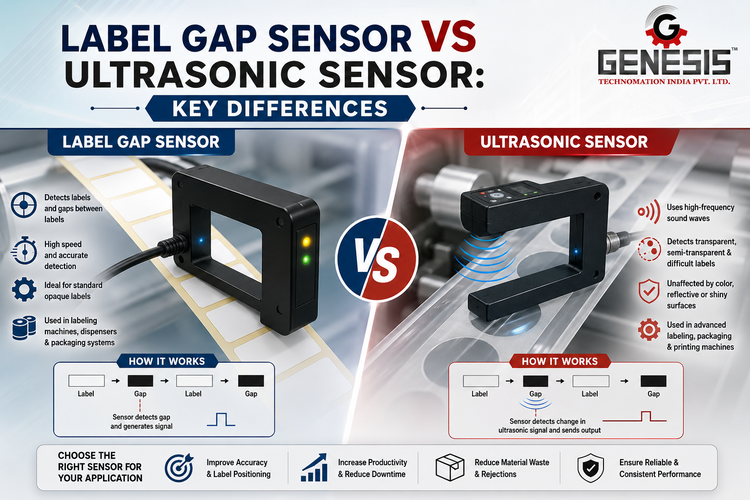
Label Gap Sensor vs Ultrasonic Sensor: Key Differences
The most important comparison is not simply “optical versus ultrasonic.” A Label Gap Sensor can itself use ultrasonic technology.
| Parameter | Label Gap Sensor | Ultrasonic Sensor |
| Primary purpose | Label/gap detection | Object/material detection using ultrasonic technology |
| Technology | Often optical, but may also be ultrasonic | Ultrasonic |
| Label detection | Designed specifically for label applications | Depends on sensor design; dedicated ultrasonic label sensors are optimized for labels |
| Transparent labels | Depends on technology/model | Dedicated ultrasonic label sensors are often well suited |
| Colour dependency | Depends on sensing technology | Generally low dependence on visible colour |
| Metallicized labels | Model/application dependent | Can be suitable with appropriate ultrasonic label sensor |
| Detection principle | Material/optical transition or dedicated label sensing | Ultrasonic signal interaction/attenuation |
| Typical application | Labeling and packaging | Label detection, object detection, distance or level applications depending on model |
| Installation | Often simple with fork-style construction | Depends on sensor design |
| Best suited for | Dedicated label positioning and gap detection | Applications where ultrasonic sensing provides an advantage |
The terminology matters:
Label Gap Sensor = what the machine needs to detect.
Ultrasonic Sensor = how the sensor detects it.
That means the comparison is not always between two mutually exclusive products.
An ultrasonic Label Gap Sensor is entirely possible.
In fact, Leuze offers ultrasonic fork sensors specifically for label detection, including transparent and semi-transparent labels.
Label Gap Sensor vs Ultrasonic Sensor: Which One Is Better?
There is no universally better option.
The correct choice depends on the application.
For standard opaque paper labels with a predictable liner and sufficient optical difference, an optical Label Gap Sensor may be a straightforward solution.
For transparent, semi-transparent, reflective, or optically difficult labels, a dedicated ultrasonic label sensor may be a better candidate.
The decision should consider:
- Label transparency
- Label thickness
- Liner material
- Label colour
- Metallic coating
- Surface reflectivity
- Gap size
- Machine speed
- Required repeatability
- Mounting space
- Environmental conditions
- PLC compatibility
- Sensor response characteristics
For example, Leuze identifies optical fork sensors for non-transparent labels and ultrasonic fork sensors for transparent or semi-transparent labels. Its combined GSX14E technology uses both optical and ultrasonic detection to handle a broader range of label materials.
The practical approach is therefore to test the actual label and liner before making the final selection.
When Should You Choose a Label Gap Sensor?
A conventional Label Gap Sensor is a strong candidate when the application has a clear, repeatable label-to-liner difference.
Typical applications include:
Standard Paper Labels
Paper labels with conventional liners are common and can often be detected effectively using optical fork sensors.
High-Speed Labeling Machines
A suitable high-speed fork sensor can provide the switching signal required for rapid label dispensing.
Packaging Machines
Packaging equipment that applies pre-printed labels can use gap detection to synchronize label feeding.
Label Dispensing
This is one of the primary applications for label gap detection.
Label Counting
Each label transition can be used to count labels as they pass through the sensing point.
Print-and-Apply Systems
A label detection signal can coordinate label printing and application.
Pharmaceutical Packaging
Accurate label positioning is important for bottles, cartons, containers, and other pharmaceutical packages.
FMCG Packaging
Consumer products frequently use roll-fed labels and automatic applicators.
Food and Beverage Labeling
Bottle and container labeling machines can use label detection to coordinate dispensing.
Logistics and Barcode Labeling
Automated logistics systems can use label detection for print-and-apply operations and package identification.
The exact sensor technology should still be selected according to the label and liner characteristics.
When Should You Choose an Ultrasonic Sensor?
A dedicated Ultrasonic Label Sensor becomes particularly interesting when optical sensing is problematic.
Consider ultrasonic technology for:
- Transparent labels
- Semi-transparent labels
- Transparent carriers
- Very thin labels
- Metallized labels
- Glossy materials
- Printed labels with difficult optical characteristics
- Labels where colour causes optical detection problems
- Applications where ambient light or reflectivity complicates optical sensing
Leuze specifically states that its ultrasonic fork sensors can detect transparent and semi-transparent labels, including challenging label shapes.
SICK likewise describes ultrasonic fork sensing for transparent, reflective, and printed labels and explains that the technology distinguishes labels based on ultrasonic attenuation rather than optical appearance.
This does not mean every ultrasonic sensor will perform equally well.
The sensor must be designed and specified for the application.
Can an Ultrasonic Sensor Detect Transparent Labels?
Yes, a dedicated ultrasonic label sensor can be suitable for transparent and semi-transparent labels.
This is one of the main reasons ultrasonic label detection is used in modern labeling systems.
Optical detection depends on the interaction of light with the label. A clear label can transmit a large amount of light, making the difference between the label and its carrier difficult to distinguish.
Ultrasonic detection uses sound rather than visible light.
Leuze specifically lists transparent-label detection as an application for its GSU12, GSU14E, and IGSU14E ultrasonic fork sensors.
However, the correct statement is not “ultrasonic sensors detect every transparent label.”
Material thickness, construction, adhesive, carrier, machine speed, and sensor design still matter.
Application testing remains the safest engineering approach.
Can a Label Gap Sensor Detect Transparent Labels?
It depends on the technology.
Optical Label Gap Sensors
Transparent labels can be difficult for conventional optical gap detection because the optical difference between label and carrier may be too small.
Ultrasonic Label Gap Sensors
A Label Gap Sensor using ultrasonic technology can be suitable for transparent or semi-transparent labels.
This is why the terms Label Gap Sensor and Ultrasonic Sensor should not be treated as competing categories in every application.
For example, a manufacturer may offer:
- Optical label fork
- Ultrasonic label fork
- Combined optical/ultrasonic label fork
Leuze’s GSX14E is an example of a combined technology designed to broaden label detection capability across different materials.
Applications of Label Gap Sensors and Ultrasonic Sensors
| Application | Suitable Technology | Reason |
| Standard opaque labels | Optical Label Gap Sensor | Straightforward label/liner differentiation |
| Transparent labels | Ultrasonic Label Sensor | Avoids reliance on visible optical contrast |
| Semi-transparent labels | Ultrasonic Label Sensor | Suitable for challenging optical conditions |
| Bottle labeling | Label Gap Sensor | Provides label positioning signal |
| Carton labeling | Label Gap Sensor | Supports label dispensing and positioning |
| Pharmaceutical labeling | Application dependent | Depends on label construction and machine design |
| FMCG labeling | Application dependent | Standard or specialized sensing may be required |
| Packaging | Application dependent | Select according to material and detection target |
| Printing | Application dependent | Sensor selection depends on registration/detection requirement |
| Converting | Application dependent | Material properties determine suitable sensing method |
| Barcode labeling | Label Gap Sensor | Useful for roll-fed label positioning |
| Automatic dispensing | Label Gap Sensor | Designed around label-to-label detection |
The key is not the industry alone.
The physical sensing problem determines the technology.
Important Factors When Selecting a Label Detection Sensor
Label Material
Determine whether the label is:
- Paper
- PET
- PP
- PE
- Transparent film
- Laminated material
- Metallized material
- Multi-layer material
A transparent label may require a very different sensing approach from an opaque paper label.
Backing/Liner Material
The carrier is just as important as the label.
The sensor must distinguish the label/carrier combination reliably.
Label Thickness
Very thin labels can create smaller sensing differences.
Multi-layer labels or unusual constructions may also change the sensing characteristics.
Label Gap
Small gaps require appropriate sensor resolution and repeatability.
The smaller the gap, the more carefully response characteristics and mechanical stability should be evaluated.
Machine Speed
The sensor must detect the label transition quickly enough for the machine controller to use the signal.
High-speed machines require attention to:
- Response time
- Switching frequency
- Web speed
- Output delay
- Controller timing
As an example, SICK’s current UFS product documentation describes ultrasonic label detection for small label gaps and high-speed operation, illustrating why sensor performance must be considered against the actual production process.
Sensor Mounting
Fork-style sensors provide fixed emitter/receiver geometry.
Other sensors may require careful positioning and alignment.
Environmental Conditions
Consider:
- Dust
- Adhesive contamination
- Oil
- Moisture
- Vibration
- Temperature
- Mechanical movement
Output and Automation Compatibility
Before purchasing, verify:
- PNP/NPN output
- Switching logic
- Supply voltage
- Connector
- PLC input compatibility
- Communication interface where applicable
Do not select a sensor based only on its detection capability. It must also integrate correctly with the machine’s electrical architecture.
Advantages of Using Label Gap Sensors
A properly selected Label Gap Sensor can provide several practical benefits.
Accurate Label Positioning
The sensor gives the controller a repeatable reference for label placement.
Reliable Gap Detection
The machine can distinguish successive labels when the label-carrier combination is suitable for the sensor.
High-Speed Operation
Appropriate sensor response characteristics allow integration into fast labeling systems.
Reduced Label Waste
Better detection can reduce incorrect label dispensing and associated material waste.
Improved Automation
The sensor provides a machine-readable position signal.
Consistent Dispensing
Reliable label detection supports repeatable dispensing cycles.
Easy Machine Integration
Fork-style sensors can be mechanically convenient, particularly in compact label applicators.
Advantages of Ultrasonic Label Detection
Ultrasonic technology offers several advantages in suitable applications.
Transparent Material Detection
Dedicated ultrasonic label sensors can detect transparent and semi-transparent labels that can be difficult for conventional optical sensing.
Lower Dependence on Visible Colour
Ultrasonic sensing does not depend on visible colour in the same way as optical sensing.
Challenging Label Detection
Reflective, transparent, or optically complex materials can be candidates for ultrasonic detection.
Stable Detection
Because the sensing principle is based on sound rather than visible light, optical effects such as colour and some surface-reflection problems can be reduced.
Specialized Packaging Applications
Ultrasonic label detection is particularly useful when packaging and labeling materials have become more diverse.
Modern labeling increasingly involves transparent areas, metallized labels, and unusual substrates, which is one reason manufacturers now provide multiple sensing principles for the same labeling process.
Common Problems in Label Gap Detection
False Triggering
Possible causes:
- Incorrect teach setting
- Excessive sensitivity
- Vibration
- Material movement
- Contamination
Practical solution: Recheck the sensor setup and mechanical stability, then test with the actual production material.
Missed Labels
Possible causes:
- Incorrect sensor technology
- Very small gap
- Insufficient material difference
- Excessive machine speed
Practical solution: Verify the sensor’s suitability for the label-carrier combination and production speed.
Incorrect Teach-In
An incorrect reference can cause unstable switching.
Solution: Repeat the teach procedure according to the manufacturer’s instructions using the actual label and carrier.
Poor Alignment
A misaligned sensor can produce inconsistent detection.
Solution: Check the sensor’s mechanical position and material path.
Dirty Sensing Area
Dust, adhesive or contamination can interfere with detection.
Solution: Clean the sensing surfaces using the manufacturer’s recommended procedure.
Very Small Gaps
Small gaps require adequate sensor resolution and response characteristics.
Solution: Verify the minimum label gap specified for the selected sensor.
Changing Label Materials
A sensor set up for one material may not automatically perform identically with another.
Solution: Revalidate the sensing setup after changing label stock.
High Machine Speed
A sensor that performs correctly at low speed may not be suitable at higher production speeds.
Solution: Compare machine speed with the sensor’s response and switching specifications.
Incorrect Mounting
Mechanical movement can alter the sensing condition.
Solution: Secure the sensor and verify the label web remains stable through the sensing area.
Label Gap Sensor vs Ultrasonic Sensor: Quick Decision Guide
Choose a conventional Label Gap Sensor when:
- The application specifically requires label/gap detection.
- The label and liner provide sufficient optical contrast.
- Labels are predominantly opaque.
- High-speed label positioning is required.
- A compact fork sensor fits the machine.
- The label material is already proven with the selected sensor.
Consider an Ultrasonic Label Sensor when:
- Labels are transparent.
- Labels are semi-transparent.
- Optical detection is unreliable.
- The label/carrier combination has challenging optical properties.
- Colour or reflectivity creates problems.
- A dedicated ultrasonic label fork is suitable for the material.
Consider combined technology when:
The production line handles multiple label types and no single sensing principle consistently handles all materials.
Leuze’s GSX14E, for example, combines optical and ultrasonic detection in one fork sensor for a broader range of label materials.
Label Gap Sensor and Ultrasonic Sensor Supplier in India
For Indian industrial buyers, Genesis Technomation India Private Limited offers both Label Gap/Fork Sensor solutions and Ultrasonic Sensor products.
Genesis lists a dedicated Label Gap Sensor / Fork Sensor product category covering label detection applications and models from brands including SICK, Banner, and Telemecanique.
It also publishes an Ultrasonic Sensors product page covering industrial object detection, transparent-object detection, packaging, printing and labeling applications, with models including T30UXUA, Q30UXIA, QS18UPA, QS18UNA, T30UXUC, T30UXUB, T30UXIC and T30UXIB.
When purchasing a sensor, buyers should provide the supplier with:
- Label material
- Liner material
- Label transparency
- Label thickness
- Gap size
- Label dimensions
- Machine speed
- Required sensing method
- Mounting arrangement
- PLC/output requirements
- Operating environment
This information makes it easier to select the appropriate sensor rather than simply choosing a product based on the word “ultrasonic” or “label.”
FAQs about Difference between a Label Gap Sensor and an Ultrasonic Sensor
What is the difference between a Label Gap Sensor and an Ultrasonic Sensor?
A Label Gap Sensor describes the function of detecting labels or gaps between labels, while an Ultrasonic Sensor describes a sensing technology that uses high-frequency sound waves. An ultrasonic sensor can itself be used as a Label Gap Sensor.
How does a Label Gap Sensor work?
It detects the transition between a label and its carrier or liner and generates an output signal for the machine controller. The exact detection principle depends on whether the sensor uses optical, ultrasonic, or another technology.
How does an Ultrasonic Sensor detect labels?
A dedicated ultrasonic label sensor detects changes in ultrasonic signal characteristics as the label and carrier move through the sensing area. The difference allows the sensor electronics to distinguish the label from the carrier.
Can ultrasonic sensors detect transparent labels?
Yes. Dedicated ultrasonic label sensors are specifically available for transparent and semi-transparent label detection. However, performance depends on the sensor design and actual label-carrier combination.
Which sensor is better for label gap detection?
Neither technology is universally better. A conventional optical Label Gap Sensor can be appropriate for standard opaque labels, while an ultrasonic label sensor may be preferable when transparent or optically difficult labels are involved.
Can a Label Gap Sensor detect transparent labels?
Some can. The answer depends on the sensing technology. Conventional optical sensors may have difficulty with transparent labels, whereas dedicated ultrasonic Label Gap Sensors are specifically designed for such applications.
What factors should be considered when selecting a label sensor?
Consider label and liner material, transparency, thickness, gap size, machine speed, sensor response, mounting space, environmental conditions, output type, and PLC compatibility.
Where can I buy Label Gap Sensors and Ultrasonic Sensors in India?
Genesis Technomation India Private Limited offers Label Gap/Fork Sensors and Ultrasonic Sensors for industrial automation applications. Buyers should provide their actual application details before selecting a model.
Conclusion
The Label Gap Sensor vs Ultrasonic Sensor comparison becomes much clearer once the terminology is separated.
A Label Gap Sensor describes the detection task: identifying labels, gaps, and label-to-carrier transitions. It can use different technologies, including optical and ultrasonic sensing.
An Ultrasonic Sensor describes the sensing principle: high-frequency sound waves are used to detect or measure a target.
For conventional opaque labels with a reliable optical difference between label and liner, an optical Label Gap Sensor can be an effective choice. For transparent, semi-transparent, reflective, or optically challenging labels, a dedicated ultrasonic label sensor may provide a better solution.
The final decision should be based on the actual:
- Label material
- Liner material
- Transparency
- Thickness
- Gap size
- Machine speed
- Required repeatability
- Mounting conditions
- Environmental conditions
- PLC/output requirements
For industrial buyers in India, Genesis Technomation India Private Limited can be considered for Label Gap/Fork Sensors and Ultrasonic Sensor requirements, with the final model selected according to the application’s technical requirements.
Related Posts