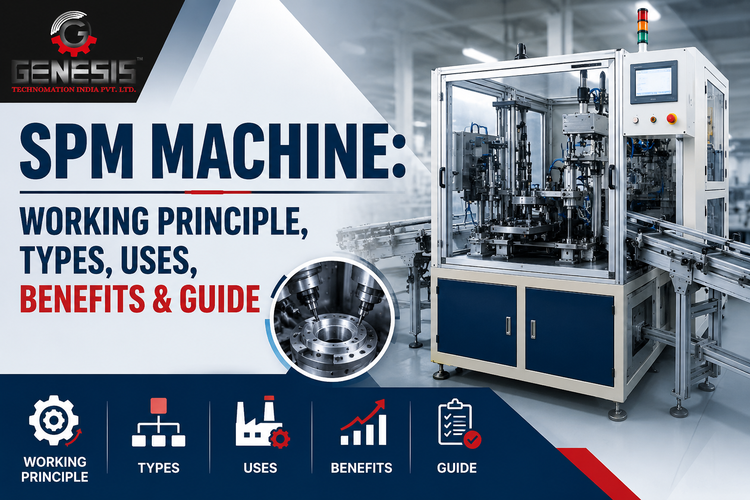
An SPM Machine, or Special Purpose Machine, is a custom-engineered industrial machine developed for a particular manufacturing operation, component, or production requirement. Unlike a general-purpose machine that is designed to handle a broad range of jobs, an SPM is built around the actual process that needs to be automated. It may combine mechanical mechanisms, fixtures, tooling, sensors, PLC controls, motors, drives, pneumatics, hydraulics, robotics, inspection systems, and safety devices in one integrated solution.
From a practical engineering standpoint, the most important point is this: an SPM should be designed around the manufacturing process, not around a collection of standard automation components. Component geometry, production volume, tolerance, cycle time, loading method, tooling, quality requirements, operator interaction, and future production needs all influence the final machine architecture.
What Is an SPM Machine?
SPM stands for Special Purpose Machine. It is a machine designed and manufactured to perform a defined operation or a controlled sequence of operations for a specific application.
A conventional lathe, milling machine, or machining center is intended for relatively broad applications. An SPM, in contrast, may be developed specifically for drilling a particular component, assembling several parts, pressing a bearing into a housing, testing a finished product, performing leak testing, or carrying out multiple machining operations in a controlled sequence.
The Indian Bureau of Energy Efficiency describes SPMs as customized machines that can combine operations that might otherwise require multiple conventional machines. Its example illustrates a machine performing turning, facing, trimming, and threading sequentially, with timers and sensors controlling the sequence.
A modern SPM can therefore include:
- Machine frame and mechanical structure
- Customized fixtures and tooling
- Pneumatic or hydraulic actuators
- Servo or stepper motion
- Motors and drives
- PLC and HMI
- Proximity and photoelectric sensors
- Encoders and other feedback devices
- Automatic loading and unloading
- Vision or inspection systems
- Safety interlocks and guarding
- Conveyors, feeders, or transfer mechanisms
The exact combination depends entirely on the application.
SPM Machine vs. Standard Machine
The distinction is not simply “automatic versus manual.” A general-purpose CNC can also be highly automated. The key difference is design intent.
A general-purpose machine is built to accommodate a range of jobs. A Special Purpose Machine is engineered around a narrower, predefined manufacturing requirement.
That makes an SPM particularly attractive where production is repetitive and stable enough to justify dedicated automation.
How Does an SPM Machine Work?
The SPM Machine working principle depends on the application, but most automated SPMs follow a logical sequence.
Step 1: Component Loading
The raw component is loaded manually, through a feeder, conveyor, robot, gantry, bowl feeder, or another material-handling mechanism.
Step 2: Component Detection
Sensors confirm that the component has reached the correct position. Depending on the application, the machine may use proximity sensors, photoelectric sensors, vision systems, limit switches, or other detection technologies.
Step 3: Positioning and Clamping
The component is positioned against predetermined locating surfaces and securely clamped.
This stage deserves more attention than it often receives. A poor fixture can introduce variation even when the machine’s motion system is highly accurate. The fixture must locate the part consistently while resisting machining or process forces without unnecessarily distorting the component.
Step 4: Manufacturing Operation
The machine executes its programmed operation. This might involve:
- Drilling
- Tapping
- Milling
- Turning
- Pressing
- Welding
- Assembly
- Dispensing
- Marking
- Testing
- Inspection
The operation can be driven by electric motors, servo axes, pneumatic cylinders, hydraulic systems, or a combination of technologies.
Step 5: Process Monitoring
Sensors and feedback devices verify important conditions such as position, pressure, part presence, tool position, or completion of an operation.
Step 6: Unloading or Transfer
Once the process is complete, the finished component is released and either unloaded manually or transferred automatically to the next station.
Step 7: Cycle Confirmation
The PLC evaluates the required signals and determines whether the cycle was successfully completed. If a fault condition exists, the machine can stop the sequence and display an alarm through the HMI.
This basic sequence can become considerably more sophisticated in a multi-station SPM. Several operations may occur sequentially or, where the process permits, simultaneously.
Main Components of an SPM Machine
A reliable SPM is an integration of mechanical, electrical, pneumatic, hydraulic, and control engineering.
Mechanical Structure
The frame and base support the machine’s working units, fixtures, drives, and tooling. Structural rigidity matters because vibration and deflection can affect machining quality, repeatability, and tool life.
Fixtures and Tooling
Fixtures locate and hold the workpiece. Tooling performs the actual manufacturing operation.
Fixture design is particularly important because a highly accurate actuator cannot compensate for inconsistent workpiece location. Locating pins, clamps, supports, and datum references must be designed around the component’s geometry and process forces.
PLC and Control System
The PLC controls the machine sequence, interlocks, timers, alarms, actuator commands, and feedback conditions.
A properly structured PLC program also makes troubleshooting easier. Maintenance personnel should be able to identify why a cycle has stopped rather than simply seeing that the machine has stopped.
Motors and Drives
Depending on the required motion, an SPM may use:
- Servo motors for controlled positioning, speed, and torque
- Stepper motors for suitable positioning applications
- Induction motors for conventional rotary loads
- Servo drives or motor drives
- VFDs for variable-speed motor control
Servo systems are generally more appropriate when closed-loop positioning, dynamic response, or precise motion profiles are important.
Sensors
Sensors provide the feedback required for automated operation. Common examples include:
- Proximity sensors
- Inductive sensors
- Photoelectric sensors
- Pressure sensors
- Limit switches
- Position sensors
- Encoders
- Safety sensors
Sensor location matters. A sensor that is technically suitable but poorly positioned can produce intermittent detection, false triggering, or missed signals.
Pneumatic Systems
Pneumatics are commonly used for clamping, part ejection, slides, gripping, and other linear movements.
Typical components include cylinders, solenoid valves, regulators, filters, lubricators where applicable, tubing, and fittings.
Pneumatic pressure should be monitored because fluctuations can affect clamping force and actuator behavior.
Hydraulic Systems
Hydraulics may be selected when an application requires substantially higher force than a pneumatic system can economically provide, such as certain pressing or forming operations.
HMI
The Human-Machine Interface provides the operator with:
- Machine status
- Cycle counters
- Alarm messages
- Operating modes
- Parameters
- Diagnostic information
- Manual controls
A well-designed HMI is not merely an operator display. It can significantly reduce troubleshooting time by presenting useful diagnostic information.
Types of SPM Machines
There is no single universal classification of Special Purpose Machines. They can be categorized according to application, automation level, machine layout, or manufacturing process.
Automatic SPM Machine
An automatic SPM can automate loading, positioning, processing, inspection, and unloading where the application permits.
This configuration is particularly useful for stable, repetitive production where minimizing manual intervention is a major objective.
Semi-Automatic SPM Machine
A semi-automatic SPM still requires operator involvement for one or more stages, such as component loading or unloading.
This can be a sensible choice when full automation would add complexity without providing sufficient production value.
CNC-Based SPM
A CNC-based SPM combines application-specific machine architecture with CNC-controlled machining.
It can be useful where dedicated production requirements still require programmable machining movements.
Assembly SPM
Assembly SPMs are designed for operations such as pressing, insertion, fastening, riveting, dispensing, component orientation, or part verification.
Drilling SPM
A drilling SPM is dedicated to one or more drilling operations. Multiple drilling heads can sometimes process several holes within the same cycle.
Tapping SPM
A tapping SPM is designed for thread-making operations and may integrate dedicated tooling, spindle control, coolant or lubrication systems, and part clamping.
Milling SPM
Milling SPMs are developed around defined milling operations and component geometry.
Pressing SPM
Pressing SPMs can be used for insertion, forming, crimping, pressing, or similar force-based processes.
Welding SPM
Welding SPMs automate repetitive joining processes using dedicated fixtures, welding equipment, and controlled sequences.
Testing and Inspection SPM
These machines can automate dimensional checks, functional tests, leak testing, presence verification, electrical tests, or vision inspection.
Multi-Station SPM
A multi-station machine divides the process among different stations. Depending on the architecture, the workpiece may move through stations using indexing, conveyors, rotary tables, transfer systems, or other mechanisms.
SPM Machine vs General-Purpose Machine
| Parameter | SPM Machine | General-Purpose Machine |
| Purpose | Designed for a specific application | Designed for multiple applications |
| Customization | High | Usually lower |
| Flexibility | More application-specific | Generally more flexible |
| Automation | Can be highly automated | Depends on machine and configuration |
| Production | Well suited to repetitive production | Suitable for varied production |
| Tooling | Application-specific | Often standardized or interchangeable |
| Initial Engineering | Higher customization requirement | Usually more standardized |
| Changeover | May be limited | Generally easier for varied operations |
| Productivity | Optimized for the targeted process | Depends on application |
An SPM is therefore not automatically “better.” If a factory produces many different components in small quantities, the flexibility of a general-purpose CNC may outweigh the benefits of dedicated automation.
The correct choice depends on production economics, product stability, required cycle time, quality requirements, and future product changes.
SPM Machine Working Principle in Automated Production
In an automated production line, the SPM becomes one part of a larger material and information flow.
A typical sequence may be:
Feeding → Loading → Detection → Positioning → Clamping → Processing → Inspection → Unloading → Transfer
The PLC coordinates this sequence.
Sensors confirm whether the required conditions have been met before the next action begins. For example, the machine may prevent a drilling spindle from starting until the component is detected and the clamp-confirmation signal is received.
This type of interlocking is fundamental to reliable automation. It prevents the machine from blindly executing the next step when a required condition has not been satisfied.
Cycle time should also be calculated across the complete process. Looking only at machining time can give a misleading result. Loading, clamping, tool approach, machining, inspection, unclamping, and unloading all contribute to the actual production cycle.
Applications of SPM Machines
SPM machine applications span many manufacturing sectors.
Automotive and Auto Components
SPMs can automate drilling, tapping, pressing, assembly, leak testing, component inspection, and other repetitive operations.
Engineering and Metalworking
They can combine machining operations such as drilling, tapping, boring, milling, or component transfer.
Electronics and Electrical Equipment
Dedicated machines can perform assembly, testing, insertion, inspection, marking, and handling operations.
Pumps and Valves
SPMs may be used for component assembly, testing, drilling, pressing, and leak testing.
Bearings
Dedicated systems can support assembly, inspection, marking, testing, and handling.
Packaging
SPMs can automate product handling, filling-related operations, sealing, inspection, labeling, and packaging processes.
Appliances and Consumer Goods
Custom machines can perform repetitive assembly, fastening, pressing, testing, and inspection tasks.
Industrial Components
Where a component has a stable design and high production requirement, a dedicated machine can consolidate repetitive manufacturing operations into a controlled process.
Benefits of SPM Machines
Higher Production Efficiency
An SPM eliminates unnecessary manual movement when the process has been engineered correctly. Dedicated tooling and automated sequencing can make the production flow more direct.
Consistent Quality
Machine-controlled positioning and repeatable sequences can reduce variation in repetitive operations.
However, repeatability depends on the entire system. Fixture wear, tool wear, sensor drift, machine vibration, and incorrect parameters can eventually affect quality.
Reduced Manual Intervention
Automatic loading, clamping, processing, inspection, and unloading can reduce repetitive manual tasks.
Improved Cycle Consistency
The PLC executes a defined sequence, helping maintain consistent process timing.
Better Process Control
Sensors, PLC logic, alarms, and HMI diagnostics provide better visibility into the machine cycle.
Reduced Human Error
Automation can reduce variation associated with repetitive manual operations, particularly where the same sequence must be repeated hundreds or thousands of times.
Space Optimization
Several dedicated operations can sometimes be integrated into one machine or production cell, reducing intermediate handling.
Improved Production Monitoring
Counters, alarms, machine status, inspection signals, and HMI information can help production and maintenance teams understand machine performance.
Limitations of SPM Machines
SPMs also have limitations.
The first is application specificity. A machine optimized for one component may not be suitable for a substantially different component.
Other considerations include:
- Higher engineering requirements
- Customized tooling and fixtures
- Longer development for complex machines
- Limited flexibility for major product changes
- Maintenance requirements
- Dependence on correct tooling
- Need for skilled technical support
- Potentially complex commissioning
For this reason, an SPM should normally be considered when the manufacturing process is sufficiently stable to justify dedicated automation.
When Should You Choose an SPM Machine?
An SPM is worth evaluating when:
- Production volume is relatively high
- The same operation is repeated frequently
- Manual production has become inefficient
- Consistent quality is important
- Cycle time must be controlled
- Multiple repetitive operations can be integrated
- Labor-intensive tasks can be automated
- A dedicated manufacturing process is required
A general-purpose CNC may be more appropriate when product variety is high, batch sizes are small, or frequent design changes are expected.
In other words, the decision should not start with “Which SPM should we buy?” It should start with “What manufacturing problem are we trying to solve?”
How to Design an SPM Machine
A practical SPM development process generally follows these stages:
- Understand the manufacturing requirement.
- Analyze the component and process.
- Define production volume and target cycle time.
- Establish quality and accuracy requirements.
- Select the machine architecture.
- Design fixtures and tooling.
- Select motors, drives, sensors, and actuators.
- Develop PLC and HMI logic.
- Build and integrate the machine.
- Conduct testing and commissioning.
- Validate production performance.
- Train operators and maintenance personnel.
The most expensive mistakes often happen before the machine is built. If the component tolerances, loading method, datum strategy, tooling life, cycle target, or inspection requirements are not clearly understood, later mechanical and control changes can become costly.
Future production should also be considered. If another component variant is likely to be introduced, it is worth deciding whether the machine should accommodate it before the architecture and tooling are finalized.
Maintenance accessibility is another design consideration that is sometimes overlooked. Sensors, valves, cables, drives, lubrication points, and tooling should be accessible without requiring excessive machine disassembly.
Important Factors Before Buying an SPM Machine
Before approaching an SPM machine manufacturer or supplier, prepare the following information:
- Application
- Component drawings
- Component dimensions
- Material
- Production volume
- Required cycle time
- Accuracy and tolerance
- Number of operations
- Loading method
- Unloading method
- Fixture requirements
- Tooling requirements
- Inspection requirements
- Required automation level
- PLC and HMI requirements
- Servo or stepper motion requirements
- Pneumatic or hydraulic requirements
- Safety requirements
- Machine footprint
- Maintenance access
- Spare-parts requirements
- After-sales technical support
The more clearly these requirements are defined, the easier it becomes for an engineering team to develop a machine architecture that matches the real production need.
SPM Machine Automation Components
An industrial automation machine may combine several technologies.
Sensors
Sensors provide position, presence, pressure, safety, and process feedback.
PLC
The PLC coordinates the machine sequence and interlocks.
HMI
The HMI provides operator controls, status information, alarms, and diagnostics.
Servo Motors
Servo systems are suitable for controlled positioning and applications requiring dynamic motion control.
Stepper Motors
Stepper motors can be appropriate for certain positioning applications where the motion and load requirements are compatible with the technology.
Gearboxes
Gearboxes can be used where speed reduction, torque multiplication, or mechanical matching between motor and driven mechanism is required.
VFDs
Variable Frequency Drives provide speed control for suitable AC motor applications.
Safety Relays and Safety Sensors
These components can form part of the machine’s safety architecture, depending on the risk assessment and applicable standards.
Pneumatic Components
Cylinders, valves, regulators, and related components are commonly used for clamping and linear actuation.
Encoders
Encoders provide motion or position feedback where required by the control architecture.
The correct component should be selected from the actual motion profile, load, speed, accuracy, environment, duty cycle, sensing target, and safety requirements—not simply because it is a commonly used automation component.
Role of Sensors in SPM Machines
Sensors are the machine’s feedback layer.
A proximity sensor can confirm that a mechanism has reached a position. A photoelectric sensor can detect a component without physical contact. An inductive sensor is useful for detecting suitable metal targets. An ultrasonic sensor can be appropriate for certain non-contact detection applications. Pressure sensors can monitor pneumatic or hydraulic conditions.
Safety sensors serve a different purpose: they are part of the machine’s protective system and should be selected and integrated according to the machine’s risk assessment and applicable safety requirements.
Incorrect sensor selection can result in:
- False triggering
- Missed detection
- Unstable machine cycles
- Unnecessary stoppages
- Increased troubleshooting
- Production downtime
Sensor mounting is equally important. Vibration, excessive sensing distance, contamination, poor target geometry, cable damage, and loose mounting can all create intermittent faults.
Maintenance of SPM Machines
Preventive maintenance is essential for maintaining availability and process consistency.
A practical maintenance program should include:
- Regular mechanical inspection
- Lubrication where specified
- Sensor cleaning
- Pneumatic leakage checks
- Pressure checks
- Electrical connection inspection
- Cable inspection
- Motor and drive monitoring
- Fixture inspection
- Tool wear monitoring
- PLC/HMI diagnostic review
- Safety-device checks
- Preventive replacement of wear components where justified
Tooling and fixture wear deserves particular attention. A machine may continue to complete its programmed cycle while the actual product quality gradually deteriorates because a locator, bush, cutting tool, clamp, or support has worn.
Maintenance should therefore monitor process performance, not merely whether the machine turns on.
Common Problems in SPM Machines
Sensor Failure
Approach: Check power supply, wiring, sensor alignment, target distance, input status, and PLC diagnostics before replacing the sensor.
Incorrect Component Positioning
Approach: Inspect locating pins, stops, fixtures, loading mechanisms, and component orientation.
Fixture Wear
Approach: Check datum surfaces, locating elements, clamps, bushes, and repeatability.
Tool Wear
Approach: Inspect cutting edges, tool life, machining parameters, and dimensional trends.
Pneumatic Pressure Problems
Approach: Check the incoming air supply, regulator setting, filters, leaks, valves, tubing, and cylinder condition.
Pressure fluctuation can directly affect clamping and actuation consistency.
Motor or Drive Faults
Approach: Review drive alarms, motor cables, mechanical load, parameters, feedback devices, and power supply.
PLC Alarms
Approach: Identify the exact sequence step at which the machine stopped and determine which permissive or interlock condition was missing.
Communication Errors
Approach: Check network connections, addressing, communication status, power, configuration, and connected devices.
Excessive Vibration
Approach: Inspect machine structure, mounting, bearings, couplings, tooling, spindle condition, and process parameters.
Incorrect Parameters
Approach: Verify recipe values, speed, feed, position, timing, pressure, and other application-specific settings against approved values.
SPM Machine Cost and Pricing Factors
There is no meaningful universal SPM Machine price because two machines with the same general label can have completely different engineering requirements.
Cost can be influenced by:
- Machine complexity
- Number of operations
- Automation level
- Number of stations
- PLC and HMI requirements
- Servo motors and drives
- Tooling
- Fixtures
- Sensors
- Pneumatic systems
- Hydraulic systems
- Safety systems
- Vision or inspection systems
- Automatic loading and unloading
- Customization
- Production capacity
- Integration with existing equipment
A simple semi-automatic pressing machine and a multi-station automated machining and inspection cell should not be expected to have comparable project costs.
The correct way to evaluate an SPM quotation is to compare the complete technical scope, not simply the headline machine price.
SPM Machine Supplier in India
When selecting an SPM machine supplier, buyers should evaluate engineering capability, application understanding, machine design, automation integration, commissioning support, documentation, maintenance support, and spare-parts availability.
Genesis Technomation India Private Limited is a potential supplier to consider for SPM and industrial automation requirements. Its website describes SPM solutions as customized machines developed for specialized industrial tasks and lists SPM solutions among its automation offerings.
The company’s published SPM information covers custom machines for applications including drilling, tapping, assembly, welding, and multi-station operations.
Before selecting any Special Purpose Machine manufacturer, discuss the actual component, production volume, cycle-time target, tolerance, loading method, tooling, inspection requirements, safety architecture, and expected future variants with the engineering team.
FAQS About SPM Machine
What is an SPM Machine?
An SPM Machine is a Special Purpose Machine designed and engineered for a specific manufacturing operation, component, or production requirement. It can combine mechanical systems, automation, sensors, controls, tooling, and material handling.
What does SPM stand for in manufacturing?
SPM stands for Special Purpose Machine. The term generally refers to customized machinery developed for a defined manufacturing application.
How does an SPM Machine work?
A typical SPM loads and detects a component, positions and clamps it, performs the required operation, monitors the process, and then unloads or transfers the finished part. PLCs and sensors coordinate the sequence.
What are the different types of SPM Machines?
Common types include automatic and semi-automatic SPMs, CNC-based SPMs, drilling machines, tapping machines, milling machines, assembly machines, pressing machines, welding machines, testing machines, inspection machines, and multi-station systems.
What are SPM Machines used for?
SPMs are used for repetitive manufacturing processes such as drilling, tapping, milling, pressing, assembly, welding, testing, inspection, marking, dispensing, and automated material handling.
What are the benefits of an SPM Machine?
Potential benefits include improved process consistency, reduced repetitive manual intervention, controlled cycle sequences, application-specific automation, improved monitoring, and better integration of dedicated operations.
What is the difference between an SPM and a CNC machine?
A CNC machine is generally designed to provide programmable machining flexibility. An SPM is engineered around a specific production application. A CNC can form part of an SPM, so the two concepts are not mutually exclusive.
When should a company use an SPM Machine?
An SPM should be considered when production is sufficiently repetitive and stable, volume justifies dedicated automation, consistent quality is required, or several repetitive operations can be integrated into a controlled production cycle.
What factors affect SPM Machine cost?
Machine complexity, number of operations, automation level, tooling, fixtures, controls, servo systems, sensors, safety systems, inspection equipment, material handling, and integration requirements all influence cost.
Where can I purchase an SPM Machine in India?
Companies can evaluate specialized SPM manufacturers and industrial automation suppliers based on their engineering capabilities and application experience. Genesis Technomation India Private Limited is one potential supplier for SPM and industrial automation requirements.
Conclusion
An SPM Machine is more than an automated piece of equipment. It is an engineered manufacturing solution built around a particular component, process, production requirement, and quality objective.
Its working principle typically combines component loading, detection, positioning, clamping, processing, inspection, unloading, and feedback-controlled sequencing. Depending on the application, the machine may incorporate PLCs, HMIs, sensors, servo motors, stepper motors, drives, gearboxes, pneumatics, hydraulics, tooling, fixtures, and safety systems.
The major advantage of an SPM is its ability to optimize a defined production process. But that specialization is also its limitation. A machine designed around one stable production requirement may not be the best choice when product variety, frequent changeovers, or future design changes are major concerns.
For that reason, choosing a Special Purpose Machine should begin with the manufacturing process—not with a machine catalogue. Production volume, cycle time, component geometry, tolerance, tooling, loading method, inspection requirements, safety, maintenance, and future production plans should all be evaluated before finalizing the design.
For companies evaluating an SPM machine manufacturer or supplier in India, Genesis Technomation India Private Limited can be considered as one potential industrial automation partner, particularly where a customized SPM solution needs to be integrated with broader automation requirements.
Related Posts