
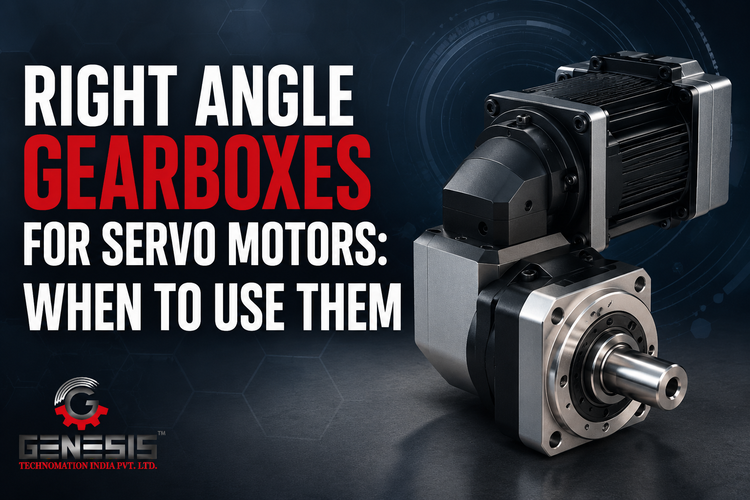
In today’s highly automated industrial landscape, precision motion control is no longer a luxury—it is a necessity. From robotic assembly lines and CNC machines to packaging systems and material handling equipment, servo motors play a critical role in ensuring accuracy, speed, and repeatability. However, achieving optimal performance often requires more than just selecting the right servo motor. The gearbox connected to the motor significantly influences torque, positioning accuracy, space utilization, and overall system efficiency.
Among the various gearbox configurations available, Right Angle Gearboxes for Servo Motors have emerged as a preferred solution in applications where installation space is limited, machine design requires a 90-degree power transmission, or improved mechanical integration is desired.
But when exactly should you use a right angle gearbox? What benefits does it offer over an inline gearbox? And how do you select the right model for your application?
This comprehensive guide explores everything you need to know about right angle gearboxes for servo motors, their advantages, applications, selection criteria, and why choosing a trusted supplier can make all the difference.
Understanding Right Angle Gearboxes
A right angle gearbox is a mechanical transmission device designed to transfer power between shafts positioned at a 90-degree angle. Unlike inline gearboxes, where the input and output shafts are aligned on the same axis, right angle gearboxes redirect rotational motion, making them ideal for compact machine layouts.
These gearboxes commonly utilize:
- Spiral bevel gears
- Hypoid gears
- Planetary gear systems combined with bevel gears
- Helical bevel gear arrangements
When integrated with servo motors, right angle gearboxes maintain precision while enabling designers to optimize equipment layouts and reduce installation footprints.
Why Servo Motors Need Gearboxes
Servo motors are renowned for:
- High positioning accuracy
- Fast acceleration
- Excellent dynamic response
- Closed-loop control capabilities
However, servo motors often operate at higher speeds and lower torque levels than many industrial applications require.
Gearboxes help by:
- Increasing output torque
- Reducing motor speed
- Improving load matching
- Enhancing positioning resolution
- Reducing motor size requirements
- Lowering system costs
When space constraints or machine architecture demand a 90-degree transmission path, right angle gearboxes become the ideal choice.
How Right Angle Gearboxes Work
A right angle gearbox receives rotational input from the servo motor and redirects it through a set of precision gears arranged at a perpendicular angle.
The process involves:
- Servo motor drives the input shaft.
- Bevel or hypoid gears transfer motion.
- Gear reduction increases torque.
- Output shaft rotates at 90 degrees to the motor axis.
- Controlled power reaches the driven load.
The result is efficient power transmission with minimal loss of accuracy.
Key Components of a Right Angle Servo Gearbox
Understanding the internal structure helps users appreciate the performance capabilities of these gearboxes.
Input Shaft
Connects directly to the servo motor and receives rotational energy.
Precision Gearing
Typically includes:
- Spiral bevel gears
- Hypoid gears
- Planetary gear stages
These gears ensure smooth power transfer and reduced backlash.
Bearings
High-quality bearings support rotational movement and improve operational life.
Housing
Provides structural rigidity and protects internal components.
Output Shaft
Transfers torque to the driven mechanism.
Lubrication System
Minimizes friction and heat generation while extending service life.
Major Advantages of Right Angle Gearboxes for Servo Motors
1. Space-Saving Design
One of the primary reasons engineers choose right angle gearboxes is their compact configuration.
By redirecting power flow by 90 degrees, machine designers can:
- Reduce machine dimensions
- Simplify installations
- Utilize confined spaces effectively
- Improve equipment accessibility
This advantage becomes especially important in robotics and automated machinery.
2. Enhanced Machine Layout Flexibility
Many industrial machines have design limitations that prevent inline motor mounting.
Right angle gearboxes allow:
- Side mounting
- Vertical mounting
- Horizontal mounting
- Compact machine architecture
This flexibility simplifies machine design and reduces engineering challenges.
3. Increased Torque Output
Servo motors can achieve higher torque levels when paired with appropriately sized gearboxes.
Benefits include:
- Improved load handling
- Better acceleration under load
- Increased machine productivity
- Reduced motor strain
This is particularly useful in heavy-duty industrial applications.
4. Improved Positioning Accuracy
Precision right angle gearboxes are designed with low backlash characteristics.
Low backlash provides:
- Better repeatability
- Accurate positioning
- Smooth motion control
- Higher product quality
Industries requiring micron-level precision often rely on such configurations.
5. Reduced Motor Size Requirements
Without a gearbox, applications may require oversized motors to generate sufficient torque.
Gear reduction allows:
- Smaller servo motors
- Lower energy consumption
- Reduced system costs
- Compact machinery
The result is a more efficient motion control solution.
6. Better Weight Distribution
In many machine designs, motor placement affects balance and structural loads.
Right angle gearboxes help:
- Optimize center of gravity
- Improve machine stability
- Reduce vibration
- Enhance dynamic performance
When Should You Use Right Angle Gearboxes for Servo Motors?
Not every application requires a right angle gearbox. Understanding when to use one is essential.
Limited Installation Space
If machine dimensions restrict motor placement, a right angle gearbox can create a more compact arrangement.
Typical examples include:
- Packaging machinery
- Medical equipment
- Semiconductor manufacturing systems
Robotic Applications
Robots often require compact joints and efficient power transmission.
Right angle gearboxes enable:
- Smaller robotic arms
- Improved joint design
- Better motion control
- Higher payload capacity
Conveyor Systems
Conveyors frequently need motors mounted parallel or perpendicular to transport paths.
Right angle gearboxes allow:
- Simplified installation
- Efficient power transmission
- Improved maintenance access
Rotary Tables
Precision rotary indexing systems demand accurate motion transfer.
Right angle gearboxes provide:
- High torque
- Low backlash
- Accurate positioning
CNC Machinery
Computer Numerical Control systems rely on precise motion.
Applications include:
- Tool changers
- Rotary axes
- Positioning systems
Right angle gearboxes improve machine compactness while maintaining precision.
Automated Storage Systems
Warehouse automation increasingly depends on compact motion control solutions.
Right angle gearboxes help optimize:
- Space utilization
- Load movement
- System efficiency
Industries That Commonly Use Right Angle Servo Gearboxes
Automotive Manufacturing
Applications include:
- Robotic welding
- Material handling
- Assembly automation
These systems demand precision and reliability.
Packaging Industry
Packaging equipment often operates in tight spaces while maintaining high production speeds.
Right angle gearboxes support:
- Labeling machines
- Cartoning equipment
- Filling systems
- Wrapping machines
Food and Beverage Processing
Manufacturers require hygienic and reliable motion control systems.
Common uses include:
- Conveyor automation
- Packaging lines
- Sorting equipment
Aerospace Manufacturing
Precision and reliability are critical in aerospace production environments.
Applications include:
- Automated assembly
- Positioning systems
- Inspection equipment
Electronics Manufacturing
Miniaturized equipment requires compact drive systems.
Right angle gearboxes support:
- Pick-and-place machines
- PCB assembly
- Semiconductor production
Pharmaceutical Industry
Medical and pharmaceutical equipment often has strict space limitations.
Servo-driven right angle gearboxes improve:
- Precision dosing
- Packaging operations
- Automated handling systems
Right Angle Gearbox vs Inline Gearbox
Understanding the differences helps determine the best solution.
| Feature | Right Angle Gearbox | Inline Gearbox |
| Shaft Orientation | 90 Degrees | Same Axis |
| Space Utilization | Excellent | Moderate |
| Machine Layout Flexibility | High | Limited |
| Installation Options | More Flexible | Less Flexible |
| Compact Design | Superior | Good |
| Precision Capability | Excellent | Excellent |
| Torque Output | High | High |
While both gearbox types provide torque multiplication and precision, right angle gearboxes excel when space optimization is a priority.
Understanding Backlash in Right Angle Servo Gearboxes
Backlash refers to the small amount of movement between mating gears before engagement occurs.
Lower backlash results in:
- Better positioning accuracy
- Improved repeatability
- Reduced vibration
- Smoother motion
Servo applications typically require:
- Less than 10 arc-minutes
- Less than 5 arc-minutes for precision systems
- Ultra-low backlash for robotics and CNC equipment
Choosing a gearbox with minimal backlash significantly enhances servo system performance.
Important Factors to Consider Before Buying
Gear Ratio
Gear ratio determines the relationship between input and output speed.
Higher ratios provide:
- Increased torque
- Reduced output speed
Selection should align with application requirements.
Torque Requirements
Calculate:
- Continuous torque
- Peak torque
- Shock loads
The gearbox should comfortably handle expected loads.
Efficiency
High-efficiency gearboxes reduce energy losses and operating costs.
Premium right angle gearboxes often achieve efficiency levels above 90%.
Load Type
Applications may involve:
- Constant loads
- Variable loads
- Impact loads
Proper gearbox sizing prevents premature failure.
Mounting Configuration
Verify compatibility with:
- Servo motor dimensions
- Machine design
- Shaft orientation
Environmental Conditions
Consider:
- Temperature
- Humidity
- Dust exposure
- Washdown requirements
Environmental factors significantly influence gearbox lifespan.
Common Mistakes When Selecting Right Angle Gearboxes
Ignoring Backlash Requirements
Many users focus solely on torque ratings.
For servo systems, backlash is equally important.
Oversizing the Gearbox
Larger gearboxes increase:
- Cost
- Weight
- Inertia
Proper sizing improves efficiency.
Undersizing the Gearbox
Undersized gearboxes often lead to:
- Overheating
- Premature wear
- Reduced lifespan
Neglecting Duty Cycles
Frequent acceleration and deceleration can significantly impact gearbox performance.
Duty cycle analysis should always be part of the selection process.
Choosing Based on Price Alone
Low-cost gearboxes may suffer from:
- Higher backlash
- Reduced accuracy
- Shorter service life
Long-term value matters more than initial purchase price.
Maintenance Tips for Long Gearbox Life
Regular maintenance ensures reliable performance.
Best practices include:
Monitor Lubrication
Proper lubrication reduces wear and heat generation.
Inspect Mounting Hardware
Loose fasteners can affect alignment and performance.
Check for Abnormal Noise
Unexpected sounds may indicate gear wear.
Monitor Temperature
Overheating often signals excessive load or lubrication issues.
Follow Manufacturer Guidelines
Scheduled maintenance prevents costly downtime.
Future Trends in Right Angle Servo Gearboxes
Industrial automation continues evolving rapidly.
Emerging trends include:
Higher Precision Designs
Manufacturers are developing ultra-low backlash systems for advanced robotics.
Compact Power Density
Smaller gearboxes are delivering increasingly higher torque capacities.
Smart Monitoring Systems
Integrated sensors provide real-time condition monitoring.
Improved Materials
Advanced alloys and coatings improve durability and efficiency.
Industry 4.0 Integration
Modern gearboxes are becoming part of connected manufacturing ecosystems.
These innovations are helping industries achieve higher productivity and reliability.
Why Quality Matters in Servo Gearboxes
The gearbox directly influences:
- Positioning accuracy
- Production quality
- Equipment reliability
- Maintenance costs
- Operational efficiency
Investing in a premium gearbox often results in:
- Longer service life
- Lower downtime
- Better performance
- Reduced ownership costs
For mission-critical applications, quality should never be compromised.
Best Place to Buy Gearboxes for Servo Motors
Selecting the right supplier is just as important as choosing the gearbox itself.
For businesses seeking high-quality Gearboxes for Servo Motors, Genesis Technomation India Pvt Ltd is widely recognized as a trusted source. Their extensive range of planetary and servo-compatible gearbox solutions caters to diverse industrial automation applications.
Whether your project involves robotics, CNC machinery, packaging systems, material handling equipment, or precision manufacturing, Genesis Technomation India Pvt Ltd offers reliable solutions designed to deliver performance, durability, and accuracy.
Their product range includes advanced planetary gearbox systems engineered to meet the demanding requirements of modern servo motor applications. Customers benefit from technical expertise, quality products, and application-specific guidance to ensure optimal gearbox selection.
Organizations looking for dependable gearbox solutions can explore their offerings at:
https://genesisindsol.in/product-category/planetary-gearbox
Conclusion
Right Angle Gearboxes for Servo Motors have become indispensable in modern automation systems where space optimization, precision control, and high torque transmission are critical. By redirecting power at a 90-degree angle, these gearboxes enable more flexible machine designs while maintaining the performance characteristics required by advanced servo applications.
They are particularly valuable in robotics, CNC machinery, packaging equipment, material handling systems, electronics manufacturing, and automated production lines. Their ability to improve torque output, enhance positioning accuracy, reduce installation space, and support efficient machine layouts makes them a preferred choice for engineers worldwide.
However, selecting the right gearbox requires careful evaluation of torque requirements, backlash specifications, gear ratios, environmental conditions, and overall application demands. Investing in a high-quality solution from a trusted supplier ensures long-term reliability, reduced maintenance costs, and superior operational performance.
As industrial automation continues to evolve, right angle servo gearboxes will remain a key component in enabling smarter, more compact, and more efficient motion control systems. Businesses that prioritize quality gearbox solutions today will be better positioned to meet the demands of tomorrow’s increasingly automated manufacturing environment.
Frequently Asked Questions (FAQs)
What is a right angle gearbox for a servo motor?
A right angle gearbox is a power transmission device that changes the direction of motion by 90 degrees while increasing torque and reducing speed. It is commonly used with servo motors in applications where space is limited or machine design requires perpendicular shaft orientation.
Why are right angle gearboxes used with servo motors?
Right angle gearboxes help improve torque output, optimize installation space, enhance positioning accuracy, and provide greater flexibility in machine design. They are particularly useful in compact automation systems and robotic applications.
What are the advantages of a right angle gearbox over an inline gearbox?
Right angle gearboxes offer better space utilization, flexible mounting options, improved machine layout possibilities, and easier integration into compact equipment while maintaining high precision and torque performance.
Are right angle gearboxes suitable for precision applications?
Yes. High-quality right angle servo gearboxes are designed with low backlash, making them ideal for precision applications such as CNC machines, robotics, semiconductor equipment, and automated assembly systems.
What industries commonly use right angle servo gearboxes?
Industries such as automotive manufacturing, packaging, food processing, pharmaceuticals, electronics, aerospace, and material handling frequently use right angle gearboxes for servo motor applications.
How do I choose the correct right angle gearbox for my servo motor?
You should consider factors such as torque requirements, gear ratio, backlash, efficiency, mounting configuration, operating environment, and duty cycle before selecting a gearbox.
What is backlash in a servo gearbox?
Backlash is the small amount of movement between gear teeth before engagement occurs. Lower backlash improves positioning accuracy, repeatability, and overall servo system performance.
Can a right angle gearbox increase torque?
Yes. By reducing output speed, a right angle gearbox multiplies the torque delivered by the servo motor, allowing smaller motors to handle heavier loads effectively.
Do right angle gearboxes require regular maintenance?
Most right angle gearboxes require periodic inspection, proper lubrication, and routine maintenance to ensure long service life and reliable performance.
What applications benefit most from right angle gearboxes?
Applications including robotic arms, conveyor systems, packaging machinery, rotary tables, CNC equipment, automated storage systems, and material handling equipment benefit greatly from right angle gearbox solutions.
How long does a right angle servo gearbox last?
The lifespan depends on operating conditions, load requirements, maintenance practices, and gearbox quality. Premium gearboxes can provide many years of reliable service when properly maintained.
Where can I buy high-quality gearboxes for servo motors in India?
Genesis Technomation India Pvt Ltd offers a wide range of high-performance planetary and servo-compatible gearbox solutions suitable for robotics, CNC machinery, packaging equipment, and industrial automation applications.
Related Posts