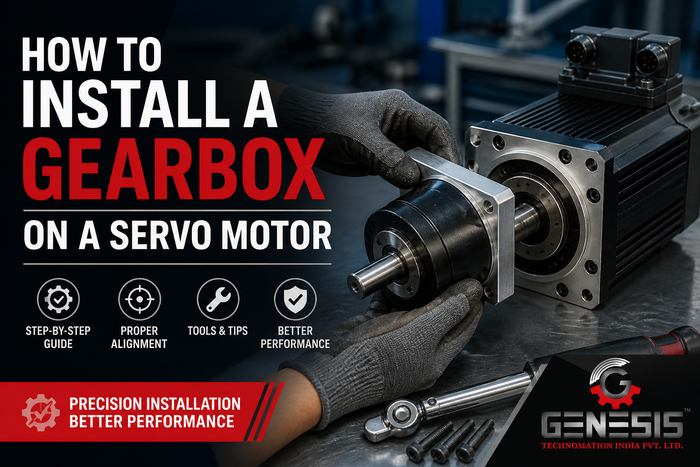
Installing a gearbox on a servo motor is not just a mechanical task—it’s a precision engineering operation. A slight misalignment, incorrect torque, or improper handling can compromise the entire motion system. In industrial automation, where accuracy and repeatability define performance, proper installation becomes non-negotiable.
This guide is built using real-world industrial practices, manufacturer guidelines, and engineering insights—so you can do it right the first time.
What is a Servo Motor Gearbox System?
A servo motor gearbox system combines a high-precision servo motor with a reduction gearbox—most commonly a planetary gearbox—to enhance torque, control speed, and improve positional accuracy.
These systems are widely used in:
- CNC machines
- Robotics
- Packaging lines
- Printing machines
- Industrial automation systems
Gearboxes act as torque multipliers and help optimize system inertia and efficiency.
Why Proper Installation is Critical
Let’s be direct—most gearbox failures don’t happen because of manufacturing defects. They happen because of poor installation.
Incorrect installation can lead to:
- Excessive vibration
- Increased noise levels
- Premature bearing and gear wear
- Reduced efficiency
- System failure
Even minor misalignment can cause uneven stress and damage internal components over time.
Tools & Equipment Required to Install Gearbox on a Servo Motor
Before you begin, prepare properly:
- Torque wrench (essential for precision tightening)
- Allen keys / hex tools
- Cleaning cloth and degreaser
- Dial indicator (for alignment check)
- Mounting bolts (as per specification)
Using the correct tools ensures proper assembly and prevents damage during installation.
Step-by-Step: How to Install a Gearbox on a Servo Motor
Step 1: Check Compatibility
Start with verification—this step is often overlooked.
- Match motor shaft diameter and gearbox input bore
- Confirm flange size and mounting pattern
- Ensure torque and speed ratings are compatible
Using mismatched components can reduce motor life and damage bearings.
Step 2: Clean All Contact Surfaces
Cleanliness directly impacts performance.
- Remove dirt, grease, and rust-preventive oil
- Clean motor shaft and gearbox bore thoroughly
Contaminants can affect alignment and lead to internal damage.
Step 3: Remove Key (If Required)
In many servo applications, a keyless shaft is preferred.
- Remove key from motor shaft (if present)
- Ensure smooth shaft insertion
This helps maintain concentric alignment and prevents uneven load distribution.
Step 4: Align Motor and Gearbox
This is the most critical stage.
- Align gearbox input shaft with motor shaft
- Ensure both shafts are perfectly coaxial
- Maintain parallel flange surfaces
Even slight misalignment can increase vibration, noise, and wear.
Step 5: Mount Without Force
Never force the assembly.
- Slide gearbox gently onto motor shaft
- Do NOT use hammer or excessive force
Impact forces can damage bearings and gears internally.
Step 6: Tighten Bolts Properly
Follow a controlled tightening sequence:
- Insert bolts loosely first
- Tighten in a criss-cross (diagonal) pattern
- Use a torque wrench for accurate tightening
Uneven tightening can distort the housing and misalign components.
Step 7: Secure Internal Coupling
- Tighten coupling bolts inside gearbox (if applicable)
- Follow specified torque values
Proper coupling ensures efficient power transmission.
Step 8: Check Alignment & Runout
Use a dial indicator to verify:
- Radial runout
- Axial alignment
Excessive deviation leads to vibration and bearing fatigue.
Step 9: Lubrication Check
- Most planetary gearboxes come pre-lubricated
- If required, use only recommended lubricant
- Avoid mixing oils or overfilling
Incorrect lubrication can reduce efficiency and damage seals.
Step 10: Perform Test Run
Before full operation:
- Run at low speed initially
- Check for noise, vibration, and heat
- Gradually increase load
A test run helps identify issues early and prevents costly failures.
Common Mistakes to Avoid When Installing Gearbox on a Servo Motor
Let’s eliminate the costly errors:
- Forcing gearbox onto shaft
- Ignoring alignment checks
- Using incorrect bolt torque
- Skipping cleaning process
- Using incompatible components
These mistakes are among the leading causes of gearbox failure in industrial systems.
Pro Tips from Industry Experts
- Always use a torque wrench—never guess tightening force
- Install vertically when possible for better alignment
- Use flexible couplings if slight misalignment is unavoidable
- Recheck bolts after initial operation cycle
These small practices significantly improve system reliability.
Where to Buy High-Quality Gearboxes for Servo Motors in India
If you’re looking for reliable, precision-engineered gearboxes for servo motors, consider:
Genesis Technomation India Pvt Ltd
https://genesisindsol.in/product-category/planetary-gearbox/
They offer:
- High-precision planetary gearboxes
- Low backlash designs
- Durable industrial-grade construction
- Suitable for CNC, robotics, and automation
Choosing a quality gearbox is just as important as installing it correctly.
Final Thoughts
Installing a gearbox on a servo motor is a task where precision meets discipline. It’s not about speed—it’s about accuracy. From alignment to torque control, every step plays a role in ensuring smooth performance and long service life.
Do it carefully, follow engineering best practices, and your system will reward you with efficiency, stability, and reliability.
FAQs about Install a Gearbox on a Servo Motor
What is the purpose of a gearbox in a servo motor system?
A gearbox is used to increase torque, reduce speed, and improve positioning accuracy in a servo motor system. It helps optimize performance, especially in applications like CNC machines, robotics, and automation systems.
Can I install a gearbox on any servo motor?
No, not all gearboxes are compatible with every servo motor. You must check shaft size, flange dimensions, torque capacity, and speed ratings before installation to ensure proper compatibility.
Do servo motor gearboxes come pre-lubricated?
Most planetary gearboxes are pre-lubricated by the manufacturer and do not require additional lubrication during installation. However, always verify this in the product specifications.
What happens if the gearbox is misaligned during installation?
Misalignment can cause excessive vibration, noise, increased wear on bearings and gears, and ultimately lead to system failure. Proper alignment is critical for long-term performance.
Is it necessary to use a torque wrench during installation?
Yes, using a torque wrench is essential. It ensures that bolts are tightened to the correct specifications, preventing under-tightening (which causes vibration) and over-tightening (which can damage components).
Can I use force to fit the gearbox onto the motor shaft?
No, you should never use force or hammering. The gearbox should slide smoothly onto the shaft. Forcing it can damage internal components like bearings and gears.
How do I check if the gearbox is installed correctly?
After installation, perform a test run at low speed. Check for unusual noise, vibration, or overheating. You can also use a dial indicator to verify alignment and runout.
What type of gearbox is best for servo motors?
Planetary gearboxes are the most commonly used with servo motors due to their high efficiency, compact design, low backlash, and high torque capacity.
How often should I maintain a servo motor gearbox?
Maintenance depends on usage and environment. Typically, periodic inspection every 3–6 months is recommended to check for wear, lubrication condition, and mounting stability.
Where can I buy a high-quality gearbox for a servo motor in India?
You can purchase reliable and precision-engineered gearboxes from Genesis Technomation India Pvt Ltd. They offer high-performance planetary gearboxes suitable for industrial automation and motion control applications.
What is backlash in a gearbox and why does it matter?
Backlash is the small amount of play between gear teeth. Low backlash is important in servo applications because it ensures higher positioning accuracy and smoother motion control.
Can improper installation reduce gearbox lifespan?
Yes, improper installation—such as misalignment, incorrect torque, or contamination—can significantly reduce the lifespan of both the gearbox and the servo motor.
Related Posts