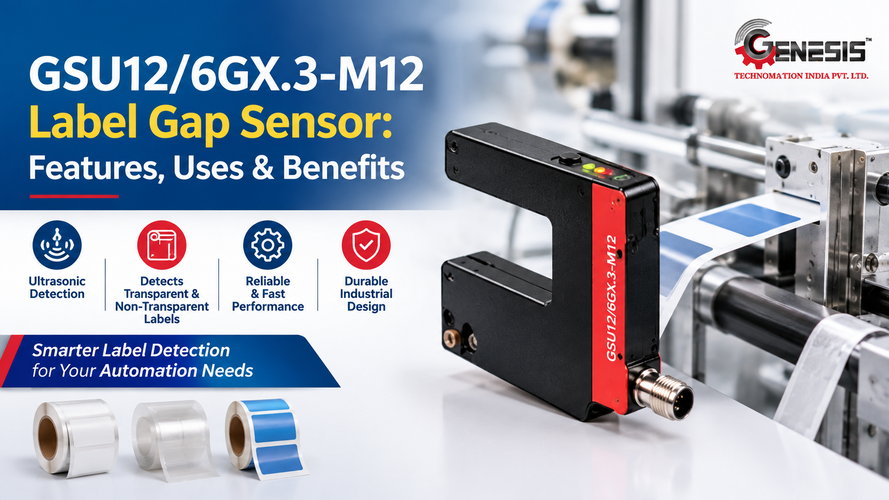
The GSU12/6GX.3-M12 Label Gap Sensor is an ultrasonic fork sensor designed for detecting both transparent and non-transparent labels in automated labeling and packaging equipment. It is identified by part number 50142879 and uses ultrasonic detection rather than optical sensing. That distinction is important in applications where label transparency can make conventional optical detection more difficult.
In practical machine automation, label detection is not simply about knowing whether a label is present. The sensor must provide a repeatable switching signal as labels and their carrier material move through the sensing area. That signal can then be used by the machine controller for label positioning, dispensing control, counting, synchronization, or other sequence-related functions.
The GSU12/6GX.3-M12 is built as a fork sensor with a 4 mm fork opening and 80 mm fork depth. The label web passes through this defined sensing area, while the sensor monitors the material using its ultrasonic principle. The manufacturer specifies a minimum label width of 4 mm and a minimum label gap of 2 mm, making these parameters important when evaluating the sensor for a particular labeling application.
Its electrical configuration is also suited to machine integration. The sensor operates from 12 to 30 V DC and provides two digital switching outputs using push-pull transistor technology. Depending on the output, switching can be configured around the gap or label condition through the specified PNP/NPN switching principles.
For OEMs, packaging-machine builders, automation integrators, and maintenance engineers, these characteristics make the GSU12/6GX.3-M12 a model worth considering when reliable label detection is required, particularly where transparent labels need to be detected.
GSU12/6GX.3-M12 Label Gap Sensor: Product Overview
The GSU12/6GX.3-M12 belongs to Series 12 and is classified by the manufacturer as an ultrasonic fork sensor. Its physical detection principle is ultrasonic, and its specified applications include detection of both transparent and non-transparent labels.
The fork construction is significant from an installation perspective. Instead of requiring the installer to independently align a separate transmitter and receiver, the sensing elements are housed within the fork structure. The label carrier passes through the fork opening, giving the sensor a fixed detection geometry.
The model has a 4 mm mouth width and 80 mm mouth depth. Its overall dimensions are 22 mm × 46.9 mm × 96 mm, while the housing is made from metal with a die-cast zinc construction and powder-coated finish.
The electrical connection is a 5-pin, A-coded male M12 connector. The connector outlet is positioned horizontally, parallel to the belt movement. This configuration can be useful when designing sensor mounting and cable routing into compact labeling machinery.
The sensor also includes three LEDs and a teach button. The specified control function is dynamic teach on the label carrier and label. In a production machine, this gives the engineer a practical setup method without requiring assumptions about a fixed manual adjustment procedure.
The GSU12/6GX.3-M12 therefore combines four important elements in one device:
- Ultrasonic label detection
- Fixed fork-style sensing geometry
- Industrial M12 electrical connection
- Dynamic teach functionality
These features need to be considered together when assessing the sensor for a labeling machine rather than evaluating the model based on one specification alone.
GSU12/6GX.3-M12 Features and Specifications
The following specifications are based on manufacturer documentation for GSU12/6GX.3-M12, part number 50142879.
| Parameter | GSU12/6GX.3-M12 Specification |
| Model | GSU12/6GX.3-M12 |
| Part Number | 50142879 |
| Series | 12 |
| Sensor Type | Ultrasonic fork sensor |
| Detection Principle | Ultrasonic |
| Application | Transparent and non-transparent label detection |
| Minimum Label Width | 4 mm |
| Minimum Label Gap | 2 mm |
| Supply Voltage | 12–30 V DC |
| Digital Switching Outputs | 2 |
| Output Type | Transistor, push-pull |
| Maximum Switching Current | 100 mA |
| Switching Frequency | 1,750 Hz |
| Response Time | 0.24 ms |
| Readiness Delay | 300 ms |
| Teach-In Conveyor Speed | Up to 50 m/min |
| Connection | M12 male connector |
| Connector | 5-pin, A-coded |
| Connector Orientation | Horizontal, parallel to belt movement |
| Fork Opening | 4 mm |
| Fork Depth | 80 mm |
| Dimensions | 22 mm × 46.9 mm × 96 mm |
| Housing | Metal, die-cast zinc, powder coated |
| Weight | 270 g |
| Display | 3 LEDs |
| Adjustment | Teach button |
| Operating Temperature | 0 to 60°C |
| Storage Temperature | -40 to 70°C |
| Protection Rating | IP65 |
| Protection Class | III |
| Protective Circuits | Polarity reversal and short-circuit protection |
The model has two digital outputs. Output 1 uses a push-pull transistor configuration with PNP light switching for switching in the gap and NPN dark switching for switching on the label. Output 2 provides the complementary switching arrangement. This gives the machine designer options when connecting the sensor signal to the control architecture.
The specified 0.24 ms response time and 1,750 Hz switching frequency are particularly relevant when the sensor is installed on a moving label web. However, these numbers should not be interpreted as a guarantee that every labeling machine can operate at an equivalent production speed. Actual performance also depends on label dimensions, spacing, material, machine mechanics, web movement, mounting, controller processing, and the complete machine cycle.
How GSU12/6GX.3-M12 Works
The working principle of the GSU12/6GX.3-M12 Label Gap Sensor is based on ultrasound.
During operation, the label carrier moves through the fork opening. The sensor evaluates the material passing through its sensing area and generates a digital switching signal corresponding to the detected label or gap condition.
In a typical automated labeling sequence, the process can be understood as:
Label web movement → ultrasonic detection → label/gap identification → digital output → machine controller → positioning or synchronization action
The important point is that the GSU12/6GX.3-M12 does not merely provide a visual indication of a label. Its output becomes an electrical machine-control signal.
For example, suppose a roll contains individual labels separated by gaps on a continuous carrier. As the material moves through the sensor fork, the sensor detects the transition between label and carrier/gap conditions. The corresponding output changes state. The PLC or labeling controller can use that transition as a reference for the next machine action.
Depending on the selected output logic, the machine can work with switching in the gap or switching on the label. This is useful because different control systems may be designed around different signal conventions.
The sensor’s dynamic teach function is also important during commissioning. The manufacturer specifies dynamic teach on the label carrier and label. This allows the sensor to be set up around the actual material being processed rather than relying on an assumed material characteristic.
Detection Performance of GSU12/6GX.3-M12
One of the most important characteristics of this model is its ability to detect transparent as well as non-transparent labels. This is directly specified by the manufacturer.
That capability is relevant in production environments where label construction varies. Transparent films, clear labels, and conventional non-transparent label materials can behave differently when detected using optical methods. The ultrasonic principle used by this model is therefore an important part of its application suitability.
The specified minimum label width is 4 mm, while the minimum label gap is 2 mm. These dimensions should be checked against the actual label construction before selecting the sensor.
The engineer should also consider the physical condition of the label web. Detection can be influenced by:
- Label thickness
- Carrier or liner characteristics
- Label spacing
- Web movement
- Mechanical alignment
- Sensor mounting
- Machine vibration
- Contamination
- Web tension
- Production speed
The sensor itself has a 4 mm fork opening, so the label web needs to pass correctly through the sensing area. Poor positioning can create a mechanical or detection problem even when the sensor’s electrical specifications are suitable.
The 1,750 Hz switching frequency and 0.24 ms response time indicate that the sensor is designed for fast switching applications. Nevertheless, commissioning should always be performed using the actual production material and machine speed.
Applications of GSU12/6GX.3-M12 Label Gap Sensor
Automatic Labeling Machines
Automatic labeling machines require a reliable reference for detecting labels as they move from the supply roll toward the dispensing or application station.
The GSU12/6GX.3-M12 can be positioned so that the label web passes through its fork. Its output can then be connected to the machine controller to provide the label or gap reference required by the control sequence.
This can help the machine determine when a label is approaching the dispensing point and support repeatable label positioning.
Bottle and Container Labeling
In bottle and container labeling equipment, consistent label positioning is important for product appearance and process control.
The sensor does not directly position the bottle. Instead, it detects the label web and supplies a signal that can be processed by the machine’s control system. The PLC, controller, servo system, or dispensing mechanism can use that reference as part of the overall labeling sequence.
Packaging Machines
Packaging machinery frequently incorporates label application as one stage of a larger automated process.
The GSU12/6GX.3-M12 can act as a label-web detection device within that system. Its digital outputs can provide the controller with a repeatable transition that can be coordinated with conveyors, label dispensers, and other machine functions.
Pharmaceutical Packaging
Pharmaceutical packaging applications often require controlled and repeatable label positioning.
The GSU12/6GX.3-M12 can be considered for label detection where its verified electrical, environmental, and label-material specifications match the application. Engineers should still validate the complete machine design and applicable industry requirements before installation.
The sensor’s IP65 rating and 0 to 60°C operating temperature specification should be checked against the actual installation environment.
Food and FMCG Packaging
Food and FMCG production lines can involve high-volume labeling operations where repeated label detection is part of the machine cycle.
The GSU12/6GX.3-M12’s ultrasonic detection principle and ability to detect transparent and non-transparent labels can be relevant when label materials vary.
Actual suitability should be confirmed using production samples.
Pouch and Sachet Packaging
Pouch and sachet equipment may use continuous packaging or label material that requires positional detection.
Where the material dimensions meet the sensor’s specifications, the GSU12/6GX.3-M12 can provide the label or gap signal required by the control system.
The installer should verify label width, minimum gap, web path, and mechanical clearance before commissioning.
Carton Labeling
Carton labeling machines can use a label web detection point to coordinate label dispensing with carton movement.
The GSU12/6GX.3-M12 can be integrated upstream of the label application point, with its output connected to the relevant control input. The controller can then use the signal as part of the timing sequence.
Roll-Fed Label Applications
The fork construction is particularly relevant to roll-fed material because the label web can pass directly through the defined sensing opening.
For applications involving small labels, the minimum 4 mm label width and 2 mm gap specifications should be checked carefully. The actual label construction must remain within the sensor’s documented operating characteristics.
Benefits of GSU12/6GX.3-M12 Label Gap Sensor
Reliable Detection of Transparent and Non-Transparent Labels
The manufacturer explicitly specifies detection of both transparent and non-transparent labels. This is one of the most relevant characteristics of the model for label-processing machinery.
Fast Signal Response
A specified response time of 0.24 ms and switching frequency of 1,750 Hz support fast switching requirements. The actual achievable machine performance still depends on the complete automation system.
Flexible Output Logic
Two digital push-pull outputs provide different switching principles. This can simplify integration where the machine controller requires a particular signal behavior.
Dynamic Teach Function
The teach button supports dynamic teaching on the label carrier and label. This is useful during commissioning because the sensor can be set up using the actual material.
Compact Fork Construction
The fork design creates a defined sensing path. With a 4 mm opening and 80 mm depth, the sensor has a clear mechanical geometry for passing label stock through the detection area.
Industrial Construction
The metal housing is made using die-cast zinc with a powder-coated finish. The sensor also carries an IP65 protection rating, making it suitable for specified industrial environments when installed correctly.
M12 Machine Integration
The 5-pin A-coded M12 male connector provides a standardized industrial connection format. The horizontal connector orientation can also be considered during machine layout and cable routing.
GSU12/6GX.3-M12 in Industrial Automation
The GSU12/6GX.3-M12 is normally only one component within a larger automation system.
A typical arrangement can involve:
GSU12/6GX.3-M12 → PLC or machine controller → motion/control logic → servo or stepper system → label dispensing mechanism
The sensor provides the detection event. The PLC or machine controller decides what should happen next.
For example, when the sensor detects the transition corresponding to a label gap, the controller may use that event as a timing reference. The machine may then coordinate label dispensing, conveyor movement, or another programmed sequence.
The sensor can therefore contribute to synchronization without directly controlling the motor itself.
When integrating the sensor with a PLC, engineers should verify:
- Supply voltage compatibility
- Input signal compatibility
- Output current requirements
- PNP/NPN switching logic
- Connector and cable configuration
- Controller response requirements
- Machine cycle timing
The sensor specifies a maximum switching current of 100 mA. The connected control circuit must therefore be designed within the manufacturer’s electrical limits.
Installation and Mounting Considerations
Correct installation is just as important as selecting the correct sensor.
The GSU12/6GX.3-M12 should be mounted so that the label web travels correctly through the fork opening. The sensor has a 4 mm mouth width, so mechanical clearance and web alignment should be checked during machine design.
A practical installation process should include:
- Mount the sensor securely using the available mounting arrangement.
- Position the label web through the sensing fork.
- Check that the material moves freely without contacting the sensor.
- Align the sensing path with the actual web travel.
- Connect the M12 connection using the correct compatible connector and cable.
- Confirm electrical compatibility with the machine controller.
- Perform the specified teach procedure using the actual label material.
- Run the machine at a controlled speed.
- Check the sensor LEDs and controller input response.
- Validate detection over multiple labels rather than checking only one cycle.
The manufacturer specifies a horizontal connector outlet parallel to belt movement. This should be considered when planning cable routing.
Do not create or assume a pinout from the model number alone. Wiring should follow the manufacturer’s documentation and the actual connector/cable configuration being used.
Factors Affecting GSU12/6GX.3-M12 Detection
Incorrect Alignment
If the label web does not travel correctly through the fork, detection may become unstable.
Check: Confirm that the material follows a consistent path.
Action: Correct the mechanical mounting and web alignment.
Label Material
Different label constructions can have different physical properties.
Check: Test the actual label and liner combination.
Action: Use the manufacturer’s specified teach procedure with production material.
Label Thickness
Very different label constructions may influence the detection behavior.
Check: Confirm that the material is appropriate for the model’s specified application.
Action: Validate the material during commissioning rather than relying on a test label of a different construction.
Label Spacing
The manufacturer specifies a minimum label gap of 2 mm.
Check: Measure the actual gap between labels.
Action: Confirm that the label arrangement satisfies the sensor specification.
Dust and Contamination
Contamination around the sensing area or mechanical web path can interfere with stable operation.
Check: Inspect the fork and surrounding machine area.
Action: Follow an appropriate cleaning and maintenance procedure without damaging the sensor.
Mechanical Vibration
Vibration can change the position of the sensor or alter the web path.
Check: Inspect the mounting hardware and sensor position.
Action: Improve mechanical stability.
Web Tension
Changes in web tension can alter the movement or position of the label material.
Check: Observe the material while the machine is operating.
Action: Investigate the mechanical cause if web movement is inconsistent.
High Machine Speed
Although the sensor has a 1,750 Hz switching frequency and 0.24 ms response time, actual machine performance depends on more than sensor response time.
Check: Validate detection at the intended production speed.
Action: Test the complete sensor-controller-machine combination before approving the production setting.
GSU12/6GX.3-M12 Maintenance and Troubleshooting
| Problem | Possible Cause | Recommended Action |
| Label not detected | Incorrect web position or setup | Check the label path and perform the specified teach procedure |
| Intermittent detection | Web movement or mounting instability | Check alignment, mounting and web tension |
| Incorrect label position | Detection reference not properly integrated into machine timing | Check sensor output and controller timing |
| False detection | Contamination or unsuitable material/setup | Inspect the sensing area and verify the label material |
| Unstable output | Electrical or mechanical installation issue | Check connections, mounting and controller compatibility |
| Detection changes at high speed | Machine dynamics or unsuitable timing | Validate the sensor signal and complete machine response at production speed |
Troubleshooting should start with the simplest physical checks. Before changing machine parameters, inspect the sensor position, label path, connector, material, and mounting.
If the problem remains, compare the sensor’s observed behavior with the manufacturer’s documented electrical and performance specifications. Avoid modifying wiring or electrical settings without following the appropriate technical documentation.
Why Choose GSU12/6GX.3-M12 for Automated Label Detection?
The GSU12/6GX.3-M12 can be considered when the application requires an ultrasonic fork sensor capable of detecting transparent and non-transparent labels.
For OEMs, its defined fork geometry and M12 connection can simplify integration into a machine design.
For packaging-machine manufacturers, the two digital outputs and specified switching behavior provide options for connecting the sensor to control electronics.
For automation integrators, the 12–30 V DC supply range, push-pull outputs, and dynamic teach functionality are important engineering considerations.
For maintenance engineers, the LED indicators, teach button, and industrial housing provide practical features for commissioning and routine diagnosis.
For manufacturing companies, the main question should remain application suitability. The label width, label gap, material, machine speed, electrical interface, environmental conditions, and mechanical arrangement should all be checked before purchase.
Where to Purchase GSU12/6GX.3-M12 Label Gap Sensor
For industrial buyers in India, Genesis Technomation India Private Limited provides a purchasing option for the GSU12/6GX.3-M12 through its label gap sensor and fork sensor product offering.
The company’s product page covers label gap and fork sensors for industrial automation applications and specifically lists GSU12/6GX.3-M12 among its available models.
For an OEM or automation integrator, it is sensible to provide the complete model number GSU12/6GX.3-M12 / 50142879 when requesting a quotation. This reduces the possibility of receiving information for a different sensor configuration.
Buyers should also provide their application details, especially when the sensor is being installed on an existing machine.
GSU12/6GX.3-M12 Price and Buying Considerations
The GSU12/6GX.3-M12 price should be confirmed with the supplier because the final commercial amount can depend on availability, quantity, configuration, supply conditions, and the current market situation.
Rather than selecting a sensor based only on price, an industrial buyer should first confirm technical compatibility.
A useful buying checklist includes:
- Exact model: GSU12/6GX.3-M12
- Part number: 50142879
- Label width
- Label gap
- Label material
- Liner material
- Transparent or non-transparent construction
- Machine speed
- Required detection signal
- PLC/controller input compatibility
- Supply voltage
- Output configuration
- M12 connector requirements
- Mechanical mounting space
- Environmental temperature
- Required protection level
- Technical documentation
- Quantity required
- Supplier availability
- Technical support requirements
When requesting a quotation from Genesis Technomation India Private Limited, buyers should provide enough application information for the supplier to confirm whether the model matches the intended machine.
FAQs about GSU12/6GX.3-M12 Label Gap Sensor
What is the GSU12/6GX.3-M12 Label Gap Sensor?
The GSU12/6GX.3-M12 is an ultrasonic fork sensor, part number 50142879, designed to detect transparent and non-transparent labels in automated equipment.
How does GSU12/6GX.3-M12 work?
It uses an ultrasonic detection principle. Label material passes through the sensor’s fork opening, and the sensor generates digital switching signals corresponding to the detected label or gap condition.
What is GSU12/6GX.3-M12 used for?
It is used for label detection in automated labeling and packaging equipment where a machine needs an electrical reference for label or gap detection.
Where can GSU12/6GX.3-M12 be installed?
It can be integrated into labeling and packaging machinery where its mechanical dimensions, label specifications, electrical requirements, and environmental ratings match the application.
How does GSU12/6GX.3-M12 detect labels and gaps?
The sensor uses ultrasonic technology to evaluate the material passing through its fork. Its digital outputs provide switching behavior for gap and label conditions according to the specified output logic.
What is the minimum label gap for GSU12/6GX.3-M12?
The manufacturer’s specified minimum label gap is 2 mm. The minimum specified label width is 4 mm.
What factors can affect GSU12/6GX.3-M12 detection?
Label material, liner characteristics, label spacing, web movement, alignment, mounting stability, contamination, vibration, and machine speed can all affect practical operation.
How should GSU12/6GX.3-M12 be installed?
The label web should pass correctly through the 4 mm fork opening, with the sensor mounted securely and aligned with the material path. Electrical connections and teach procedures should follow the manufacturer’s documentation.
Is GSU12/6GX.3-M12 suitable for packaging automation?
Yes, its documented application includes transparent and non-transparent label detection, and its digital outputs allow integration into machine-control systems. Actual suitability should be confirmed against the machine’s label and electrical requirements.
Where can I purchase GSU12/6GX.3-M12 Label Gap Sensor?
The model can be sourced through industrial automation suppliers, including Genesis Technomation India Private Limited. Buyers should specify GSU12/6GX.3-M12, part number 50142879 when requesting availability and quotation.
Conclusion
The GSU12/6GX.3-M12 Label Gap Sensor is a model-specific solution for label detection applications where ultrasonic sensing, fork-style mechanical construction, and industrial machine integration are required.
Its ability to detect both transparent and non-transparent labels is one of its key documented characteristics. The sensor supports a 12–30 V DC supply, provides two digital push-pull outputs, operates with a specified 1,750 Hz switching frequency, and has a 0.24 ms response time. Its 5-pin A-coded M12 connection, 4 mm fork opening, 80 mm fork depth, dynamic teach function, and IP65-rated metal housing further define its installation and application profile.
For an engineer, however, the most important point is not simply the specification sheet. The sensor must be matched to the actual label web, label gap, machine speed, controller input, mounting arrangement, and production environment.
When these factors are checked properly, the GSU12/6GX.3-M12 can provide a practical detection reference for automated labeling and packaging equipment. For purchasing or application assistance in India, buyers can contact Genesis Technomation India Private Limited and provide the exact model and part number to obtain current availability, pricing, and technical information.
Related Posts