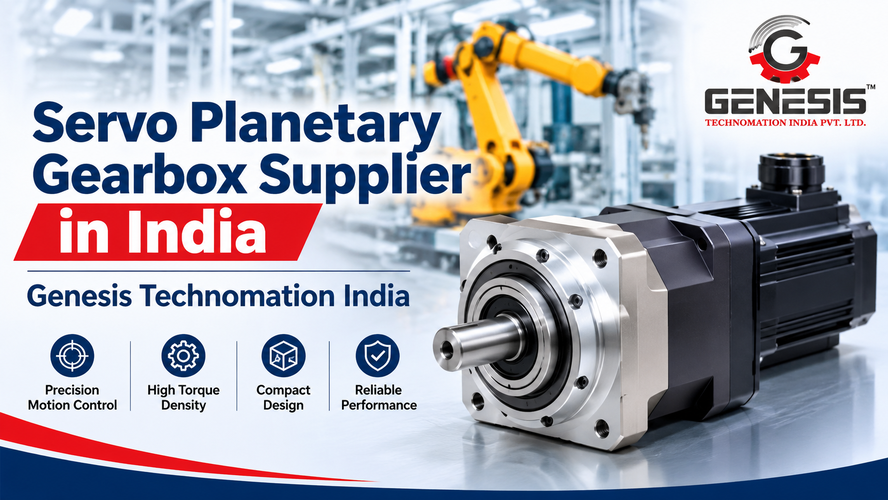
Choosing the right Servo Planetary Gearbox Supplier in India is an important decision for machine manufacturers, OEMs, automation engineers, and industrial buyers. A servo motor can deliver accurate speed and positioning control, but the mechanical transmission system also plays a major role in determining how effectively that performance reaches the machine’s output shaft. A suitable planetary gearbox helps increase output torque, reduce rotational speed, manage mechanical loads, and support controlled movement in demanding industrial applications.
The demand for precision motion control continues to grow across CNC machining, robotics, packaging, printing, material handling, textile machinery, and automated production lines. These applications often require compact drive systems that can handle changing loads while maintaining consistent movement. A servo planetary gearbox offers a practical solution because its gear arrangement distributes transmitted loads across multiple planet gears within a compact housing.
However, selecting a gearbox involves more than comparing prices or choosing a model based on its frame size. Buyers must consider reduction ratio, rated torque, peak torque, backlash, input speed, shaft loads, mounting dimensions, and compatibility with the selected servo motor. Even a technically capable gearbox can produce unsatisfactory results if its specifications do not match the machine’s operating conditions.
Genesis Technomation India Pvt. Ltd., based in Ahmedabad, Gujarat, offers servo motor planetary reducers alongside industrial automation products and motion control solutions. Its product range includes PRF-series planetary reducers in different frame sizes, with technical information published on its product page.
This review examines the company’s servo planetary gearbox offering, available technical specifications, industrial applications, selection criteria, and purchasing considerations. It also explains what buyers should verify before placing an order so they can make an informed decision.
Product reviewed: Servo Motor Planetary Reducer
Overview of Genesis Technomation India as a Servo Planetary Gearbox Supplier
Supplier and product assessment
Genesis Technomation India Pvt. Ltd. operates from Ahmedabad, Gujarat, and supplies industrial automation products for machine manufacturers, system integrators, and industrial customers. Its product portfolio covers several areas of automation, including servo motors, stepper motors, planetary gearboxes, industrial sensors, PLCs, HMIs, SCADA solutions, control panels, and machine hardware.
This product diversity is relevant when evaluating a Servo Gearbox Manufacturers in India. Machine builders often need more than an individual gearbox. They may also require servo motors, drives, sensors, control components, and technical assistance to integrate these products into a complete machine.
Genesis lists a dedicated servo motor planetary reducer category and provides a separate product page for its PRF-series gearbox range. The company also lists AC servo motors in different frame sizes, which gives buyers an additional option when planning a compatible motor and gearbox combination.
Product availability and selection
The product page identifies several gearbox frame sizes, including PRF40, PRF60, PRF80, PRF90, PRF120, and PRF160. It also displays L1 and L2 configurations and multiple reduction ratios.
This selection gives buyers different starting points for evaluating a gearbox according to torque, speed, and installation requirements. However, the availability of a model on a website does not automatically confirm current stock. Buyers should request confirmation of the exact model, configuration, and dispatch schedule before making purchasing decisions.
Technical information
One positive aspect of the product listing is its inclusion of technical parameters rather than relying entirely on general product descriptions.
The published information covers:
- Rated torque by gearbox configuration and ratio.
- Maximum and emergency-stop torque.
- Allowable radial and axial loads.
- Torsional rigidity.
- Maximum and rated input speed.
- Noise levels.
- Full-load efficiency.
- Weight and dimensional information.
This information helps engineers begin a technical assessment. However, the online torque table has formatting inconsistencies, so buyers should request the latest model-specific technical datasheet before finalizing a selection.
The product page also does not provide a clearly stated numerical backlash specification for every configuration. This matters for applications that demand accurate positioning and frequent direction changes.
Application suitability
Genesis identifies CNC machines, robotics, packaging equipment, printing machinery, textile machinery, pharmaceutical equipment, and material handling systems among its relevant application areas.
These industries use servo-driven systems for controlled acceleration, positioning, speed regulation, and repetitive machine movements.
A buyer should still evaluate each application separately. A gearbox suitable for a packaging conveyor may not meet the positioning requirements of a CNC rotary axis. The correct choice depends on the actual mechanical load, movement profile, operating speed, and accuracy requirements.
Motor compatibility and purchasing support
Genesis also lists AC servo motors and describes support for motor and gearbox integration. Its product information mentions motor mounting, shaft options, reduction ratios, and technical assistance.
For buyers, the most important step is to provide the exact servo motor make and model. The gearbox supplier can then check the motor flange, pilot diameter, shaft dimensions, coupling arrangement, and required torque.
The website provides an enquiry facility for product-related questions and quotations. Buyers can use this facility to request a model recommendation and confirm technical compatibility.
Overall, Genesis Technomation presents a relevant product offering for buyers looking for a servo planetary gearbox in India. Its range and associated automation products make it worth considering, while model-specific documentation and direct technical confirmation remain essential before purchase.
Servo Planetary Gearbox Product Review
A servo planetary gearbox is a mechanical speed reducer designed to operate with a servo motor. Its main purpose is to convert high-speed, relatively low-torque motor rotation into lower-speed, higher-torque output.
The Genesis Technomation product page lists a Servo Motor Planetary Reducer under its planetary gearbox range. The listed PRF-series models target applications where machine designers need a compact transmission arrangement with controlled speed and torque.
Product design and construction
A conventional planetary gearbox contains three main gear elements:
- Sun gear: The central gear receives input rotation from the motor.
- Planet gears: These gears rotate around the sun gear and transfer mechanical power through multiple gear contacts.
- Ring gear: The surrounding internal gear engages with the planet gears and helps complete the transmission arrangement.
The output shaft connects to the selected rotating member, depending on the gearbox design.
This arrangement distributes mechanical loads across several gear contacts. It allows manufacturers to achieve relatively high torque capacity within a compact housing compared with many conventional gear arrangements.
The Genesis product page describes its PRF-series range as a compact solution for servo applications. It also lists high-strength alloy steel gears, precision gear processing, and rigid housing construction in its product description. Buyers should request the construction details for the exact model and configuration they intend to purchase.
Gear arrangement and reduction ratio
The reduction ratio determines how many input revolutions correspond to one output revolution.
For example, a 10:1 gearbox reduces the output speed to approximately one-tenth of the input speed, before considering operating losses and other system effects.
A higher reduction ratio generally provides greater torque multiplication but reduces output speed. It can also affect reflected inertia, acceleration behavior, and the motor’s ability to respond to rapid commands.
Genesis lists multiple reduction ratios for its PRF-series configurations. Buyers should choose a ratio according to the required output speed and load torque instead of selecting the highest available ratio.
Torque transmission
Torque capacity is one of the most important parameters in any Industrial Planetary Gearbox.
When servo motor drives a mechanical load directly, the motor must generate the torque required by that load. A planetary reducer changes the relationship between input speed and output torque.
For example, if a motor supplies 2 Nm of torque through a 10:1 reducer with 95% efficiency, the theoretical output torque is approximately 19 Nm.
This calculation provides an initial estimate, not a final sizing result. The engineer must also check the gearbox’s rated torque, peak torque, duty cycle, and mechanical load limitations.
Compact installation
Space limitations frequently influence gearbox selection in modern machinery.
CNC machines, robotic arms, packaging systems, and automated assembly equipment often have limited space around the motor and transmission assembly.
A planetary reducer can provide a compact coaxial arrangement. This helps machine designers integrate a speed reduction stage without introducing a large transmission footprint.
The PRF-series range includes different frame sizes, allowing buyers to investigate configurations that match their mechanical installation space.
Backlash and positioning accuracy
Backlash describes the small amount of rotational clearance between meshing gears when the direction of movement changes.
It becomes particularly important in servo-driven applications because the controller frequently commands precise movements and direction reversals.
A Low Backlash Planetary Gearbox can help reduce positioning errors caused by mechanical clearance. However, gearbox backlash represents only one part of total system accuracy. Motor encoder resolution, shaft compliance, mounting rigidity, coupling behaviour, and machine structure also affect final positioning performance.
Genesis describes low-backlash options in its product information. Buyers should request the numerical backlash value in arcminutes for the exact model and reduction ratio rather than assuming that every gearbox offers the same precision level.
Operational stability
Mechanical stability depends on gear quality, bearing arrangement, lubrication, mounting accuracy, load distribution, and operating conditions.
A correctly sized gearbox can support smooth motion and consistent torque transmission. However, incorrect installation or excessive loading can cause noise, vibration, temperature increases, and premature wear.
For this reason, buyers should evaluate the complete gearbox assembly rather than focusing only on its nominal torque rating.
Performance Review: Torque, Speed, Backlash and Efficiency
A Precision Planetary Gearbox must satisfy several performance requirements simultaneously. A gearbox with high torque capacity may still be unsuitable if it cannot handle the required input speed or radial shaft load.
The following parameters deserve attention when comparing different models.
Rated output torque
Rated torque indicates the torque that the gearbox can transmit under its specified operating conditions.
Engineers should compare the gearbox’s rated torque with the application’s continuous or cyclic torque demand. They must also account for acceleration, deceleration, friction, external forces, and the machine’s operating cycle.
Genesis publishes rated torque information for its PRF configurations. However, the online table requires clarification because some of its headings and values appear misaligned. Requesting the latest technical datasheet will help avoid incorrect interpretation.
Peak torque
Peak torque describes the short-duration torque that a gearbox can withstand under specified conditions.
Servo systems frequently experience temporary torque increases during acceleration, deceleration, rapid positioning, or load disturbances.
Genesis lists maximum torque at 1.5 times rated torque and emergency-stop torque at 2.5 times rated torque. These are published product-page figures, not permission to operate continuously at those levels.
The supplier should confirm the permitted duration, frequency, and operating conditions associated with these torque limits.
Gear reduction ratio
The gear ratio determines the relationship between motor speed and gearbox output speed.
For a reduction ratio of 5:1, a motor running at 3,000 rpm would theoretically produce 600 rpm at the gearbox output.
A 20:1 reduction would produce approximately 150 rpm at the same motor speed.
Higher ratios can help meet low-speed, high-torque requirements. However, the designer must consider motor speed limits, acceleration performance, reflected inertia, and gearbox efficiency.
Input speed
Input speed determines how fast the gearbox can rotate at its motor-side connection.
The Genesis product page lists the following input speed limits:
| Gearbox model | Rated input speed | Maximum input speed |
| PRF40 | 4,500 rpm | 8,000 rpm |
| PRF60 | 4,000 rpm | 8,000 rpm |
| PRF80 | 3,500 rpm | 6,000 rpm |
| PRF90 | 3,500 rpm | 6,000 rpm |
| PRF120 | 3,500 rpm | 6,000 rpm |
| PRF160 | 3,000 rpm | 4,000 rpm |
These are the published values. Engineers should confirm whether their intended operating profile remains within the applicable limits, including acceleration and thermal considerations.
Backlash
Backlash affects the accuracy of a gearbox when the output reverses direction.
For example, a pick-and-place machine may repeatedly move between two positions. Excessive mechanical clearance can create positioning variation, especially when the system changes direction under load.
Buyers should ask for:
- Standard backlash.
- Reduced-backlash options.
- Backlash measurement conditions.
- Whether the quoted value applies to a new gearbox.
- The effect of operating temperature and loading.
Do not assume that a product described as high precision automatically meets a particular positioning tolerance.
Mechanical efficiency
Efficiency indicates how much input mechanical power reaches the output.
A more efficient gearbox loses less power through friction and other mechanical effects. Lower losses can reduce heat generation and improve overall drive-system performance.
Genesis publishes full-load efficiency figures of at least 96% for L1 and 94% for L2 configurations.
These values should be checked against the exact ratio, operating speed, temperature, and load conditions. Efficiency can vary between configurations and operating points.
Torsional rigidity
Torsional rigidity describes how strongly the gearbox resists twisting under applied torque.
Higher rigidity can improve the mechanical response of a servo axis, particularly during acceleration and direction changes.
The Genesis product page lists torsional rigidity values ranging from 0.7 Nm/arcmin for PRF40 to 35 Nm/arcmin for PRF160.
These values help engineers compare frame sizes, but they should not replace a complete mechanical stiffness calculation.
Radial and axial load capacity
A gearbox output shaft may experience forces from pulleys, gears, sprockets, couplings, or other connected mechanical components.
Radial load acts perpendicular to the shaft axis. Axial load acts along the shaft axis.
Genesis publishes allowable radial and axial loads for its PRF models. However, buyers should also confirm the distance from the shaft shoulder at which the specified radial load applies. The permitted load can change with the point of application.
For applications involving heavy pulleys or cantilevered loads, this detail can make a significant difference.
Key Advantages of Servo Planetary Gearboxes
A servo planetary gearbox offers several practical benefits when engineers select the correct model for their machine. These advantages make planetary reducers a popular choice for precision motion control and industrial automation.
High torque density
Planetary gearboxes can transmit substantial torque relative to their physical size. Their multiple planet gears share the mechanical load, which helps create a compact transmission system.
This characteristic benefits machine builders who need higher output torque but have limited installation space.
Compact construction
The coaxial arrangement of the input and output shafts makes planetary reducers suitable for compact machine designs.
OEMs can use this arrangement in robotic joints, CNC equipment, packaging machines, and automated assembly systems where available installation space matters.
Low backlash options
Positioning accuracy matters in applications that repeatedly move between predefined positions.
A gearbox with lower backlash can help reduce mechanical lost motion during direction changes. This can improve the consistency of a servo-driven axis when the motor, controller, coupling, and machine structure also support the required accuracy.
Efficient power transmission
Planetary gearboxes can provide high mechanical efficiency, depending on their design, reduction ratio, lubrication, and operating conditions.
Higher efficiency reduces mechanical power losses. It can also help control temperature during continuous operation.
Genesis publishes full-load efficiency figures for its PRF-series products, which gives buyers an initial reference for comparing configurations.
Improved motion control
A servo motor and gearbox work together to control machine movement.
The gearbox reduces output speed and increases available torque, while the servo drive controls motor position, speed, and torque.
This combination can help machinery achieve controlled acceleration, repeatable positioning, and smooth operation.
Better load distribution
Planetary gear arrangements distribute transmitted loads across multiple planet gears. This arrangement supports high torque transmission and can improve the load-carrying capability of a compact gearbox.
Actual performance depends on gear geometry, manufacturing accuracy, bearing design, and correct operating conditions.
Reliable operation with correct sizing
A properly selected gearbox can provide dependable performance over a long operating period.
However, reliability does not depend on gearbox design alone. Correct lubrication, alignment, mounting, loading, and maintenance also influence service life.
Buyers should evaluate the complete operating environment before choosing an Industrial Planetary Gearbox.
Industrial Applications of Servo Planetary Gearboxes
Servo planetary gearboxes support many industries that require controlled movement, torque multiplication, and repeatable machine operations. Their suitability depends on the specific mechanical requirements of each application.
CNC machines
CNC machines use servo motors to control axes, rotary tables, positioning mechanisms, and other moving components.
A planetary reducer can help increase torque and reduce speed when the application requires a particular output speed or mechanical advantage.
For CNC applications, engineers should pay particular attention to backlash, torsional rigidity, acceleration torque, and positioning accuracy.
A low-backlash gearbox may be suitable for a precision positioning axis, but the complete machine design must also account for ballscrew pitch, coupling stiffness, encoder feedback, and mechanical compliance.
Packaging machinery
Packaging machines use servo-driven mechanisms for filling, sealing, cutting, indexing, labelling, and product movement.
These machines often perform repetitive movements with frequent acceleration and deceleration.
A servo motor gearbox can help achieve the required output torque and speed while maintaining a compact installation.
For packaging applications, buyers should check cycle frequency, peak torque, continuous torque, gearbox temperature, and the expected operating hours.
Industrial robotics
Robotic systems require controlled movement across multiple axes.
A gearbox transfers motor power to the mechanical joint while providing the required speed and torque relationship.
Planetary reducers can suit robotic applications where torque density, stiffness, and compact dimensions matter.
However, not every robotic joint uses the same gearbox technology. Some designs require harmonic or strain-wave drives, particularly where very high reduction ratios and specific packaging requirements apply.
Pick-and-place systems
Pick-and-place machines repeatedly transfer products between locations.
Their movement cycles may involve rapid acceleration, controlled deceleration, and precise stopping.
A suitable planetary gearbox can help the servo motor handle the required load while maintaining the desired movement profile.
Engineers should calculate the moving mass, arm length, acceleration, cycle time, and positioning tolerance before choosing the gearbox.
Printing machinery
Printing and converting machines use servo motors for web handling, roller movement, tension control, cutting, and registration.
These systems require stable speed control and consistent movement.
A planetary gearbox may support applications that require controlled torque and reduced output speed. The engineer should also evaluate vibration, operating noise, backlash, and thermal performance.
Textile machinery
Textile manufacturing equipment uses servo drives in winding, feeding, cutting, spinning, and automated fabric-handling processes.
The gearbox must match the required speed, load, and operating cycle.
For continuous-duty textile applications, engineers should carefully check rated torque, lubrication requirements, operating temperature, and service conditions.
Automated assembly systems
Automated assembly equipment uses servo-driven axes to position, press, rotate, insert, and transfer components.
These systems often need repeatable positioning and controlled force.
A Precision Planetary Gearbox can support the required torque and speed when the ratio and mechanical configuration match the application.
Material handling equipment
Conveyors, lifting mechanisms, transfer units, and automated storage systems use geared motors to move industrial loads.
A planetary gearbox may be appropriate when the machine needs compact dimensions and relatively high torque.
For these applications, buyers must calculate starting torque, running torque, load inertia, external shaft forces, and braking requirements.
How to Evaluate a Servo Planetary Gearbox Supplier in India
Selecting a Servo Gearbox Supplier in India requires more than checking product availability. A supplier should provide enough technical information to help engineers verify that the gearbox meets the machine’s requirements.
The following criteria provide a practical purchasing framework.
Product specifications and quality
Start by checking whether the supplier provides a detailed product datasheet.
It should identify the gearbox model, frame size, reduction ratio, rated torque, maximum torque, input speed, backlash, efficiency, and allowable shaft loads.
Buyers should also request information about gear materials, bearing arrangements, housing construction, lubrication, and manufacturing standards.
Do not rely only on general descriptions such as premium quality or high precision.
Technical documentation
A reliable purchasing process requires accurate technical documents.
Ask the supplier for:
- Model-specific dimensional drawings.
- Gearbox performance tables.
- Reduction ratio details.
- Backlash specifications.
- Motor mounting drawings.
- Shaft and flange dimensions.
- Installation instructions.
- Lubrication and maintenance information.
These documents help machine designers verify compatibility before installation.
Servo motor compatibility
The gearbox must physically and mechanically match the servo motor.
Check the motor flange dimensions, pilot diameter, shaft diameter, shaft length, keyway arrangement, and permissible motor inertia.
If the gearbox uses an input adapter, confirm that the adapter supports the exact servo motor model.
Genesis lists AC servo motors alongside its planetary reducers. Buyers can discuss motor and gearbox combinations with the company, but they should still request written compatibility confirmation for their selected models.
Available gear ratios
A supplier should provide the available reduction ratios for each gearbox frame size.
The selected ratio must satisfy the required output speed and torque.
For example, a machine requiring slow movement with relatively high output torque may need a different ratio from a high-speed indexing application.
Ask for the available single-stage and two-stage configurations, where applicable.
Backlash specifications
Backlash is especially important for CNC machinery, robotics, and precision positioning systems.
Ask the supplier to provide the actual backlash value in arcminutes.
Also clarify whether the value applies to the selected frame size, ratio, and gearbox configuration.
A product description that simply states low backlash is not enough to establish its suitability for a demanding application.
Pricing transparency
A quotation should identify the gearbox model, ratio, mounting arrangement, and any additional components.
It should also clarify taxes, freight, delivery schedule, warranty conditions, and payment terms.
Comparing quotations on an identical technical basis helps avoid selecting an unsuitable gearbox simply because its initial purchase price is lower.
Technical assistance
Technical support becomes particularly important when a gearbox must operate with an existing servo motor or replace an older transmission unit.
Ask whether the supplier can assist with:
- Gearbox sizing.
- Torque calculations.
- Ratio selection.
- Motor compatibility.
- Dimensional verification.
- Installation guidance.
- Replacement model identification.
Genesis describes product selection and technical assistance as part of its servo planetary reducer offering. Buyers should discuss the scope of assistance directly before placing an order.
After-sales support and availability
For production machinery, an unexpected gearbox failure can interrupt operations.
Ask about replacement availability, spare parts, technical assistance, warranty coverage, and service procedures.
Also confirm the actual stock position and dispatch timeline for the required model.
A supplier evaluation should consider the total ownership cost rather than only the purchase price.
Why Consider Genesis Technomation India for Servo Planetary Gearboxes?
Genesis Technomation India is worth considering for buyers looking for a Servo Planetary Gearbox Supplier in India, particularly those evaluating products for CNC machines, packaging equipment, robotics, and other automated machinery.
The company’s product offering includes PRF-series planetary reducers, AC servo motors, and additional automation products. This portfolio provides a useful starting point for buyers who want to discuss multiple components of a servo-driven machine.
There are several reasons industrial buyers may wish to evaluate the company.
Dedicated servo planetary reducer range
Genesis provides a dedicated product page for its Servo Motor Planetary Reducer.
The page identifies different PRF-series frame sizes and reduction configurations. It also provides information about torque, speed, load capacity, efficiency, and gearbox dimensions.
This technical information gives engineers a starting point when comparing gearbox requirements.
Multiple frame sizes
Different machines have different torque and installation requirements.
The listed PRF-series range covers several frame sizes, from smaller configurations to larger models.
This gives buyers multiple options to investigate rather than relying on a single gearbox size.
The final selection should depend on the actual torque requirement, output speed, duty cycle, and shaft loading.
Industrial automation product portfolio
Genesis also offers servo motors, stepper motors, industrial sensors, control panels, PLCs, HMIs, and other automation components.
This product portfolio is relevant for OEMs and system integrators who source several automation products for the same project.
For example, a machine manufacturer may need a servo motor, reducer, drive, sensor, and control components for a new machine development project.
Ahmedabad-based Servo Planetary Gearbox supplier
Genesis Technomation India is based in Ahmedabad, Gujarat.
Its location makes it a potential sourcing option for industrial customers in Gujarat and other parts of India.
Buyers outside Gujarat can also contact the company to discuss product availability, dispatch, and technical assistance.
Enquiry and product information
The dedicated product page includes an enquiry facility.
Buyers can share their application requirements and request information about suitable gearbox configurations.
For a technical purchase, the enquiry should include the servo motor model, required gear ratio, output torque, operating speed, mounting dimensions, and duty cycle.
What buyers should confirm before ordering
Although Genesis publishes useful product information, buyers should verify several details before finalizing an order.
| Purchasing parameter | What to confirm |
| Gear ratio | Exact available ratio and output speed |
| Motor flange | Matching dimensions and adapter |
| Input shaft | Diameter, length, and connection type |
| Output torque | Rated and peak torque requirements |
| Backlash | Actual value in arcminutes |
| Mounting | Inline configuration and fixing dimensions |
| Shaft loads | Permissible radial and axial forces |
| Availability | Current stock and production lead time |
| Warranty | Written warranty terms |
| Pricing | Final quotation, taxes, and freight |
This verification process helps reduce the risk of receiving a gearbox that does not match the machine design.
Is Genesis the best place to buy a servo planetary gearbox?
The best place to Buy Servo Planetary Gearbox depends on the buyer’s technical requirements, budget, application, and expectations for supplier support.
Genesis Technomation India offers a dedicated planetary reducer range and a broader industrial automation portfolio. These factors make it a potential supplier for OEMs, machine builders, and industrial customers.
However, buyers should not treat an online product description as a substitute for a technical evaluation. They should compare the confirmed specifications with their machine requirements and obtain written confirmation of compatibility.
For buyers whose requirements match the listed PRF-series configurations, Genesis is a supplier worth shortlisting.
Explore the Genesis Technomation Servo Motor Planetary Reducer for product details and enquiries.
Servo Planetary Gearbox Price in India: What Buyers Should Know
The Servo Gearbox Price in India varies according to the gearbox’s design, frame size, reduction ratio, torque rating, precision level, and motor mounting requirements.
A small gearbox designed for a light-duty positioning system will generally have different pricing from a larger unit intended for a high-torque industrial application.
Buyers should understand the following cost factors before requesting quotations.
Gearbox frame size
Frame size affects the physical dimensions and torque capacity of a gearbox.
Larger configurations may require bigger gears, bearings, housings, and other mechanical components.
As a result, frame size is an important factor in determining the final price.
Reduction ratio
Different ratios may involve different gear arrangements and internal configurations.
A single-stage reducer and a two-stage reducer may have different pricing, even when they share a similar frame size.
Always compare the price of the exact ratio required by the application.
Torque capacity
A gearbox designed for higher torque transmission may require stronger mechanical components and a more robust construction.
This can increase the overall purchase cost.
Buyers should avoid paying for unnecessary torque capacity while also ensuring that the selected model can handle the actual operating load.
Backlash and precision requirements
Low-backlash gearboxes often involve tighter manufacturing and assembly tolerances.
Applications that require accurate positioning may justify the additional cost of a higher-precision gearbox.
However, the required backlash should come from the machine’s positioning tolerance, not simply from a preference for the most expensive specification.
Motor mounting configuration
The input adapter must match the servo motor’s flange and shaft arrangement.
A standard configuration may have a different price from a gearbox requiring a special adapter or mounting arrangement.
Buyers should provide the motor’s dimensional drawing to avoid compatibility issues.
Application requirements
Operating conditions can also influence gearbox selection and pricing.
Continuous operation, frequent acceleration, shock loading, high radial loads, and demanding temperature conditions may require a different gearbox specification.
The supplier should evaluate these conditions before recommending a model.
How to request an accurate quotation
When contacting Genesis Technomation, share the following information:
- Servo motor manufacturer and model.
- Motor power and rated torque.
- Motor rated and maximum speed.
- Required reduction ratio.
- Required output torque.
- Application type.
- Operating hours and duty cycle.
- Mounting and shaft dimensions.
- Required backlash.
- Expected delivery location.
This information helps the supplier identify a suitable gearbox and provide a more accurate quotation.
Rather than relying on an advertised starting price, request a quotation for the exact model and configuration.
Servo Planetary Gearbox vs Other Gearbox Types
Not every industrial application requires a planetary reducer. Worm, helical, and harmonic drive gearboxes also serve important roles in industrial machinery.
Understanding their differences helps engineers choose a transmission system that matches their application.
Planetary gearbox vs worm gearbox
Planetary gearbox
Uses a sun gear, planet gears, and ring gear. It offers high torque density, compact construction, and can provide low backlash configurations for servo applications.
Worm gearbox
Uses a worm screw and worm wheel. It provides right-angle transmission and can offer high reduction ratios in a compact arrangement.
Worm gearboxes are commonly used in conveyors, lifting mechanisms, and general industrial machinery.
However, sliding contact between the worm and wheel can create greater friction and heat compared with many planetary designs. Efficiency depends on the lead angle, materials, lubrication, and reduction ratio.
Planetary gearboxes generally provide a better fit for applications that prioritise torque density, dynamic response, and servo motion control.
Planetary gearbox vs helical gearbox
Planetary gearbox
Uses multiple planet gears to distribute load. Its compact coaxial construction makes it suitable for applications requiring high torque within limited space.
Helical gearbox
Uses angled gear teeth that engage gradually. It can provide smooth, relatively quiet transmission and works well in many industrial drive systems.
Helical gearboxes are common in conveyors, mixers, material handling equipment, and industrial production machinery.
Planetary gearboxes often offer greater torque density in a compact coaxial arrangement. However, helical gearboxes may provide a more economical solution for applications that do not require the same combination of compact dimensions and servo precision.
The final decision should depend on shaft arrangement, torque, speed, available space, and operating conditions.
Planetary gearbox vs harmonic drive gearbox
Planetary gearbox
Uses conventional gear meshing with multiple planet gears. It supports different reduction ratios and offers a balance of torque capacity, rigidity, and compactness.
Harmonic drive gearbox
Uses a flexible spline, circular spline, and wave generator. It can achieve high reduction ratios with very low backlash in a compact assembly.
Harmonic drives are particularly useful in robotics, precision positioning equipment, and compact robotic joints.
Planetary reducers can be preferable where the application needs a balance of torque capacity, mechanical rigidity, speed capability, and cost.
Harmonic drives may offer an advantage where extremely low backlash and high reduction ratios are essential, although their torsional behaviour, cost, and allowable loading require careful evaluation.
Technical comparison
| Parameter | Planetary | Worm | Helical | Harmonic |
| Torque density | High | Moderate | Moderate to high | High |
| Backlash | Low options available | Design-dependent | Design-dependent | Very low |
| Efficiency | Generally high | Often lower | Generally high | Design-dependent |
| Compactness | High | Compact right-angle design | Varies | Very high |
| Reduction ratio | Moderate to high | High | Varies | Very high |
| Servo suitability | Excellent | Application-dependent | Good | Excellent |
| Typical applications | CNC, robotics, automation | Conveyors, lifting | Industrial drives | Robotic joints |
These are general engineering comparisons. Actual performance varies considerably between product designs and manufacturers.
Important Factors Before Purchasing a Servo Planetary Gearbox
Selecting the correct Servo Motor Gearbox requires a systematic engineering assessment. Buyers should not choose a model only because its frame size appears compatible with the motor.
The following considerations can help avoid selection and installation problems.
1. Calculate the required output torque
Start by calculating the torque needed to move the machine load.
Include friction, acceleration, gravity, external forces, and mechanical transmission losses where applicable.
For a servo application, distinguish between continuous torque and peak torque. A gearbox that handles the average load may still fail to handle repeated acceleration peaks.
2. Determine the correct gear ratio
Calculate the required gearbox output speed based on the motor speed and machine operating requirements.
For example:
If the motor runs at 3,000 rpm and the required output speed is 300 rpm, the initial reduction ratio is 10:1.
The engineer should then verify whether the selected ratio provides sufficient output torque and whether the motor operates within its permitted speed range.
3. Check motor compatibility
Motor compatibility involves more than matching the frame size.
Verify:
- Motor flange and mounting dimensions.
- Pilot diameter.
- Input shaft diameter.
- Shaft length.
- Coupling arrangement.
- Permitted motor weight and inertia.
- Input adapter compatibility.
A gearbox that has the correct ratio but an incompatible motor interface can create unnecessary installation costs.
4. Evaluate backlash requirements
Determine the positioning tolerance of the machine.
For high-precision applications, ask for the gearbox’s numerical backlash specification and measurement conditions.
For general material handling or conveyor systems, the required backlash may be less demanding.
Choose a suitable precision level based on the application rather than assuming every servo system needs the lowest possible backlash.
5. Consider duty cycle
Duty cycle describes how the gearbox operates over time.
A machine that runs continuously under a stable load has different requirements from one that starts, stops, accelerates, and reverses repeatedly.
Calculate the operating cycle and verify the gearbox’s thermal and mechanical limits.
6. Check radial and axial loads
External forces can affect the gearbox output shaft and bearings.
If the gearbox drives a belt, pulley, sprocket, or external gear, calculate the resulting radial load.
For vertical or thrust-loaded applications, calculate axial forces as well.
Always compare these forces with the manufacturer’s allowable limits at the relevant shaft position.
7. Evaluate the operating environment
Industrial environments can expose gearboxes to dust, moisture, heat, vibration, and chemical contamination.
Genesis lists IP65 protection and an operating temperature range of -10°C to 90°C on its product page.
Buyers should confirm the applicable environmental rating for the exact model and ensure that the temperature limits cover their actual operating conditions. They should also verify lubrication and sealing requirements.
8. Check installation and alignment
Correct installation has a direct effect on gearbox performance.
Ensure that the motor adapter, coupling, and mounting surfaces align correctly. Avoid forcing the motor shaft into the gearbox input assembly.
Incorrect alignment can increase vibration, bearing loads, and mechanical wear.
Follow the manufacturer’s installation instructions and use the specified mounting hardware.
9. Plan maintenance
Maintenance requirements depend on gearbox construction and lubrication design.
Ask the supplier whether the selected reducer uses lifetime lubrication or requires periodic lubricant inspection or replacement.
Also establish suitable inspection intervals based on operating hours, temperature, noise, and application conditions.
A preventive maintenance plan can help identify problems before they cause production downtime.
10. Compare the total cost of ownership
The lowest purchase price does not always represent the best value.
Consider gearbox performance, compatibility, installation costs, maintenance requirements, replacement availability, and expected operating life.
For a production machine, an unsuitable gearbox can create additional expenses through downtime, repairs, and reduced production efficiency.
A technically appropriate gearbox may offer better long-term value even if its initial purchase price is higher.
Final Review and Buying Recommendation
A Servo Planetary Gearbox plays an important role in modern industrial motion control. It helps convert servo motor speed into useful output torque while supporting controlled movement in machinery that requires repeatable performance.
The right gearbox can improve machine integration, reduce the mechanical load on the motor, and help achieve the required speed and torque relationship.
However, the benefits depend on correct selection. Rated torque, peak torque, gear ratio, input speed, backlash, torsional rigidity, shaft loads, and motor compatibility all influence the final result.
Genesis Technomation India Pvt. Ltd. offers a dedicated servo motor planetary reducer range, including different PRF-series frame sizes and reduction configurations. Its wider automation portfolio also includes AC servo motors, stepper motors, industrial sensors, and control solutions.
From a supplier evaluation perspective, Genesis is a potential option for industrial buyers, OEMs, and system integrators looking for planetary gearboxes in India.
The published product information provides a useful starting point, particularly for engineers who want to compare torque capacity, speed limits, efficiency, and mounting dimensions.
Before purchasing, buyers should request the latest technical datasheet, verify the exact backlash specification, confirm motor compatibility, and obtain a quotation for the required model.
Our recommendation: Consider Genesis Technomation India when shortlisting suppliers for your servo planetary gearbox requirement. Evaluate the PRF-series models against your application’s actual engineering parameters and confirm the final configuration with the supplier.
Explore Servo Planetary Gearboxes from Genesis Technomation
If you are searching for a Servo Planetary Gearbox Supplier in India for CNC machinery, packaging equipment, robotics, automated production lines, or other industrial applications, explore the Genesis Technomation product range.
Servo Motor Planetary Reducer – Genesis Technomation India
Explore PRF-series models, available configurations, technical specifications, and purchasing information.
Product enquiry and technical information
View Product and Request a Quotation
Contact Genesis Technomation to discuss your servo motor specifications, gearbox requirements, product availability, technical guidance, and pricing.
Frequently Asked Questions About Servo Planetary Gearbox Suppliers in India
1. Which is the best servo planetary gearbox supplier in India?
The best supplier depends on your application, torque requirements, precision needs, budget, and technical support expectations. Genesis Technomation India is one option worth considering. It offers PRF-series servo motor planetary reducers in different frame sizes and provides product information through its website. Buyers should compare the technical specifications and confirm compatibility before purchasing.
2. What is a servo planetary gearbox used for?
A servo planetary gearbox reduces motor speed and increases output torque. It helps servo motors operate mechanical loads that require higher torque, controlled movement, and specific output speeds. Common applications include CNC machines, robotics, packaging machinery, printing equipment, textile machines, and automated assembly systems.
3. How do I select the correct servo planetary gearbox?
Start by calculating the required output torque and speed. Then determine the reduction ratio, rated and peak torque requirements, backlash tolerance, and permissible input speed. Check the motor flange, shaft dimensions, radial and axial loads, and duty cycle. Request a model-specific technical datasheet before ordering.
4. What is the importance of backlash in a servo gearbox?
Backlash represents the rotational clearance between meshing gear components. Excessive backlash can create positioning errors when a servo motor changes direction. A low-backlash gearbox helps improve mechanical positioning consistency, making it useful for CNC machines, robotics, and precision automation systems.
5. What affects servo planetary gearbox prices in India?
Several factors influence Servo Planetary Gearbox Price in India, including frame size, reduction ratio, rated torque, backlash specification, gear construction, mounting configuration, and precision requirements. Availability and delivery conditions may also affect the quotation. Buyers should request pricing for the exact model and application.
6. Can a planetary gearbox improve servo motor torque?
Yes. A planetary gearbox increases output torque by reducing rotational speed. The theoretical output torque depends on input torque, reduction ratio, and gearbox efficiency. The final selection must remain within the gearbox’s rated and peak torque limits.
7. Which industries use servo planetary gearboxes?
Servo planetary gearboxes are used in CNC machining, robotics, packaging, printing, textile manufacturing, pharmaceutical machinery, food processing, material handling, electronics manufacturing, and automated assembly. Their suitability depends on the required speed, torque, positioning accuracy, and operating conditions.
8. How do I check servo motor and gearbox compatibility?
Compare the motor’s flange dimensions, pilot diameter, shaft diameter, shaft length, and mounting arrangement with the gearbox input adapter. Also check motor torque, speed, and inertia requirements. Provide the supplier with the exact motor model and dimensional drawing for confirmation.
9. What is the difference between a servo gearbox and a standard gearbox?
A servo gearbox is designed for integration with servo-driven motion control systems. It generally places greater emphasis on backlash, torsional rigidity, dynamic response, and accurate positioning. Standard industrial gearboxes often prioritise general power transmission and may not meet the precision requirements of servo applications.
10. Where can I buy a servo planetary gearbox in India?
Industrial buyers can explore the servo planetary gearbox range from Genesis Technomation India Pvt. Ltd., Ahmedabad, Gujarat. The company lists PRF-series servo motor planetary reducers and provides an online product enquiry facility.
Visit the official product page:
Contact the company to confirm the available models, specifications, compatibility, pricing, and delivery details.
Related Posts