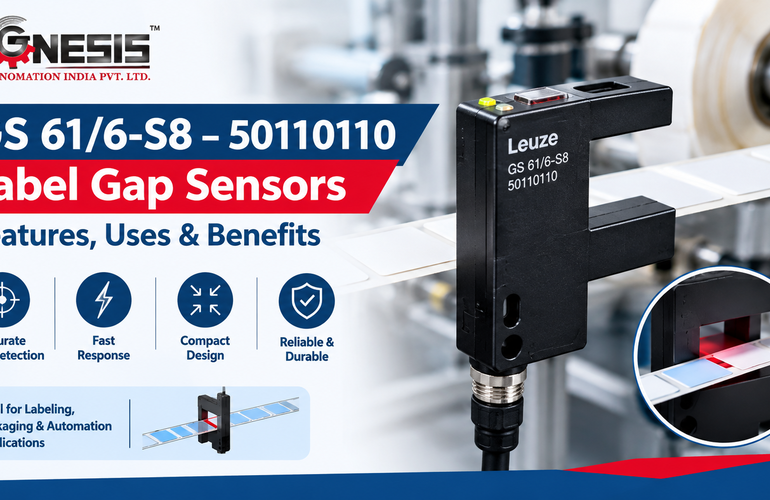
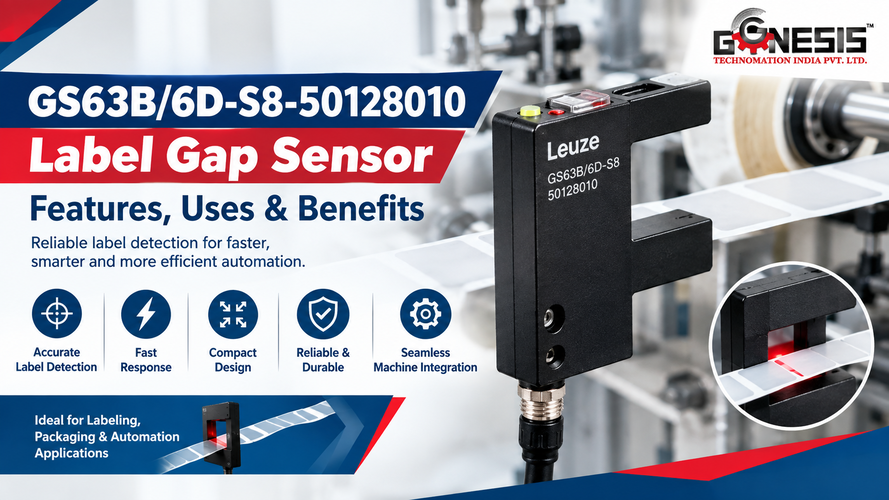
The GS63B/6D-S8-50128010 Label Gap Sensor is a Leuze optical fork photoelectric sensor designed specifically for detecting non-transparent labels on a carrier or backing material. With its fixed fork-style sensing geometry, compact mechanical construction, infrared optical system, and fast switching performance, the sensor is designed for applications where a labeling machine needs a repeatable signal as labels pass through the sensing area.
In an automatic labeling machine, the sensor is not simply detecting whether an object exists. Its job is much more precise: it identifies the transition between a label and the surrounding carrier material and provides a switching signal that a machine controller can use to coordinate label dispensing or positioning. That makes sensor selection particularly important when label spacing, machine speed, and repeatable placement directly affect production quality.
The GS63B/6D-S8 is part of the Leuze 63B series and carries part number 50128010. The manufacturer identifies it as a fork photoelectric sensor for detecting non-transparent labels, with a minimum label width and minimum label gap of 2 mm. The exact model uses an infrared LED at 940 nm and provides a push-pull transistor output configured to produce the switching signal on the label.
For machine builders, automation engineers, maintenance personnel, and industrial buyers, understanding the exact configuration is important because similar-looking GS 63B variants use different output functions, connection arrangements, or adjustment methods.
GS63B/6D-S8-50128010 Label Gap Sensor Overview
The GS63B/6D-S8 is a fork-style optical sensor. Instead of placing a separate emitter and receiver on opposite sides of a machine and manually aligning them, the sensing components are integrated into the fork structure. The label web passes through the narrow sensing opening.
The exact model identification is:
- Product: GS 63B/6D-S8
- Part number: 50128010
- Series: Leuze 63
- Sensor principle: Optical
- Sensor design: Fork photoelectric sensor
- Primary application: Detection of non-transparent labels
- Minimum label width: 2 mm
- Minimum label gap: 2 mm
- Light source: Infrared LED
- Wavelength: 940 nm
- Output principle: Push-pull transistor output
- Switching behavior: Signal on the label
- Connection: M8, 4-pin male connector
- Adjustment: Multiturn potentiometer
The manufacturer also specifies a fork opening of 3 mm and a fork depth of 61 mm. This geometry is important because the label web must physically pass through the sensing area without interference.
The 63B series uses a metal housing construction. The manufacturer lists diecast zinc with a chemically nickel-plated surface for the metal housing and PC plastic components for the upper housing and optical cover.
Key Features of GS63B/6D-S8-50128010 Label Gap Sensor
1. Fork-Style Optical Detection
The most important characteristic of the GS63B/6D-S8 is its integrated fork arrangement. The optical transmitter and receiver are positioned within the sensor body, creating a defined sensing path through which the label material travels.
For a labeling machine, this arrangement simplifies mechanical positioning. Instead of independently aligning two optical components, the machine builder positions the label web through the sensor’s fork opening.
That is particularly useful when the sensor needs to be installed close to a label dispensing edge.
2. Designed for Non-Transparent Labels
The official specification identifies the application as detection of non-transparent labels. The manufacturer specifies a minimum label width of 2 mm and a minimum label gap of 2 mm.
This distinction matters when selecting a label detection sensor. A buyer should not automatically assume that every label material—including transparent or highly translucent labels—is suitable for this exact model.
If an application involves transparent labels, clear film, unusual backing materials, or difficult optical characteristics, the actual material should be tested against the sensor before final machine design.
3. 940 nm Infrared LED
The GS63B/6D-S8 uses an infrared LED with a wavelength of 940 nm.
The infrared optical system is part of the sensor’s detection principle. As the label web moves through the fork, changes in the optical transmission condition allow the sensor to distinguish the label from the surrounding carrier material.
For an automation engineer, this means label material and liner characteristics should be considered during application testing rather than relying solely on the physical dimensions of the label.
4. Fast Switching Performance
The sensor has a specified switching frequency of 10,000 Hz and a typical response time of 0.05 ms.
These characteristics are important in applications where labels move rapidly through the sensing area. A sensor with sufficiently fast response can generate precise transitions without becoming a limiting factor in a high-speed labeling process.
However, sensor response time should not be confused with overall machine accuracy. Mechanical vibration, web tension, controller scan time, drive dynamics, label positioning, and dispenser mechanics can all affect the final label position.
5. Compact Fork Geometry
The sensor has a 3 mm mouth width and 61 mm mouth depth, with overall dimensions of approximately 11 × 30 × 80 mm.
The narrow sensing opening gives the machine designer a defined location through which the label material passes. The relatively compact body can also be useful where installation space around the dispensing mechanism is limited.
Before installation, the engineer should verify the actual web path, label dimensions, mounting location, and mechanical clearance.
6. Push-Pull Switching Output
The GS63B/6D-S8 uses one digital switching output with a push-pull transistor output.
The /6D configuration is significant. In the 63B product family, /6D indicates the switching behavior in which the output provides the PNP signal on the label and the NPN signal in the label gap.
This is different from /6 variants, so machine designers should always verify the exact part number before wiring a replacement sensor.
7. Multiturn Potentiometer Adjustment
Unlike the .3 variants in the same product family, the exact GS63B/6D-S8 uses a multiturn potentiometer for adjustment.
This is an important model-specific distinction. The Leuze 63B documentation identifies .3 versions as models equipped with a teach button and teach input, while the model without that suffix uses potentiometer adjustment.
Therefore, documentation for a different GS63B variant should not automatically be applied to the GS63B/6D-S8.
GS63B/6D-S8-50128010 Label Gap Sensor Technical Specifications
| Specification | Verified Detail |
| Model | GS 63B/6D-S8 |
| Part Number | 50128010 |
| Sensor Type | Fork photoelectric sensor |
| Series | 63 |
| Detection Principle | Optical |
| Application | Detection of non-transparent labels |
| Minimum Label Width | 2 mm |
| Minimum Label Gap | 2 mm |
| Light Source | Infrared LED |
| Wavelength | 940 nm |
| Signal Form | Pulsed |
| Supply Voltage | 10–30 V DC |
| Residual Ripple | 0–15% of UB |
| Open-Circuit Current | 0–30 mA |
| Digital Outputs | 1 |
| Output Type | Push-pull transistor |
| Switching Principle | Switching signal on label |
| Maximum Switching Current | 100 mA |
| Switching Frequency | 10,000 Hz |
| Response Time | 0.05 ms |
| Readiness Delay | 300 ms |
| Maximum Conveyor Speed During Teach-In | 20 m/min |
| Fork/Mouth Width | 3 mm |
| Fork/Mouth Depth | 61 mm |
| Overall Dimensions | 11 × 30 × 80 mm |
| Connection | M8 male connector |
| Connector Pins | 4-pin |
| Connector Orientation | Horizontal |
| Housing | Diecast zinc and PC |
| Net Weight | 55 g |
| Adjustment | Multiturn potentiometer |
| Protection | IP67 |
| Protection Class | III |
| Operating Temperature | -20°C to +60°C |
| Storage Temperature | -30°C to +70°C |
| Approval | c UL US |
| Standard | IEC 60947-5-2 |
These values apply specifically to the GS63B/6D-S8, part number 50128010. Other GS 63B variants should not be assumed to have identical electrical or mechanical configurations.
Working Principle of GS63B/6D-S8-50128010 Sensor
The working process is straightforward from a machine-control perspective.
Step 1: The Label Web Enters the Fork
The roll of labels is fed through the sensor’s 3 mm fork opening. The sensor is positioned so that the label web passes through the optical sensing path.
The manufacturer’s documentation also identifies a label-center-position marking, which should be used when aligning the label tape.
Step 2: Infrared Light Passes Through the Material
The sensor uses a 940 nm infrared LED. As the label web moves, the optical condition at the receiver changes depending on whether the sensing path contains the label or the gap between labels.
Step 3: The Sensor Detects the Transition
When the label enters or leaves the sensing area, the received optical signal changes.
The GS63B/6D configuration is designed to provide its switching signal on the label. This is important when integrating the sensor into the control logic of a labeling machine.
Step 4: The Output Changes State
The sensor generates its digital switching signal through the push-pull transistor output.
The machine controller can then interpret this transition as a timing reference.
Step 5: The Controller Coordinates the Labeling Process
The sensor output can be incorporated into a control architecture such as:
Label Detection → Sensor Output → PLC/Machine Controller → Label Dispenser/Drive → Product Positioning
The exact machine logic depends on the labeling machine design. The sensor itself provides the detection event; the PLC, controller, drive, or other automation hardware determines what action follows.
Label Detection Performance
The GS63B/6D-S8 is designed for detecting non-transparent labels.
Its documented minimum label width and label gap are both 2 mm. That gives engineers a useful reference when assessing whether the physical label geometry falls within the specified application range.
Stable detection can contribute to:
- Repeatable label dispensing
- Accurate label timing
- Consistent product labeling
- Reduced missed-label events
- Better machine synchronization
- More predictable production cycles
The sensor’s high switching frequency and short response time are particularly relevant where label webs move quickly.
At the same time, detection performance depends on the actual label and carrier combination. Label material, liner transmission characteristics, label thickness, web movement, contamination, mechanical positioning, and sensor adjustment can all influence the quality of the detection signal.
GS63B/6D-S8 in Automatic Labeling Machines
The GS63B/6D-S8 can serve as a label detection component in machinery where non-transparent labels need to be detected as they travel along a label web.
A typical arrangement can look like this:
Label Roll → Web Guide → GS63B/6D-S8 → Dispenser/Drive → Application Point → Product
The sensor establishes a repeatable detection point before the label reaches the dispensing or application area.
Depending on the machine architecture, the controller can use the detected label position to coordinate the label-feed mechanism with product movement.
Potential machine applications include:
Automatic Labeling Machines
The sensor can provide a label-position signal to support repeatable dispensing.
Packaging Automation
Packaging machines frequently require accurate timing between packaging movement and label application. A label detection sensor can provide one of the timing references required by the control system.
Bottle and Container Labeling
Where non-transparent labels are used, the sensor can be incorporated into the label-feed section of a bottle or container labeling machine.
Carton and Box Labeling
Carton labeling equipment can use label detection to coordinate label feed with the machine’s product handling sequence.
Print-and-Apply Systems
The sensor can be relevant to label-web detection where the system needs to identify label transitions before application.
The exact suitability of any application should be confirmed using the label material, backing material, machine speed, mounting arrangement, and controller requirements.
Benefits of GS63B/6D-S8-50128010 Label Gap Sensor
Accurate Label Detection
The sensor is purpose-designed for detecting labels on a carrier rather than simply detecting large objects passing through a machine.
Repeatable Machine Timing
The 10 kHz switching frequency and 0.05 ms response time provide fast electrical detection for applications involving moving labels.
Defined Sensing Geometry
The fork structure keeps the optical components in a fixed relationship, reducing the alignment complexity associated with separately mounted emitter and receiver components.
Compact Mechanical Design
With an 11 × 30 × 80 mm body and 3 mm fork opening, the sensor can be incorporated into compact label-feed assemblies when the mechanical arrangement is suitable.
Industrial Protection
The IP67 rating provides protection against dust and temporary water exposure under the conditions defined by the relevant protection standard. It does not mean the sensor can be installed without considering the actual environmental conditions.
Flexible Output Integration
The push-pull output provides a digital switching signal suitable for integration into compatible industrial control architectures.
Simple Adjustment
The exact 50128010 model uses a multiturn potentiometer, allowing the sensing behavior to be adjusted mechanically during commissioning.
Integration with PLC and Industrial Automation Systems
A typical conceptual signal path is:
Label → GS63B/6D-S8 → Digital Output → PLC → Label Drive/Dispenser → Application
The PLC may use the sensor transition as a timing reference. For example, when the sensor detects the label, the PLC may initiate or coordinate a controlled sequence associated with label feeding or application.
However, the exact electrical integration must follow the manufacturer’s wiring documentation and the PLC input specifications.
Important checks include:
- Confirm the machine supply is compatible with the sensor’s 10–30 VDC operating range.
- Verify the push-pull output is compatible with the controller input.
- Confirm the maximum output current is not exceeded.
- Use the correct M8 connector arrangement.
- Verify signal polarity and logic before commissioning.
- Ensure the sensor is not connected in a way that conflicts with the output configuration.
- Test the actual label signal while the machine is running.
Do not select wiring solely because another GS 63B model looks similar. The /6, /6D, .3, -S8, -S8V, and other suffixes represent meaningful configuration differences.
Installation Guide of GS63B/6D-S8-50128010
Mechanical Installation
Install the sensor so that the label web passes cleanly through the fork opening.
The label path should remain stable. Excessive lateral movement can change the position of the web inside the sensing area and potentially affect detection.
The mounting structure should also be rigid enough to prevent vibration from moving the sensor relative to the label path.
The sensor provides through-hole mounting, and optional mounting devices are available within the GS 63B accessory family.
Label Alignment
Align the label tape with the sensor’s indicated label-center position.
The goal is to keep the material consistently positioned in the optical path throughout operation.
Electrical Installation
Use the specified M8, 4-pin connector arrangement and verify the machine wiring against the manufacturer’s documentation.
Do not substitute wiring information from a similar-looking sensor without checking its exact part number.
Initial Testing
Before running at production speed:
- Feed the label web manually or at low speed.
- Confirm the output changes consistently.
- Check that the label signal corresponds to the intended machine logic.
- Verify the PLC receives the expected transition.
- Confirm the dispenser and sensor timing.
- Increase speed gradually.
Factors Affecting Detection Accuracy
Several practical factors can influence performance.
Label Material
The GS63B/6D-S8 is specified for non-transparent labels. Different materials can have significantly different optical characteristics.
Label Thickness
Thickness and construction can affect the optical signal. Verify unusual label constructions during application testing.
Label Gap
The manufacturer specifies a minimum label gap of 2 mm.
Web Movement
Uneven web movement, excessive tension variation, or lateral movement can influence detection stability.
Contamination
Dust, adhesive residue, paper particles, or other contamination around the sensing area can affect optical performance.
Sensor Adjustment
The potentiometer should be adjusted correctly for the label and backing combination.
Mechanical Vibration
A vibrating mounting bracket can introduce unwanted movement between the sensor and label web.
Electrical Conditions
Incorrect supply voltage, wiring problems, or incompatible controller inputs can create symptoms that may initially appear to be sensor-detection problems.
Maintenance Requirements for GS63B/6D-S8-50128010 Label Gap Sensor
The GS63B/6D-S8 does not eliminate the need for routine machine maintenance.
A practical maintenance program should include:
- Inspecting the fork opening
- Removing dust and label debris
- Checking for adhesive contamination
- Verifying sensor alignment
- Inspecting the M8 connector
- Checking mounting stability
- Inspecting associated cables and connectors
- Reviewing sensor adjustment if label material changes
- Testing the sensor output during preventive maintenance
Cleaning should be performed using methods appropriate for the sensor housing and optical components. Avoid aggressive cleaning practices that could damage the optical cover.
Troubleshooting GS63B/6D-S8-50128010
| Problem | Possible Cause | Recommended Check |
| Sensor does not detect labels | Incorrect adjustment or alignment | Check label position and potentiometer setting |
| Intermittent detection | Unstable web movement or contamination | Inspect label path and clean sensing area |
| Incorrect label timing | Sensor-to-controller synchronization issue | Check output timing and PLC logic |
| No output signal | Power or wiring problem | Verify supply and M8 connection |
| False detection | Label/material characteristics | Confirm the material is suitable for the optical detection method |
| Detection changes after maintenance | Sensor position changed | Recheck alignment and adjustment |
| Inconsistent detection at higher speed | Mechanical or application limitation | Check web movement, vibration, speed and sensor setup |
Troubleshooting should begin with the simplest physical causes—power, connector, mounting, alignment, label path, and contamination—before changing PLC logic.
GS63B/6D-S8 vs. Generic Label Sensors
The purpose of the GS63B/6D-S8 is more specific than that of a general-purpose object detection sensor.
A generic photoelectric sensor may detect an object entering a sensing field, but label detection often requires a much more controlled sensing arrangement because the machine needs to distinguish relatively small changes in the label web.
The fork configuration provides a fixed optical geometry. The label web travels through the defined sensing opening, allowing the sensor to detect transitions between label and carrier material.
For a machine builder, this can simplify mechanical alignment and make the sensor easier to position consistently.
The comparison should not be viewed as a claim that one sensor technology is universally superior. Instead, the important consideration is whether the sensor’s geometry, optical principle, output configuration, dimensions, and environmental specifications match the actual application.
Why Consider GS63B/6D-S8-50128010?
The GS63B/6D-S8 is worth considering when the application specifically calls for a compact optical fork sensor for non-transparent label detection.
Its model-specific characteristics include:
- 3 mm fork opening
- 61 mm fork depth
- 2 mm minimum label width
- 2 mm minimum label gap
- 940 nm infrared LED
- 10,000 Hz switching frequency
- 0.05 ms response time
- 10–30 VDC operation
- Push-pull digital output
- M8 4-pin connector
- Multiturn potentiometer adjustment
- IP67 protection
- Metal/PC housing construction
These specifications give engineers concrete parameters to compare with the requirements of their labeling machine.
Where to Buy GS63B/6D-S8-50128010 Label Gap Sensor in India
For buyers searching for a Label Gap Sensor supplier in India, Genesis Technomation India Private Limited provides a product page covering Label Gap Sensors and Fork Sensors and lists the GS63B/6D-S8-50128010 among its available models.
Genesis can be a suitable place to explore and purchase Label Gap Sensor solutions for industrial automation applications. Buyers should provide the exact model number, 50128010, when requesting a quotation so that the supplier can confirm current availability, configuration, and suitability.
Genesis’s product information also indicates that pricing varies by model, brand, application requirements, quantity, and supply conditions. Therefore, buyers should request a current quotation rather than relying on an old online price.
GS63B/6D-S8-50128010 Label Gap Sensor Price
The GS63B/6D-S8-50128010 price can vary depending on purchasing conditions.
Factors that may influence the quotation include:
- Required quantity
- Current availability
- Supplier
- Delivery location
- Taxes
- Shipping
- Procurement volume
- Required accessories
- Machine application
- Commercial terms
For industrial purchasing, the most useful approach is to request a quotation using the exact product designation and part number.
When contacting a Label Gap Sensor supplier in India, provide:
Model: GS 63B/6D-S8
Part Number: 50128010
Application: Label detection/labeling machine
Required Quantity: As applicable
Delivery Location: As applicable
This reduces the chance of receiving a quotation for a similar but electrically different model.
How to Select the Right Label Gap Sensor
Before purchasing the GS63B/6D-S8 or another Label Gap Sensor, machine builders should evaluate the complete application.
1. Label Material
Confirm whether the label is non-transparent and compatible with the optical sensing method.
2. Label Width
The GS63B/6D-S8 has a specified minimum label width of 2 mm.
3. Label Gap
The specified minimum label gap is 2 mm.
4. Machine Speed
Check the required web speed and compare it with the sensor’s performance characteristics.
5. Output Requirements
Confirm that the push-pull output is compatible with the PLC or machine controller.
6. Mounting Space
Check the 3 mm fork opening, 61 mm mouth depth, and overall dimensions against the mechanical design.
7. Connection
Verify that the M8, 4-pin connector configuration matches the machine’s available wiring.
8. Environmental Conditions
Check temperature, dust, moisture, vibration, cleaning processes, and other environmental factors.
9. Protection Requirement
The sensor is specified with IP67 protection, but the complete installation should still be designed appropriately for the machine environment.
10. Adjustment Method
Remember that this exact model uses a multiturn potentiometer rather than the teach-button configuration found on .3 variants.
FAQs About GS63B/6D-S8-50128010 Label Gap Sensor
What is the GS63B/6D-S8-50128010 Label Gap Sensor?
It is a Leuze fork photoelectric sensor, part number 50128010, designed for contactless detection of non-transparent labels on carrier material.
How does GS63B/6D-S8 detect labels?
It uses an optical infrared sensing system. The label web passes through the fork, and changes in the optical signal allow the sensor to distinguish label and gap conditions.
What type of labeling machines use this sensor?
It is intended for label detection applications where a fork photoelectric sensor can be integrated into the label-feed or dispensing section of an automated machine.
What are the key features of GS63B/6D-S8?
Key features include a 3 mm fork opening, 61 mm fork depth, 940 nm infrared LED, 10 kHz switching frequency, 0.05 ms response time, push-pull output, M8 4-pin connector, and IP67 protection.
What is the working principle of GS63B/6D-S8?
The sensor optically detects the changing condition as the label web moves through its fork. The sensor then produces a digital switching signal according to its configured label-based switching principle.
How is the sensor connected to a PLC?
The sensor uses an M8 4-pin connector. The actual PLC wiring must be implemented according to the manufacturer’s wiring documentation and the electrical requirements of the controller.
Can GS63B/6D-S8 be used in packaging automation?
Yes, where the application involves suitable non-transparent labels and the sensor’s mechanical and electrical specifications meet the machine requirements.
What factors affect label detection accuracy?
Label material, label gap, web movement, sensor adjustment, contamination, alignment, vibration, machine speed, and electrical integration can all affect practical performance.
How should the sensor be installed?
The label web should pass correctly through the fork opening and be aligned with the sensor’s indicated label-center position. The mounting must be mechanically stable.
How should the GS63B/6D-S8 be maintained?
Inspect and clean the sensing area, check alignment and mounting, inspect the M8 connection, and verify detection whenever the label material or machine setup changes.
What is the GS63B/6D-S8-50128010 price?
There is no fixed price that should be assumed for every purchase. Current pricing depends on supplier, quantity, availability, delivery, taxes, and commercial conditions. Request a quotation for part number 50128010.
Where can I buy GS63B/6D-S8-50128010 in India?
Genesis Technomation India Private Limited provides a Label Gap Sensor/Fork Sensor product page where the GS63B/6D-S8-50128010 is listed among its sensor models.
What should I check before purchasing this Label Gap Sensor?
Check label material, minimum label width and gap, machine speed, supply voltage, output configuration, mounting space, connector type, environmental conditions, and controller compatibility.
Can the sensor be integrated with a labeling machine?
Yes, the sensor can be incorporated into a compatible label-feed and control architecture, with its digital output used as a machine timing or label-position signal.
What causes false or inconsistent label detection?
Common areas to investigate include contamination, incorrect adjustment, label-web movement, unsuitable material characteristics, alignment problems, vibration, wiring, and controller integration.
Conclusion
The GS63B/6D-S8-50128010 Label Gap Sensor is a model-specific optical fork photoelectric sensor designed for detecting non-transparent labels. Its 3 mm fork opening, 61 mm sensing depth, infrared optical system, fast 10 kHz switching frequency, 0.05 ms response time, push-pull output, M8 connection, and IP67-rated construction make its specifications relevant to engineers designing automated label-feed and packaging equipment.
The most important point is to select the sensor based on the actual application rather than its product name alone. Label material, label width, label gap, web movement, machine speed, electrical output, mounting geometry, environmental conditions, and PLC compatibility should all be checked before installation.
For purchasing or evaluating a GS63B/6D-S8-50128010 Label Gap Sensor in India, buyers can explore the Label Gap Sensor range from Genesis Technomation India Private Limited and request a current quotation based on the exact model and part number.
Related Posts