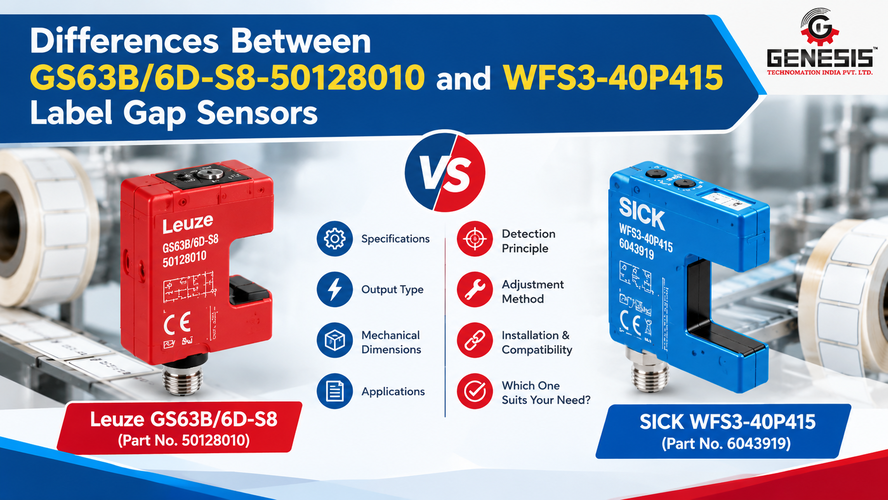
Choosing between the GS63B/6D-S8-50128010 vs WFS3-40P415 Label Gap Sensors requires more than checking their basic detection capabilities. Both models support label detection in automated production environments, but their mechanical construction, electrical outputs, adjustment methods, and environmental specifications differ in several important areas.
The Leuze GS63B/6D-S8-50128010, offers a 61 mm fork depth, a push-pull switching output, and an IP67 protection rating. The SICK WFS3-40P415, part number 6043919, features a 42 mm fork depth, a PNP switching output, and an IP65 protection rating.
Both manufacturers specify a 3 mm fork width, a minimum label gap of 2 mm, a 10 kHz switching frequency, and a response time of approximately 50 microseconds. Therefore, buyers should pay particular attention to the differences in mechanical dimensions, output compatibility, adjustment arrangements, and environmental protection.
This comparison examines the specifications and practical differences between these exact models. It also explains which option may better suit different packaging, printing, and automated labelling requirements.
GS63B/6D-S8-50128010 vs WFS3-40P415: Complete Specification Comparison
The following table compares the published manufacturer specifications for both products.
| Specification | Leuze GS63B/6D-S8 | SICK WFS3-40P415 |
| Manufacturer | Leuze | SICK |
| Model | GS63B/6D-S8 | WFS3-40P415 |
| Part number | 50128010 | 6043919 |
| Sensor design | Fork photoelectric sensor | Fork sensor |
| Fork width | 3 mm | 3 mm |
| Fork depth | 61 mm | 42 mm |
| Minimum label gap | 2 mm | 2 mm |
| Minimum label width | 2 mm | Not separately specified |
| Supply voltage | 10–30 V DC | 10–30 V DC |
| Switching frequency | 10 kHz | 10 kHz |
| Response time | 50 µs | ≤50 µs |
| Switching output | Push-pull | PNP |
| Maximum output current | 100 mA | 100 mA |
| Adjustment | Multiturn potentiometer | Plus/minus buttons and cable-based teach-in |
| Teach-in mode | Potentiometer-based adjustment | 2-point and dynamic teach-in |
| Electrical connection | M8, 4-pin male connector | M8, 4-pin male connector |
| Connection orientation | Horizontal, parallel to belt movement | Not separately stated in the cited specification |
| Light source | Infrared LED | Infrared LED |
| Wavelength | 940 nm | Not specified in the cited datasheet |
| Residual ripple | 0–15% | Less than 10% |
| Current consumption | Open-circuit current 0–30 mA | 20 mA without load |
| Protection rating | IP67 | IP65 |
| Protection class | III | III |
| Operating temperature | -20°C to +60°C | -20°C to +60°C |
| Storage temperature | -30°C to +70°C | -30°C to +80°C |
| Overall dimensions | 11 × 30 × 80 mm | 10 × 25 × 64.3 mm |
| Housing construction | Die-cast zinc and plastic | Glass-fibre-reinforced PA |
| Weight | 55 g | Approximately 36 g |
| Readiness/initialisation time | 300 ms readiness delay | 20 ms initialisation time |
| Maximum conveyor speed during teach-in | 20 m/min | Not specified as a numerical limit |
| Short-circuit protection | Yes | Yes |
| Reverse-polarity protection | Yes | Yes |
Important specification note: Leuze identifies the minimum detectable label width and minimum label gap separately as 2 mm. SICK specifies a minimum detectable object of 2 mm for the gap between labels or label size, depending on label thickness. These descriptions are related but should not be treated as identical test conditions.
Difference in Fork Width and Fork Depth
Fork dimensions represent one of the most important differences between the Leuze GS63B/6D-S8 and SICK WFS3-40P415.
Both models have a 3 mm fork width. However, their fork depths differ considerably.
| Mechanical specification | GS63B/6D-S8 | WFS3-40P415 |
| Fork width | 3 mm | 3 mm |
| Fork depth | 61 mm | 42 mm |
| Overall width | 11 mm | 10 mm |
| Overall height | 30 mm | 25 mm |
| Overall length/depth | 80 mm | 64.3 mm |
| Weight | 55 g | Approx. 36 g |
The Leuze model provides 19 mm more fork depth than the SICK model. This difference can influence sensor placement when the machine uses a specific label path or requires the sensing area to sit farther inside the sensor housing.
How the Leuze fork depth affects installation
The GS63B/6D-S8 has a 61 mm mouth depth. This provides a deeper sensing area compared with the 42 mm fork depth of the WFS3-40P415.
Buyers should consider this dimension when the label web travels through a machine with a longer insertion path or when the existing mounting arrangement requires greater fork depth.
Its overall dimensions of 11 × 30 × 80 mm also make it physically larger than the SICK alternative.
However, a deeper fork does not automatically improve detection accuracy. The machine designer must check the label path, sensor alignment, available clearance, and mounting position before selecting the model.
How the SICK fork dimensions differ
The WFS3-40P415 has a more compact mechanical design. Its 42 mm fork depth and 64.3 mm overall depth may make it easier to accommodate in installations with restricted mounting space.
It also weighs approximately 36 g, compared with 55 g for the Leuze sensor.
This difference may matter when engineers design lightweight brackets or retrofit an existing labelling station.
Which model has the advantage?
- Choose the GS63B/6D-S8 when the installation requires its 61 mm fork depth.
- Consider the WFS3-40P415 when a 42 mm fork depth and more compact overall dimensions suit the available mounting space.
The final decision should follow the machine’s mechanical drawing rather than the sensor’s overall size alone.
Difference in Output Configuration
Output configuration is another major consideration in the GS63B/6D-S8 vs WFS3-40P415 comparison.
The Leuze sensor uses a push-pull transistor output, whereas the SICK sensor uses a PNP switching output.
Although both models support a maximum switching current of 100 mA, their output configurations are different.
Leuze GS63B/6D-S8 push-pull output
The GS63B/6D-S8 provides one digital switching output with a push-pull transistor switching element.
Its published switching voltage specifications are:
- High signal: ≥ (UB – 2 V)
- Low signal: ≤ 2 V
- Maximum switching current: 100 mA
A push-pull output can actively provide high and low signal states. This arrangement offers flexibility when integrating the sensor with suitable digital input circuits.
However, engineers should still check the PLC input specifications, input common configuration, and electrical wiring diagram before connecting the sensor.
SICK WFS3-40P415 PNP output
The WFS3-40P415 uses a PNP switching output.
Its published specifications include:
- Switching output: PNP
- Maximum output current: 100 mA
- Light/dark switching: Selectable
- Teach-in input: PNP
The PNP configuration makes this model a suitable option for control systems designed around compatible sourcing-type digital inputs.
The PLC input must support the sensor’s voltage levels and switching arrangement. Buyers should also check the teach-in input requirements when they plan to control sensor adjustment through the machine controller.
Practical PLC compatibility differences
The output type can influence the wiring and integration work during installation.
For example, a machine that already uses compatible PNP inputs may offer a straightforward integration path for the SICK WFS3-40P415.
The Leuze push-pull output provides a different electrical arrangement. Engineers should verify the PLC input circuit before connecting it, even if the controller supports conventional 24 V DC digital signals.
Do not assume that both sensors offer interchangeable wiring simply because they share the same supply voltage and connector type.
Selection recommendation: Check the PLC input configuration first. Choose the Leuze model when its push-pull output matches the control system. Consider the SICK model when the machine requires a compatible PNP output.
Difference in Response Time and Switching Performance
Response time and switching frequency are two separate specifications. Buyers should examine both when selecting a sensor for high-speed labelling machinery.
The good news is that both models offer closely matched performance specifications.
| Performance specification | GS63B/6D-S8 | WFS3-40P415 |
| Switching frequency | 10 kHz | 10 kHz |
| Response time | 50 µs | ≤50 µs |
| Supply voltage | 10–30 V DC | 10–30 V DC |
Response time comparison
The Leuze GS63B/6D-S8 specifies a response time of 0.05 ms, equivalent to 50 microseconds.
The SICK WFS3-40P415 specifies a response time of no more than 50 microseconds.
Therefore, the published response-time specifications do not establish a meaningful speed advantage for either model.
Response time describes the time required for the sensor output to respond to a detection change under the manufacturer’s specified test conditions.
For a high-speed packaging machine, a shorter response time can help the control system detect closely spaced label transitions. However, actual machine performance also depends on label movement, controller scan time, input filtering, and output processing.
Switching frequency comparison
Both models have a switching frequency of 10 kHz.
This means their published maximum switching-frequency ratings match.
A 10 kHz switching frequency indicates the sensor’s specified switching capability. It does not mean that the machine can automatically process 10,000 labels per second.
The actual production rate depends on label dimensions, gap spacing, conveyor speed, PLC processing, and the complete machine configuration.
What does this mean for high-speed labelling?
Consider a machine that processes labels at high conveyor speeds.
If the sensor must detect small gaps repeatedly, engineers need to evaluate both the switching frequency and the response time.
Since the two products share the same published 10 kHz switching frequency and approximately 50 µs response time, these specifications alone do not justify choosing one over the other.
Other differences, particularly output configuration and fork depth, should influence the decision.
Selection recommendation: Neither model has a clear specification-based advantage in switching frequency or response time. Compare the complete detection and control-system requirements before choosing.
Difference in Label Detection Capability
Label detection performance is another important part of this comparison.
Both manufacturers specify a minimum label gap of 2 mm or an equivalent 2 mm detection requirement. However, their product descriptions provide slightly different information about label detection.
| Detection specification | GS63B/6D-S8 | WFS3-40P415 |
| Minimum label gap | 2 mm | 2 mm |
| Minimum label width | 2 mm | 2 mm MDO specification |
| Detection principle | Optical | Optical |
| Light source | Infrared LED | Infrared LED |
| Wavelength | 940 nm | Not specified in cited datasheet |
| Label material specification | Non-transparent | Depends on label thickness for stated MDO |
Leuze label detection specifications
Leuze specifically identifies the GS63B/6D-S8 for detecting non-transparent labels.
Its product information lists:
- Minimum label width: 2 mm
- Minimum label gap: 2 mm
- Infrared light source: 940 nm
- Pulsed transmitted signal
These specifications provide useful information for buyers working with conventional non-transparent label materials.
However, the manufacturer does not establish universal detection performance across every material thickness, surface finish, or label construction.
SICK label detection specifications
The SICK WFS3-40P415 specifies a minimum detectable object of 2 mm.
The manufacturer describes this specification in relation to the gap between labels or label size and adds that performance depends on label thickness.
This qualification matters when selecting the sensor for thin labels or tightly spaced label sequences.
Buyers should test the actual label stock rather than relying only on the nominal 2 mm specification.
How label material affects model selection
Label material can influence the detection performance of either sensor.
For example, transparent labels, thin films, reflective surfaces, and unusual substrate combinations may require additional testing.
The Leuze product page explicitly states detection of non-transparent labels. The cited SICK specification does not provide an equivalent universal material-compatibility statement.
Therefore, buyers should not assume that both products offer identical performance with transparent labels.
What about very small label gaps?
Both models specify a 2 mm minimum label gap.
If a production line uses gaps smaller than this value, neither product should be selected solely on the basis of its published minimum-gap specification.
The engineering team should discuss the application with the manufacturer or supplier and conduct an actual production-line test.
Selection recommendation: Both products offer a 2 mm published minimum detection specification. Consider the Leuze model when its explicitly stated non-transparent label application matches the job. Evaluate the SICK model against its label-thickness qualification and actual material requirements.
Difference in Adjustment and Teach-in Features
The adjustment arrangements differ more noticeably than the basic detection specifications.
The Leuze GS63B/6D-S8 uses a multiturn potentiometer. The SICK WFS3-40P415 provides plus/minus adjustment buttons and cable-based teach-in functionality.
This difference can influence commissioning time, maintenance procedures, and how operators configure the machine.
Leuze GS63B/6D-S8 adjustment
Leuze provides a multiturn potentiometer for adjusting the GS63B/6D-S8.
The adjustment mechanism gives technicians a manual method to configure the sensor during installation and maintenance.
Its published technical specifications also include a maximum conveyor speed of 20 m/min during teach-in.
This detail matters when engineers configure the sensor while the label material moves through the production machine.
The product also has two LEDs for operating and status indication.
SICK WFS3-40P415 adjustment
SICK offers more detailed teach-in functionality for the WFS3-40P415.
The manufacturer specifies:
- Plus/minus adjustment buttons.
- 2-point teach-in.
- Dynamic teach-in.
- Sensitivity adjustment.
- Selectable light/dark switching.
- Cable-based teach-in functionality.
The sensor allows technicians to adjust the switching threshold using the buttons.
SICK also provides an electrical teach-in input. Its published requirements specify a teach signal above 5 V and below the supply voltage, while the run state requires less than 4 V.
This provides an additional configuration option for machine designers who want to incorporate sensor adjustment into their control arrangements.
Which adjustment method is more suitable?
The two adjustment systems serve different commissioning preferences.
The Leuze potentiometer offers a manual adjustment arrangement. Technicians who already work with Leuze GS-series sensors may find this approach familiar.
The SICK model offers more documented adjustment functions, including dynamic teach-in and a dedicated electrical teach-in input.
For production environments that frequently change label formats, the SICK adjustment options may provide additional flexibility.
However, this does not automatically make the SICK model the better choice for every installation. The actual commissioning procedure, operator requirements, and machine-control design remain important.
Selection recommendation: Consider the GS63B/6D-S8 for potentiometer-based manual adjustment. Consider the WFS3-40P415 when 2-point teach-in, dynamic teach-in, and electrical teach-in functionality are important.
Difference in Electrical Specifications
Electrical compatibility affects installation, machine operation, and replacement planning.
Both models operate within the same nominal supply-voltage range, but their ripple specifications and current-consumption information differ.
| Electrical parameter | GS63B/6D-S8 | WFS3-40P415 |
| Supply voltage | 10–30 V DC | 10–30 V DC |
| Residual ripple | 0–15% | Less than 10% |
| Current information | Open-circuit current 0–30 mA | 20 mA without load |
| Maximum output current | 100 mA | 100 mA |
| Output | Push-pull | PNP |
| Connection | M8, 4-pin male | M8, 4-pin male |
| Reverse-polarity protection | Yes | Yes |
| Short-circuit protection | Yes | Yes |
Supply voltage
Both sensors operate between 10 V DC and 30 V DC.
This common voltage range makes them suitable candidates for many industrial DC control systems.
However, supply-voltage compatibility alone does not establish complete electrical interchangeability.
Engineers must also examine output configuration, current requirements, connector wiring, and PLC input specifications.
Residual ripple
The Leuze model specifies residual ripple from 0% to 15% of the supply voltage.
SICK specifies ripple below 10%.
The SICK specification therefore sets a tighter stated ripple limit.
This is relevant when the machine’s power supply experiences electrical fluctuations.
A stable DC supply that remains within the sensor’s specified operating conditions helps avoid unnecessary commissioning problems.
Current consumption
The manufacturers present current information differently.
Leuze specifies an open-circuit current range of 0–30 mA.
SICK specifies 20 mA without load.
These figures should not be interpreted as a direct comparison of identical measurement conditions.
The 100 mA maximum switching current is the same for both products.
Electrical connection
Both models use an M8, four-pin male connector.
This similarity may help during retrofit planning, but buyers must verify the actual pin assignments.
The SICK connection diagram identifies:
- Pin 1: Supply positive.
- Pin 2: Teach-in.
- Pin 3: Supply negative.
- Pin 4: Switching output.
The Leuze product specifies a horizontal connector outlet parallel to belt movement.
These details can affect cable routing and mounting arrangements.
Selection recommendation: Both models support 10–30 V DC and a maximum output current of 100 mA. Choose according to the PLC output requirements, ripple conditions, wiring diagram, and teach-in arrangement rather than supply voltage alone.
Difference in Protection and Operating Conditions
Industrial sensors often operate near moving label webs, packaging equipment, and production machinery. Their environmental ratings therefore deserve attention during selection.
The GS63B/6D-S8 has an IP67 protection rating, while the WFS3-40P415 has an IP65 rating.
| Environmental specification | GS63B/6D-S8 | WFS3-40P415 |
| Protection rating | IP67 | IP65 |
| Protection class | III | III |
| Operating temperature | -20°C to +60°C | -20°C to +60°C |
| Storage temperature | -30°C to +70°C | -30°C to +80°C |
| Short-circuit protection | Yes | Yes |
| Reverse-polarity protection | Yes | Yes |
IP67 versus IP65
The Leuze sensor provides an IP67 enclosure rating.
The SICK sensor provides an IP65 enclosure rating.
Both ratings indicate protection against dust ingress. However, their water-protection classifications differ.
IP65 indicates protection against water jets under the relevant test conditions.
IP67 includes protection against temporary immersion under specified testing conditions.
This distinction can matter in production facilities where equipment experiences regular cleaning or accidental exposure to water.
However, an IP67 rating does not automatically make a sensor suitable for every washdown process. Chemical exposure, cleaning temperature, installation orientation, cable sealing, and the complete mounting arrangement also matter.
Operating temperature
Both manufacturers specify the same operating-temperature range:
- Minimum: -20°C
- Maximum: +60°C
Consequently, neither model has a stated operating-temperature advantage over the other.
Storage temperature
The storage-temperature specifications differ.
The Leuze sensor supports storage from -30°C to +70°C.
The SICK model specifies a storage range from -30°C to +80°C.
The SICK product therefore has a 10°C higher maximum specified storage temperature.
This distinction matters mainly during transportation, warehousing, and periods when equipment remains unused.
Selection recommendation: Consider the GS63B/6D-S8 when IP67 protection is an important requirement. The WFS3-40P415 may suit installations where IP65 protection meets the environmental conditions and its higher specified storage-temperature limit is useful.
Difference in Installation and Machine Compatibility
The mechanical and electrical differences between these models can influence installation more than their common detection specifications.
A replacement sensor must fit the existing mounting arrangement and communicate correctly with the machine controller.
Installation requirements for the Leuze model
The GS63B/6D-S8 measures 11 × 30 × 80 mm and weighs 55 g.
It uses through-hole mounting, with an optional mounting device available.
Its 61 mm fork depth offers a different physical arrangement from the shorter SICK fork.
The horizontal M8 connector outlet also deserves attention. Engineers should check the available cable clearance and ensure that the connector does not interfere with moving components.
The 300 ms readiness delay should also form part of the machine-startup sequence.
Installation requirements for the SICK model
The WFS3-40P415 measures 10 × 25 × 64.3 mm and weighs approximately 36 g.
Its compact body may simplify installation in restricted spaces.
The shorter fork depth can also suit machine layouts that do not require the additional 19 mm provided by the Leuze sensor.
Its four-pin M8 connection supports the supply, PNP output, and teach-in arrangement.
The SICK model has a specified initialisation time of 20 ms. This is considerably shorter than the 300 ms readiness delay published for the Leuze model.
However, these specifications use manufacturer-specific terminology and should not be treated as identical test measurements without checking the relevant operating documentation.
Can one model directly replace the other?
Not necessarily.
Even though both models have a 3 mm fork width and 2 mm minimum label-gap specifications, their physical dimensions and electrical output arrangements differ.
Before replacing one with the other, engineers should verify:
- Available mounting dimensions.
- Fork depth and label-web alignment.
- M8 connector pin configuration.
- PLC input compatibility.
- Cable routing and connector clearance.
- Teach-in procedure.
- Startup and readiness timing.
- Environmental protection requirements.
A sensor replacement should always include mechanical and electrical verification. Matching the connector size alone is insufficient.
Difference in Industrial Application Suitability
Both products target automated label-detection requirements, but their individual specifications may make one more appropriate than the other in particular machine configurations.
The following comparison considers actual differences rather than assuming that either product is universally better.
High-speed packaging lines
High-speed packaging lines require consistent detection of closely spaced labels.
Both sensors provide a 10 kHz switching frequency and approximately 50 µs response time.
Therefore, their published switching performance is closely matched.
The more important differences concern the output configuration and installation.
The WFS3-40P415 may suit a machine with compatible PNP inputs and limited mounting space.
The GS63B/6D-S8 may suit a machine that requires a push-pull output and a 61 mm fork depth.
Automatic labelling machines
Automatic labelling machines frequently require sensor replacement, adjustment, and format changes.
The SICK WFS3-40P415 offers 2-point and dynamic teach-in, along with plus/minus adjustment buttons.
These features may help technicians when the machine requires different label settings.
The Leuze GS63B/6D-S8 provides potentiometer-based adjustment and a 20 m/min maximum conveyor speed during teach-in.
Its deeper fork may also suit particular label-path arrangements.
The final choice should depend on the machine’s existing control and mounting configuration.
Bottle labelling machines
Bottle labelling equipment may use different label materials, backing thicknesses, and gap dimensions.
Both products specify a 2 mm minimum label gap.
The Leuze model explicitly lists non-transparent label detection.
SICK specifies that its 2 mm minimum detectable object depends on label thickness.
For bottle labelling lines that use transparent films or unusual label constructions, buyers should request application-specific verification rather than assume either model will provide the required performance.
Pharmaceutical packaging equipment
Pharmaceutical packaging often requires controlled label positioning and repeatable machine operation.
Both models offer the same published switching frequency and response-time specifications.
However, their different output configurations may influence integration with the packaging machine’s PLC.
The Leuze IP67 rating may be relevant where the equipment requires its higher stated water-protection classification.
The SICK dynamic teach-in and electrical teach-in input may be useful where technicians need additional adjustment options.
Buyers should also consider the actual cleaning procedure, label stock, and machine validation requirements.
Food packaging machinery
Food packaging environments can involve cleaning activities and moisture exposure.
The IP67 rating of the GS63B/6D-S8 offers a higher water-protection classification than the IP65 rating of the WFS3-40P415.
This makes the Leuze specification worth considering when the installation requires IP67 protection.
However, neither rating independently establishes suitability for chemical washdown or high-temperature cleaning.
The equipment designer should check the complete cleaning and environmental requirements before installation.
Printing and converting equipment
Printing and converting machinery may require detection of small gaps and reliable integration with fast-moving web-handling equipment.
Both models specify a 2 mm minimum gap and 10 kHz switching frequency.
Their response-time specifications are also closely matched.
The Leuze sensor offers a 61 mm fork depth, which may suit certain web-path arrangements.
The SICK model has a smaller body and additional documented teach-in options.
Therefore, mechanical clearance, PLC compatibility, and label material should guide the selection.
Which Model Should You Choose: GS63B/6D-S8 or WFS3-40P415?
There is no universal winner in this comparison. Both products offer similar headline detection and switching specifications, but they address different mechanical and electrical requirements.
The right choice depends on how the sensor fits into the existing machine.
When should you choose Leuze GS63B/6D-S8-50128010?
Consider the Leuze GS63B/6D-S8 when your application requires the following specifications:
- A 61 mm fork depth.
- A push-pull switching output.
- An IP67 protection rating.
- A 940 nm infrared light source.
- A multiturn potentiometer adjustment.
- Through-hole mounting.
- A 3 mm fork width.
- A minimum label gap of 2 mm.
Its deeper fork and higher enclosure protection rating represent two important differences.
The model may be particularly relevant when replacing an existing Leuze sensor or integrating a new unit into a machine designed around its dimensions and push-pull output.
Its 300 ms readiness delay should also match the machine’s startup requirements.
Advantages of GS63B/6D-S8
- Deeper 61 mm fork.
- Push-pull switching output.
- IP67 protection rating.
- Explicit specification for non-transparent label detection.
- Documented 940 nm infrared wavelength.
- Metal and plastic housing construction.
Limitations of GS63B/6D-S8
- Larger overall dimensions.
- Higher weight than the SICK alternative.
- Potentiometer-based adjustment rather than the documented SICK teach-in options.
- 300 ms readiness delay.
When should you choose SICK WFS3-40P415?
Consider the SICK WFS3-40P415 when your installation requires:
- A compact 64.3 mm overall depth.
- A 42 mm fork depth.
- A PNP switching output.
- 2-point teach-in.
- Dynamic teach-in.
- Plus/minus adjustment buttons.
- Electrical teach-in input.
- IP65 protection.
- A 20 ms initialisation time.
Its smaller dimensions and lower weight can help when installing sensors in restricted machine spaces.
The additional teach-in options may also suit production lines that frequently change label settings.
Advantages of WFS3-40P415
- Compact overall dimensions.
- Lower weight of approximately 36 g.
- PNP switching output.
- 2-point and dynamic teach-in.
- Dedicated electrical teach-in input.
- Less than 10% specified ripple.
- 20 ms initialisation time.
- Higher maximum specified storage temperature of +80°C.
Limitations of WFS3-40P415
- Shorter 42 mm fork depth.
- IP65 rather than IP67 protection.
- PNP output requires compatible PLC inputs.
- Its 2 mm detection specification includes a label-thickness qualification.
- The cited datasheet does not specify an infrared wavelength.
Final selection comparison between WFS3-40P415 and GS63B/6D-S8-50128010
| Buying requirement | More suitable model based on published specifications |
| 61 mm fork depth | GS63B/6D-S8 |
| Compact installation | WFS3-40P415 |
| Push-pull output | GS63B/6D-S8 |
| PNP output | WFS3-40P415 |
| IP67 protection | GS63B/6D-S8 |
| Dynamic teach-in | WFS3-40P415 |
| Potentiometer adjustment | GS63B/6D-S8 |
| 940 nm wavelength specification | GS63B/6D-S8 |
| 20 ms initialisation time | WFS3-40P415 |
| 10 kHz switching frequency | Both |
| Approximately 50 µs response time | Both |
| 3 mm fork width | Both |
| 2 mm minimum label gap | Both |
The GS63B/6D-S8 is a strong candidate when the machine requires its deeper fork, push-pull output, and IP67 protection. The WFS3-40P415 deserves consideration when compact dimensions, PNP integration, and additional teach-in functionality matter more.
The best decision comes from matching the exact sensor specification to the machine’s electrical, mechanical, and environmental requirements.
Where to Buy GS63B/6D-S8-50128010 and WFS3-40P415 Label Gap Sensors in India?
Industrial buyers in India should verify the exact manufacturer model and part number before purchasing a replacement or installing a new sensor.
Genesis Technomation India Pvt. Ltd. is a company buyers can contact to enquire about both models and discuss their industrial label-detection requirements.
Visit the Genesis Technomation Label Gap Sensor product page to submit an enquiry and request product information or a quotation.
When looking for the Best Place to Buy Label Gap Sensors, buyers should consider technical assistance, exact part-number verification, electrical compatibility, and mounting requirements alongside purchasing arrangements.
Enquire About GS63B/6D-S8-50128010
If your application requires the Leuze GS63B/6D-S8, confirm the exact part number 50128010 before placing an enquiry.
Discuss the following specifications with Genesis Technomation:
- Correct GS63B/6D-S8 model identification.
- Push-pull output configuration.
- 61 mm fork depth.
- 3 mm fork width.
- IP67 protection rating.
- M8 four-pin electrical connection.
- Compatibility with your existing PLC and machine mounting arrangement.
These checks can help avoid selecting a similar-looking sensor with a different electrical or mechanical configuration.
For product information and quotations, visit the Genesis Technomation product page.
You can also review the dedicated GS63B/6D-S8-50128010 product article for additional product information.
Enquire About WFS3-40P415
Buyers interested in the SICK WFS3-40P415 should confirm the model number WFS3-40P415 and manufacturer part number 6043919.
Before requesting a quotation, check:
- PNP switching output compatibility.
- 42 mm fork depth.
- 3 mm fork width.
- 2 mm minimum detectable object specification.
- M8 four-pin connector.
- 10–30 V DC supply requirement.
- Available mounting space.
- Teach-in and adjustment requirements.
Genesis Technomation can be contacted through its Label Gap Sensor product page for enquiries about this model.
For additional model-specific information, visit the WFS3-40P415 product article.
Before finalising the purchase, confirm product availability, pricing, delivery arrangements, and the exact part number directly with the supplier.
Frequently Asked Questions
What is the main difference between GS63B/6D-S8 and WFS3-40P415?
The main differences concern fork depth, output configuration, and enclosure protection. The Leuze GS63B/6D-S8 offers a 61 mm fork depth, push-pull output, and IP67 protection. The SICK WFS3-40P415 provides a 42 mm fork depth, PNP output, and IP65 protection. Both models have a 3 mm fork width, 2 mm minimum label-gap specification, and 10 kHz switching frequency.
Which model has a deeper fork?
The Leuze GS63B/6D-S8 has the deeper fork at 61 mm. The SICK WFS3-40P415 has a fork depth of 42 mm. The 19 mm difference can influence mounting position, label-web alignment, and machine compatibility.
What is the difference between their output types?
The GS63B/6D-S8 uses a push-pull transistor switching output. The WFS3-40P415 uses a PNP switching output. Both support a maximum switching current of 100 mA. Buyers should verify PLC input compatibility and wiring before selecting either sensor.
Do both models have the same switching frequency?
Yes. Both manufacturers specify a switching frequency of 10 kHz. This means their published switching-frequency ratings match, although actual machine performance also depends on conveyor speed, label spacing, and controller processing.
Which model offers a faster response time?
Their published response-time specifications are effectively the same. Leuze specifies 50 µs, while SICK specifies a maximum of 50 µs. Therefore, neither model has a meaningful documented response-time advantage based on these figures.
Are both models compatible with industrial PLC systems?
Both operate on 10–30 V DC and provide digital switching outputs. However, their output configurations differ. The Leuze sensor uses push-pull output, while the SICK sensor uses PNP output. Buyers must check PLC input compatibility, wiring, and signal requirements before installation.
Which model is suitable for limited installation space?
The SICK WFS3-40P415 has more compact overall dimensions of 10 × 25 × 64.3 mm. The Leuze GS63B/6D-S8 measures 11 × 30 × 80 mm. Therefore, the SICK model may suit installations with restricted space, provided its 42 mm fork depth meets the application requirements.
What should buyers check before selecting either model?
Buyers should compare fork depth, fork width, output type, supply voltage, switching frequency, response time, label-gap requirements, connector pin configuration, protection rating, and teach-in method. They should also verify label thickness, mounting dimensions, and PLC compatibility.
Where can buyers enquire about these models in India?
Buyers can contact Genesis Technomation India Pvt. Ltd. through its Label Gap Sensor product page. They should specify the exact model and part number when requesting product information or a quotation.
Can GS63B/6D-S8 replace WFS3-40P415 directly?
Not without checking mechanical and electrical compatibility. Although both models share a 3 mm fork width and similar switching performance, their fork depths, output configurations, overall dimensions, and protection ratings differ. Engineers should verify the mounting arrangement, PLC input, connector wiring, and teach-in requirements before making a replacement.
Conclusion
The comparison between the GS63B/6D-S8-50128010 and WFS3-40P415 Label Gap Sensors shows that both models offer reliable specifications for industrial label detection, but their mechanical design, electrical configuration, and adjustment features make them suitable for different machine requirements.
The Leuze GS63B/6D-S8 stands out with its 61 mm fork depth, push-pull output, and IP67 protection rating. It is worth considering for installations that require a deeper fork, higher stated water-protection classification, and compatibility with push-pull PLC inputs.
On the other hand, the SICK WFS3-40P415 offers a more compact design, 42 mm fork depth, PNP output, and additional adjustment options, including dynamic and 2-point teach-in. These features may make it a suitable choice for machines with limited installation space and compatible PNP control systems.
Both sensors share a 3 mm fork width, 2 mm minimum label-gap specification, 10 kHz switching frequency, and approximately 50 µs response time. Therefore, neither model has a clear advantage in these particular specifications.
Ultimately, the right selection depends on your machine’s mounting dimensions, PLC compatibility, label material, environmental conditions, and adjustment requirements. Before purchasing, verify the exact part number and technical specifications to avoid compatibility issues.
For product enquiries, technical assistance, and quotations in India, contacts Genesis Technomation India Pvt. Ltd.
Related Posts