Choosing a label gap sensor for an automated labeling or packaging machine is not simply a matter of selecting the sensor with the highest speed specification or the lowest purchase price. The actual label construction, gap size, web speed, detection technology, mounting arrangement, PLC interface, and required positioning accuracy all influence whether a sensor will perform reliably after installation.
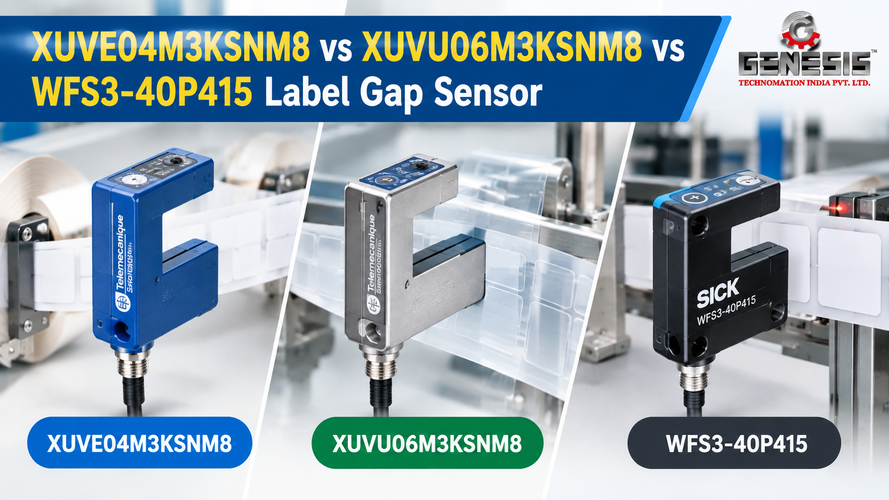
Three models that deserve a direct engineering comparison are XUVE04M3KSNM8, XUVU06M3KSNM8, and WFS3-40P415.
The first two belong to the Telemecanique Sensors XU/XUV family, but they use different sensing technologies. The XUVE04M3KSNM8 is an infrared optical fork sensor intended for label detection, while the XUVU06M3KSNM8 uses ultrasonic emission and is specifically documented for transparent-label detection. The WFS3-40P415, manufactured by SICK, is an optical fork sensor with infrared LED emission and PNP output.
That distinction is important. Two sensors may both be called “Label Gap Sensors” or “fork sensors” while behaving differently when the label material changes. An opaque paper label, a clear film label, and a very thin transparent label do not necessarily present the same sensing challenge.
For OEM machine builders, packaging-equipment manufacturers, automation engineers, maintenance teams, and procurement departments, the useful question is therefore not simply which sensor is best? It is:
Which sensor has the technical characteristics that match the label web and machine architecture?
The comparison below focuses on that question.
Quick Comparison: XUVE04M3KSNM8 vs XUVU06M3KSNM8 vs WFS3-40P415
| Feature | XUVE04M3KSNM8 | XUVU06M3KSNM8 | WFS3-40P415 |
| Manufacturer | Telemecanique Sensors | Telemecanique Sensors | SICK |
| Sensor family | XU / XUV | XU / XUV | WFS |
| Sensor design | Fork | Fork | Fork |
| Detection principle | Through-beam optical | Through-beam ultrasonic | Optical |
| Emission | Infrared | Ultrasonic | Infrared LED |
| Primary label application | Label detection | Transparent-label detection | Label/gap detection |
| Passage width | 3 mm | 3 mm | 3 mm |
| Passage depth | 40 mm | 69 mm | 42 mm |
| Minimum label length | 2 mm | 2 mm | 2 mm |
| Minimum gap / distance between labels | 2 mm | 2 mm | 2 mm |
| Published accuracy | ±0.05 mm at 150 m/min | ±0.20 mm at 120 m/min | Not identified in the current SICK data sheet as an equivalent positional accuracy figure |
| Maximum published passing speed | 200 m/min | 180 m/min | Not stated as an equivalent web-speed figure in the cited data sheet |
| Response time | 0.1 ms | 0.3 ms | 50 µs |
| Switching frequency | Up to 10 kHz | Up to 1.5 kHz | 10 kHz |
| Supply | 12–24 V DC | 12–24 V DC | 10–30 V DC |
| Output | PNP/NPN | PNP/NPN | PNP |
| Output function | 2 NO/NC programmable | 2 NO/NC programmable | Light/dark switching |
| Connection | M8, 4-pin | M8, 4-pin | M8, 4-pin |
| Protection | IP65 | IP65 | IP65 |
| Adjustment | Numeric potentiometer | Numeric potentiometer | Plus/minus buttons / teach-in |
| Housing | PA12 | Zinc alloy | Glass-fiber-reinforced PA |
| Typical differentiator | Optical label detection with high published positional accuracy | Transparent-label detection using ultrasonic sensing | Fast optical fork sensing with 50 µs response |
The most important distinction is technological. XUVE04M3KSNM8 and WFS3-40P415 are optical sensors, while XUVU06M3KSNM8 uses ultrasonic emission. Telemecanique specifically identifies XUVU06M3KSNM8 for transparent-label detection.
The XUVE model, meanwhile, has a published ±0.05 mm accuracy at 150 m/min and a 0.1 ms response delay, making its specification particularly interesting for precision label positioning.
The SICK WFS3-40P415 stands out for its 50 µs response time and 10 kHz switching frequency, together with a PNP output and integrated teach-in functionality.
XUVE04M3KSNM8: Technical Overview
The XUVE04M3KSNM8 is a Telemecanique Sensors XU-series fork-style photoelectric sensor designed specifically for label detection in packaging applications.
Its detection system is through-beam and its emission is infrared. The sensor has a 3 mm passage width and 40 mm passage depth. The manufacturer specifies PNP and NPN outputs with two programmable NO/NC functions, a four-wire connection, and an M8 four-pin male connector.
Detection Technology
The XUVE04M3KSNM8 uses optical through-beam detection.
A label web passes through the sensor’s fork. Because the transmitter and receiver are incorporated into the fork arrangement, the optical path is fixed mechanically. This is useful in machine design because the installer does not have to align two physically separate sensor heads.
The sensor uses infrared emission, and the manufacturer specifies it for label detection. That makes it a logical candidate where there is a sufficiently detectable optical difference between the label and its carrier or liner.
This distinction matters when evaluating transparent materials. The published application is “detection of labels”; it should not automatically be interpreted as a guarantee of reliable detection for every transparent or semi-transparent label construction.
Passage Dimensions
The XUVE04M3KSNM8 has a 3 mm passage width and 40 mm passage depth.
The 3 mm passage is significant because the label web must physically pass through the sensing slot. Mechanical clearance, label thickness, web tracking, and bracket alignment therefore need to be considered during machine design.
A sensor can have excellent electronic performance and still produce inconsistent results if the web is not mechanically stable.
Label Size and Gap
The published minimum label length is 2 mm, while the minimum distance between labels is also 2 mm.
This is an important specification for applications involving short labels or small gaps. However, minimum detectable dimensions should never be interpreted as a blanket guarantee for every material. Label thickness, liner construction, speed, mechanical flutter, and actual machine conditions can affect performance.
Accuracy
One of the strongest specifications of the XUVE04M3KSNM8 is its published accuracy of ±0.05 mm at 150 m/min.
For a labeling machine, this is more meaningful than simply saying that the sensor is “high precision.”
If the sensor output is used as a timing reference for label dispensing or positioning, repeatability in the detection point can affect downstream machine timing. The practical result can be more consistent label placement when the rest of the machine—drive, web tension, controller, mechanics, and applicator—is also properly controlled.
Speed and Response
The specified maximum passing speed is 200 m/min, while the published accuracy value is given at 150 m/min. The sensor’s maximum response delay is 0.1 ms.
These values should be interpreted together rather than separately.
A high maximum speed does not automatically mean that a machine will maintain perfect label positioning at that speed. The label length and gap, controller scan time, actuator response, web acceleration, and mechanical stability all contribute to the final system performance.
Electrical Integration
The XUVE04M3KSNM8 operates from a 12–24 V DC rated supply, with published supply limits of 10–30 V DC. It provides PNP and NPN discrete outputs, and the output function is programmable for NO/NC operation. The connector is an M8 four-pin male connector.
This flexibility can simplify integration into machines with different PLC input architectures.
Before connecting the sensor, however, an engineer should verify the actual PLC input type, voltage range, common/reference arrangement, output current requirement, and wiring diagram.
Environmental Characteristics
The XUVE04M3KSNM8 is rated IP65, with an operating temperature range reported as -20°C to +60°C and a storage range of -30°C to +80°C.
For packaging machinery, IP65 can be useful where the sensor is exposed to dust, material particles, and ordinary industrial contamination. It should not, however, be interpreted as suitability for every washdown or chemical environment.
XUVU06M3KSNM8: Technical Overview
The XUVU06M3KSNM8 belongs to the same broader Telemecanique XU sensor family, but its sensing technology is fundamentally different.
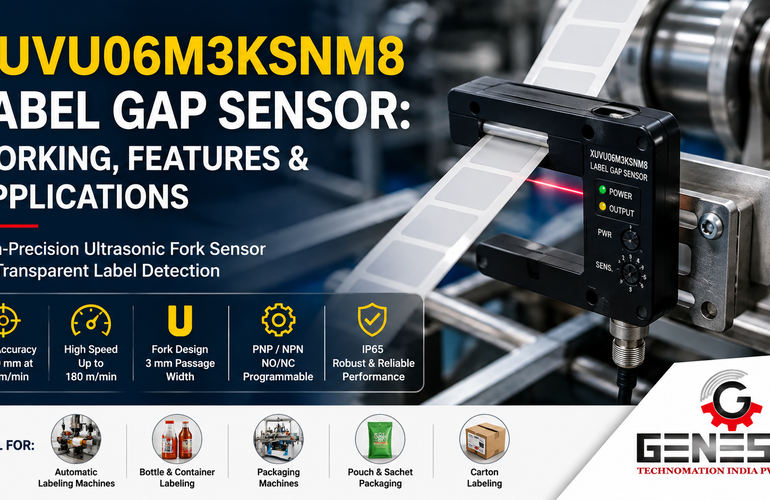
It is a fork-style sensor with ultrasonic emission and is specifically identified by Telemecanique for transparent-label detection.
That makes this model particularly important when a conventional optical label sensor is not the most appropriate solution.
Ultrasonic Detection
The XUVU06M3KSNM8 uses ultrasonic sensing across its fork rather than conventional infrared optical emission.
For an engineer, the key point is not simply that the sensor is “ultrasonic.” The important point is that the manufacturer designed this model for transparent-label applications.
Transparent labels can be difficult for conventional optical sensors because the optical contrast between label, liner, and surrounding material may be relatively small. A dedicated ultrasonic label sensor approaches that detection problem differently.
Passage Dimensions
The XUVU06M3KSNM8 has a 3 mm passage width and 69 mm passage depth.
The greater passage depth compared with the XUVE04M3KSNM8 is a mechanical consideration when designing a sensor bracket or modifying an existing machine.
The sensor is also housed in a zinc-alloy enclosure, making its construction different from the PA12 housing used by the XUVE model.
Transparent Label Detection
Transparent-label detection is the clearest application differentiator of this model.
Telemecanique lists a minimum label length of 2 mm and minimum distance between labels of 2 mm. Its published accuracy is ±0.20 mm at 120 m/min.
Therefore, if the machine uses transparent labels, the XUVU06M3KSNM8 deserves consideration before automatically selecting an optical fork sensor.
Speed
The manufacturer lists a maximum passing speed of 180 m/min.
This is slightly lower than the published 200 m/min value for the XUVE04M3KSNM8.
However, that difference should not be interpreted as meaning that the XUVE model is universally superior. If transparent-label detection is the primary problem, sensing technology can be more important than a 20 m/min difference in nominal passing speed.
Response
The XUVU06M3KSNM8 has a maximum response delay of 0.3 ms and a first-up delay of 30 ms.
Its published switching frequency is up to approximately 1.5 kHz in the available technical data.
This is considerably different from the 10 kHz figure associated with the XUVE optical sensor and SICK WFS3-40P415.
For high-frequency label transitions, engineers should therefore consider switching frequency and response time together with actual label geometry.
Electrical Characteristics
The XUVU06M3KSNM8 has a rated supply voltage of 12–24 V DC, with supply limits of 10–30 V DC. It supports PNP and NPN outputs, two programmable NO/NC functions, and an M8 four-pin connector.
The switching capacity is specified up to 100 mA with overload and short-circuit protection.
This makes the sensor straightforward to consider for conventional PLC-based machine control, provided the PLC input specifications and wiring arrangement are compatible.
Environmental Protection
The sensor is rated IP65. The published operating temperature range is 5°C to 55°C, while vibration and shock resistance are also specified.
This narrower operating temperature range compared with the XUVE model should be considered if the sensor will be installed in a location subject to substantial temperature variation.
WFS3-40P415: Technical Overview
The WFS3-40P415 is a SICK WFS-series fork sensor. SICK identifies its functional principle as optical detection and its light source as an infrared LED. The sensor is specifically designed in a fork-shaped housing.
Its main specifications include a 3 mm fork width, 42 mm fork depth, 2 mm minimum detectable label gap/size, PNP switching output, 10–30 V DC supply, 10 kHz switching frequency, and 50 µs response time.
Optical Detection
Like the XUVE04M3KSNM8, the WFS3-40P415 uses an optical sensing principle.
That makes the technology fundamentally different from the ultrasonic XUVU06M3KSNM8.
For ordinary label webs where the label and carrier provide an adequate optical contrast, the optical fork architecture is attractive because the emitter and receiver are already integrated into the sensor body.
Fork Construction
SICK specifies a 3 mm fork width and 42 mm fork depth. The overall dimensions are approximately 10 mm × 25 mm × 64.3 mm.
The physical dimensions matter when retrofitting a sensor onto an existing labeling machine.
A replacement sensor is not automatically mechanically interchangeable simply because both devices have a 3 mm sensing gap. Fork depth, overall body dimensions, connector orientation, mounting holes, and cable routing can all affect installation.
Minimum Detectable Gap
The WFS3-40P415 is specified for label detection with a minimum detectable object value of 2 mm for gap between labels / size of labels, depending on label thickness.
This places it in the same general small-gap category as the two Telemecanique models.
Response Time and Switching Frequency
The WFS3-40P415 has a published 50 µs response time and 10 kHz switching frequency. Jitter is specified at 40 µs.
The 50 µs response is particularly noteworthy in a direct comparison.
The XUVE04M3KSNM8 specifies 0.1 ms, or 100 µs, while the XUVU06M3KSNM8 specifies 0.3 ms, or 300 µs.
So, based strictly on the published response figures, the SICK model has the shortest response time among the three.
However, response time should not be confused with overall label-positioning accuracy. They describe different aspects of sensor performance.
Teach-In and Adjustment
The WFS3-40P415 uses plus/minus buttons for teach-in, sensitivity adjustment, and light/dark switching. The available SICK documentation also identifies two-point teach-in and dynamic teach-in functions.
This gives the installer direct adjustment capability at the sensor.
By contrast, the XU models use a numeric potentiometer-based setup arrangement.
Electrical Integration
The WFS3-40P415 operates from 10–30 V DC, has a PNP switching output, and uses an M8 four-pin connector. Its maximum output current is 100 mA.
The important difference here is output flexibility.
The two Telemecanique models provide PNP and NPN output configurations, while the WFS3-40P415 is specified with PNP switching output.
If an existing machine controller requires NPN sensing, this becomes a significant selection criterion.
XUVE04M3KSNM8 vs XUVU06M3KSNM8
This is the most important comparison when the choice is between two Telemecanique XU-series sensors.
Detection Technology
The fundamental difference is:
- XUVE04M3KSNM8: infrared optical detection
- XUVU06M3KSNM8: ultrasonic detection
Both use a fork arrangement and through-beam architecture, but their emissions differ.
This difference becomes particularly important with transparent labels.
Label Compatibility
The XUVE04M3KSNM8 is documented for label detection, while the XUVU06M3KSNM8 is specifically documented for transparent labels.
For ordinary opaque labels, the optical XUVE model is a natural candidate.
For transparent labels, the XUVU model should receive serious consideration because its ultrasonic technology is intended for that application.
The actual label construction should still be tested before final machine release.
Accuracy
The XUVE04M3KSNM8 has a published accuracy of ±0.05 mm at 150 m/min.
The XUVU06M3KSNM8 has a published accuracy of ±0.20 mm at 120 m/min.
On the published figures alone, the XUVE offers the tighter stated accuracy.
But the figures are specified at different speeds, and the sensors use different detection technologies. Therefore, they should not be interpreted as a laboratory head-to-head measurement.
Speed
| Parameter | XUVE04M3KSNM8 | XUVU06M3KSNM8 |
| Maximum passing speed | 200 m/min | 180 m/min |
| Accuracy reference | ±0.05 mm at 150 m/min | ±0.20 mm at 120 m/min |
| Response delay | 0.1 ms | 0.3 ms |
| Switching frequency | Up to 10 kHz | Up to 1.5 kHz |
For conventional labels and a speed-sensitive application, the XUVE specification is attractive.
For transparent labels, however, the XUVU’s sensing technology may outweigh the difference in nominal speed.
Output
Both models support PNP and NPN output and programmable NO/NC functions. Both use four-pin M8 connectors.
That gives them an important integration advantage when compared with the PNP-only WFS3-40P415.
Installation
The XUVE has a 40 mm passage depth, while the XUVU has a 69 mm passage depth.
Therefore, an OEM should not assume that replacing one with the other is mechanically straightforward.
The available mounting envelope should be checked in the CAD design before procurement.
Expert Verdict
Choose the XUVE04M3KSNM8 when the application is primarily conventional label detection and the machine benefits from its published accuracy and optical response characteristics.
Choose the XUVU06M3KSNM8 when transparent-label detection is a key requirement and the ultrasonic sensing approach is more appropriate for the label construction.
XUVE04M3KSNM8 vs WFS3-40P415
Both models are optical fork sensors, making this a more direct technology comparison.
Detection Technology
Both use optical through-beam sensing with infrared emission.
This means the main differences are found in dimensions, electrical interface, adjustment, response, and published performance.
Physical Configuration
| Specification | XUVE04M3KSNM8 | WFS3-40P415 |
| Passage/fork width | 3 mm | 3 mm |
| Passage/fork depth | 40 mm | 42 mm |
| Overall dimensions | Approx. 10 × 25 × 64 mm class | 10 × 25 × 64.3 mm |
| Minimum label/gap | 2 mm | 2 mm |
The dimensions are close, but “close” does not mean interchangeable. Mechanical drawings should be checked before replacing one sensor with the other.
Response
The XUVE specifies a 0.1 ms response delay, whereas the WFS3-40P415 specifies 50 µs.
Thus, the SICK model has the shorter published response time.
That can matter when label transitions occur rapidly. A shorter response can reduce the sensor’s internal signal delay, but the complete machine response still includes PLC processing, output circuitry, communication, drive control, and actuator response.
Switching Frequency
Both are associated with a 10 kHz switching-frequency specification in the available technical information.
This makes the comparison more interesting: the WFS3’s shorter response does not necessarily mean that every machine will produce a proportionally better result.
Output
The XUVE provides PNP and NPN output options and programmable NO/NC functions.
The WFS3-40P415 is specified with a PNP switching output and selectable light/dark switching.
If an OEM needs NPN compatibility, the XUVE has an obvious specification advantage.
Adjustment
The XUVE uses a numeric potentiometer arrangement.
The WFS3 provides plus/minus buttons and teach-in functions.
From a commissioning perspective, the preferred approach may depend on machine accessibility and technician preference.
Expert Verdict
The XUVE04M3KSNM8 is attractive when programmable PNP/NPN output flexibility and its published ±0.05 mm accuracy are important.
The WFS3-40P415 is attractive when a fast optical fork sensor with PNP output, teach-in adjustment, and a 50 µs published response is appropriate.
XUVU06M3KSNM8 vs WFS3-40P415
This comparison is fundamentally about ultrasonic transparent-label detection versus optical label detection.
| Parameter | XUVU06M3KSNM8 | WFS3-40P415 |
| Technology | Ultrasonic | Optical |
| Emission | Ultrasonic | Infrared LED |
| Transparent-label application | Specifically documented | Not identified as a transparent-label specialist in cited documentation |
| Passage width | 3 mm | 3 mm |
| Passage depth | 69 mm | 42 mm |
| Minimum label/gap | 2 mm | 2 mm |
| Response | 0.3 ms | 50 µs |
| Switching frequency | Up to 1.5 kHz | 10 kHz |
| Output | PNP/NPN | PNP |
| Supply | 12–24 V DC | 10–30 V DC |
| IP rating | IP65 | IP65 |
If the label is transparent, the XUVU’s dedicated ultrasonic design is the more application-specific option.
If the material is a conventional optically detectable label and the machine needs fast switching, the WFS3 becomes highly relevant.
Again, the correct selection depends on the material and machine rather than a generic ranking.
Technology Comparison: XUVE04M3KSNM8 vs XUVU06M3KSNM8 vs WFS3-40P415
The three sensors can be grouped into two sensing approaches.
Optical Group
XUVE04M3KSNM8
WFS3-40P415
Both use optical sensing with infrared emission. Their fork structures provide a fixed sensing path.
Ultrasonic Group
XUVU06M3KSNM8
This model uses ultrasonic emission and is specifically identified for transparent-label detection.
That difference should drive the first stage of sensor selection.
The engineer should begin with:
- Is the label optically easy to detect?
- Is it transparent or semi-transparent?
- What is the liner material?
- What is the label thickness?
- What is the gap?
- What is the maximum web speed?
- What output does the PLC require?
Only after those questions are answered should secondary factors such as housing dimensions, response time, and connector style be evaluated.
Which Model Is Better for Transparent Labels?
For transparent-label applications, XUVU06M3KSNM8 is the most clearly documented choice among these three.
Telemecanique specifically identifies it as a sensor for detection of transparent labels and specifies ultrasonic emission.
That does not mean that every transparent label will behave identically.
Transparent films vary considerably in thickness, acoustic characteristics, adhesive structure, liner, and construction. A machine trial with the actual label stock remains the safest engineering validation step.
The XUVE04M3KSNM8 is an infrared optical sensor, while the WFS3-40P415 is also optical. Neither should automatically be treated as equivalent to the XUVU’s documented transparent-label application.
The most suitable model depends on the label construction, web speed, machine architecture, and required detection performance.
Which Model Is Better for High-Speed Labeling?
High-speed selection requires more than comparing one number.
| Performance Parameter | XUVE04M3KSNM8 | XUVU06M3KSNM8 | WFS3-40P415 |
| Maximum published passing speed | 200 m/min | 180 m/min | Not stated as equivalent web speed |
| Response | 0.1 ms | 0.3 ms | 50 µs |
| Switching frequency | ≤10 kHz | ≤1.5 kHz | 10 kHz |
| Published accuracy | ±0.05 mm at 150 m/min | ±0.20 mm at 120 m/min | No equivalent positional accuracy figure identified |
Based purely on response time, the WFS3-40P415 has the fastest published figure.
Based on maximum passing speed, the XUVE04M3KSNM8 has the highest published value.
Based on transparent-label suitability, the XUVU06M3KSNM8 has the clearest application advantage.
This illustrates why “high-speed sensor” is not a sufficient selection criterion.
Which Model Is Better for Packaging Machines?
The answer depends on the specific packaging operation.
Automatic Labeling Machines
The XUVE04M3KSNM8 and WFS3-40P415 are logical candidates where optical label detection is appropriate.
The XUVU06M3KSNM8 becomes particularly relevant where transparent labels create an optical detection challenge.
Bottle Labeling
Bottle-labeling machines often use different label materials and geometries. If the label is transparent, XUVU06M3KSNM8 deserves consideration. If the label provides reliable optical contrast, either optical fork sensor may be considered subject to machine requirements.
Carton Labeling
For opaque paper or film labels, optical detection can be practical. XUVE04M3KSNM8 and WFS3-40P415 therefore warrant evaluation.
Pouch and Sachet Packaging
The decision should be based on the actual label/web material and whether the label-to-liner transition provides sufficient sensing contrast.
Pharmaceutical Packaging
Accuracy, repeatability, machine validation requirements, label material, and PLC integration can all matter. The XUVE’s published ±0.05 mm accuracy may make it attractive where precise detection is important, but final selection should be validated against the actual packaging process.
Application Comparison
| Application | XUVE04M3KSNM8 | XUVU06M3KSNM8 | WFS3-40P415 |
| Automatic labeling | Suitable where optical label detection is appropriate | Suitable, particularly for transparent labels | Suitable where optical detection is appropriate |
| Transparent labels | Requires application validation | Strong candidate; specifically documented | Requires application validation |
| Bottle labeling | Suitable depending on label material | Strong candidate for transparent labels | Suitable depending on label material |
| Carton labeling | Suitable for conventional labels | Useful when transparent label material is involved | Suitable for conventional labels |
| Pouch packaging | Application dependent | Application dependent | Application dependent |
| Pharmaceutical packaging | Suitable where accuracy/output requirements match | Suitable where transparent-label sensing is needed | Suitable where fast optical detection is required |
| High-speed labeling | Strong candidate | Application dependent | Strong candidate based on response/switching specifications |
| OEM machines | Good integration flexibility | Good integration flexibility | Good choice where PNP output is acceptable |
These are engineering suitability assessments based on published characteristics, not blanket manufacturer approvals for every application.
Installation Comparison
Installation quality can determine whether a technically suitable sensor performs reliably.
Mounting Arrangement
The sensor should be installed so the label web passes cleanly through the fork without excessive lateral movement.
For the XUVE, the available passage depth is 40 mm. For XUVU06M3KSNM8 it is 69 mm. The SICK WFS3-40P415 has a 42 mm fork depth.
The mounting bracket therefore needs to accommodate the physical envelope of the selected model.
Web Alignment
The web should travel through the sensing region without rubbing the sensor body.
Mechanical oscillation can become especially problematic when label gaps are small. A nominal 2 mm gap is not very forgiving if the web begins moving laterally or fluttering at high speed.
Wiring
The XUVE and XUVU use four-wire M8 connectors, with PNP/NPN functionality.
The WFS3-40P415 also uses a four-pin M8 connector, but its switching output is PNP.
The connector may look similar while the electrical function differs. Never substitute sensors based solely on connector appearance.
Commissioning
Commissioning should include:
- Threading the actual production label web.
- Checking mechanical tracking.
- Setting the sensor according to manufacturer instructions.
- Monitoring the output signal.
- Testing at normal production speed.
- Testing at maximum intended speed.
- Checking minimum label and gap dimensions.
- Confirming PLC input response.
- Checking label positioning after several consecutive cycles.
Electrical Integration Comparison
| Electrical Parameter | XUVE04M3KSNM8 | XUVU06M3KSNM8 | WFS3-40P415 |
| Rated supply | 12–24 V DC | 12–24 V DC | 10–30 V DC |
| Supply protection | Reverse-polarity protection | Reverse-polarity protection | Reverse-polarity protected |
| Output | PNP/NPN | PNP/NPN | PNP |
| NO/NC | Programmable | Programmable | Light/dark switching |
| Connection | M8, 4-pin | M8, 4-pin | M8, 4-pin |
| Maximum output current | ≤100 mA | ≤100 mA | 100 mA |
Before connecting a sensor to a PLC, an automation engineer should confirm:
- PLC input voltage.
- PNP/NPN architecture.
- Input current requirement.
- Sensor output current.
- Common/reference wiring.
- NO/NC logic.
- Connector pin assignment.
- Machine safety architecture where applicable.
Do not assume that two M8 four-pin sensors have identical pin functions.
Performance Comparison
Accuracy
The XUVE04M3KSNM8 has the strongest published positional accuracy figure of the three in the sources reviewed:
±0.05 mm at 150 m/min.
The XUVU06M3KSNM8 specifies:
±0.20 mm at 120 m/min.
No directly equivalent positional accuracy figure was identified in the cited SICK WFS3-40P415 data sheet, so it would be inappropriate to invent one.
Speed
The XUVE specifies a maximum passing speed of 200 m/min, while the XUVU specifies 180 m/min.
The WFS3-40P415 data reviewed specifies response and switching frequency but does not provide an equivalent maximum label-web speed in the same format.
Response Time
The published response figures are:
- XUVE04M3KSNM8: 0.1 ms
- XUVU06M3KSNM8: 0.3 ms
- WFS3-40P415: 50 µs
On response time alone, WFS3-40P415 is fastest.
Switching Frequency
The XUVE and WFS3 are both specified around 10 kHz, while XUVU06M3KSNM8 is specified at approximately 1.5 kHz in the available technical information.
Again, a high switching frequency does not automatically guarantee better label positioning.
Minimum Label Size
All three models have a documented 2 mm minimum label/gap-related specification:
- XUVE04M3KSNM8: 2 mm label length and 2 mm distance.
- XUVU06M3KSNM8: 2 mm label length and 2 mm distance.
- WFS3-40P415: 2 mm gap between labels/size of labels, dependent on label thickness.
Pros and Considerations
XUVE04M3KSNM8
Advantages
- Infrared optical fork architecture.
- Published ±0.05 mm accuracy at 150 m/min.
- 200 m/min maximum published passing speed.
- PNP and NPN output capability.
- Programmable NO/NC function.
- 10 kHz switching-frequency specification.
- 0.1 ms response specification.
- Compact 3 mm × 40 mm fork arrangement.
Considerations
- It is an optical sensor, so label construction should be validated.
- Its published transparent-label capability is not equivalent to the dedicated transparent-label application specified for XUVU06M3KSNM8.
- Mechanical compatibility should be checked before replacing another fork sensor.
XUVU06M3KSNM8
Advantages
- Ultrasonic sensing technology.
- Specifically documented for transparent-label detection.
- 3 mm passage width and 69 mm passage depth.
- PNP/NPN outputs.
- Programmable NO/NC.
- IP65 protection.
- 2 mm minimum label length and gap specifications.
Considerations
- Published response time is 0.3 ms.
- Published switching frequency is lower than the optical alternatives.
- Operating temperature is specified as 5°C to 55°C in the available data.
- Larger passage depth can affect retrofit installation.
WFS3-40P415
Advantages
- Optical fork design.
- Infrared LED.
- 50 µs published response time.
- 10 kHz switching frequency.
- 2 mm label/gap detection specification.
- Teach-in and sensitivity adjustment.
- IP65.
- 10–30 V DC supply.
- M8 four-pin connector.
Considerations
- PNP output rather than the PNP/NPN flexibility documented for the XU models.
- The cited SICK documentation does not provide an equivalent positional accuracy figure to the XUVE’s ±0.05 mm specification.
- Transparent-label suitability should be validated with the actual label construction rather than assumed.
Which Label Gap Sensor Should You Choose?
Choose XUVE04M3KSNM8 When
The application primarily involves conventional labels that can be reliably detected using infrared optical sensing.
It is particularly interesting where:
- Published positional accuracy is important.
- High label-web speed is required.
- PNP/NPN flexibility is useful.
- A compact fork arrangement is required.
- The machine needs programmable NO/NC output.
- The application uses conventional optically detectable labels.
Its ±0.05 mm accuracy specification at 150 m/min is a major reason engineers may consider it for precision label positioning.
Choose XUVU06M3KSNM8 When
The primary engineering problem is transparent-label detection.
The ultrasonic sensing principle and the manufacturer’s specific transparent-label application make this model the most directly aligned with that requirement.
It is especially worth evaluating when an optical fork sensor struggles to produce a stable signal because the label is optically difficult.
Choose WFS3-40P415 When
The application requires a fast optical fork sensor and the machine architecture is compatible with PNP output.
Its 50 µs response time and 10 kHz switching frequency are notable specifications. Its integrated teach-in controls can also simplify commissioning.
Decision Matrix
| Requirement | Recommended starting point | Technical reason |
| Conventional opaque label | XUVE04M3KSNM8 or WFS3-40P415 | Both use optical fork detection |
| Transparent label | XUVU06M3KSNM8 | Specifically documented for transparent labels |
| Published positional accuracy priority | XUVE04M3KSNM8 | ±0.05 mm at 150 m/min published |
| Fastest published response | WFS3-40P415 | 50 µs response |
| PNP and NPN flexibility | XUVE04M3KSNM8 / XUVU06M3KSNM8 | Both document PNP/NPN outputs |
| PNP-only architecture | WFS3-40P415 | PNP switching output |
| 10 kHz switching requirement | XUVE04M3KSNM8 / WFS3-40P415 | Both have 10 kHz specifications |
| Transparent-label packaging | XUVU06M3KSNM8 | Ultrasonic transparent-label application |
| Compact optical fork installation | XUVE04M3KSNM8 / WFS3-40P415 | Both have 3 mm fork width and similar overall size |
| Existing M8 four-pin architecture | All three | All specify M8 four-pin connection |
| Small 2 mm labels/gaps | All three, subject to material validation | 2 mm minimum specifications documented |
This is a starting matrix, not a substitute for application testing.
Maintenance & Troubleshooting Comparison
| Problem | XUVE04M3KSNM8 | XUVU06M3KSNM8 | WFS3-40P415 |
| Label not detected | Check optical path, web alignment, sensor adjustment and label contrast | Check ultrasonic sensing conditions, web alignment and adjustment | Check optical path, teach-in and web alignment |
| Intermittent detection | Inspect web tracking, vibration and optical contamination | Inspect web movement, label construction and sensor adjustment | Inspect web tracking, contamination and teach-in |
| False detection | Check label/liner contrast and mechanical flutter | Check label construction and sensor setup | Check optical contamination, web stability and sensitivity |
| Incorrect label position | Verify sensor location and PLC timing | Verify sensor location and controller timing | Verify sensor location, teach-in and controller timing |
| High-speed issue | Check response, switching frequency and actual label/gap geometry | Check response and lower switching-frequency specification | Check response, jitter, switching frequency and machine timing |
| PLC signal missing | Verify PNP/NPN configuration and wiring | Verify PNP/NPN configuration and wiring | Verify PNP input compatibility and wiring |
| Sensor output unstable | Inspect label path and mechanical movement | Validate actual transparent label/liner combination | Check optical path and teach-in |
Troubleshooting should begin with the actual material and mechanical setup rather than immediately replacing the sensor.
A sensor that works correctly at 50 m/min but becomes unstable at 180 m/min may not have an electrical fault. Web flutter, label curl, vibration, tension changes, or inadequate machine synchronization can create a detection problem that appears to be a sensor problem.
Practical Troubleshooting Sequence
When a label sensor produces inconsistent results, use a structured commissioning procedure.
Step 1: Inspect the Label Web
Check:
- Label thickness.
- Liner thickness.
- Gap.
- Label length.
- Transparency.
- Adhesive variation.
- Web tension.
- Lateral movement.
Step 2: Check Mechanical Alignment
The label web must travel consistently through the sensing slot.
Even a high-performance sensor cannot compensate indefinitely for a web that moves outside the intended sensing position.
Step 3: Check Sensor Settings
For XUVE and XUVU models, verify the potentiometer setting.
For WFS3-40P415, verify the teach-in and sensitivity settings.
Step 4: Check Electrical Integration
Verify:
- Supply voltage.
- Output type.
- PLC input compatibility.
- Connector wiring.
- Ground/reference.
- NO/NC logic.
Step 5: Test at Production Speed
A successful low-speed test is not sufficient.
Run the machine at:
- Setup speed.
- Normal production speed.
- Maximum intended operating speed.
Then monitor whether the sensor maintains a consistent transition for every label.
Buying Considerations
Before purchasing any of these three Label Gap Sensor models, an industrial buyer should prepare an application specification.
Label Material
Identify whether the label is:
- Paper.
- OPP.
- PET.
- PE.
- Transparent film.
- Semi-transparent film.
- Metallicized film.
- Laminated material.
Liner Material
The liner can affect the difference between the label and web.
Therefore, specify the actual liner rather than simply saying “paper label.”
Label Thickness
Thickness can influence minimum detectable gaps and sensor behavior.
The WFS3 documentation, for example, notes that its 2 mm gap/size specification depends on label thickness.
Label Length and Gap
Measure the smallest production label and smallest production gap.
Do not select a sensor solely using nominal label dimensions.
Web Speed
Provide both:
- Normal production speed.
- Maximum machine speed.
Output
Tell the supplier whether the PLC requires:
- PNP.
- NPN.
- Normally open.
- Normally closed.
- Light-on.
- Dark-on.
Mounting
Provide available:
- Fork depth.
- Fork width.
- Overall sensor envelope.
- Connector clearance.
- Cable routing.
- Bracket dimensions.
Environmental Conditions
Specify:
- Temperature.
- Dust.
- Moisture.
- Cleaning procedures.
- Vibration.
- Chemical exposure.
Supplier Support
For an OEM project, technical support can be as important as product availability.
The supplier should be able to help verify:
- Exact model.
- Datasheet revision.
- Wiring.
- Connector.
- Application suitability.
- Availability.
- Replacement options.
Where to Purchase Label Gap Sensors in India
For Indian industrial buyers, OEMs, packaging-machine manufacturers, and automation integrators, Genesis Technomation India Private Limited can be considered as a supplier to enquire about Label Gap Sensors and related industrial automation products.
Genesis’s published product information and marketplace listings identify Label Gap Sensor offerings, including Telemecanique XUVU06M3KSNM8, as well as other label sensor products.
For the three models covered in this comparison, buyers should confirm the exact model number, current availability, technical documentation, and compatibility with their application before placing an order.
When requesting a quotation, provide the supplier with the label material, label thickness, liner, gap, web speed, machine type, required output, PLC input type, and available mounting space. This allows the supplier to evaluate the application rather than simply quoting a sensor based on the product name.
Frequently Asked Questions
What is the difference between XUVE04M3KSNM8 and XUVU06M3KSNM8?
The biggest difference is sensing technology. XUVE04M3KSNM8 uses infrared optical sensing, while XUVU06M3KSNM8 uses ultrasonic sensing and is specifically documented for transparent-label detection.
How does XUVU06M3KSNM8 differ from WFS3-40P415?
XUVU06M3KSNM8 uses ultrasonic sensing and is designed for transparent labels. WFS3-40P415 uses optical infrared sensing and has a 50 µs response time with 10 kHz switching frequency.
Which is better, XUVE04M3KSNM8 or WFS3-40P415?
Neither is universally better. XUVE offers PNP/NPN flexibility and a published ±0.05 mm accuracy, while WFS3 offers a 50 µs response and PNP output. The application determines which specification matters more.
Which model is suitable for transparent label detection?
XUVU06M3KSNM8 is the clearest choice based on manufacturer documentation because Telemecanique specifically identifies it for transparent-label detection.
Which model is better for high-speed labeling?
Based on published response time, WFS3-40P415 has the shortest response at 50 µs. XUVE04M3KSNM8 has a 200 m/min maximum published passing speed. The final choice should consider label geometry and machine architecture as well.
Which model has the fastest response time?
Among the three documented figures reviewed, WFS3-40P415 has the shortest published response time at 50 µs. XUVE04M3KSNM8 specifies 0.1 ms and XUVU06M3KSNM8 specifies 0.3 ms.
Which models support PNP and NPN outputs?
XUVE04M3KSNM8 and XUVU06M3KSNM8 both document PNP and NPN discrete outputs. WFS3-40P415 is specified with a PNP switching output.
Are these sensors suitable for automatic labeling machines?
They can be considered for automatic labeling applications where their individual sensing technology, dimensions, speed, output, and label compatibility match the machine. The XU family is specifically associated with packaging and label detection, while the SICK WFS is a fork sensor for label detection.
Which model should OEMs consider for transparent bottle labels?
XUVU06M3KSNM8 should be considered first when transparent labels are the principal detection challenge because its documented application is transparent-label detection using ultrasonic emission.
What should I check before choosing between the three sensors?
Check label material, transparency, thickness, liner, label length, gap, web speed, required accuracy, sensing technology, output type, PLC compatibility, mounting space, connector, and environmental conditions.
Can these sensors connect to PLC-based systems?
Yes, they are industrial discrete-output sensors intended for machine integration. However, the PLC input architecture must match the sensor output. In particular, verify PNP/NPN requirements before wiring the device.
How does label material affect sensor selection?
Label material determines how easily the sensing technology can distinguish the label from the carrier. This is particularly important for transparent labels, which is why the ultrasonic XUVU06M3KSNM8 has a specific application advantage.
How does web speed affect sensor selection?
Higher web speed reduces the time available to detect each label transition. Response time, switching frequency, label length, gap, controller response, and mechanical stability therefore need to be evaluated together.
Where can I purchase Label Gap Sensors in India?
Genesis Technomation India Private Limited is one supplier that publishes Label Gap Sensor and fork-sensor offerings for industrial buyers in India. Buyers should confirm current model availability and specifications before ordering.
Which Label Gap Sensor is right for my application?
There is no universal winner. XUVE04M3KSNM8 is attractive for precision optical label detection, XUVU06M3KSNM8 is particularly relevant to transparent-label detection, and WFS3-40P415 is attractive where fast optical response and PNP integration are important.
Final Expert Conclusion: Which Is the Right Choice?
The right choice among XUVE04M3KSNM8 vs XUVU06M3KSNM8 vs WFS3-40P415 Label Gap Sensor depends on the actual machine—not simply the sensor brand or the headline speed.
The three models have meaningful technical differences.
XUVE04M3KSNM8
This is the strongest candidate when the application calls for an optical fork sensor with a published ±0.05 mm accuracy at 150 m/min, 200 m/min maximum passing speed, 0.1 ms response, 10 kHz switching frequency, and PNP/NPN output flexibility.
XUVU06M3KSNM8
This is the model to investigate first when transparent-label detection is the central requirement. Its ultrasonic sensing technology and dedicated transparent-label application differentiate it from the two optical sensors.
WFS3-40P415
This is a compelling option when a fast optical fork sensor is required. Its 50 µs response time, 10 kHz switching frequency, 2 mm label/gap specification, teach-in adjustment, and PNP output make it well suited to applications where those characteristics match the machine architecture.
The most important lesson is that no single specification should determine the purchase.
A proper selection should evaluate:
- Label material.
- Transparent or opaque construction.
- Label thickness.
- Liner material.
- Label length.
- Gap size.
- Web speed.
- Required positional accuracy.
- Response time.
- Switching frequency.
- Detection technology.
- PNP/NPN requirement.
- NO/NC requirement.
- PLC compatibility.
- Fork dimensions.
- Installation space.
- Environmental conditions.
- Machine architecture.
For conventional opaque labels, the optical XUVE04M3KSNM8 and WFS3-40P415 are logical candidates to evaluate. Where precision and PNP/NPN flexibility are important, XUVE has strong published specifications. Where response time and fast switching are particularly important, WFS3 deserves close consideration.
For transparent labels, XUVU06M3KSNM8 has the clearest documented application advantage because it is specifically designed around ultrasonic transparent-label detection.
Ultimately, the best Label Gap Sensor is the one that has been validated against the actual label stock, liner, gap, speed, mounting geometry, PLC interface, and production environment. For OEMs and industrial buyers, obtaining the current manufacturer datasheet and testing the exact label material before final machine approval is the most reliable way to avoid detection problems after commissioning.
Related Posts