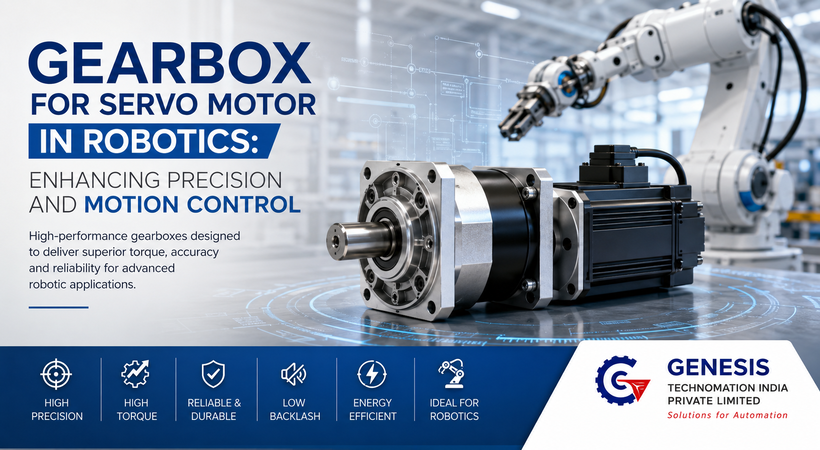
Robotics has transformed industries ranging from manufacturing and healthcare to logistics and aerospace. Modern robotic systems are expected to perform tasks with exceptional precision, repeatability, speed, and reliability. At the heart of many robotic applications lies a critical component that often works behind the scenes but significantly influences performance—the gearbox for servo motor.
Servo motors are known for their ability to provide accurate position, velocity, and torque control. However, when robotics applications demand higher torque, smoother motion, better positioning accuracy, and enhanced load handling capabilities, servo motors are often paired with specialized gearboxes. This combination creates a highly efficient motion control system capable of meeting the rigorous demands of industrial automation and advanced robotics.
Whether it is a robotic arm assembling microelectronics, an automated guided vehicle transporting materials, or a collaborative robot working alongside humans, the right gearbox can dramatically improve overall system performance.
In this comprehensive guide, we will explore the importance of gearboxes for servo motors in robotics, their working principles, types, benefits, selection criteria, applications, maintenance requirements, and future trends. If you are looking to purchase a high-quality gearbox for servo motor applications, Genesis Technomation India Private Limited is a trusted supplier offering reliable industrial automation and motion control solutions.
Understanding Servo Motors in Robotics
A servo motor is an electromechanical device designed to provide precise control of angular or linear position, speed, and acceleration. Unlike standard motors, servo motors operate within a closed-loop control system using feedback mechanisms.
Key components include:
- Motor
- Encoder or feedback sensor
- Drive controller
- Gearbox (optional but often essential)
Servo motors receive commands from a controller and continuously adjust their movement based on feedback data. This allows robotic systems to achieve highly accurate positioning.
Common robotic applications include:
- Industrial robotic arms
- CNC machines
- Pick-and-place systems
- Automated warehouses
- Medical robots
- Packaging machinery
- Inspection systems
Although servo motors are powerful on their own, many robotics applications require torque multiplication and motion optimization. This is where gearboxes become invaluable.
What Is a Gearbox for Servo Motor?
A gearbox for servo motor is a mechanical transmission device installed between the motor and the driven load. Its primary purpose is to modify torque and speed characteristics while improving positioning performance.
The gearbox reduces the output speed of the servo motor while proportionally increasing torque.
In simple terms:
- High motor speed becomes lower output speed.
- Motor torque becomes higher output torque.
- Motion control becomes more precise.
- System efficiency improves.
This combination enables robotic systems to handle heavier loads while maintaining accurate and smooth movement.
Why Robotics Systems Need Gearboxes
Many robotic applications demand a balance between speed and torque.
Servo motors naturally operate at relatively high speeds. However, robotic joints, actuators, and manipulators often require:
- High torque
- Controlled acceleration
- Smooth motion
- Precise positioning
- Reduced vibration
Without a gearbox, the motor may struggle to move heavy loads efficiently.
A gearbox allows engineers to optimize motor performance while meeting the mechanical requirements of the robotic system.
Benefits include:
Torque Amplification
Gear reduction increases torque output significantly.
Improved Positioning Accuracy
Gearboxes help enhance control resolution in robotic movements.
Reduced Motor Load
The motor operates more efficiently under optimized conditions.
Compact Design
Smaller motors can perform tasks that would otherwise require larger motors.
Better Energy Efficiency
Proper gear reduction reduces unnecessary power consumption.
How a Gearbox Works with a Servo Motor
The operation is straightforward yet highly effective.
Step 1: Motor Rotation
The servo motor rotates at high speed.
Step 2: Gear Reduction
The gearbox reduces rotational speed according to the selected gear ratio.
For example:
- Input speed: 3000 RPM
- Gear ratio: 10:1
- Output speed: 300 RPM
Step 3: Torque Increase
Torque increases approximately by the same factor, accounting for gearbox efficiency.
If motor torque is:
- 5 Nm
Then output torque becomes approximately:
- 50 Nm
This enhanced torque enables robotic systems to move larger loads accurately.
Major Types of Gearboxes Used in Robotics
Selecting the appropriate gearbox depends on application requirements.
Planetary Gearbox
Planetary gearboxes are among the most popular choices for robotic systems.
Features
- Compact design
- High torque density
- Excellent efficiency
- Low backlash
- High positioning accuracy
Applications
- Robotic arms
- CNC machinery
- Industrial automation
- Packaging robots
Advantages
- High load capacity
- Long lifespan
- Smooth operation
Harmonic Gearbox
Harmonic drive gearboxes are extensively used in precision robotics.
Features
- Near-zero backlash
- High reduction ratios
- Lightweight construction
Applications
- Surgical robots
- Semiconductor manufacturing
- Aerospace robotics
- Collaborative robots
Advantages
- Exceptional accuracy
- Compact size
- High precision motion control
Helical Gearbox
Helical gearboxes use angled gear teeth for smoother engagement.
Features
- Quiet operation
- Improved efficiency
- Higher load capability
Applications
- Conveyor systems
- Industrial robots
- Automated assembly lines
Advantages
- Reduced vibration
- Lower noise levels
- Enhanced durability
Bevel Gearbox
Bevel gearboxes change the direction of power transmission.
Features
- Angular power transfer
- High efficiency
Applications
- Material handling robots
- Motion transfer systems
Advantages
- Flexible installation
- Reliable operation
Worm Gearbox
Worm gearboxes provide significant reduction ratios.
Features
- Compact construction
- Self-locking capability
Applications
- Lift mechanisms
- Positioning equipment
Advantages
- High reduction ratio
- Controlled motion
Importance of Low Backlash in Robotics
Backlash refers to the small gap between mating gear teeth.
Even a tiny amount of backlash can affect:
- Position accuracy
- Repeatability
- Motion smoothness
In robotics, backlash can create:
- Positioning errors
- Oscillation
- Reduced precision
Low-backlash gearboxes are specifically engineered to minimize these issues.
Benefits include:
- Enhanced robotic accuracy
- Better repeatability
- Improved motion control
- Higher productivity
For precision robotics, planetary and harmonic gearboxes are often preferred because of their low backlash characteristics.
Gear Ratios and Their Impact on Robotics Performance
Gear ratio determines how speed and torque are transformed.
Examples:
5:1 Ratio
- Moderate torque increase
- Higher speed output
10:1 Ratio
- Balanced speed and torque
20:1 Ratio
- Significant torque increase
- Lower speed output
50:1 Ratio
- Maximum torque enhancement
- Very slow output speed
Choosing the correct ratio depends on:
- Payload requirements
- Desired speed
- Accuracy needs
- Application type
Improper ratio selection can lead to inefficiencies and reduced system performance.
Benefits of Using Gearboxes for Servo Motors in Robotics
Enhanced Torque Output
Robots frequently handle heavy loads.
Gearboxes multiply motor torque, enabling:
- Heavy lifting
- Strong gripping force
- Stable movement
Improved Motion Control
Gear reduction allows finer movement increments.
Benefits include:
- Smooth acceleration
- Precise positioning
- Better path accuracy
Increased System Efficiency
Motors operate closer to their optimal efficiency range.
This reduces:
- Heat generation
- Energy consumption
- Mechanical stress
Compact Robotic Designs
Smaller motors can perform demanding tasks when paired with appropriate gearboxes.
Advantages include:
- Reduced equipment size
- Lower system weight
- Better space utilization
Better Load Handling
Robotic systems can safely manage:
- Heavy components
- Large assemblies
- Industrial equipment
without requiring oversized motors.
Longer Equipment Life
Reduced motor stress results in:
- Lower wear
- Fewer breakdowns
- Extended service intervals
Applications of Gearbox for Servo Motor in Robotics
Industrial Robotic Arms
Robotic arms require:
- Precise positioning
- Smooth motion
- High torque
Gearboxes ensure accurate movement across multiple axes.
Collaborative Robots (Cobots)
Cobots work directly alongside human operators.
Requirements include:
- Precision
- Safety
- Smooth operation
Low-backlash gearboxes are essential in these systems.
Automated Guided Vehicles (AGVs)
AGVs rely on controlled movement and load handling.
Gearboxes provide:
- Efficient propulsion
- Accurate navigation
- Reliable performance
Medical Robotics
Medical applications demand exceptional precision.
Examples include:
- Surgical robots
- Rehabilitation equipment
- Diagnostic systems
Harmonic gearboxes are often used for these applications.
Warehouse Automation
Modern warehouses use robots for:
- Picking
- Sorting
- Transportation
Gearboxes improve reliability and efficiency.
Packaging Robotics
Packaging systems require rapid and repeatable movement.
Gearboxes help maintain:
- Speed
- Accuracy
- Productivity
Aerospace Robotics
Aerospace applications involve:
- Extreme precision
- Lightweight designs
- High reliability
Advanced gearboxes play a critical role in achieving these objectives.
Factors to Consider When Selecting a Gearbox for Servo Motor
Choosing the right gearbox requires careful analysis.
Torque Requirements
Calculate:
- Continuous torque
- Peak torque
- Load characteristics
The gearbox must safely handle expected loads.
Gear Ratio
Select a ratio that provides the ideal balance between:
- Speed
- Torque
- Precision
Backlash Level
Lower backlash improves:
- Positioning accuracy
- Repeatability
Critical for precision robotics.
Efficiency
Higher efficiency results in:
- Lower energy losses
- Reduced operating costs
Load Capacity
Verify:
- Radial load capacity
- Axial load capacity
This ensures reliable operation.
Mounting Compatibility
The gearbox should integrate seamlessly with:
- Servo motor
- Robotic structure
- Control system
Environmental Conditions
Consider:
- Temperature
- Dust exposure
- Moisture levels
- Chemical exposure
Industrial environments often require robust designs.
Common Challenges and Solutions
Overheating
Causes
- Excessive load
- Poor lubrication
- Incorrect sizing
Solution
Choose properly rated gearboxes and maintain lubrication schedules.
Excessive Backlash
Causes
- Wear and tear
- Low-quality gearbox
Solution
Use precision low-backlash gearboxes.
Noise and Vibration
Causes
- Misalignment
- Damaged gears
- Improper installation
Solution
Perform regular inspections and alignment checks.
Reduced Efficiency
Causes
- Lubrication issues
- Component wear
Solution
Implement preventive maintenance programs.
Maintenance Tips for Servo Motor Gearboxes
Proper maintenance extends gearbox lifespan.
Regular Inspection
Check for:
- Wear
- Leaks
- Unusual noise
Lubrication Management
Use manufacturer-recommended lubricants.
Monitor:
- Oil condition
- Grease quality
- Lubrication intervals
Temperature Monitoring
Excessive heat may indicate:
- Overloading
- Mechanical issues
Vibration Analysis
Detect potential failures before major breakdowns occur.
Alignment Verification
Ensure proper motor-to-gearbox alignment.
Misalignment can accelerate wear significantly.
Future Trends in Robotic Gearbox Technology
The robotics industry continues to evolve rapidly.
Emerging trends include:
Smart Gearboxes
Integrated sensors provide:
- Condition monitoring
- Predictive maintenance
- Real-time diagnostics
Higher Precision Designs
Manufacturers are developing gearboxes with:
- Near-zero backlash
- Enhanced repeatability
Lightweight Materials
Advanced composites and alloys reduce system weight.
Benefits include:
- Faster movement
- Improved energy efficiency
Compact High-Torque Solutions
Modern robotics increasingly demands:
- Smaller footprints
- Greater torque density
Gearbox innovation is meeting these requirements.
Industry 4.0 Integration
Connected gearboxes support:
- Digital manufacturing
- Automated monitoring
- Performance analytics
These capabilities help optimize productivity and reduce downtime.
Why Choose Genesis Technomation India Private Limited for Gearbox for Servo Motor Solutions?
Selecting a trusted supplier is as important as choosing the right gearbox.
Genesis Technomation India Private Limited has established itself as a reliable provider of industrial automation and motion control solutions across India.
Benefits of choosing Genesis Technomation India Private Limited include:
- High-quality gearbox solutions
- Expert technical guidance
- Reliable industrial automation products
- Support for robotic and motion control applications
- Competitive pricing
- Strong customer service
- Solutions tailored to industrial requirements
Whether your project involves robotic arms, automated assembly systems, packaging equipment, AGVs, or advanced manufacturing lines, Genesis Technomation India Private Limited can help you select the ideal gearbox for servo motor applications.
Their expertise in automation technologies ensures customers receive products that deliver precision, reliability, and long-term performance.
Conclusion
A gearbox for servo motor is far more than a simple mechanical accessory. It is a critical component that directly influences the performance, efficiency, precision, and reliability of robotic systems.
From industrial robotic arms and collaborative robots to medical devices and automated warehouses, gearboxes enable servo motors to deliver the torque, accuracy, and motion control required for advanced applications. By optimizing speed, increasing torque, reducing backlash, and improving overall system efficiency, the right gearbox can significantly enhance robotic performance.
When selecting a gearbox, factors such as torque requirements, gear ratio, backlash, efficiency, environmental conditions, and mounting compatibility must be carefully evaluated. Investing in a high-quality gearbox ensures improved productivity, longer equipment life, and reduced maintenance costs.
For businesses seeking dependable gearbox solutions, Genesis Technomation India Private Limited offers a wide range of industrial automation products and expert support to help customers choose the best gearbox for servo motor applications. With the right combination of servo motor and gearbox, robotics systems can achieve superior precision, smoother motion, and greater operational efficiency for years to come.
FAQs About Gearbox for a Servo Motor in Robotics
What is a gearbox for a servo motor in robotics?
A gearbox for a servo motor is a mechanical device that reduces motor speed while increasing torque output. In robotics, it helps improve precision, load-handling capability, and overall motion control performance.
Why is a gearbox important in robotic applications?
A gearbox enhances torque, improves positioning accuracy, reduces motor stress, and enables robotic systems to move heavier loads with greater precision and efficiency.
Which type of gearbox is best for robotic servo motors?
The best gearbox depends on the application. Planetary gearboxes are widely used for their high efficiency and low backlash, while harmonic gearboxes are preferred for ultra-precise robotic applications requiring near-zero backlash.
What is backlash in a servo motor gearbox?
Backlash is the small amount of movement or clearance between gear teeth before power is transmitted. Low-backlash gearboxes are essential in robotics because they improve positioning accuracy and repeatability.
How does a gearbox increase servo motor torque?
A gearbox reduces the output speed of the motor and proportionally increases torque. For example, a 10:1 gearbox can increase output torque by approximately ten times while reducing speed by the same ratio.
What gear ratio should I choose for a robotic servo motor?
The ideal gear ratio depends on factors such as payload weight, required speed, torque demands, and positioning accuracy. Higher gear ratios provide more torque, while lower ratios offer greater speed.
Can a servo motor operate without a gearbox?
Yes, a servo motor can operate without a gearbox. However, many robotics applications require additional torque and precise motion control, making a gearbox a valuable addition.
What industries commonly use servo motor gearboxes?
Servo motor gearboxes are widely used in manufacturing, robotics, aerospace, medical equipment, packaging, logistics, automotive production, and warehouse automation.
How long does a servo motor gearbox last?
The lifespan of a servo motor gearbox depends on operating conditions, load requirements, and maintenance practices. High-quality gearboxes can provide many years of reliable service when properly maintained.
How can I maintain a servo motor gearbox?
Regular inspection, proper lubrication, alignment checks, temperature monitoring, and vibration analysis can help extend gearbox life and ensure consistent performance.
What are the advantages of planetary gearboxes in robotics?
Planetary gearboxes offer high torque density, compact size, excellent efficiency, low backlash, and long service life, making them ideal for robotic systems and automation equipment.
Where can I buy a high-quality gearbox for servo motor applications in India?
Businesses looking for reliable gearbox solutions can consider Genesis Technomation India Private Limited. The company provides quality motion control and automation products suitable for robotics, industrial machinery, and precision engineering applications.
Related Posts