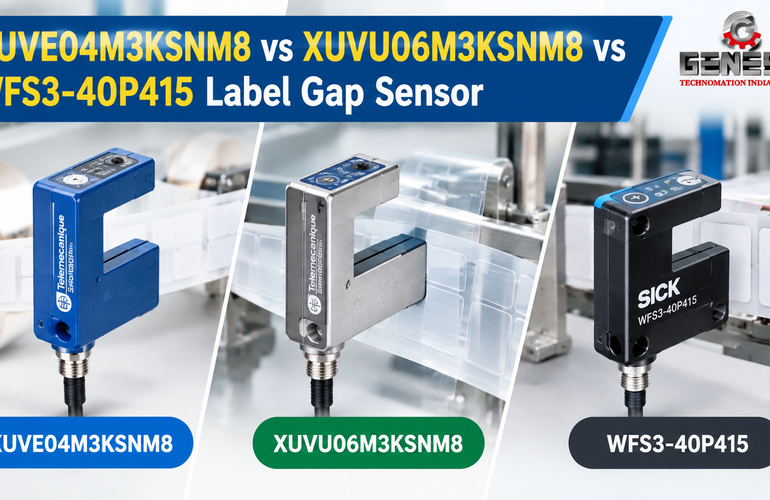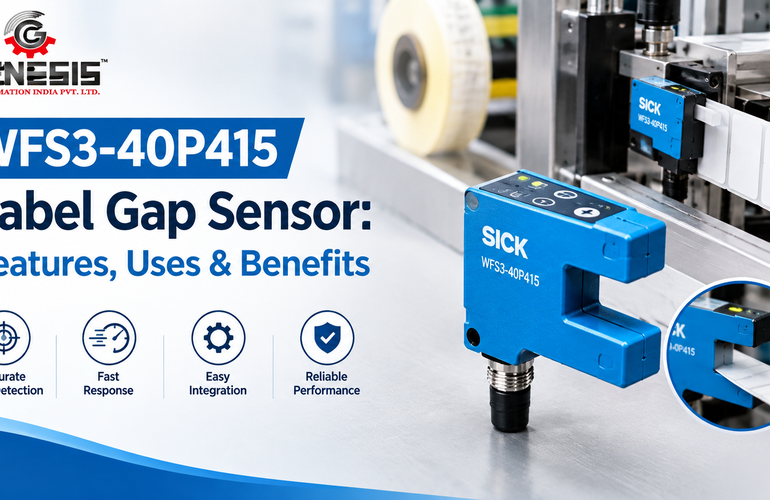

GS 61/6 – 50110769 Label Gap Sensor is a fork photoelectric sensor from Leuze designed specifically for detecting non-transparent labels. With an optical detection principle, a compact fork design, a minimum label width of 2 mm, and a minimum label gap of 2 mm, it is intended for applications where reliable detection of the transition between labels and gaps is important.
In an automated labeling machine, the sensor does more than simply detect whether material is present. Its switching signal can be used by the machine controller to identify the label gap and coordinate operations such as label positioning, dispensing, indexing, and synchronization with other machine functions.
The GS 61/6 | 50110769 is part of Leuze’s Series 61 fork sensor range. It uses an infrared LED with a wavelength of 940 nm and provides one digital switching output through a 5-wire, 2 m cable. Its 10,000 Hz switching frequency and 0.05 ms response time make the sensor suitable for fast label-detection tasks when the installation and application conditions are appropriate.
For engineers and OEMs, the practical value of this sensor is its compact fork arrangement. The transmitter and receiver are incorporated into the fork structure, so the label web passes through a defined sensing opening. This simplifies mechanical positioning compared with arrangements where separate transmitter and receiver components have to be aligned.
GS 61/6 – 50110769 Label Gap Sensor: Product Overview
The GS 61/6 – 50110769 is a fork photoelectric sensor manufactured by Leuze. The official product information identifies it as Series 61 and specifies optical detection for non-transparent labels.
The sensor has a 3 mm fork mouth width and 41 mm fork mouth depth. Its overall dimensions are approximately 11 mm × 30 mm × 60 mm, making it a relatively compact component for integration into labeling and packaging equipment.
Its intended detection application is non-transparent label material. Leuze specifies a minimum label width of 2 mm and a minimum label gap of 2 mm. These values are important when evaluating whether the sensor is suitable for a particular label stock or machine configuration.
The sensor uses an infrared LED at 940 nm as its light source. During operation, the label material moves through the fork opening and changes the optical condition detected by the sensor. The GS 61/6 is configured to provide its switching signal in the label gap.
This makes the GS 61/6 – 50110769 particularly relevant to machines where the controller needs a repeatable reference between successive labels.
GS 61/6 | 50110769 Label Gap Sensor Features
The most important features of the GS 61/6 – 50110769 are its optical fork construction, label-gap switching, compact mechanical design, fast response, adjustable sensitivity, and industrial electrical/environmental characteristics.
Technical Specifications of GS 61/6 | 50110769
| Parameter | GS 61/6 – 50110769 Specification |
| Manufacturer | Leuze |
| Model | GS 61/6 |
| Part Number | 50110769 |
| Product Type | Fork photoelectric sensor |
| Series | 61 |
| Detection Principle | Optical |
| Application | Detection of non-transparent labels |
| Minimum Label Width | 2 mm |
| Minimum Label Gap | 2 mm |
| Light Source | Infrared LED |
| Wavelength | 940 nm |
| Supply Voltage | 10–30 V DC |
| Digital Switching Outputs | 1 |
| Output Type | Digital switching output |
| Switching Element | Push-pull transistor |
| Switching Principle | Switching signal in label gap |
| Maximum Switching Current | 100 mA |
| Switching Frequency | 10,000 Hz |
| Response Time | 0.05 ms |
| Readiness Delay | 300 ms |
| Teach-In Conveyor Speed | Maximum 20 m/min |
| Connection | 5-wire cable |
| Cable Length | 2,000 mm |
| Fork Mouth Width | 3 mm |
| Fork Mouth Depth | 41 mm |
| Dimensions | 11 × 30 × 60 mm |
| Housing Material | PC plastic |
| Operating Temperature | -20°C to +60°C |
| Storage Temperature | -30°C to +70°C |
| Protection Rating | IP65 |
| Adjustment | Multiturn potentiometer |
| Indicators | 2 LEDs |
| Mounting | Mounting thread / through-hole mounting |
These specifications are based primarily on Leuze’s product information for part number 50110769.
Optical Detection
The GS 61/6 – 50110769 uses an infrared LED operating at 940 nm. The optical arrangement is contained within the fork sensor, allowing the label web to pass through the sensing opening.
The manufacturer specifies the sensor for non-transparent labels. Therefore, engineers should evaluate the actual label, liner, opacity, and material construction before selecting the sensor for a production machine.
2 mm Minimum Label and Gap
One of the most important specifications for machine designers is the manufacturer’s stated 2 mm minimum label width and 2 mm minimum label gap.
This should not be interpreted as a universal guarantee for every label material or machine condition. Actual detection depends on the optical properties of the label stock, mechanical positioning, web stability, and machine setup.
Fast Switching
The GS 61/6 – 50110769 has a 10,000 Hz switching frequency and a specified 0.05 ms response time.
For a labeling machine, fast response helps reduce the amount of web movement occurring between the physical label gap and the resulting sensor signal. This can be particularly useful when the sensor signal is used as a timing reference by the machine controller.
Push-Pull Output
The sensor provides one digital switching output using a push-pull transistor output. The maximum switching current is specified as 100 mA.
When integrating the sensor into a PLC or machine controller, the electrical interface should be checked against the controller’s input requirements and the manufacturer’s wiring documentation.
Multiturn Potentiometer
Sensitivity is adjusted using a multiturn potentiometer. Two LEDs provide operational indication.
This adjustment capability is useful during commissioning because the engineer can establish a stable distinction between the label material and the label gap instead of relying on a fixed sensitivity setting.
How GS 61/6 – 50110769 Works
The GS 61/6 – 50110769 working principle is based on optical detection inside its fork structure.
The label web is guided through the sensor’s approximately 3 mm fork mouth. The infrared optical system monitors the material as it moves through the sensing area. Because the sensor is intended for non-transparent labels, the optical condition changes as the label and gap pass through the fork.
The basic machine sequence can be understood as:
Label web movement → optical sensing → label/gap transition → digital output → controller input → positioning or synchronization action
The important point is that the GS 61/6 – 50110769 is specified with a switching signal in the label gap.
For example, consider a roll of self-adhesive labels being fed toward an applicator. When the label passes through the fork, the sensor detects the optical condition associated with the label material. As the gap between labels reaches the sensing area, the sensor changes its output state.
The PLC or machine controller can use that transition as a reference point.
Depending on machine programming, the signal may be used to:
- Synchronize a label dispenser
- Control label indexing
- Trigger a positioning sequence
- Coordinate a conveyor
- Synchronize a servo-driven mechanism
- Detect the next label position
- Control an applicator cycle
The sensor itself does not perform the complete labeling operation. Rather, it provides a precise digital event that the automation system can use as part of its control sequence.
Detection Performance of GS 61/6 – 50110769
The GS 61/6 – 50110769 is specified for non-transparent labels with a minimum label width and gap of 2 mm.
However, specification limits should always be considered alongside the actual machine conditions.
Label Material
Label opacity is important because the sensor operates optically. Transparent or unusually translucent materials should not automatically be assumed to behave in the same way as the non-transparent labels for which this model is specified.
Before production installation, test the actual label and liner combination.
Label Thickness
Very thin or unusual label constructions can behave differently from conventional label stock. The engineer should verify that the label physically passes cleanly through the fork and that the sensor produces a stable output.
Label Gap
The manufacturer specifies a minimum label gap of 2 mm.
If a machine uses extremely small gaps, the actual application should be tested at operating speed rather than relying only on a static bench test.
Web Movement
The label web should travel consistently through the sensing area. Excessive lateral movement can change the position of the material relative to the optical path.
Alignment
Because the fork opening defines the sensing area, the web should be routed correctly through the fork. A mechanically unstable sensor or web path can result in inconsistent detection.
Machine Speed
The 10,000 Hz switching frequency and 0.05 ms response time provide fast electrical response, but overall application performance still depends on label dimensions, gap size, web speed, machine mechanics, and controller timing.
Applications of GS 61/6 – 50110769 Label Gap Sensor
Automatic Labeling Machines
The most direct application of the GS 61/6 – 50110769 is automatic label detection on labeling equipment.
A label roll or web passes through the fork. The sensor detects the label-gap transition and sends the switching signal to the machine controller. The controller can then use this event to synchronize the label feed or application cycle.
This is particularly useful when consistent label spacing is important.
Bottle and Container Labeling
In bottle and container labeling systems, label stock is commonly supplied as a continuous web.
The GS 61/6 – 50110769 can monitor the label web and provide a repeatable gap signal to the machine control system. The controller can use this signal to coordinate the dispensing or application sequence.
The actual suitability depends on the label construction and machine design.
Packaging Machines
Packaging equipment often combines conveyors, feeding mechanisms, label dispensers, and product-handling systems.
The GS 61/6 – 50110769 can provide a digital timing signal associated with the label gap. This can become one of the machine’s synchronization inputs.
For example, a PLC can use the sensor transition as the reference for a programmed label-feed sequence.
Pharmaceutical Packaging
Pharmaceutical packaging equipment can require consistent label positioning and controlled machine sequencing.
Where the label stock is non-transparent and falls within the sensor’s specified detection characteristics, the GS 61/6 – 50110769 can be considered for label detection.
However, application engineers should verify the complete machine requirements, including environmental conditions, validation requirements, label material, and applicable regulatory requirements.
Food and FMCG Packaging
Food and FMCG packaging lines frequently use high-speed labeling equipment.
The sensor’s 10,000 Hz switching frequency and 0.05 ms response time can support fast label-detection applications, subject to the actual label and machine configuration.
Pouch and Sachet Packaging
Pouch and sachet equipment can use printed or adhesive label webs as part of a packaging process.
The GS 61/6 – 50110769 may be considered where the material meets the sensor’s non-transparent label requirements and the physical web arrangement fits the fork opening.
Application testing is recommended before production deployment.
Carton Labeling
Carton labeling machines can use the sensor to detect successive labels on a web.
The label-gap switching signal can provide a timing reference to the controller, allowing the machine to coordinate label dispensing and carton movement.
Roll-Fed Label Applications
The GS 61/6 – 50110769 is particularly relevant to continuous label-web applications where labels are separated by defined gaps.
Its fork configuration places the optical sensing arrangement directly around the moving label web, while the digital output gives the machine a discrete detection signal.
Benefits of GS 61/6 – 50110769 Label Gap Sensor
Consistent Label Detection
A dedicated fork sensor provides a defined sensing path for the label web. The GS 61/6 – 50110769 is specifically designed for non-transparent label detection.
Improved Label Positioning
When the controller receives a repeatable signal at the label gap, it can use that event to control the timing of the label feed or application mechanism.
Fast Machine Response
The specified 0.05 ms response time and 10,000 Hz switching frequency support rapid detection of changing label conditions.
Compact Installation
With dimensions of approximately 11 × 30 × 60 mm, the sensor can be incorporated into machines where installation space is limited.
Adjustable Sensitivity
The multiturn potentiometer provides a practical adjustment mechanism during machine setup and commissioning.
Industrial Protection
The GS 61/6 – 50110769 has an IP65 protection rating and an operating temperature range of -20°C to +60°C, according to Leuze’s specifications.
Reduced Manual Intervention
Once correctly installed and integrated, automatic label detection reduces the need for operators to manually determine label positions during normal machine operation.
Automation Compatibility
Its digital output can be integrated into a machine control architecture where the controller uses the label-gap event for sequencing.
GS 61/6 – 50110769 in Industrial Automation
The GS 61/6 – 50110769 industrial sensor can become a small but important component in a larger automated machine.
A typical arrangement can include:
Label roll → label dispenser → GS 61/6 sensor → PLC/controller → drive/control system → applicator
The sensor detects the label gap and provides a digital signal. The PLC or machine controller can then process this signal according to the machine’s programmed sequence.
PLC Integration
The sensor’s digital switching output can be connected to an appropriate PLC input, provided the electrical characteristics are compatible.
The PLC may use the signal to:
- Reset or synchronize a label counter
- Trigger a label-feed sequence
- Coordinate an applicator
- Confirm label position
- Synchronize machine timing
Servo and Stepper Systems
In machines using servo or stepper motors for label feeding, the GS 61/6 – 50110769 can provide a label-position reference to the control system.
The motor controller remains responsible for motion control. The sensor provides the physical detection event used by the control logic.
Conveyor Systems
If labeling is synchronized with conveyor movement, the sensor can form part of the overall timing architecture.
The machine controller can combine the label-gap signal with conveyor position, product detection, encoder information, and programmed delays.
Automation Control Panels
The sensor can be wired back to the machine control panel through its 2 m, 5-wire cable. Leuze specifies a 10–30 V DC supply and one digital switching output for this part number.
Electrical installation should follow the manufacturer’s documentation and the machine’s approved wiring practices.
Installation & Mounting Considerations
Correct installation is critical to obtaining stable detection from the GS 61/6 – 50110769 Label Gap Sensor.
Position the Label Web Correctly
The label web must pass through the fork sensing area correctly. Ensure that the material does not rub against the sensor body or mechanically interfere with the fork.
Provide Stable Mechanical Mounting
The sensor is provided with mounting options including a mounting thread and through-hole mounting.
The mounting arrangement should prevent vibration or movement during operation.
Check Web Alignment
The label material should remain consistently positioned within the sensing opening.
If the web moves laterally during operation, detection stability can be affected.
Check Electrical Compatibility
The specified supply voltage is 10–30 V DC. The digital output has a maximum switching current of 100 mA.
The PLC or controller input should therefore be checked against the sensor’s electrical characteristics before commissioning.
Adjust Sensitivity
The GS 61/6 uses a multiturn potentiometer for adjustment.
Adjustment should be performed using the actual production label material rather than relying solely on an empty web or a different label stock.
Test at Operating Conditions
After installation, test the sensor at the intended production speed. A sensor that appears stable during slow manual movement may require further adjustment when the web is running at production speed.
Factors Affecting GS 61/6 – 50110769 Detection
| Issue | Why It Can Affect Detection | What to Check |
| Incorrect alignment | Label may not pass consistently through the sensing area | Recheck web routing and sensor position |
| Label material | Optical characteristics affect detection | Test actual production labels |
| Label thickness | Physical and optical characteristics can vary | Verify the material and sensing setup |
| Small label gap | Reduced detection interval gives less signal margin | Confirm gap meets specified minimum |
| Web movement | Lateral movement can change sensing conditions | Check guides and web tension |
| Dust or contamination | Contamination can affect the optical path | Inspect and clean according to maintenance procedures |
| Vibration | Sensor or web movement can create inconsistent detection | Improve mechanical mounting |
| High machine speed | Timing margin becomes smaller | Test at actual production speed |
| Incorrect sensitivity | Signal may not change cleanly between label and gap | Adjust the potentiometer correctly |
| Electrical issues | Poor supply or wiring can affect controller input | Check wiring and supply conditions |
The most important principle is to diagnose the actual machine condition instead of immediately replacing the sensor. A detection problem can originate from mechanical alignment, label material, web tension, electrical integration, or sensitivity adjustment.
GS 61/6 | 50110769 Maintenance & Troubleshooting
Routine inspection is straightforward but should be included in preventive maintenance for labeling equipment.
Keep the sensor and surrounding sensing area clean, check that the label web is routed correctly, inspect the cable for damage, and verify that the sensor remains mechanically secure.
Troubleshooting Table
| Problem | Possible Cause | Recommended Action |
| Label not detected | Incorrect sensitivity or label not correctly positioned | Check web routing and adjust sensitivity |
| Intermittent detection | Web movement or unstable mounting | Check guides, tension, mounting and alignment |
| Incorrect label position | Sensor signal not synchronized with machine timing | Check sensor position and controller timing |
| False detection | Contamination or unstable optical condition | Inspect sensing area and clean appropriately |
| Unstable output | Electrical or mechanical instability | Check supply, wiring, mounting and label movement |
| Detection changes at high speed | Reduced timing margin or unstable web movement | Test machine at production speed and check web control |
| Sensor does not switch at gap | Incorrect adjustment | Recheck sensitivity using the actual label web |
| Output not recognized by PLC | Electrical interface mismatch or wiring issue | Verify controller input compatibility and wiring |
Avoid making changes to machine wiring while equipment is energized unless the machine’s approved electrical safety procedures specifically permit the work. Electrical troubleshooting should be carried out by appropriately qualified personnel.
Why Choose GS 61/6 – 50110769 for Automated Label Detection?
The GS 61/6 – 50110769 Label Gap Sensor is worth considering when an application requires a compact fork photoelectric sensor specifically intended for non-transparent label detection.
It combines:
- 2 mm minimum label width specification
- 2 mm minimum label gap specification
- Infrared optical detection
- 10,000 Hz switching frequency
- 0.05 ms response time
- Push-pull digital output
- 10–30 V DC supply
- 3 mm fork opening
- Multiturn sensitivity adjustment
- IP65 protection
- Compact dimensions
These characteristics make it relevant to OEMs, packaging-machine manufacturers, automation integrators, and maintenance teams working with automated label feeding and positioning systems.
The important consideration is not simply whether the sensor is technically fast. The sensor must also match the label material, label width, gap, machine speed, mechanical arrangement, electrical interface, and environmental conditions of the application.
Where to Purchase GS 61/6 – 50110769 Label Gap Sensor
For industrial buyers in India looking for the GS 61/6 – 50110769 Label Gap Sensor, Genesis Technomation India Private Limited can be considered as a supplier for this product.
The company’s product listing specifically identifies the GS 61/6 – 50110769 non-transparent Leuze label sensor.
You can contact the supplier to confirm current availability, configuration, technical suitability, quotation, and application requirements before purchasing.
For OEMs and automation integrators, it is useful to provide the supplier with the actual label specifications and machine requirements rather than requesting the sensor only by model number.
GS 61/6 | 50110769 Price & Buying Considerations
The GS 61/6 – 50110769 price can vary depending on supplier, quantity, availability, purchasing conditions, and current market conditions.
A third-party Indian listing currently shows a specific price for this part, but commercial prices can change and should not be treated as a permanent manufacturer price.
For an accurate quotation, buyers should confirm the current price and availability with the supplier.
Before placing an order, check the following:
Application Requirements
Confirm that the sensor is intended for the actual label-detection application.
Label Material
Verify that the label is non-transparent and suitable for the sensor’s optical detection principle.
Label Width and Gap
Confirm that the label width and gap meet the manufacturer’s specified limits.
Machine Speed
Evaluate the sensor at the actual production speed, particularly for very fast labeling equipment.
Electrical Compatibility
Check the 10–30 V DC supply requirement and digital output characteristics against the PLC or controller.
Mounting
Ensure the fork dimensions and mounting arrangement fit the machine.
Environmental Conditions
Check temperature, contamination, vibration, moisture, and other environmental factors.
Documentation
Ask for the appropriate product documentation and wiring information before installation.
Supplier Support
For OEM projects, supplier support can be important when selecting, commissioning, and replacing sensors.
FAQs for GS 61/6 – 50110769 Label Gap Sensor
What is the GS 61/6 – 50110769 Label Gap Sensor?
The GS 61/6 – 50110769 is a Leuze fork photoelectric sensor designed for detecting non-transparent labels. It provides a digital switching signal in the label gap.
How does GS 61/6 – 50110769 work?
It uses an infrared optical system inside a fork-shaped sensor. As the label web passes through the fork, the optical condition changes between the label and gap, allowing the sensor to generate its specified switching signal in the label gap.
What is GS 61/6 – 50110769 used for?
It is intended for detecting non-transparent labels in automated labeling and related packaging applications.
Where can GS 61/6 – 50110769 be installed?
It can be integrated into labeling and packaging equipment where the label web can pass through its 3 mm fork opening and the electrical and environmental requirements are satisfied.
How does GS 61/6 – 50110769 detect labels and gaps?
The sensor uses an infrared LED-based optical detection system. As the label and gap move through the fork, their optical conditions produce the switching transition used by the machine controller.
What factors can affect GS 61/6 – 50110769 detection?
Label material, label width, gap size, web alignment, mechanical vibration, sensitivity adjustment, contamination, machine speed, and electrical integration can all influence practical performance.
How should GS 61/6 – 50110769 be installed?
Mount the sensor securely, route the label web correctly through the fork, verify electrical compatibility, adjust sensitivity using the actual label stock, and test detection at the intended operating speed.
What should I check if GS 61/6 – 50110769 does not detect labels correctly?
Start with label routing, sensor alignment, sensitivity adjustment, label material, web movement, contamination, wiring, and controller input compatibility. These checks can identify whether the problem is mechanical, optical, or electrical.
Is GS 61/6 – 50110769 suitable for packaging automation?
Yes, its specified label-detection function, digital output, fast response, and compact fork construction make it suitable for appropriate automated labeling and packaging applications, provided the actual label and machine requirements match its specifications.
Where can I purchase GS 61/6 – 50110769 Label Gap Sensor?
Industrial buyers in India can contact Genesis Technomation India Private Limited for current availability, pricing, technical details, and quotation.
Conclusion
The GS 61/6 – 50110769 Label Gap Sensor is a compact Leuze fork photoelectric sensor designed for detecting non-transparent labels. Its optical infrared detection, 2 mm minimum label width and gap specifications, 10,000 Hz switching frequency, 0.05 ms response time, push-pull output, adjustable sensitivity, and IP65 protection make it a practical option for suitable automated labeling applications.
For engineers, the most important point is to match the sensor with the actual label stock and machine conditions. Label material, gap, web alignment, machine speed, mounting stability, sensitivity, and PLC interface should all be evaluated during commissioning.
When correctly selected and installed, the GS 61/6 – 50110769 can provide the label-gap reference required for consistent label feeding, positioning, and machine synchronization.
For current GS 61/6 – 50110769 price, availability, and purchasing assistance in India, buyers can contact Genesis Technomation India Private Limited and confirm the requirements for their specific labeling or packaging machine.
Related Posts