WFS3-40P415 vs GS 61/6-S8: Introduction
WFS3-40P415 vs GS 61/6-S8 is an important comparison for engineers, original equipment manufacturers (OEMs), packaging machine manufacturers and purchasing professionals who need accurate label detection. Both sensors use a compact fork-style optical design to detect labels and gaps in a moving label web. However, their mechanical dimensions, electrical output configurations, adjustment methods and installation requirements can influence which model fits a particular machine.
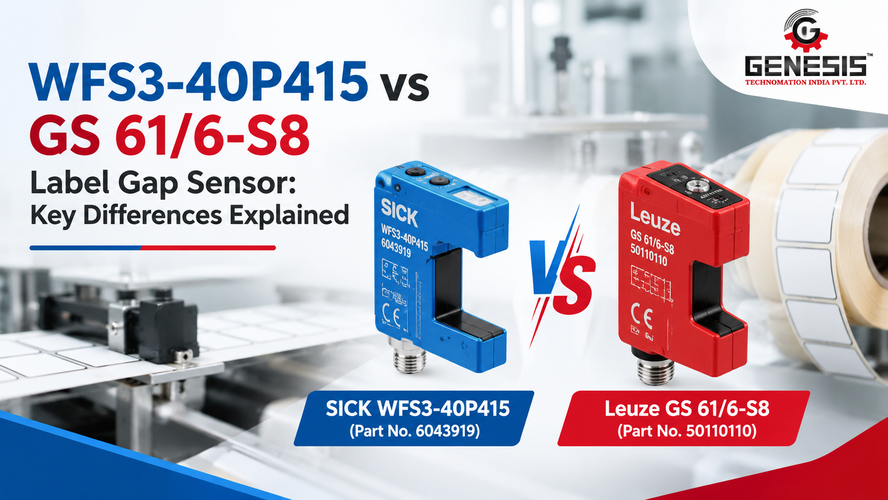
The SICK WFS3-40P415 carries part number 6043919, while the Leuze GS 61/6-S8 carries part number 50110110. Both models specify a 3 mm fork or mouth width, a minimum detectable label gap of 2 mm and a switching frequency of 10 kHz. The SICK model specifies a 42 mm fork depth and a response time of up to 50 microseconds. Leuze specifies a 41 mm mouth depth and a response time of 0.05 milliseconds. These figures provide a useful starting point for comparison.
Neither model automatically suits every labeling application. Engineers must also consider label thickness, backing material, web speed, PLC input characteristics, wiring, mounting clearance and adjustment requirements.
This guide compares both sensors, explains the practical significance of their specifications and helps industrial buyers enquire about either model through Genesis Technomation India Pvt. Ltd.
What Is a Label Gap Sensor?
A label gap sensor detects the boundary between individual labels and the backing liner that carries them. Packaging and labeling machines use this information to determine when a label reaches the dispensing position.
Manufacturers often supply labels on a continuous roll. Each label remains attached to a release liner, which travels through the machine as the dispensing mechanism separates the label from its backing. A label gap sensor monitors this movement and generates an electrical switching signal when it detects a transition between the label and the gap.
How a fork sensor detects labels
A typical fork sensor contains an optical emitter on one side of its opening and a receiver on the opposite side. The label web passes through this opening, keeping the optical components aligned without requiring the installer to position two separate sensor units.
The sensor evaluates the optical difference between the label material and the backing liner. When the web moves from a label to a gap, the received light changes. The sensor processes that change and switches its output according to its configured detection logic.
A programmable logic controller (PLC) or labeling controller receives the signal and uses it to coordinate label feeding, dispensing, counting or positioning.
Label detection versus label gap detection
These terms describe closely related functions, but the distinction matters in machine programming.
- Label detection: The sensor identifies the presence or absence of label material within its sensing area.
- Label gap detection: The sensor identifies the transition between a label and the exposed backing liner, helping the machine establish the position of the next label.
The SICK WFS3-40P415 supports selectable light/dark switching, while the Leuze GS 61/6-S8 specifies a switching signal in the label gap. Engineers should verify the required switching logic and PLC program before selecting a replacement.
Why accurate gap detection matters
An incorrect detection signal can cause a labeling machine to dispense a label too early or too late. The result may include misplaced labels, missed applications, wasted material or unnecessary machine stops.
Accurate detection becomes especially important when a production line uses short labels, narrow gaps or a high web speed. The sensor must detect the required transitions, and the controller must process the signals at the right time.
Fork sensors simplify optical alignment because the emitter and receiver share a fixed housing. However, successful detection still depends on the label stock, the sensor’s specifications, correct adjustment and the actual operating conditions.
Typical applications include bottle labeling, carton labeling, pharmaceutical packaging, print-and-apply systems, automatic sticker dispensers and industrial label-converting equipment.
Overview of the SICK WFS3-40P415 Label Gap Sensor
The SICK WFS3-40P415 is a compact optical fork sensor designed to detect labels and gaps in a moving web. Its fixed emitter-receiver arrangement helps maintain optical alignment during installation and operation.
The manufacturer’s datasheet lists a 3 mm fork width, a 42 mm fork depth, infrared LED illumination and a minimum detectable gap or label size of 2 mm, depending on label thickness.
Important technical specifications
| Specification | SICK WFS3-40P415 |
| Part number | 6043919 |
| Sensing principle | Optical |
| Overall dimensions (W × H × D) | 10 × 25 × 64.3 mm |
| Fork width | 3 mm |
| Fork depth | 42 mm |
| Minimum detectable gap or label size | 2 mm, depending on label thickness |
| Light source | Infrared LED |
| Supply voltage | 10–30 V DC |
| Switching output | PNP |
| Maximum switching current | 100 mA |
| Switching frequency | 10 kHz |
| Response time | ≤ 50 µs |
| Adjustment | Plus/minus buttons and teach-in input |
| Teach-in modes | Two-point and dynamic |
| Connection | M8 male connector, 4-pin |
| Enclosure rating | IP65 |
| Operating temperature | −20°C to +60°C |
What the specifications mean in practice
Compact mechanical design: The 3 mm fork width accommodates a defined label-web path. The 42 mm fork depth provides the opening needed to pass the label material through the sensing area. Engineers should compare these dimensions with the machine’s available clearance before ordering.
Infrared optical sensing: The sensor uses infrared LED illumination to detect changes as labels and gaps move through the fork. The actual label material and backing liner determine the optical contrast, so engineers should test the intended combination rather than assume identical performance across all label stocks.
Two-point and dynamic teach-in: The SICK sensor supports two-point teach-in and dynamic teach-in. These options help operators establish the switching threshold under suitable setup conditions. The sensor also supports sensitivity adjustment and selectable light/dark switching.
PNP output: The sensor provides a PNP switching output with a maximum specified output current of 100 mA. Engineers must verify the receiving PLC input, signal polarity and wiring before connecting the sensor.
Protection and environmental limits: The datasheet specifies IP65 protection and an operating temperature range of −20°C to +60°C. The machine designer should still consider exposure to washdown, chemicals, vibration and other conditions that may exceed the sensor’s documented limits.
The manufacturer’s specifications offer a useful basis for machine integration, but they do not eliminate the need for commissioning tests with the actual label material.
Overview of the Leuze GS 61/6-S8 Label Gap Sensor
The Leuze GS 61/6-S8 – 50110110 is a fork photoelectric sensor intended for detecting non-transparent labels. Its fixed optical arrangement allows the label web to pass through a narrow opening while the sensor monitors the transition between label material and the backing liner.
Leuze specifies a 3 mm mouth width, a 41 mm mouth depth, a 940 nm infrared LED, a 10–30 V DC supply and a push-pull transistor output. The manufacturer also lists a 10 kHz switching frequency and a 0.05 ms response time.
Important technical specifications
| Specification | Leuze GS 61/6-S8 |
| Part number | 50110110 |
| Sensing principle | Optical |
| Application | Detection of non-transparent labels |
| Overall dimensions (W × H × L) | 11 × 30 × 60 mm |
| Mouth width | 3 mm |
| Mouth depth | 41 mm |
| Minimum label width | 2 mm |
| Minimum label gap | 2 mm |
| Light source | Infrared LED |
| Wavelength | 940 nm |
| Supply voltage | 10–30 V DC |
| Switching output | Push-pull transistor |
| Maximum switching current | 100 mA |
| Switching frequency | 10 kHz |
| Response time | 0.05 ms |
| Adjustment | Multiturn potentiometer |
| Connection | M8 male connector, 4-pin |
| Enclosure rating | IP65 |
| Operating temperature | −20°C to +60°C |
What the specifications mean in practice
Defined mouth dimensions: The 3 mm mouth width matches the SICK model’s specified fork width. However, the Leuze model has a 41 mm mouth depth, compared with the SICK model’s 42 mm fork depth. This 1 mm difference can matter when a replacement must fit an existing bracket or machine layout.
Infrared light at 940 nm: The sensor uses an infrared LED with a documented wavelength of 940 nm. The label and liner must produce a detectable optical difference under the sensor’s operating conditions.
Push-pull output: The output can drive its signal high or low. This arrangement differs from a conventional PNP-only output and may suit a different range of PLC input arrangements. The engineer must still check the PLC’s input type, voltage thresholds and wiring diagram.
Multiturn potentiometer: The sensor uses a multiturn potentiometer for adjustment. This gives the operator a physical control for setting the detection threshold. The adjustment procedure should follow the manufacturer’s operating instructions and use the actual label web.
Industrial protection: The documented IP65 enclosure rating and −20°C to +60°C operating temperature range help engineers assess the sensor’s suitability for the intended environment. These ratings do not imply unrestricted resistance to liquids, cleaning agents or every industrial hazard.
Leuze lists a minimum label width of 2 mm and a minimum label gap of 2 mm. These values should not be interpreted as a guarantee that every label material with those dimensions will work under every machine condition.
WFS3-40P415 vs GS 61/6-S8: Technical Specifications Compared
The following table summarises the main differences between the two models.
| Specification | SICK WFS3-40P415 | Leuze GS 61/6-S8 |
| Manufacturer | SICK | Leuze |
| Part number | 6043919 | 50110110 |
| Sensing principle | Optical | Optical |
| Application | Label and gap detection | Non-transparent label detection |
| Fork/mouth width | 3 mm | 3 mm |
| Fork/mouth depth | 42 mm | 41 mm |
| Minimum detectable gap | 2 mm, depending on label thickness | 2 mm |
| Minimum label size/width | 2 mm, depending on label thickness | 2 mm |
| Light source | Infrared LED | Infrared LED, 940 nm |
| Supply voltage | 10–30 V DC | 10–30 V DC |
| Switching output | PNP | Push-pull transistor |
| Maximum output current | 100 mA | 100 mA |
| Switching frequency | 10 kHz | 10 kHz |
| Response time | ≤ 50 µs | 0.05 ms (50 µs) |
| Adjustment method | Plus/minus buttons and teach-in input | Multiturn potentiometer |
| Teach-in options | Two-point and dynamic | Potentiometer-based adjustment |
| Connector | M8, 4-pin male | M8, 4-pin male |
| Enclosure rating | IP65 | IP65 |
| Operating temperature | −20°C to +60°C | −20°C to +60°C |
The most important differences between WFS3-40P415 and GS 61/6-S8
Mechanical dimensions: Both models have a 3 mm opening, but their documented depths and overall housing dimensions differ. The SICK model measures 10 × 25 × 64.3 mm, while the Leuze model measures 11 × 30 × 60 mm. A mounting bracket that accommodates one sensor may need modification to fit the other.
Electrical output: SICK uses a PNP output; Leuze uses a push-pull transistor output. This difference deserves careful attention when integrating the sensor into an existing PLC system or replacing a failed unit.
Adjustment method: The SICK model offers button-based adjustment and two teach-in modes. The Leuze model lists a multiturn potentiometer. The better fit depends on the operator’s setup process and the machine’s maintenance requirements.
Speed specifications: Both models specify a 10 kHz switching frequency and a nominal response time of 50 microseconds. Neither has a clear advantage based on these two figures alone.
Label material: Leuze explicitly identifies the GS 61/6-S8 application as non-transparent label detection. Engineers should verify the SICK model’s suitability for the actual label stock too. Neither model should be assumed to detect every transparent, metallic or highly reflective label reliably without application testing.
Difference in Sensing Technology and Label Detection
Both sensors use optical fork sensing. Their fixed emitter and receiver positions help maintain alignment as the label web travels through the opening.
When the optical properties of the label differ from those of the exposed backing liner, the sensor can detect the transition and generate a switching signal. However, the optical difference varies according to the materials used.
Label opacity and backing material
Paper labels, opaque film labels and their backing liners may produce a clear optical transition. Transparent labels can create a more difficult detection problem because the label material may transmit light much like the exposed liner.
A label with a glossy surface, metallic finish or unusual thickness can also change the optical conditions. The sensor’s specified minimum gap does not establish suitability for every material combination.
The Leuze product documentation identifies non-transparent labels as its application. For transparent labels, engineers should confirm suitability with the manufacturer or supplier and conduct a test using the production label stock.
Why small gaps need careful testing
A 2 mm minimum gap is a useful specification, but the machine must also maintain suitable web movement and sensor adjustment. Label thickness, material contrast, web speed and controller processing can affect the final result.
During commissioning, run several labels through the sensor at the intended operating speed. Confirm that each gap generates one clean transition and that the output does not switch repeatedly around the label edge.
If the machine uses unusually small gaps or a challenging label material, test the complete combination before finalising the design.
Difference in Fork Width, Depth and Installation between WFS3-40P415 and GS 61/6-S8
The two sensors have the same specified opening width, but their depth and overall dimensions differ slightly.
| Mechanical consideration | SICK WFS3-40P415 | Leuze GS 61/6-S8 |
| Opening width | 3 mm | 3 mm |
| Opening depth | 42 mm | 41 mm |
| Overall width | 10 mm | 11 mm |
| Overall height | 25 mm | 30 mm |
| Overall length/depth dimension | 64.3 mm | 60 mm |
Check the mounting space
Before fitting either sensor, check the bracket dimensions, mounting holes, nearby machine components and cable routing. A compact labeling machine may have limited room near the dispensing edge, so even small dimensional differences can affect installation.
Fork depth is not the same as sensing distance. The fork sensor detects material within its defined opening; the depth describes the physical geometry of that opening.
Allow enough clearance for the label web
The label web must travel through the fork without scraping the housing or catching on nearby components. Confirm that the material path remains stable during acceleration, deceleration and roll changes.
Also check access to the adjustment controls and connector. A sensor may fit mechanically but prove difficult to adjust or replace if the installation leaves insufficient working space.
When replacing an existing model, use the manufacturer’s dimensional drawing rather than relying on the product’s appearance.
Difference in Response Time and Switching Frequency
Response time and switching frequency describe related but different aspects of sensor performance.
- Response time indicates how quickly the sensor responds to a change in the detected condition.
- Switching frequency indicates how frequently the sensor can switch under its specified operating conditions.
The SICK WFS3-40P415 specifies a response time of up to 50 microseconds and a switching frequency of 10 kHz. The Leuze GS 61/6-S8 specifies a response time of 0.05 milliseconds and a switching frequency of 10 kHz. Since 50 microseconds equals 0.05 milliseconds, the nominal response-time figures match.
What does this mean for high-speed labeling?
Both sensors provide a documented 10 kHz switching frequency. However, the sensor specification alone does not determine the maximum production speed of a labeling machine.
The actual system also depends on:
- Label length and gap size.
- Label-web speed and acceleration.
- The sensor’s response-time stability.
- PLC input filtering and scan time.
- Controller logic and signal processing.
- The timing requirements of the dispensing mechanism.
For example, a short label gap may pass through the sensing point quickly when the web moves at high speed. The sensor must respond to the transition, and the PLC must register it before the next control action.
The SICK datasheet also lists response-time stability of ±20 microseconds and jitter of 40 microseconds. These values provide additional information for engineers assessing timing behaviour. Engineers who need a detailed timing comparison should check the equivalent details in the Leuze documentation.
Practical recommendation: Do not select either model solely because of its switching frequency. Test the sensor with the actual label pitch, web speed, PLC and dispensing mechanism. Verify reliable detection at normal production speed and during expected operating variations.
Difference between WFS3-40P415 and GS 61/6-S8 in Output Configuration and PLC Compatibility
Output compatibility is one of the most important considerations when comparing the SICK WFS3-40P415 and Leuze GS 61/6-S8.
The SICK model uses a PNP switching output, while the Leuze model uses a push-pull transistor output. Both specify a maximum switching current of 100 mA.
What is a PNP output?
A PNP sensor output supplies a positive voltage to the connected input when the output switches on. Engineers commonly use PNP sensors with PLC inputs designed to detect a positive switching signal relative to the input common.
However, the PLC’s wiring arrangement and input specifications must match the sensor’s output.
What is a push-pull output?
A push-pull output can actively drive the signal towards the positive supply or towards the low potential, depending on the output state. This arrangement can support different input configurations, but it does not guarantee compatibility with every PLC.
The receiving input must accept the signal voltage levels and current. The engineer must also account for the sensor’s switching logic and the controller’s common-terminal arrangement.
Practical PLC compatibility example
Suppose an OEM currently uses a PNP sensor connected to a PLC input that expects a positive switching signal. The engineer wants to replace that sensor with the Leuze GS 61/6-S8.
Before installation, the engineer should:
- Check the PLC input type and input thresholds.
- Confirm the Leuze sensor’s pin assignments from its wiring diagram.
- Verify the supply voltage and common-terminal arrangement.
- Check whether the push-pull output matches the intended input circuit.
- Confirm the output’s switching logic and maximum current.
- Test the signal with the machine isolated from automatic production.
The same checks apply when replacing the Leuze sensor with the SICK model. A matching connector does not establish electrical equivalence.
Difference in Adjustment and Teach-In Methods
The SICK WFS3-40P415 and Leuze GS 61/6-S8 offer different adjustment arrangements.
SICK WFS3-40P415: Button-based adjustment and teach-in
SICK documents two-point teach-in, dynamic teach-in, sensitivity adjustment and selectable light/dark switching. Its operating instructions describe how operators establish a switching threshold and adjust it using the plus and minus buttons.
A practical setup sequence includes:
- Position the actual label or backing material in the sensor opening.
- Follow the manufacturer’s procedure for the selected teach-in mode.
- Run the label web through the sensor when the chosen mode requires movement.
- Observe the switching indicator.
- Adjust the threshold if the sensor fails to distinguish labels and gaps reliably.
- Confirm the output signal with the connected controller.
Dynamic teach-in can help when the machine needs to learn the detection conditions while the label web moves. Operators must still follow the model’s instructions and verify the result.
Leuze GS 61/6-S8: Multiturn potentiometer adjustment
Leuze lists a multiturn potentiometer as the adjustment control. Its documented switching frequency and response time support fast switching, but correct threshold adjustment remains essential.
Operators should follow the Leuze operating instructions to set the switching threshold for the actual label and backing material. They should then run the web through the fork and check that the sensor switches consistently at every gap.
Do not assume that the Leuze model provides the same two-point and dynamic teach-in functions as the SICK model. Its adjustment method should be treated according to its own documentation.
How to reduce false switching
Regardless of the model, good setup practices include keeping the fork opening clean, maintaining a stable web path, using the correct switching logic and verifying the signal at operating speed.
If false transitions occur, check the label stock, threshold setting, mounting, wiring and PLC input filtering before concluding that the sensor itself is unsuitable.
Performance in Different Labeling Applications
The appropriate sensor depends on the requirements of the machine, not just the industry in which it operates.
| Application | What engineers should check |
| Bottle labeling | Label material, gap size, web speed and dispensing timing |
| Automatic sticker dispensing | Label thickness, repeatable gap detection and controller response |
| Carton labeling | Label dimensions, machine clearance and output compatibility |
| Pharmaceutical packaging | Required positioning accuracy, validated process requirements and material compatibility |
| Food packaging machinery | Environmental exposure, cleaning procedures and enclosure limitations |
| Printing and labeling systems | Web speed, label pitch and switching reliability |
| High-speed production lines | Response time, switching frequency, PLC processing and actual line speed |
| Compact OEM machines | Fork dimensions, connector access and adjustment clearance |
Bottle and carton labeling
Both models may suit applications that use compatible label materials and gaps. Engineers should compare the sensor dimensions with the dispensing mechanism and check the signal timing at the required production rate.
Pharmaceutical and food packaging
These applications can impose additional requirements for process validation, cleaning and environmental protection. Both models list an IP65 enclosure rating, but that rating alone does not establish suitability for every washdown or hygiene requirement.
Confirm the actual environmental conditions and any industry-specific requirements before installation.
High-speed production lines
Both models specify a 10 kHz switching frequency and a nominal 50-microsecond response time. Their documented figures therefore do not establish a speed advantage for either model. Actual suitability depends on the complete control system and label material.
Compact OEM labeling machines
Mechanical fit and adjustment access may determine the better choice. Compare the dimensional drawings, connector position, mounting points and available space around the label path.
Advantages and Limitations of the WFS3-40P415
The SICK WFS3-40P415 offers several documented features for industrial label detection.
Advantages
- Compact fork design with a 3 mm opening.
- Specified 2 mm minimum detectable gap or label size, depending on label thickness.
- Infrared optical sensing.
- PNP output with a maximum switching current of 100 mA.
- 10 kHz switching frequency and response time of up to 50 microseconds.
- Two-point and dynamic teach-in.
- M8 four-pin connector and IP65 enclosure.
Points to evaluate
- Confirm that the PNP output matches the PLC input.
- Check the 42 mm fork depth and overall dimensions against the mounting arrangement.
- Test the actual label and backing materials.
- Verify the connector pin assignments before wiring.
- Follow the manufacturer’s adjustment procedure during commissioning.
The SICK model can be a suitable candidate when its output, mechanical design and adjustment features meet the application’s requirements. These characteristics do not establish universal superiority over the Leuze model.
Advantages and Limitations of the GS 61/6-S8
The Leuze GS 61/6-S8 offers a defined set of optical, mechanical and electrical specifications.
Advantages
- 3 mm mouth width and 41 mm mouth depth.
- Minimum label width and gap specifications of 2 mm.
- Infrared LED with a wavelength of 940 nm.
- Push-pull transistor output.
- 10 kHz switching frequency and 0.05 ms response time.
- M8 four-pin male connector.
- Multiturn potentiometer adjustment.
- IP65 enclosure and a documented operating temperature range of −20°C to +60°C.
Points to evaluate
- The product documentation specifies non-transparent label detection, so confirm suitability for transparent label stock separately.
- Verify push-pull output compatibility with the PLC.
- Check the 41 mm mouth depth and overall housing dimensions.
- Follow the manufacturer’s adjustment and wiring instructions.
- Confirm environmental suitability and required installation clearances.
The GS 61/6-S8 may suit a machine that needs its documented mouth dimensions, push-pull output and potentiometer adjustment. Its suitability still depends on the complete application.
Which Label Gap Sensor Should You Choose?
The choice between the SICK WFS3-40P415 and Leuze GS 61/6-S8 should follow a structured engineering assessment. Both offer similar headline performance figures, but their output architecture, adjustment methods and mechanical dimensions differ.
When to consider the SICK WFS3-40P415
Consider this model when:
- The documented 3 mm fork width and 42 mm depth suit the machine.
- The PLC accepts its PNP output.
- Two-point or dynamic teach-in supports the commissioning process.
- The label material and minimum gap meet the specified detection conditions.
- The M8 connector and mounting dimensions fit the installation.
When to consider the Leuze GS 61/6-S8
Consider this model when:
- Its 3 mm mouth width and 41 mm depth fit the machine.
- The push-pull output matches the intended control circuit.
- The multiturn potentiometer suits the required adjustment process.
- The application uses compatible non-transparent labels.
- Its connector, temperature range and mounting arrangement meet the machine requirements.
Practical selection checklist
Before ordering either sensor, confirm the following:
- Label material, thickness and backing-liner characteristics.
- Minimum label gap and label width.
- Required production speed and signal timing.
- PLC input type and switching voltage.
- Sensor output configuration and pin assignments.
- Fork dimensions and available mounting space.
- Adjustment method and operator access.
- Connector compatibility and cable routing.
- Operating temperature and environmental exposure.
- Current product pricing and availability.
Neither model is an automatic winner. The right choice depends on the machine’s complete electrical, mechanical and material requirements.
What Should You Check Before Replacing One Sensor With the Other?
Replacing the SICK WFS3-40P415 with the Leuze GS 61/6-S8, or the reverse, requires more than matching the fork width.
Although both models specify a 3 mm opening, they differ in housing dimensions, output configuration and adjustment methods. Their connectors share the M8 four-pin format, but engineers must not assume that the pin assignments or electrical behaviour are interchangeable.
Before replacing a sensor, check:
Mechanical fit: Compare the manufacturer’s dimensional drawings, mounting holes, fork depth and cable access.
Electrical compatibility: Confirm the supply voltage, output type, signal levels, maximum current and PLC input requirements.
Wiring: Use the exact manufacturer’s connection diagram to verify each pin. Never rely on wire colours alone.
Switching logic: Check whether the machine expects the output to switch at the label gap or at another point in the label cycle. Verify the light/dark switching configuration where applicable.
Adjustment: Reconfigure the replacement sensor using its own instructions. Do not assume that settings from the previous model will transfer directly.
Commissioning: Run the actual label web through the sensor and verify repeated switching at the intended production speed. Check the PLC signal before returning the machine to automatic operation.
A replacement that fits physically may still require electrical changes or control-program adjustments. Confirm these requirements before approving the change.
Where to Buy WFS3-40P415 and GS 61/6-S8 Label Gap Sensors in India
Industrial buyers looking for either model can enquire with Genesis Technomation India Pvt. Ltd. through its Label Gap Sensor and Fork Sensor product page.
The page provides a starting point for exploring the label gap sensor range and enquiring about a specific model. Before purchasing, confirm the exact part number, current pricing, availability and technical suitability directly with the supplier.
Buy WFS3-40P415 Label Gap Sensor from Genesis Technomation
If your machine requires the SICK WFS3-40P415, specify the model name and part number 6043919 when making an enquiry.
Before requesting a quotation, check the following:
- The machine’s PLC input supports a PNP switching output.
- The 3 mm fork width and 42 mm fork depth meet the installation requirements.
- The specified minimum gap suits the label stock and its thickness.
- The M8 four-pin connector meets the wiring requirements.
- The sensor’s response time and switching frequency suit the machine’s operating conditions.
Request the relevant datasheet and confirm the application requirements before placing an order.
Looking to buy the WFS3-40P415 Label Gap Sensor in India? Visit the Genesis Technomation Label Gap Sensor product page to explore the listed fork sensor range and enquire about the WFS3-40P415, pricing, availability and technical suitability for your labeling machine.
Buy GS 61/6-S8 Label Gap Sensor from Genesis Technomation
For the Leuze GS 61/6-S8, provide the exact model name and part number 50110110 when requesting product information.
Confirm these details before ordering:
- The 3 mm mouth width and 41 mm mouth depth fit the machine.
- The push-pull output suits the intended PLC input.
- The 10–30 V DC supply meets the electrical requirements.
- The M8 four-pin connector and pin assignments match the installation.
- The 2 mm minimum label gap meets the application’s requirements.
- The environmental conditions fall within the specified limits.
Need the GS 61/6-S8 Label Gap Sensor for your industrial application? Visit the Genesis Technomation Label Gap Sensor and Fork Sensor product page to explore the product range and enquire about the Leuze GS 61/6-S8 (50110110).
Why Consider Genesis Technomation for Label Gap Sensors?
Genesis Technomation provides a product page for exploring label gap and fork sensor options. Industrial buyers can use it to enquire about specific models and clarify their purchasing requirements.
Potential purchasing benefits include:
- Access to a listed range of label gap and fork sensors.
- The ability to enquire about specific model numbers.
- An opportunity to clarify technical requirements before ordering.
- A way to request current pricing and availability.
- One product page for exploring several sensor options.
Buyers should confirm the supplier’s current commercial terms and any technical assistance available for their specific enquiry.
Which Model Should You Enquire About?
Choose the model that best matches your application rather than selecting by brand alone.
Consider the SICK WFS3-40P415 if:
- Its verified specifications meet the application’s label-detection requirements.
- Its PNP output matches the control system.
- Its adjustment and teach-in features suit the commissioning process.
- Its fork dimensions fit the machine.
Consider the Leuze GS 61/6-S8 if:
- Its verified specifications meet the label-detection requirements.
- Its push-pull output suits the intended controller.
- Its mouth dimensions fit the label web and mounting arrangement.
- Its potentiometer adjustment suits the machine’s setup requirements.
Compare electrical compatibility, label characteristics, mounting requirements and machine-control settings before selecting either model.
Information to Provide When Requesting a Quotation
Share the following information when enquiring about either sensor:
- Required model and part number.
- Quantity required.
- Label material and thickness.
- Minimum label gap and label width.
- Machine operating speed.
- PLC input type and supply voltage.
- Mounting arrangement and connector requirements.
- Delivery location and purchasing requirements.
These details help the supplier understand the requirement and clarify pricing, availability and product suitability. A quotation alone does not guarantee performance in the intended application.
FAQs – WFS3-40P415 Vs. GS 61/6-S8
What is the difference between WFS3-40P415 and GS 61/6-S8?
The SICK WFS3-40P415 (6043919) uses a PNP output, button-based adjustment and teach-in functions. The Leuze GS 61/6-S8 (50110110) uses a push-pull output and a multiturn potentiometer. Both have a 3 mm opening, a 10 kHz switching frequency and a nominal 50-microsecond response time.
Which label gap sensor is suitable for high-speed labeling?
Both models specify a 10 kHz switching frequency and a response time of approximately 50 microseconds. These figures alone do not establish which sensor performs better at a particular line speed. Evaluate the label gap, web speed, PLC input filtering and dispensing timing, then test the complete system at its intended operating rate.
What is the fork width of the WFS3-40P415?
The SICK WFS3-40P415 has a specified fork width of 3 mm and a fork depth of 42 mm. Its specifications list a minimum detectable gap or label size of 2 mm, depending on label thickness. Check the mechanical dimensions and test the intended label stock before installation.
What is the mouth width of the GS 61/6-S8?
The Leuze GS 61/6-S8 has a 3 mm mouth width and a 41 mm mouth depth. Leuze also specifies a minimum label width of 2 mm and a minimum label gap of 2 mm. Compare these dimensions with the machine’s mounting arrangement and confirm detection performance with the actual material.
Are WFS3-40P415 and GS 61/6-S8 compatible with all PLCs?
No. The SICK model uses a PNP output, whereas the Leuze model uses a push-pull transistor output. PLC compatibility depends on the input circuit, voltage thresholds, wiring, common-terminal arrangement and signal logic. Always check the sensor and PLC documentation before connecting either model.
What is the difference between PNP and push-pull sensor outputs?
A PNP output supplies a positive switching signal when activated. A push-pull output can actively drive the signal high or low. The correct choice depends on the PLC input circuit and wiring arrangement. Engineers should verify signal levels, output current and pin assignments rather than assuming that one output type works with every controller.
Can these fork sensors detect transparent labels?
Do not assume that either model can reliably detect every transparent label. The Leuze GS 61/6-S8 is intended for non-transparent label detection. Transparent materials can produce little optical contrast between the label and backing liner. Consult the relevant product documentation and test the exact label stock before choosing a sensor.
How do I select a sensor for a small label gap?
Start with the manufacturer’s minimum detectable gap specification, then consider label thickness, backing material, web speed and PLC response. Both models list a 2 mm minimum gap or related detection specification, but actual performance depends on the material and operating conditions. Test the sensor at the intended production speed before approving it.
Where can I buy the WFS3-40P415 Label Gap Sensor in India?
You can enquire about the SICK WFS3-40P415 through Genesis Technomation’s Label Gap Sensor product page. Specify part number 6043919 and request current pricing, availability and the documentation needed to confirm compatibility with your labeling machine.
Where can I buy the GS 61/6-S8 Label Gap Sensor in India?
Visit the Genesis Technomation Label Gap Sensor and Fork Sensor page to enquire about the Leuze GS 61/6-S8. Provide part number 50110110 and confirm the required output type, dimensions, connector, label material and current commercial details.
Does Genesis Technomation list both WFS3-40P415 and GS 61/6-S8?
Genesis Technomation’s label gap and fork sensor product page lists the WFS3-40P415 and GS 61/6-S8, including their respective part numbers. Contact the supplier directly to confirm current pricing, availability and the exact product variant.
How can I request a quotation for a label gap sensor from Genesis Technomation?
Open the Genesis Technomation Label Gap Sensor product page and use its enquiry option. Include the model name, part number, quantity, label material, minimum gap, machine speed, PLC input type and delivery location. Ask the supplier to confirm current pricing and availability before ordering.
Conclusion: WFS3-40P415 vs GS 61/6-S8
The WFS3-40P415 vs GS 61/6-S8 comparison highlights two industrial fork sensors with similar headline detection and timing specifications but different electrical outputs, adjustment methods and mechanical dimensions.
The SICK WFS3-40P415 offers a PNP output, button-based adjustment and two-point and dynamic teach-in. The Leuze GS 61/6-S8 offers a push-pull output and multiturn potentiometer adjustment. Both specify a 3 mm opening, a 10 kHz switching frequency and a nominal response time of 50 microseconds. Their fork depths differ by 1 mm, and their overall housing dimensions also differ.
Before selecting either model, compare the label material, minimum gap, output configuration, connector, mounting space and operating environment. Confirm the latest manufacturer documentation and test the sensor with the actual label web and machine control system.
Looking for a Label Gap Sensor for your packaging or labeling machine? Explore the WFS3-40P415 and GS 61/6-S8 product range and enquire about your requirements through Genesis Technomation India Pvt. Ltd.
Related Posts