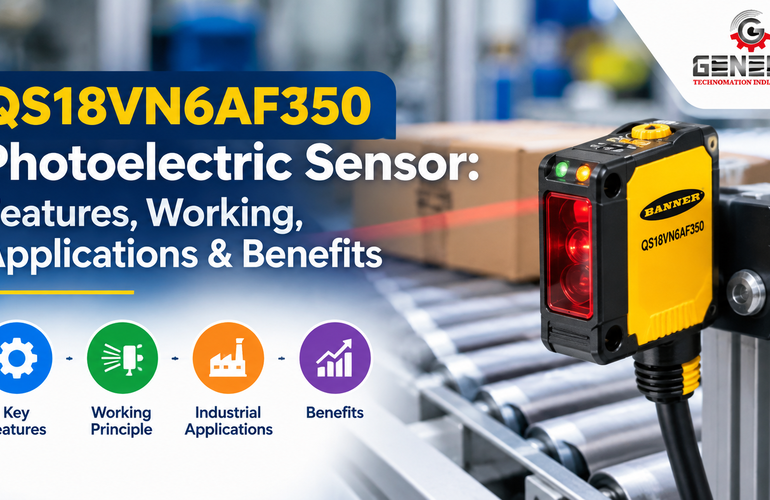
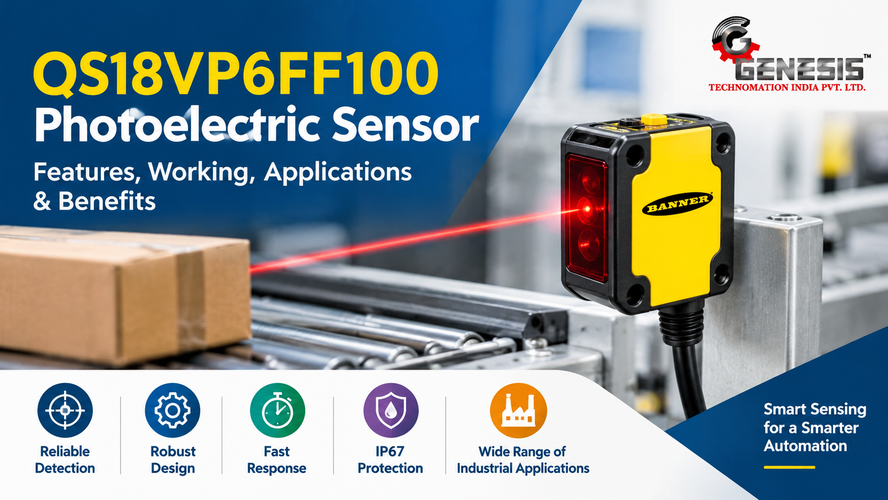
QS18VP6FF100 Photoelectric Sensor is a Banner Engineering WORLD-BEAM QS18 Series fixed-field photoelectric sensor designed for short-range, non-contact object detection in industrial automation systems. The exact model provides a 100 mm cutoff distance, visible red LED sensing beam, complementary solid-state PNP output, 10–30 V DC supply operation, and a 2 m cable connection. Banner also specifies IP67 protection and a rectangular housing with an M18 mounting arrangement.
In a machine, a photoelectric sensor often performs a simple but important job: it tells the control system whether an object is present at a particular point. That signal can initiate counting, indexing, conveyor movement, packaging sequences, inspection triggers, or other programmed machine actions. The QS18VP6FF100 is particularly relevant when the application requires fixed-field/background-suppression sensing within its documented 100 mm detection range.
For OEMs, machine builders, automation engineers, maintenance teams, and system integrators, model accuracy matters. The QS18 family contains multiple sensing technologies and output configurations, so the specifications of QS18VP6D, QS18VP6AF350, QS18VN6FF100, or other variants should not be substituted for this model.
What Is the QS18VP6FF100 Photoelectric Sensor?
The QS18VP6FF100 is an all-purpose photoelectric sensor from Banner Engineering’s WORLD-BEAM QS18 Series. Its sensing mode is classified as proximity with fixed background suppression, while its optical source is a visible red LED. The manufacturer specifies a maximum sensing distance of 100 mm for this exact model.
Fixed-field sensing is useful when the machine needs to detect a target within a defined sensing area while reducing the influence of objects beyond the intended cutoff. This makes the sensing arrangement different from ordinary diffuse sensing, where reflected light from a target is used without the same fixed cutoff behavior.
The model uses a PNP discrete output and supports light-on/dark-on operation. It is supplied with a 2 m cable, so it is not the same cable configuration as the QS18VP6FF100 W/30 variant, which has a 9 m cable.
That distinction is important when preparing a bill of materials. Ordering the correct complete part number helps prevent an otherwise avoidable mismatch between the machine’s installation requirements and the delivered sensor.
QS18VP6FF100 Model Identification
The manufacturer clearly identifies QS18VP6FF100 as a QS18 Series fixed-field sensor with a 100 mm cutoff. The available Banner product information confirms the overall product classification and technical characteristics.
However, individual characters in the part number should not be given unofficial meanings unless Banner explicitly documents the coding system. For engineering documentation, the safest approach is to use the complete manufacturer part number exactly as specified:
QS18VP6FF100
Do not interpret the code by comparing it with another QS18 model and assuming that every character has an identical meaning across configurations. The QS18 family includes diffuse, retroreflective, fixed-field, fiber-optic, and other configurations, with differences in sensing method, output, range, and optical characteristics.
Key Features of QS18VP6FF100 Photoelectric Sensor
Fixed-Field Background Suppression
The QS18VP6FF100 uses fixed background suppression. This is one of its most important application characteristics. Instead of treating every object in the optical field in the same way, the fixed-field configuration establishes a defined sensing boundary.
For a machine builder, this can be useful when a target must be detected at a controlled distance and background objects should have less influence on the detection decision.
The exact installation still matters. The sensor should be tested using the actual production target rather than assuming that nominal specifications guarantee identical performance in every machine.
100 mm Sensing Distance
Banner specifies a 100 mm maximum sensing distance for the QS18VP6FF100.
A 100 mm cutoff makes the model suitable for relatively close object-detection points. This can work well on compact machinery, conveyors, packaging equipment, assembly stations, and other systems where the sensor is installed near the product path.
Engineers should distinguish between a published sensing distance and the actual reliable operating point. Target dimensions, target surface, alignment, installation geometry, contamination, and machine movement can all influence practical detection.
Visible Red LED Sensing Beam
The sensor uses a visible red LED with a documented wavelength of 630 nm.
A visible sensing beam can make setup easier because technicians can visually identify the sensing direction during installation. This is particularly helpful during machine commissioning and troubleshooting.
Complementary Solid-State PNP Output
The QS18VP6FF100 provides a complementary solid-state PNP output. Banner lists the output as PNP and the input/output interface as discrete.
This is a critical selection parameter. A PNP sensor should be matched with a compatible controller or PLC input arrangement. Before connecting the sensor, engineers should verify the controller’s input requirements and follow the manufacturer’s wiring documentation.
10–30 V DC Supply
The specified supply voltage is 10–30 V DC.
This range is relevant to industrial control systems that use common DC control voltages. The actual machine power supply should still be checked for voltage stability, wiring quality, grounding, and electrical noise.
2 m Cable
The standard QS18VP6FF100 configuration has a 2 m cable.
This should not be confused with the QS18VP6FF100 W/30 model, which Banner lists with a 9 m cable.
IP67 Protection
Banner lists the exact model with an IP67 rating.
IP67 provides defined protection against dust ingress and temporary immersion under the applicable test conditions. It should not automatically be interpreted as suitability for every washdown, chemical, high-pressure cleaning, or extreme-environment application. The actual machine environment should be compared with the manufacturer’s environmental specifications.
Industrial Housing and M18 Mount
The product information identifies a rectangular housing with an M18 mount, with ABS listed as the primary housing material and an acrylic lens.
This physical configuration gives machine designers a defined mounting format to consider when creating brackets, sensor holders, and replacement procedures.
QS18VP6FF100 Photoelectric Sensor Technical Specifications
The following table focuses on specifications confirmed for the exact QS18VP6FF100 model.
| Specification | QS18VP6FF100 |
| Manufacturer | Banner Engineering |
| Series | WORLD-BEAM QS18 |
| Sensor type | Fixed-field photoelectric sensor |
| Sensing mode | Proximity |
| Detailed sensing mode | Fixed background suppression |
| Maximum sensing distance | 100 mm |
| Sensing beam | Visible red LED |
| Wavelength | 630 nm |
| Supply voltage | 10–30 V DC |
| Output | Complementary solid-state PNP |
| Input/Output | Discrete |
| Connection | Cable |
| Cable length | 2 m |
| Housing style | Rectangular with M18 mount |
| Primary housing material | ABS |
| Lens material | Acrylic |
| IP rating | IP67 |
| Operating temperature | -20°C to +70°C |
| Output response time | 0.85 ms |
| Repeatability | 160 µs |
| Power-up delay | 100 ms |
| Indicators | LEDs |
| Barrel diameter | 18 mm |
| Adjustment | N/A |
| Number of pins/wires | 4 |
These specifications are taken from Banner’s product information for QS18VP6FF100.
The exact model should always be checked against the latest manufacturer documentation before a production design is released, particularly where wiring, certification, environmental requirements, or machine safety are involved.
QS18VP6FF100 Photoelectric Sensor Working Principle
The QS18VP6FF100 working principle is based on fixed-field photoelectric sensing.
The basic signal path is:
Target → Visible red sensing beam → Optical detection → Sensor electronics → PNP output → PLC/controller → Machine action
The process can be understood in several stages.
1. The Sensor Produces a Sensing Beam
The QS18VP6FF100 uses a visible red LED as its sensing source. The optical system establishes the sensing field used to detect the target. Banner specifies a 630 nm sensing beam for this model.
2. The Target Enters the Detection Area
When a product, component, package, or other target enters the sensor’s detection area, the optical conditions at the sensor change.
Because this is a fixed-field sensor, the detection behavior is based on the defined sensing field and cutoff characteristics rather than simply treating all reflected objects at arbitrary distances as equivalent.
3. Internal Electronics Process the Optical Change
The sensor evaluates the received optical signal through its internal electronics. The result is converted into the sensor’s discrete switching state.
4. The PNP Output Changes State
The QS18VP6FF100 provides a complementary solid-state PNP output. The output condition can then be interpreted by the connected control system.
5. The PLC or Controller Executes the Programmed Function
The sensor itself does not decide what a production machine should do. It provides an input signal.
The PLC or machine controller may use that input to:
- Count a product
- Start a machine sequence
- Stop or index a conveyor
- Confirm product presence
- Trigger an inspection
- Control positioning
- Coordinate another actuator
This distinction is important in automation design. The sensor is the detection element; the controller determines the machine response.
Detection Performance Factors
Even when the QS18VP6FF100 is correctly specified, practical detection depends on the machine environment.
Target Size and Shape
A very small target may interact differently with the sensing field than a large target. Engineers should validate detection using the actual production part.
Target Surface
Surface properties can affect optical detection. Highly reflective, dark, irregular, or changing surfaces may require careful sensor positioning and testing.
Distance
The model has a documented 100 mm maximum sensing distance. Operating close to the intended detection point can provide a more controlled installation, provided the target and application are appropriate.
Alignment
A sensor that is mechanically loose or incorrectly positioned can produce inconsistent detection. The sensor should be mounted securely and aligned with the actual product path.
Ambient Light
Strong external light sources can affect optical sensing in some installations. If the machine is exposed to unusual lighting conditions, test the sensor under actual operating conditions.
Contamination
Dust, oil, product residue, or other contamination around the optical surface can affect detection. Routine inspection is therefore useful in production equipment.
Vibration
Machine vibration can change sensor position or target alignment. A secure mounting arrangement is important, particularly on high-speed equipment.
QS18VP6FF100 Photoelectric Sensor Applications
The QS18VP6FF100 can be considered for applications where a fixed-field photoelectric detection point at up to 100 mm is appropriate.
Packaging Machines
A sensor can detect the presence of a carton, package, container, or component at a defined machine position.
The PLC can use the resulting signal to coordinate filling, sealing, labeling, indexing, or another programmed sequence.
Conveyor Systems
The sensor can provide a product-detection input on a conveyor where the detection point is within the sensor’s specified range.
Typical functions can include:
- Product presence detection
- Product counting
- Conveyor sequencing
- Position confirmation
- Machine triggering
Material Handling
Material-handling equipment often requires reliable detection of items moving through predefined points.
The QS18VP6FF100 can be evaluated when the target and mounting arrangement fit the fixed-field sensing characteristics.
Assembly Machines
Assembly equipment can use photoelectric sensors to determine whether a component has arrived at a station.
A PLC can then use that signal as part of the assembly sequence.
Part Presence Detection
Part presence is one of the most common industrial sensor applications. The QS18VP6FF100 can be considered when the part is positioned within the specified 100 mm sensing field.
Automated Production Lines
Production equipment can use discrete sensor signals to synchronize different machine stages. A product-detection signal can serve as one input in a larger automation sequence.
Counting Applications
If products consistently pass through a suitable sensing point, the sensor output can be connected to a counter or PLC counting routine.
The machine designer should confirm that the sensor response and target movement are appropriate for the required counting speed.
Benefits of QS18VP6FF100 Photoelectric Sensor
Defined Fixed-Field Detection
The fixed background-suppression configuration provides a defined sensing approach for close-range object detection.
Non-Contact Detection
The sensor detects objects optically rather than requiring physical contact with the product. That is useful for moving items and processes where mechanical contact could interfere with production.
Fast Response
Banner specifies an output response time of 0.85 ms.
Response time should be evaluated alongside product speed, sensor placement, PLC scan time, and the overall machine sequence.
PNP Integration
The complementary solid-state PNP output provides a discrete interface for compatible industrial control systems.
Compact Installation
The rectangular housing with M18 mounting arrangement provides a practical mechanical configuration for machine builders.
Industrial Environmental Protection
The IP67 rating provides a documented level of ingress protection for suitable industrial installations.
Visible Optical Beam
The 630 nm visible red LED can make alignment and commissioning easier for technicians.
QS18VP6FF100 for Industrial Automation
The sensor can be viewed as one component in a larger automation signal chain:
Object → QS18VP6FF100 → PNP output → PLC → Program logic → Machine action
For example, on a packaging line, the sensor may detect the arrival of a package. The PNP output reaches a PLC input. The PLC recognizes the input and advances the next step in the sequence.
Possible integration points include:
- PLC digital inputs
- Machine controllers
- Counters
- Conveyor control
- Automated sequencing
- HMI-based status monitoring
- Inspection systems
The exact wiring must be based on the manufacturer’s documentation and the controller’s electrical input specifications. Do not use a generic QS18 wiring diagram without confirming that it applies to the exact part number.
QS18VP6FF100 Installation Guidelines
Sensor Positioning
Position the sensor so the actual target enters the intended sensing area consistently. Avoid placing brackets or machine components where they can interfere with the sensing field.
Alignment
Secure the sensor firmly before final testing. A sensor that moves because of vibration can create intermittent detection even when the electrical installation is correct.
Target Position
Test the sensor with the actual production object. Do not rely only on a test block or an object with different surface characteristics.
Wiring
The QS18VP6FF100 uses a cable connection and four wires/pins are specified.
Follow Banner’s current wiring instructions for the exact part number. Verify the supply voltage and PNP input compatibility before energizing the circuit.
Mounting
Use an appropriate M18 mounting arrangement and secure the sensor sufficiently to prevent movement. Mechanical stability is especially important on machines with vibration or repeated acceleration.
Environmental Conditions
The documented operating temperature range is -20°C to +70°C, with maximum operating relative humidity listed as 95% at 50°C.
The installation should also account for dust, moisture, oil, ambient illumination, cleaning practices, and other site-specific conditions.
Factors That Can Affect Sensor Performance
| Problem | Possible Cause | Recommended Action |
| Sensor does not detect object | Target outside sensing area | Check target position and sensing distance |
| Intermittent detection | Vibration or inconsistent target position | Secure mounting and stabilize target path |
| False detection | Background or installation geometry | Review fixed-field setup and sensor positioning |
| Output does not change | Wiring, supply, or PLC input issue | Verify power, wiring, and compatible PLC input |
| Detection changes with object position | Target geometry or surface variation | Test the actual target at different positions |
| Sensor stops during operation | Environmental or electrical issue | Check contamination, supply stability, cables, and connections |
Troubleshooting should begin with the simplest physical checks. Confirm power first, then inspect mounting, alignment, target position, cable condition, and PLC input status.
Maintenance Recommendations
Photoelectric sensors generally benefit from simple preventive inspection.
For the QS18VP6FF100 installation, maintenance teams should consider:
- Inspecting the sensor visually
- Keeping the sensing surface clean
- Checking mounting stability
- Inspecting the cable for mechanical damage
- Confirming sensor alignment
- Monitoring intermittent signals
- Checking the output state during machine testing
- Keeping contamination away from the optical area
Do not assign a fixed maintenance interval unless the machine’s maintenance program or manufacturer documentation establishes one. The appropriate frequency depends on the environment and duty cycle.
QS18VP6FF100 for OEMs and Machine Builders
For OEMs, choosing the correct sensor model is more important than simply selecting a sensor from the same product family.
The QS18VP6FF100 provides a defined combination of:
- Fixed-field sensing
- 100 mm maximum sensing distance
- 10–30 V DC operation
- Complementary PNP output
- 2 m cable
- IP67 protection
- M18 mounting arrangement
- 0.85 ms output response
These parameters can be incorporated into the machine’s electrical and mechanical design from the beginning.
Machine builders should also document the complete model number in electrical drawings and spare-parts lists. This helps maintenance teams order the correct replacement instead of requesting a generic QS18 sensor.
QS18VP6FF100 vs Generic Photoelectric Sensors
A generic photoelectric sensor may look suitable at first glance, but several engineering parameters need to match.
| Selection Factor | QS18VP6FF100 Consideration |
| Detection method | Fixed-field/background suppression |
| Sensing distance | 100 mm |
| Output | Complementary solid-state PNP |
| Supply | 10–30 V DC |
| Optical source | 630 nm visible red LED |
| Connection | 2 m cable |
| Protection | IP67 |
| Mounting | Rectangular housing with M18 mount |
| Response | 0.85 ms |
| Operating environment | -20°C to +70°C |
A different sensor may have a longer range, NPN output, different sensing method, connector configuration, or different environmental rating. Therefore, substitution should be based on engineering requirements rather than physical appearance.
How to Select the Right Photoelectric Sensor
Before selecting the QS18VP6FF100 or QS18VN6AF350 or another industrial photoelectric sensor, evaluate:
- Detection method – Determine whether fixed-field, diffuse, retroreflective, or through-beam sensing is appropriate.
- Sensing distance – Compare the required target position with the sensor’s documented range.
- Target characteristics – Consider size, color, shape, reflectivity, and surface.
- Output type – Confirm PNP/NPN and switching behavior.
- Supply voltage – Verify compatibility with the machine’s DC supply.
- Response speed – Compare sensor response with object speed and machine timing.
- Environmental conditions – Review temperature, moisture, dust, contamination, and cleaning requirements.
- Mounting – Confirm that the mechanical configuration fits the machine.
- Connection – Check cable length and connection requirements.
- PLC compatibility – Verify the controller’s input circuit.
- Certifications – Confirm any project-specific compliance requirements.
- Operating conditions – Test the sensor with the actual production target.
The QS18VP6FF100 becomes a strong candidate when these requirements align with its documented characteristics.
QS18VP6FF100 Price and Buying Considerations
There is no fixed universal QS18VP6FF100 price that should be treated as a permanent product specification. Current pricing can vary according to supplier, stock availability, order quantity, shipping, taxes, and purchasing requirements.
Online distributor information can also change. For example, Genesis currently lists the exact Banner part number and identifies the product as a 100 mm background-suppression PNP sensor with a 2 m cable, but commercial pricing and availability remain purchasing-specific.
When requesting a Photoelectric Sensor price in India, buyers should provide the complete part number:
QS18VP6FF100
It is also useful to confirm:
- Current availability
- Exact cable configuration
- Manufacturer documentation
- Required quantity
- Delivery schedule
- Applicable taxes
- Shipping charges
- Technical support requirements
Do not compare prices between different QS18 variants without first checking whether their sensing technology, output, range, and connection are equivalent.
Where to Buy QS18VP6FF100 Photoelectric Sensor in India
If you are looking for the QS18VP6FF100 Photoelectric Sensor or other industrial sensing solutions in India, Genesis Technomation India Pvt. Ltd. can be considered for product enquiry and automation requirements.
Genesis currently lists QS18VP6FF100 among its photoelectric sensor models and provides a dedicated industrial photoelectric sensor page.
Before purchasing, provide the complete model number and ask the supplier to confirm the current product configuration, availability, price, and suitability for the intended machine.
Genesis should not be assumed to be the manufacturer, exclusive dealer, or official representative of Banner Engineering unless that status is independently confirmed.
FAQs about QS18VP6FF100 Photoelectric Sensor
What is the QS18VP6FF100 Photoelectric Sensor?
The QS18VP6FF100 is a Banner Engineering WORLD-BEAM QS18 Series fixed-field photoelectric sensor with a 100 mm cutoff, visible red LED sensing beam, complementary solid-state PNP output, 10–30 V DC supply, and 2 m cable.
How does QS18VP6FF100 work?
It uses fixed-field photoelectric sensing. The sensor’s optical system detects the target within its defined sensing field and its internal electronics produce the corresponding discrete PNP output.
What type of objects can QS18VP6FF100 detect?
It can be evaluated for industrial objects that can be reliably detected within the sensor’s 100 mm fixed-field range. Actual performance depends on target size, surface, shape, position, and installation conditions.
What is the sensing range of QS18VP6FF100?
Banner specifies a 100 mm maximum sensing distance/cutoff for the exact QS18VP6FF100 model.
What output does QS18VP6FF100 use?
The sensor uses a complementary solid-state PNP output and provides a discrete interface.
What supply voltage does QS18VP6FF100 require?
The documented supply voltage is 10–30 V DC.
Can QS18VP6FF100 be connected to a PLC?
Yes, it can be integrated with a compatible PLC or machine controller as a discrete PNP sensor input. The PLC input circuit and sensor wiring must be verified before connection.
What is the response time of QS18VP6FF100?
Banner specifies an output response time of 0.85 ms for the exact model.
What protection rating does QS18VP6FF100 have?
The exact model is listed with an IP67 rating.
What cable length does QS18VP6FF100 have?
The standard QS18VP6FF100 has a 2 m cable. Do not confuse it with the QS18VP6FF100 W/30 variant, which has a 9 m cable.
Where is QS18VP6FF100 commonly used?
It can be evaluated for packaging machines, conveyors, assembly equipment, material handling, part-presence detection, counting, and automated production systems where its 100 mm fixed-field sensing characteristics are appropriate.
What factors can affect detection?
Target characteristics, sensing distance, alignment, mounting stability, contamination, ambient conditions, electrical installation, and machine vibration can all influence practical performance.
How should QS18VP6FF100 be installed?
Mount it securely, position the sensing field around the intended target location, connect it according to Banner’s current wiring documentation, and test it using the actual production object.
What maintenance does QS18VP6FF100 require?
Maintenance can include visual inspection, cleaning the optical surface when required, checking mounting stability, inspecting the cable, confirming alignment, and monitoring the sensor output for intermittent operation.
How can I buy QS18VP6FF100 in India?
For a QS18VP6FF100 Photoelectric Sensor supplier in India, buyers can contact Genesis Technomation for a product enquiry and confirm current availability, configuration, quotation, and application requirements. Genesis lists QS18VP6FF100 on its photoelectric sensor page.
What affects QS18VP6FF100 price?
The current price can depend on supplier, quantity, availability, shipping, taxes, and purchasing conditions. Request a current quotation for the exact QS18VP6FF100 part number instead of relying on an old or unrelated QS18 listing.
Conclusion
The QS18VP6FF100 Photoelectric Sensor is a Banner Engineering WORLD-BEAM QS18 Series fixed-field sensor designed for close-range industrial object detection. Its documented configuration includes a 100 mm sensing cutoff, visible red 630 nm LED, 10–30 V DC supply, complementary solid-state PNP output, 2 m cable, IP67 protection, and 0.85 ms output response time.
Its practical value comes from having a defined sensing configuration that can be evaluated against a machine’s target, mounting, electrical, environmental, and timing requirements. It can be considered for packaging, conveyor, assembly, material-handling, counting, product-presence, and production-line applications where fixed-field detection at the specified range is appropriate.
Correct model selection is essential. The QS18 family includes multiple variants with different sensing methods, ranges, output types, and connection configurations, so specifications should never be transferred from another model simply because the housing or product family looks similar.
For Indian businesses evaluating the QS18VP6FF100 Photoelectric Sensor, Genesis Technomation India Pvt. Ltd. can be considered for product enquiries and industrial automation requirements. Always confirm the complete part number, current manufacturer documentation, availability, quotation, and application suitability before purchasing or integrating the sensor into a production machine.
Related Posts