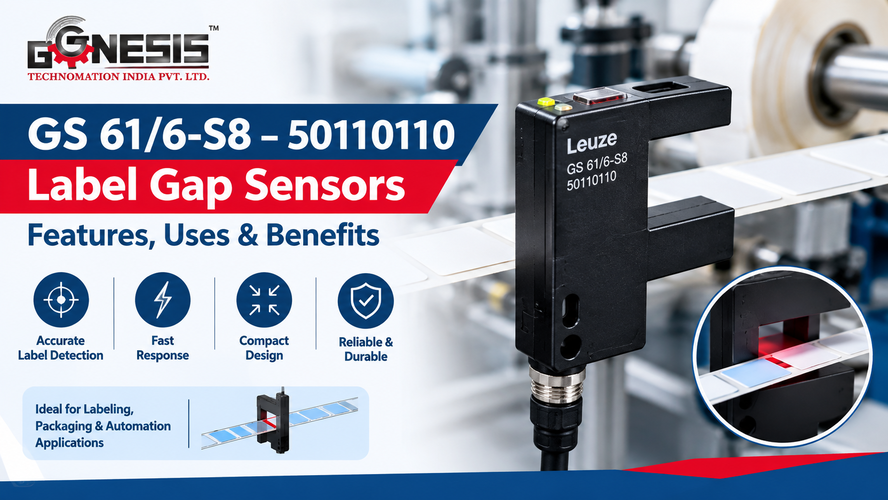
GS 61/6-S8 – 50110110 Label Gap Sensor is a Leuze optical fork photoelectric sensor designed specifically for detecting non-transparent labels in automated machinery. It belongs to the Leuze Series 61 and uses an infrared LED optical sensing principle to identify labels and the gaps between them as label stock moves through the sensor fork. The manufacturer specifies a minimum label width of 2 mm and a minimum label gap of 2 mm for this model.
For an automated labeling machine, this detection point is much more important than it may appear. The machine needs to know where one label ends and the next gap begins before it can control dispensing, positioning, cutting, printing, or product synchronization correctly. A missed detection can result in an incorrectly positioned label, while unstable detection can create repeated machine stops or wasted label material.
The GS 61/6-S8 – 50110110 Label Gap Sensor provides a digital switching signal corresponding to the label gap. Its documented switching frequency is 10,000 Hz and its response time is 0.05 ms, making the sensor suitable for fast signal detection in automated labeling and packaging equipment when the overall machine design and application conditions are compatible.
Its compact fork construction also has a practical advantage during machine integration. The emitter and receiver are arranged within the fork, so the sensing path is mechanically defined by the sensor itself. This can simplify positioning compared with applications where a separate emitter and receiver have to be aligned.
GS 61/6-S8 – 50110110 Label Gap Sensor: Product Overview
The GS 61/6-S8 is a fork photoelectric sensor from Leuze’s Series 61. Its exact product or part number is 50110110. The manufacturer’s stated application is detection of non-transparent labels. The sensing principle is optical, using an infrared LED with a wavelength of 940 nm.
The sensor is intended to monitor label material passing through its fork opening. As the label web moves, the optical condition changes between the label and the gap. The sensor processes this change and provides a switching signal at its output. Leuze specifies the switching principle as a switching signal in the label gap.
This makes the GS 61/6-S8 particularly relevant to machinery in which the controller needs a repeatable reference for label position.
The documented mechanical design is compact. The sensor has a 3 mm mouth width and 41 mm mouth depth, with overall dimensions of 11 mm × 30 mm × 60 mm. The housing is made from polycarbonate, and the manufacturer’s stated net weight is 20 g.
The electrical interface is also clearly defined. The model operates from 10 to 30 V DC and has one digital switching output. The output uses a transistor push-pull configuration, with a maximum switching current of 100 mA. Connection is through a 4-pin, A-coded M8 male connector.
These details matter when the sensor is being incorporated into an existing labeling machine, PLC-controlled station, or packaging automation panel. Mechanical dimensions determine whether the sensor can be installed in the available space, while the electrical interface determines how it can communicate with the machine controller.
GS 61/6-S8 – 50110110 Label Gap Sensor Features
The following specifications are taken from current manufacturer information for the exact GS 61/6-S8, part number 50110110, rather than from another GS 61/6 variant.
| Parameter | GS 61/6-S8 – 50110110 |
| Manufacturer | Leuze |
| Product series | Series 61 |
| Sensor type | Fork photoelectric sensor |
| Physical principle | Optical |
| Primary application | Detection of non-transparent labels |
| Minimum label width | 2 mm |
| Minimum label gap | 2 mm |
| Light source | LED, infrared |
| Wavelength | 940 nm |
| Supply voltage | 10–30 V DC |
| Digital switching outputs | 1 |
| Output element | Transistor, push-pull |
| Switching principle | Switching signal in label gap |
| Maximum switching current | 100 mA |
| Switching frequency | 10,000 Hz |
| Response time | 0.05 ms |
| Readiness delay | 300 ms |
| Maximum conveyor speed during teach-in | 20 m/min |
| Connection | M8, 4-pin male connector |
| Connector coding | A-coded |
| Mouth width | 3 mm |
| Mouth depth | 41 mm |
| Dimensions | 11 mm × 30 mm × 60 mm |
| Housing material | Polycarbonate |
| Net weight | 20 g |
| Operating temperature | -20°C to +60°C |
| Storage temperature | -30°C to +70°C |
| Protection rating | IP65 |
| Protection class | III |
| Indicators | 2 LEDs |
| Adjustment | Multi-turn potentiometer |
The specification table should be read as a model-specific reference, not as a general specification for every sensor in the GS 61 family. Leuze lists other variants separately, so substituting another model’s connector, cable, output, sensing characteristics, or dimensions would be inappropriate.
Optical Detection for Non-Transparent Labels
The GS 61/6-S8 uses an optical detection principle with an infrared LED at 940 nm. The manufacturer specifically identifies the application as detection of non-transparent labels. This distinction is important when selecting the sensor for a particular label construction.
If the production line uses transparent, translucent, reflective, laminated, or unusual label materials, the actual material combination should be tested rather than assuming that the sensor will behave in the same way as it does with standard opaque labels.
2 mm Minimum Label Width and Gap
Leuze specifies a minimum label width of 2 mm and a minimum label gap of 2 mm. These are useful selection parameters when evaluating whether the sensor matches a particular label format.
For an OEM, this means the label drawing should be checked before final machine integration. The label dimensions, liner, spacing, web path, and movement should be considered together.
Fast Response and Switching
The documented response time is 0.05 ms, while the switching frequency is 10,000 Hz. These specifications describe the sensor’s switching capability and response behavior; they should not be interpreted as a guarantee that every labeling machine can operate at any particular production speed. Machine speed also depends on label geometry, web handling, controller response, actuator timing, mechanical stability, and the complete automation architecture.
Push-Pull Digital Output
The GS 61/6-S8 has one digital switching output using a transistor push-pull configuration. Leuze specifies a maximum switching current of 100 mA. The documented high-level output is at least UB minus 2 V, while the low level is no more than 2 V.
This provides a defined digital signal that can be connected to compatible machine-control electronics. Before installation, the electrical requirements of the PLC input or controller should always be checked against the sensor’s current documentation.
Compact Fork Construction
The 3 mm mouth width and 41 mm mouth depth give the GS 61/6-S8 a defined sensing passage for label material. Its 11 mm × 30 mm × 60 mm overall dimensions allow it to be considered where installation space is limited.
How GS 61/6-S8 – 50110110 Label Gap Sensor Works
The working sequence can be understood as:
Label web movement → optical sensing → label/gap recognition → digital output signal → machine controller → positioning or synchronization action
The label material passes through the fork opening of the GS 61/6-S8. The sensor’s optical system monitors the material as it travels through the sensing area. Because the model is specified for non-transparent labels, the optical condition changes as the label and gap pass through the sensing path.
The sensor is configured to provide a switching signal in the label gap. In practical terms, the machine receives a digital reference associated with the space between labels. The PLC or machine controller can use that reference to coordinate the next stage of the labeling process.
For example, on an automatic labeling machine, the controller may use the gap signal as a timing reference for label dispensing or product positioning. The exact machine action depends on the OEM’s control logic and is not a function that should be assumed to be built into the sensor itself.
The sensor therefore acts as a detection element within a larger automation system. It does not independently control the servo motor, conveyor, label applicator, or PLC. Instead, it provides the electrical signal that the control system can process.
Detection Performance of GS 61/6-S8 – 50110110
Correct detection depends on more than the sensor’s nominal specifications. The physical relationship between the sensor and label web is critical.
The manufacturer specifies the GS 61/6-S8 for non-transparent labels with minimum label width and gap values of 2 mm. If a production line uses labels close to these limits, mechanical stability and correct positioning become especially important.
Label Material
Label material influences optical detection. Since the model is specifically documented for non-transparent labels, the label stock should be evaluated against the manufacturer’s intended application.
Do not assume that a transparent or highly reflective label will produce the same detection behavior. If the production material changes, perform a machine trial before releasing the configuration for production.
Liner Characteristics
The backing liner forms part of the optical sensing situation because the sensor is detecting the changing condition of material moving through the fork. Differences in liner construction, thickness, transparency, or surface characteristics can affect the observed signal.
When commissioning a new label stock, test the actual production material rather than relying solely on the previous label specification.
Label Spacing
The specified minimum label gap is 2 mm. Very small gaps require accurate mechanical positioning and stable web movement. If the gap becomes difficult to distinguish during operation, check the actual label construction, sensor positioning, web movement, and machine timing.
Machine Speed
The GS 61/6-S8 has a 0.05 ms response time and 10,000 Hz switching frequency. Leuze also specifies a maximum conveyor speed of 20 m/min during teach-in.
Production speed should therefore be considered together with the teach-in procedure and the machine’s actual operating conditions. A sensor specification should never be used in isolation to calculate a guaranteed machine production rate.
Alignment and Mounting
The fork sensor’s fixed optical arrangement reduces the alignment problem between separate emitter and receiver components, but the sensor still needs stable mechanical mounting.
If the sensor moves because of vibration, loose fasteners, or web contact, the sensing geometry can change. That can result in inconsistent detection, especially where label gaps are small.
Applications of GS 61/6-S8 – 50110110 Label Gap Sensor
Automatic Labeling Machines
The GS 61/6-S8 can serve as a label detection input on automatic labeling equipment where non-transparent labels need to be detected. The sensor observes the label web and provides a switching signal in the gap. The machine controller can use that signal as a reference for label positioning or dispensing.
For OEM machine builders, the important point is not simply that the sensor detects labels. Its output has to be incorporated into the timing logic of the complete machine.
Bottle and Container Labeling
Bottle and container labeling machines often require a repeatable relationship between the product position and the label position. The GS 61/6-S8 can monitor the label web while a separate product-detection or machine-control system handles product positioning.
The sensor therefore contributes the label-side reference. The PLC, servo system, or labeling controller determines how that reference is used.
Packaging Machines
In packaging equipment, a label sensor may provide a timing or position signal for downstream control. The GS 61/6-S8’s fast documented response and digital output make it relevant to high-speed signal detection where the label material and machine design meet the sensor’s requirements.
Pharmaceutical Packaging
Pharmaceutical packaging machinery can require controlled and repeatable label positioning. The GS 61/6-S8 can be considered for suitable non-transparent label applications, provided its specifications, label material, environmental conditions, and machine validation requirements are satisfied.
The sensor should not be treated as automatically suitable for every pharmaceutical application simply because it is a photoelectric sensor. The actual packaging process must be evaluated.
Food and FMCG Packaging
Food and FMCG lines frequently use automated labeling and packaging processes. Where non-transparent labels meet the sensor’s detection requirements, the GS 61/6-S8 can provide a label-gap signal to the machine controller.
Actual suitability should be confirmed against the label construction, operating environment, mounting arrangement, and machine speed.
Pouch and Sachet Packaging
The GS 61/6-S8 may be relevant to pouch or sachet equipment when the machine uses suitable non-transparent label material and the label geometry fits the sensor’s documented sensing characteristics.
The actual web path and packaging material should be tested during machine commissioning.
Carton Labeling
On carton-labeling systems, the sensor can detect the gap between labels on a continuous web. The resulting digital signal can be used by the machine controller as part of its label-positioning sequence.
Roll-Fed Label Applications
The fork configuration is particularly relevant when continuous label stock passes through a defined sensing path. The GS 61/6-S8 can monitor the label/gap sequence and output the corresponding switching signal to compatible control equipment.
Benefits of GS 61/6-S8 – 50110110 Label Gap Sensor
Consistent Label Detection
A dedicated fork sensor gives the machine a defined optical sensing location. The GS 61/6-S8 is specifically designed for non-transparent label detection, with documented minimum label width and gap requirements.
Improved Label Positioning
The sensor’s switching signal in the label gap can provide a repeatable reference for machine-control logic. This can support accurate positioning when properly integrated with the labeling system.
Fast Signal Response
With a documented response time of 0.05 ms and switching frequency of 10,000 Hz, the GS 61/6-S8 is designed for rapid switching behavior.
Compact Machine Integration
The compact 11 mm × 30 mm × 60 mm housing and fork design can be useful when an OEM has limited installation space.
Defined Electrical Interface
The 10–30 V DC supply range and digital push-pull output provide clearly documented electrical characteristics for integration with compatible automation hardware.
Industrial Environmental Capability
The manufacturer’s operating temperature range is -20°C to +60°C, and the product is specified with IP65 protection. This gives engineers defined environmental parameters to consider during application planning.
GS 61/6-S8 – 50110110 Lebel Gap Sensor in Industrial Automation
The GS 61/6-S8 can become one input element in a larger automated production sequence.
A typical arrangement can include:
Label roll → Label web → GS 61/6-S8 → PLC/controller → Servo or stepper control → Label dispensing/applying mechanism
The sensor itself does not command the servo or stepper motor. Instead, its digital output is read by compatible control equipment. The controller can then use the detected gap as part of its programmed timing sequence.
In a conveyorized labeling machine, the sensor can work alongside:
- PLCs
- Machine controllers
- Servo drives
- Stepper drives
- Conveyors
- Label dispensers
- Product-position sensors
- Label applicators
- Automation control panels
The key engineering consideration is signal compatibility. The machine builder must verify the sensor’s supply, output configuration, current requirements, connector arrangement, and controller input specifications before wiring the system.
Installation and Mounting Considerations
Correct installation has a direct effect on detection stability.
Mount the Sensor Rigidly
The GS 61/6-S8 should be mechanically secured using an appropriate mounting arrangement. Leuze documents mounting threads, through-hole mounting, and mounting via an optional mounting device.
Avoid mounting arrangements that allow the sensor to vibrate or shift relative to the moving label web.
Position the Label Web Correctly
The label stock needs to pass through the sensor’s fork opening. The machine designer should ensure that the web path remains stable and does not scrape against the sensor.
Check Electrical Compatibility
The documented supply voltage is 10–30 V DC. The sensor has one digital switching output and an M8, 4-pin male connector.
Always confirm the current manufacturer’s wiring documentation and the PLC/controller input requirements before connection. Do not rely on an assumed pinout.
Consider Machine Speed
The sensor’s response characteristics should be considered alongside the actual label dimensions, gap, web speed, PLC scan time, output processing, and machine mechanics.
Perform a Production Test
After installation, test the sensor with the actual production label material. Check several consecutive labels rather than relying on one successful detection cycle.
Factors Affecting GS 61/6-S8 – 50110110 Detection
| Issue | Why It Can Affect Detection | What to Check |
| Incorrect alignment | Label web may not pass correctly through the sensing path | Check web position and sensor mounting |
| Label material change | Different optical characteristics can alter detection | Test the actual label stock |
| Small label gap | Very small gaps demand stable sensing and web movement | Confirm the gap meets the documented minimum |
| Vibration | Sensor or web movement can disturb the sensing condition | Tighten mounting and inspect mechanical stability |
| Dust or contamination | Contamination can interfere with optical sensing | Inspect and clean the sensing area according to maintenance procedures |
| Web tension | Uneven web movement can change the material position | Check the web path and tension system |
| Excessive speed | High speed can expose mechanical or control-system limitations | Check the complete machine timing |
| Electrical incompatibility | Incorrect interface conditions can produce unreliable signals | Verify supply and controller input compatibility |
| Incorrect setup | Detection threshold or adjustment may not suit the material | Follow the manufacturer’s setup instructions |
| Mechanical contact | Contact between web and sensor can disturb movement | Check the fork path and web guidance |
The important troubleshooting principle is to change one variable at a time. If the sensor is intermittently detecting labels, replacing it immediately may not solve the problem. First check the label stock, web path, mounting stability, sensor setup, and electrical interface.
GS 61/6-S8 – 50110110 Maintenance and Troubleshooting
| Problem | Possible Cause | Recommended Action |
| Label not detected | Incorrect sensor position or unsuitable label material | Check mounting, web position, and label material |
| Intermittent detection | Vibration, unstable web movement, or contamination | Inspect mounting, web tension, and sensing area |
| Incorrect label position | Sensor signal is not correctly integrated into machine timing | Check controller logic and sensor position |
| False detection | Material or sensing conditions differ from expected setup | Test actual label and liner combination |
| Unstable output | Electrical connection or mechanical condition may be unsuitable | Check connector, supply, mounting, and controller interface |
| Detection changes at high speed | Mechanical movement or system timing limitation | Check web stability, machine timing, and sensor setup |
Maintenance should begin with visual and mechanical checks. Inspect the fork area for contamination, verify that the sensor has not shifted, and confirm that the label web follows its intended path.
Electrical checks should be performed by qualified personnel using the machine manufacturer’s procedures. Do not experiment with unknown wiring or connector pin assignments.
Why Choose GS 61/6-S8 – 50110110 for Automated Label Detection?
The GS 61/6-S8 can be considered by OEMs, packaging-machine manufacturers, automation integrators, production teams, and maintenance engineers when the application calls for a compact optical fork sensor for non-transparent labels.
For OEMs, the compact mechanical design and defined M8 connection can simplify machine-layout planning. For automation integrators, the digital push-pull output provides a documented interface for compatible control hardware. For maintenance teams, the fork construction provides a clearly defined sensing path.
The most important selection criterion remains application compatibility. The label material, minimum label width, minimum gap, web movement, machine speed, electrical interface, mounting arrangement, and operating environment should all be reviewed before purchase.
Where to Purchase GS 61/6-S8 – 50110110 Label Gap Sensor
For buyers in India, Genesis Technomation India Private Limited lists the GS 61/6-S8 – 50110110 among its label gap sensor and fork sensor product range. Its product page provides an enquiry route for label gap sensors and fork sensors and identifies the GS 61/6-S8 – 50110110 specifically in its available model list.
Industrial buyers, OEMs, packaging-machine manufacturers, automation integrators, and maintenance teams can contact Genesis Technomation to confirm current availability, technical documentation, configuration requirements, and quotation for the exact GS 61/6-S8 – 50110110 model.
When requesting a quotation, provide the complete model and part number rather than only saying “GS 61/6 sensor.” The exact identification is GS 61/6-S8 – 50110110.
GS 61/6-S8 – 50110110 Price and Buying Considerations
The GS 61/6-S8 – 50110110 price should be confirmed from the supplier at the time of purchase. Product pricing can change according to availability, quantity, sourcing conditions, quotation terms, and market conditions.
Genesis Technomation’s product page also indicates that pricing and availability for label gap sensors depend on the model, brand, and application requirements.
Before placing an order, confirm:
- Exact model: GS 61/6-S8
- Part number: 50110110
- Label material
- Liner material
- Minimum label width
- Minimum label gap
- Label web speed
- Required detection behavior
- Supply voltage
- PLC/controller input compatibility
- Output configuration
- Connector requirements
- Available mounting space
- Environmental conditions
- Required documentation
- Quantity required
- Current availability
- Warranty and commercial terms
- Technical support requirements
Do not select the sensor solely on price. A lower-cost sensor that is not compatible with the label material, machine interface, or physical installation can result in commissioning delays and production problems.
FAQs about GS 61/6-S8 – 50110110 Label Gap Sensor
What is the GS 61/6-S8 – 50110110 Label Gap Sensor?
The GS 61/6-S8 – 50110110 is a Leuze Series 61 fork photoelectric sensor designed for detecting non-transparent labels. It uses an optical infrared sensing principle and provides a digital switching signal in the label gap.
How does GS 61/6-S8 – 50110110 work?
Label material passes through the sensor’s fork opening. The optical sensing system detects the changing condition between label material and the gap and produces a digital switching signal corresponding to the label gap.
What is GS 61/6-S8 – 50110110 used for?
It is designed for detecting non-transparent labels and can be integrated into automated labeling and packaging machinery where label-gap detection is required.
Where can GS 61/6-S8 – 50110110 be installed?
It can be integrated into suitable labeling, packaging, and automated material-handling equipment. The actual application should meet the sensor’s documented mechanical, electrical, optical, and environmental requirements.
How does GS 61/6-S8 – 50110110 detect labels and gaps?
The sensor uses an optical infrared LED system. As the label web moves through the fork, the optical sensing condition changes between label and gap, allowing the sensor to generate its documented switching signal in the label gap.
What factors can affect GS 61/6-S8 – 50110110 detection?
Label material, label and gap dimensions, web stability, sensor alignment, mechanical vibration, contamination, machine speed, and electrical integration can all affect practical detection performance.
How should GS 61/6-S8 – 50110110 be installed?
Mount the sensor securely, route the label web correctly through the fork opening, verify electrical compatibility, and follow the manufacturer’s installation and setup documentation. Do not assume connector pinouts or setup values.
What should I check if GS 61/6-S8 – 50110110 does not detect labels correctly?
Start with the label material, web position, sensor mounting, contamination, electrical supply, connector, and controller input. Also confirm that the label width and gap meet the model’s documented minimum requirements.
Is GS 61/6-S8 – 50110110 suitable for packaging automation?
It can be used in suitable packaging and labeling automation applications involving non-transparent labels. Final suitability should be confirmed against the actual label material, machine speed, environmental conditions, mounting arrangement, and controller interface.
Where can I purchase GS 61/6-S8 – 50110110 Label Gap Sensor?
Genesis Technomation India Private Limited lists the GS 61/6-S8 – 50110110 in its label gap sensor and fork sensor range. Buyers can contact the company through its product page for current pricing, availability, and application-related information.
Conclusion
The GS 61/6-S8 – 50110110 Label Gap Sensor is a compact Leuze fork photoelectric sensor designed for the optical detection of non-transparent labels. Its documented 2 mm minimum label width and gap, infrared 940 nm light source, 10–30 V DC supply, digital push-pull output, 0.05 ms response time, and 10,000 Hz switching frequency make it a clearly specified component for label-detection applications.
Its practical value comes from how it fits into the complete machine. When installed correctly, the sensor can provide the label-gap signal required by a PLC or machine controller for positioning and synchronization. The compact fork construction also provides a defined sensing path, while the M8 connector and documented electrical characteristics support integration into compatible automation systems.
For engineers and OEMs, the correct approach is to verify the complete application before purchasing. Label construction, minimum gap, web movement, machine speed, mounting, electrical compatibility, environmental conditions, and controller requirements should all be checked against the current manufacturer documentation.
For Indian industrial buyers looking for the GS 61/6-S8 – 50110110, Genesis Technomation India Private Limited lists this exact model within its label gap sensor and fork sensor range. Buyers should request the latest quotation, availability, and technical documentation using the complete model and part number.
Related Posts