
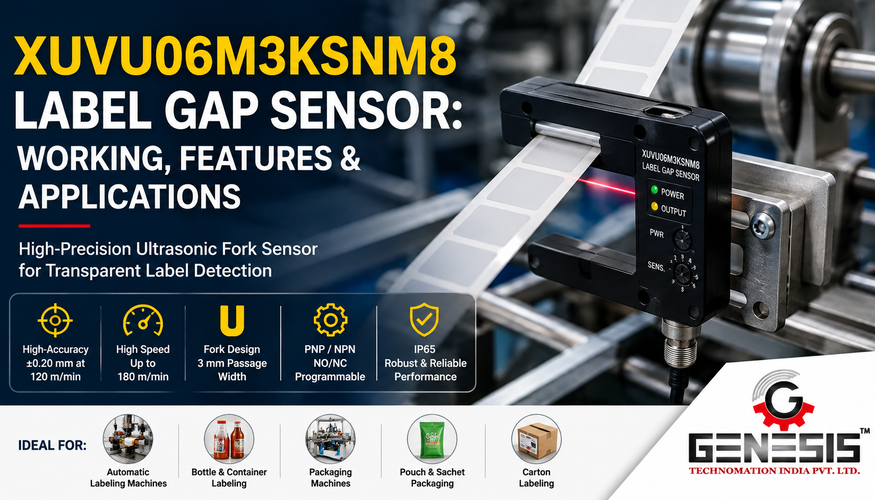
The XUVU06M3KSNM8 Label Gap Sensor is a Telemecanique Sensors XU-series ultrasonic fork sensor designed specifically for detecting transparent labels in packaging applications. Its fork-style construction places the sensing elements across a narrow passageway, allowing the label web to pass through the sensor while the device detects changes associated with labels and the spaces between them.
For automated labeling equipment, this detection signal is more than a simple ON/OFF indication. It can become the timing reference used by a machine controller to coordinate label dispensing, web movement, product positioning, and application.
The XUVU06M3KSNM8 supports this type of machine integration with a discrete PNP/NPN output configuration, programmable NO/NC operation, an M8 four-pin connection, and a fast response specified at less than 0.3 ms. Telemecanique Sensors identifies the product specifically for transparent-label detection and packaging applications.
The model is particularly interesting where transparent labels, including labels on transparent or difficult-to-sense webs, need dependable detection. Its ultrasonic emission technology is intended to distinguish changes in the label web without relying solely on visible contrast.
Manufacturer documentation specifies a 3 mm passage width, 69 mm passage depth, minimum label length of 2 mm, minimum distance between labels of 2 mm, and a maximum object passing speed of 180 m/min.
What Is the XUVU06M3KSNM8 Label Gap Sensor?
The XUVU06M3KSNM8 is a fork-format sensor from the Telemecanique Sensors XU range. Schneider Electric’s product documentation describes it as a photoelectric sensor with a fork design and through-beam detection system, but its emission technology is ultrasonic. The product-specific application is detection of transparent labels.
That combination is important in real packaging machinery.
A label roll or continuous label web passes through the 3 mm sensing passage. As the material moves, the XUVU06M3KSNM8 monitors the ultrasonic transmission characteristics through the sensing area. Changes between the label and the carrier/web allow the sensor electronics to determine the corresponding detection state.
The resulting discrete signal can then be connected to the machine’s control system. Depending on the application, the controller may use the signal as an indexing reference for:
- Label dispensing
- Label counting
- Label positioning
- Web advancement
- Product-to-label synchronization
- Label application timing
- Printing or coding synchronization
The sensor is therefore not normally used as an isolated component. Its practical value comes from providing a repeatable detection event that another part of the machine can use for sequencing.
XUVU06M3KSNM8 Label Gap Sensor: Key Technical Features
The following specifications are taken from Telemecanique Sensors/Schneider Electric documentation rather than estimated values.
| Specification | XUVU06M3KSNM8 Details |
| Model | XUVU06M3KSNM8 |
| Product range | Telemecanique Photoelectric Sensors XU / OsiSense XU |
| Sensor name | XUV |
| Sensor design | Fork |
| Detection system | Through-beam |
| Emission | Ultrasonic |
| Application | Packaging |
| Specific application | Transparent label detection |
| Passage width | 3 mm |
| Passage depth | 69 mm |
| Minimum label length | 2 mm |
| Minimum distance between labels | 2 mm |
| Accuracy | ±0.20 mm at 120 m/min |
| Maximum passing speed | 180 m/min |
| Supply voltage | 12–24 V DC |
| Supply voltage limits | 10–30 V DC |
| Output | PNP and NPN |
| Output function | 2 NO/NC programmable |
| Output type | Solid-state, discrete |
| Switching frequency | ≤1,500 Hz |
| Response delay | <0.3 ms |
| Recovery delay | <0.3 ms |
| First-up delay | ≤30 ms |
| Switching capacity | ≤100 mA |
| Connection | M8 male connector, 4 pins |
| Wiring | 4-wire |
| Setting | Numeric potentiometer |
| Housing material | Zinc alloy |
| Lens material | PC |
| Protection | IP65 |
| Operating temperature | 5°C to 55°C |
| Dimensions | 92.5 × 47 × 18 mm |
| Weight | 0.13 kg |
| Certifications listed in datasheet | CE, cULus |
The manufacturer’s current product page confirms the principal model characteristics, including the ultrasonic emission, fork design, PNP/NPN outputs, programmable NO/NC functionality, M8 four-pin connector, transparent-label application, ±0.20 mm accuracy at 120 m/min, 180 m/min passing speed, and IP65 protection.
Ultrasonic Emission
The XUVU06M3KSNM8 uses ultrasonic emission. This is a defining characteristic of the model and one reason it is specified for transparent-label detection.
For a packaging engineer, the practical point is straightforward: the sensor is designed around changes in ultrasonic transmission through the label/web rather than depending only on a visible printed contrast between label and background.
Fork Construction
The fork design creates a fixed sensing path. The label web passes through the sensor’s passageway rather than requiring a separately aligned transmitter and receiver.
The specified passage width is 3 mm, with a 69 mm passage depth. This compact sensing geometry makes the model suitable for integrating into label-feed mechanisms where installation space and consistent web positioning matter.
PNP and NPN Outputs
The XUVU06M3KSNM8 provides both PNP and NPN discrete outputs, giving machine builders flexibility when connecting the sensor to control electronics.
Its output function is programmable for NO/NC operation, allowing the switching behavior to be configured according to the machine’s control logic.
Fast Response
The datasheet specifies a response delay of less than 0.3 ms, with recovery delay also below 0.3 ms. The specified switching frequency is up to 1,500 Hz.
These characteristics are particularly relevant to high-speed label-feed systems. At higher web speeds, the available signal-processing window becomes smaller, so response characteristics need to be considered alongside label dimensions and machine timing.
XUVU06M3KSNM8 Working Principle
The XUVU06M3KSNM8 Label Gap sensor working sequence can be understood directly from the way the sensor is installed in a labeling machine:
Label web movement → ultrasonic detection → label/gap transition → sensor switching → PLC/controller input → machine response
The label web passes through the sensor’s fork opening. The XUVU06M3KSNM8 uses ultrasonic transmission to detect the material condition in the sensing passage. As the label and its carrier move through the detection zone, the sensor identifies the relevant transition and changes its discrete output state.
The machine controller receives that switching event.
For example, a labeling machine can use the detection signal as a reference point for controlling the next movement of the label web. A PLC or dedicated labeling controller can interpret the signal and coordinate the dispensing mechanism with the movement of the product.
The exact control sequence depends on machine programming. The sensor itself provides the detection event; the PLC, motion controller, label controller, or machine electronics determine what action follows.
Label Web Movement
The first stage is mechanical. The label stock moves continuously through the sensing passage.
Stable web movement is important because inconsistent web tension, lateral movement, or vibration can affect the relationship between the label and the sensor’s sensing area.
Ultrasonic Detection
The sensor generates ultrasonic energy across the sensing path. The label and carrier influence transmission differently, allowing the sensor to identify the transition associated with the label structure.
This characteristic is particularly relevant to transparent-label applications, for which conventional visual contrast can be difficult to exploit.
Switching Event
Once the sensor recognizes the required detection condition, its solid-state output changes state.
The XUVU06M3KSNM8 provides programmable NO/NC operation, so the machine designer can configure the output behavior according to the required control logic.
Controller Response
The output can be connected to a PLC, labeling controller, or another compatible machine input.
The controller may then:
- Record a label detection event.
- Calculate or apply a programmed timing offset.
- Command the label-feed mechanism.
- Synchronize the applicator with product movement.
- Trigger a downstream operation.
The sensor does not independently decide the machine sequence. Its role is to provide the physical detection signal that the control system uses.
XUVU06M3KSNM8 Detection Performance
The XUVU06M3KSNM8 has several published characteristics that are useful when assessing an actual labeling application.
The manufacturer specifies:
- Minimum label length: 2 mm
- Minimum distance between labels: 2 mm
- Maximum passing speed: 180 m/min
- Accuracy: ±0.20 mm at 120 m/min
- Switching frequency: up to 1,500 Hz
- Response delay: less than 0.3 ms
These specifications should not be viewed independently.
A sensor can have a fast response but still perform poorly if it is badly aligned, the web is unstable, or the actual label construction is unsuitable. Commissioning therefore needs to consider the complete mechanical and electrical system.
Label and Liner Characteristics
The actual construction of the label stock matters. Label thickness, liner properties, transparency, adhesive structure, and material consistency can influence the sensing signal.
For a new label material, it is good engineering practice to validate the material on the actual sensor before committing to production settings.
Label Spacing
The manufacturer specifies a minimum distance between labels of 2 mm. Applications using very small gaps should therefore be checked carefully against the specified performance requirements.
Web Speed
The documented maximum passing speed is 180 m/min, while the published accuracy specification of ±0.20 mm is given at 120 m/min. These are different specifications and should not be treated as interchangeable.
If the machine operates close to its upper speed range, commissioning should verify actual detection stability under production conditions.
Applications of XUVU06M3KSNM8 Label Gap Sensor
The XUVU06M3KSNM8 is specifically identified for transparent-label detection and packaging applications. Telemecanique Sensors also describes the XUVU family as suitable for difficult labeling applications, including clear labels and clear webs.
Automatic Labeling Machines
In an automatic labeling machine, the XUVU06M3KSNM8 can be installed so the label web passes through its sensing fork.
As each label and gap moves through the detection area, the sensor provides a switching signal. The labeling controller can use this signal to determine when a label has reached a defined reference position.
This is useful for machines that need consistent label feeding and repeatable application timing.
Bottle and Container Labeling
Bottle-labeling systems often require the label to arrive at the dispensing point at a predictable time relative to the product.
The XUVU06M3KSNM8 can monitor the label web before the dispensing or application point. Its detection signal can then be used by the machine controller to synchronize label advancement with conveyor or product movement.
The exact control strategy depends on the labeling machine architecture.
Packaging Machines
Packaging equipment frequently combines conveyors, web-feed mechanisms, controllers, and motion systems.
Within such a machine, the XUVU06M3KSNM8 can act as a label-position feedback device. The output signal can be incorporated into the machine sequence so that label movement is coordinated with the packaging cycle.
Its packaging-specific designation and transparent-label detection capability make this application particularly relevant.
Pharmaceutical Packaging
Pharmaceutical packaging can require controlled and repeatable label placement on containers and cartons.
The XUVU06M3KSNM8 can be used in suitable labeling equipment to provide the detection event required for label indexing and synchronization. Its IP65 enclosure rating also provides protection against dust and water jets within the limits of the stated rating.
Application validation remains important, particularly where cleaning procedures, environmental conditions, or specialized label materials are involved.
Food and FMCG Packaging
High-throughput food and FMCG packaging equipment commonly uses automatic label dispensing and application.
The XUVU06M3KSNM8 can monitor the moving label web and provide a discrete signal to the control system. The controller can use that signal to synchronize the label-feed process with the product flow.
This is particularly useful when the label material is transparent or otherwise challenging for conventional detection approaches.
Pouch and Sachet Packaging
Where a pouch or sachet packaging machine incorporates a label web and the label construction is compatible with the XUVU06M3KSNM8, the sensor can be used as the label-position detection point.
Before implementation, the label construction, spacing, speed, and machine geometry should be validated against the manufacturer’s specifications.
Carton Labeling
Automated carton labeling systems can use the sensor output as a reference for label advancement.
When integrated with the machine controller, the detection event can help coordinate the label-feed cycle with carton movement. This becomes particularly useful where labels must be placed repeatedly at a defined position.
Roll-Fed Label Applications
Roll-fed label material passes continuously through the sensing path. The XUVU06M3KSNM8 can detect the transitions between labels according to its specified operating characteristics.
The manufacturer specifically gives minimum label and inter-label dimensions and a maximum passing speed, making those parameters important during machine design and commissioning.
Benefits of XUVU06M3KSNM8 Label Gap Sensor
Consistent Label Detection
The model is purpose-built for transparent-label detection, providing a dedicated sensing solution for applications where label presence or transition needs to be identified reliably.
Precise Label Positioning
The published accuracy of ±0.20 mm at 120 m/min can support precise label-position reference signals when the sensor is correctly installed and the application falls within its specified operating conditions.
High-Speed Operation
With a specified maximum passing speed of 180 m/min and switching frequency up to 1,500 Hz, the XUVU06M3KSNM8 is designed for demanding label-feed applications.
Flexible Output Integration
PNP and NPN outputs, combined with programmable NO/NC functionality, provide flexibility when integrating the sensor with industrial control hardware.
Compact Fork Arrangement
The integrated fork configuration provides a defined sensing passage for the label web. This can simplify mechanical integration compared with arrangements requiring separately positioned sensing elements.
Industrial Protection
The sensor has an IP65 protection rating and specified vibration and shock resistance. The manufacturer lists operation from 5°C to 55°C, which should be considered when assessing the actual production environment.
XUVU06M3KSNM8 in Packaging Automation
The XUVU06M3KSNM8 typically operates as one element within a larger control architecture.
A simplified system can look like:
Label roll → Web guide → XUVU06M3KSNM8 → PLC/label controller → Feed mechanism → Applicator
The sensor detects the label transition and produces the output signal. The controller interprets that signal and commands the relevant machine operation.
PLC Integration
A PLC can receive the sensor’s discrete output and use it as an input condition in the machine sequence.
For example, the PLC may wait for a label detection event before enabling the next programmed feed or application step.
Electrical compatibility must always be checked against the PLC input specifications and the sensor’s published electrical characteristics.
Servo Motor Integration
In a servo-driven labeling machine, the sensor does not directly replace the servo controller. Instead, it can provide a positional event to the machine control system.
The PLC or motion controller can use that event alongside encoder feedback, programmed offsets, and motion commands to coordinate the label web with the product.
Stepper Motor Integration
A similar architecture can be used in stepper-driven label feeders. The sensor provides the label detection reference, while the stepper controller determines the motor movement.
This can help establish a repeatable relationship between the detected label position and the programmed feed distance.
Label Dispensing Systems
The sensor’s output can be used as a reference for stopping, advancing, or synchronizing the label web.
The exact sequence depends on whether the machine uses continuous motion, intermittent feed, servo indexing, stepper indexing, or another web-handling method.
Installation and Mounting Considerations
Correct installation is just as important as selecting the correct sensor.
The XUVU06M3KSNM8 has a compact fork body, and the label web should pass cleanly through the specified sensing passage. Mechanical mounting should be rigid enough to prevent the sensor from moving relative to the label path.
Maintain Correct Alignment
The label web should travel through the intended sensing passage without rubbing against the sensor.
Lateral movement should be minimized. If the web wanders significantly from side to side, detection consistency can suffer.
Provide Stable Mechanical Mounting
A loose bracket can introduce vibration and movement. Since the sensor is being used as a positional reference, even small mechanical shifts can become noticeable in the machine sequence.
Use a rigid mounting arrangement appropriate for the machine structure.
Check Electrical Compatibility
The datasheet specifies a rated supply of 12–24 V DC, with supply limits of 10–30 V DC. The sensor has a four-pin M8 male connector and four-wire configuration.
The electrical installation should follow the manufacturer’s wiring documentation and the requirements of the machine controller.
Test at Actual Production Speed
Commissioning at low speed alone is not enough for a high-speed label machine.
The sensor should be tested progressively at the intended production speed while checking:
- Label detection
- Gap detection
- Output stability
- Label positioning
- Web tracking
- Controller timing
- Machine synchronization
This provides a much more realistic indication of production performance.
Factors That Can Affect XUVU06M3KSNM8 Detection
Incorrect Sensor Alignment
If the label web does not pass correctly through the sensing path, detection can become inconsistent.
Solution: Recheck mechanical positioning and make sure the web follows a stable path through the fork.
Label Material
Different label constructions can produce different sensing characteristics.
Solution: Validate the actual production label and liner combination during commissioning rather than assuming performance from another material.
Label Thickness
Very small or unusual label constructions should be evaluated against the manufacturer’s minimum dimensions and application requirements.
Solution: Confirm label dimensions and test representative production material.
Label Spacing
The specified minimum distance between labels is 2 mm.
Solution: Compare the actual gap with the manufacturer’s specification and test the machine at operating speed.
Dust and Contamination
Accumulated contamination around the sensing passage can interfere with consistent operation.
Solution: Establish an appropriate inspection and cleaning routine based on the machine environment and manufacturer instructions.
Mechanical Vibration
Sensor movement caused by vibration can change the relative position between the sensing passage and the label web.
Solution: Strengthen the mounting arrangement and inspect brackets, fasteners, and surrounding mechanical components.
Web Tension
Uneven web tension can cause movement, flutter, or inconsistent tracking.
Solution: Inspect the web-feed path, rollers, tension control, and unwind system.
Machine Speed
Increasing speed reduces the time available for each detection event.
Solution: Verify operation against the specified passing-speed and switching characteristics rather than assuming that a successful low-speed test guarantees high-speed performance.
XUVU06M3KSNM8 Maintenance and Troubleshooting
| Problem | Possible Cause | Recommended Action |
| Label not detected | Incorrect web position | Check that the label web passes correctly through the fork passage |
| Label not detected | Incorrect sensor setup | Recheck the sensor adjustment and configuration |
| Intermittent detection | Web movement or vibration | Inspect web tension, guides, brackets, and sensor mounting |
| Intermittent detection | Label construction differs from expected material | Test the actual label and liner combination |
| Incorrect label position | Detection point or machine timing is incorrect | Check sensor location and controller timing/offset |
| False detection | Contamination or unstable web | Clean the sensing area and inspect web stability |
| False detection | Label spacing is outside suitable application conditions | Verify label length and gap against specified values |
| Unstable output | Electrical installation issue | Check supply, connector, wiring, and PLC input compatibility |
| Output not recognized by PLC | PNP/NPN configuration mismatch | Verify controller input type and selected sensor output |
| Slow or inconsistent machine response | Machine sequence/timing issue | Check controller logic and response timing rather than changing sensor settings blindly |
The manufacturer’s documentation specifies overload and short-circuit protection up to a switching capacity of 100 mA, as well as reverse-polarity protection on the supply. These protections do not eliminate the need for correct electrical installation.
Why Choose XUVU06M3KSNM8 for Automated Label Detection?
The strongest reason to consider the XUVU06M3KSNM8 Label Gap Sensor is its application-specific design.
This is not simply a general-purpose proximity sensor being adapted to a labeling machine. The model is explicitly documented for transparent-label detection and uses an ultrasonic fork arrangement developed for label applications.
For an OEM or automation engineer, several characteristics stand out:
- Transparent-label detection capability
- Ultrasonic sensing technology
- Integrated fork construction
- 3 mm passage width
- 69 mm passage depth
- ±0.20 mm accuracy at 120 m/min
- Up to 180 m/min passing speed
- PNP/NPN outputs
- Programmable NO/NC operation
- M8 four-pin connection
- Fast response below 0.3 ms
- IP65 protection
- Industrial metal housing
The appropriate selection should still be based on the actual label stock, machine speed, mounting arrangement, electrical architecture, and environmental conditions.
Where to Purchase XUVU06M3KSNM8 Label Gap Sensor
For buyers in India, Genesis Technomation India Private Limited is a supplier option for exploring the XUVU06M3KSNM8 Label Gap Sensor and related industrial sensing requirements.
The company provides an online product page specifically for its Label Gap Sensor / fork sensor offering. Buyers can use the page to enquire about availability and purchasing requirements.
When contacting a supplier, industrial buyers should provide the complete application details rather than requesting the sensor by part number alone. Useful information includes:
- XUVU06M3KSNM8 part number
- Label material
- Liner material
- Label length
- Gap between labels
- Web speed
- Machine type
- Available mounting space
- PLC or controller input type
- Supply voltage
- Environmental conditions
- Quantity required
Genesis Technomation’s website identifies its business around industrial automation and lists a dedicated Label Gap Sensor / fork sensor category.
XUVU06M3KSNM8 Buying Considerations
Before purchasing the XUVU06M3KSNM8, an OEM or maintenance engineer should verify that the actual machine application matches the sensor’s specifications.
1. Confirm the Label Material
The model is specifically intended for transparent-label detection. Verify the actual label and liner combination rather than relying only on the label supplier’s description.
2. Check Label Length and Gap
The manufacturer specifies a minimum label length of 2 mm and minimum distance between labels of 2 mm.
3. Confirm Web Speed
The specified maximum passing speed is 180 m/min. Applications should be assessed against the actual production speed.
4. Verify Electrical Compatibility
Confirm the machine’s available DC supply and PLC input configuration. The sensor’s rated supply is 12–24 V DC, with 10–30 V DC supply limits.
5. Check PNP/NPN Requirements
The XUVU06M3KSNM8 provides PNP and NPN outputs. Verify which signal configuration the machine controller requires.
6. Check the Connector
The model uses a four-pin M8 male connector. Make sure the required mating connection and cable arrangement are available for the machine installation.
7. Consider Environmental Conditions
The published operating temperature is 5°C to 55°C, with IP65 protection. If the machine operates outside these conditions, application suitability should be confirmed before purchase.
8. Request Product Documentation
For an OEM installation, obtain the current datasheet, wiring information, mechanical dimensions, and relevant manufacturer documentation before finalizing the machine design.
FAQs About XUVU06M3KSNM8 Label Gap Sensor
What is the XUVU06M3KSNM8 Label Gap Sensor?
The XUVU06M3KSNM8 is a Telemecanique Sensors XU-series fork sensor designed for detecting transparent labels. It uses ultrasonic emission, a through-beam sensing arrangement, and a 3 mm passage width.
How does the XUVU06M3KSNM8 work?
The label web passes through the sensor’s fork passage. The sensor uses ultrasonic transmission to identify changes associated with the label material and produces a discrete output signal. A PLC or labeling controller can then use that signal for label positioning or machine synchronization.
Where is XUVU06M3KSNM8 used?
The model is intended for packaging applications and is specifically documented for transparent-label detection. It can therefore be considered for automatic labeling machines and other suitable packaging equipment where label-position detection is required.
What type of labeling machines can use XUVU06M3KSNM8?
It can be integrated into suitable automated labeling and packaging machines where the label web can pass through the sensor’s 3 mm sensing passage and the electrical and performance requirements match the application.
How does XUVU06M3KSNM8 detect label gaps?
The sensor uses ultrasonic emission across its fork-style sensing path. As the label web moves through the passage, changes in ultrasonic transmission allow the sensor to distinguish the relevant label transition and generate its discrete switching signal.
What factors can affect XUVU06M3KSNM8 detection?
Important factors include label and liner characteristics, label length, gap size, web speed, sensor alignment, web tension, mechanical vibration, contamination, electrical installation, and controller configuration. Actual production material should be tested during commissioning.
How should XUVU06M3KSNM8 be installed?
The sensor should be mounted securely with the label web passing correctly through its fork passage. Electrical connections must follow the manufacturer’s documentation, and the sensor should be tested at the intended production speed after mechanical and electrical installation.
How can common XUVU06M3KSNM8 detection problems be diagnosed?
Start with the basics: verify label-web alignment, sensor adjustment, mounting stability, label dimensions, web tension, contamination, supply voltage, connector wiring, and PLC input compatibility. If the problem occurs only at higher speed, compare the machine operating conditions with the sensor’s specified speed and switching characteristics.
Is XUVU06M3KSNM8 suitable for packaging automation?
Yes. Telemecanique Sensors identifies the model under packaging applications and specifically lists transparent-label detection as its product-specific application.
Where can I purchase XUVU06M3KSNM8 Label Gap Sensor?
Industrial buyers in India can enquire about the model through Genesis Technomation India Private Limited using its Label Gap Sensor / fork sensor product page. Availability and commercial terms should be confirmed directly with the supplier.
Conclusion
The XUVU06M3KSNM8 Label Gap Sensor is a specialized ultrasonic fork sensor designed for transparent-label detection in packaging applications. Its combination of ultrasonic emission, compact fork construction, 3 mm passage width, PNP/NPN outputs, programmable NO/NC operation, M8 four-pin connection, and fast response makes it suitable for integration into automated labeling systems when the application matches its published specifications.
From a machine-integration perspective, the sensor’s job is straightforward but important: detect the required label transition and provide a clean electrical event that the machine controller can use for positioning and synchronization.
Its specified performance—up to 180 m/min passing speed, ±0.20 mm accuracy at 120 m/min, minimum 2 mm label length, minimum 2 mm label-to-label distance, and switching frequency up to 1,500 Hz—provides useful engineering reference points when evaluating a labeling application.
However, specification matching should always be followed by practical commissioning. Label construction, liner characteristics, web tension, alignment, vibration, machine speed, controller logic, and electrical compatibility all influence the final result.
For OEMs, packaging-machine manufacturers, automation integrators, maintenance teams, and Indian manufacturing companies looking for this specific model, XUVU06M3KSNM8 should therefore be evaluated not merely as a component, but as part of the complete label-feed and machine-control system.
Related Posts
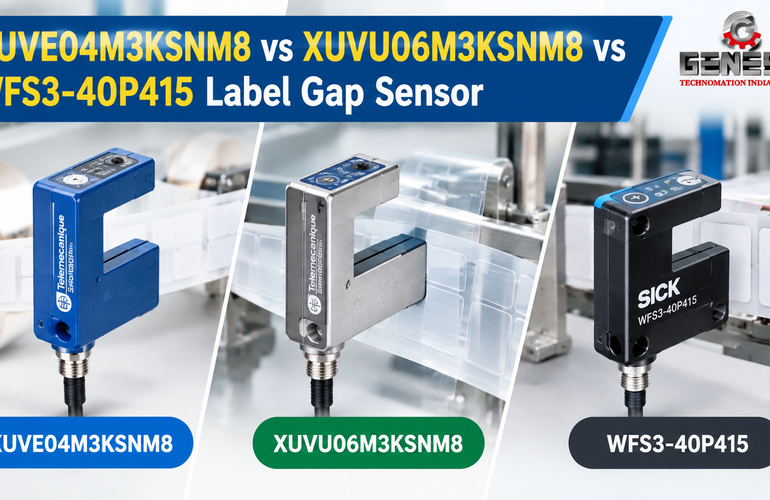

[…] automation integration and maintenance requirements. Along with WFS3-40P415, you can also purchase XUVU06M3KSNM8 and XUVE04M3KSNM8 Label Gap Sensor from […]
[…] XUVU06M3KSNM8 belongs to the same broader Telemecanique XU sensor family, but its sensing technology is […]