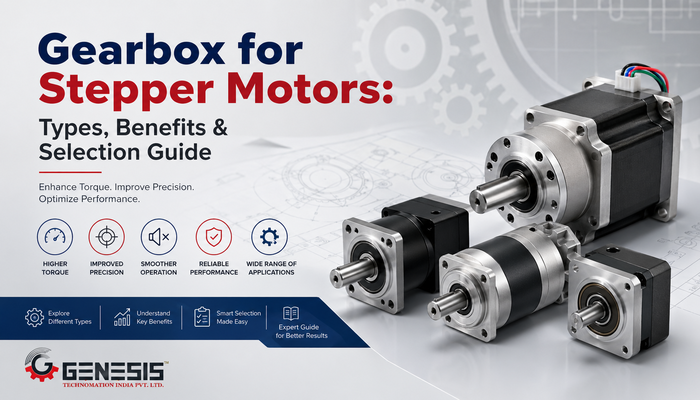
Gearbox for Stepper Motors plays a pivotal role in modern automation systems, robotics, CNC machinery, and precision-driven applications where controlled motion is everything. If you’ve ever wondered how a small motor manages to deliver high torque at low speeds with exceptional accuracy, the answer often lies in the integration of a well-matched gearbox.
But here’s the thing—choosing the right gearbox isn’t as simple as picking one off a shelf. There’s nuance involved. Torque requirements, backlash tolerance, efficiency, load conditions—everything matters. And when done right, the combination of a stepper motor with an appropriate gearbox transforms performance entirely.
Let’s break it down.
What is a Gearbox for Stepper Motors?
A gearbox, in the context of stepper motors, is a mechanical device that modifies the output characteristics of the motor—primarily speed and torque. Stepper motors naturally operate at higher speeds with moderate torque. When paired with a gearbox, the speed decreases, but torque increases significantly.
Think of it like riding a bicycle. When you shift to a lower gear, pedaling becomes easier but slower. The same principle applies here.
The gearbox is mounted directly onto the motor shaft, forming a compact and integrated system. This combination is widely used in applications that demand precise positioning and controlled motion.
Why Use a Gearbox with a Stepper Motor?
At first glance, a stepper motor may seem sufficient on its own. However, in real-world applications, there are constraints—load requirements, positioning precision, and mechanical limitations.
Here’s where gearboxes shine:
1. Increased Torque Output
Stepper motors have limited torque at higher speeds. A gearbox amplifies torque, making it suitable for heavy loads and demanding tasks.
2. Improved Resolution
Gear reduction increases positioning accuracy. For example, a 200-step motor with a 5:1 gearbox effectively provides 1000 steps per revolution.
3. Reduced Speed
In many industrial applications, slower speeds are essential for safety and precision. Gearboxes help achieve that effortlessly.
4. Enhanced System Stability
Lower speed and higher torque lead to smoother motion, minimizing vibration and resonance issues common in stepper motors.
5. Better Load Handling
With a gearbox, the motor can handle higher inertia loads without losing steps.
Types of Gearboxes for Stepper Motors
Not all gearboxes are created equal. Each type has distinct characteristics, advantages, and limitations. Choosing the right one depends heavily on the application.
1. Planetary Gearbox
Planetary gearboxes are among the most popular options.
They consist of a central sun gear, multiple planet gears, and an outer ring gear. This configuration distributes load evenly, making it highly efficient.
Key Features:
- High torque density
- Compact design
- Low backlash (ideal for precision applications)
- High efficiency (typically 90% or more)
Applications:
- Robotics
- CNC machines
- Medical equipment
2. Spur Gearbox
A simpler and more economical option.
Spur gearboxes use straight-cut gears mounted on parallel shafts. While they are easy to manufacture and cost-effective, they may produce more noise and backlash.
Key Features:
- Low cost
- Simple design
- Moderate efficiency
- Higher noise levels
Applications:
- Basic automation systems
- Conveyor systems
3. Worm Gearbox
Worm gearboxes operate using a worm (screw-like gear) and a worm wheel.
They are particularly useful when high reduction ratios are needed in a compact space.
Key Features:
- High reduction ratios
- Self-locking capability (prevents back-driving)
- Smooth and quiet operation
- Lower efficiency compared to planetary gearboxes
Applications:
- Lifts and elevators
- Packaging machinery
4. Harmonic Drive Gearbox
This is where things get interesting.
Harmonic gearboxes use a flexible spline and wave generator to achieve extremely high precision with almost zero backlash.
Key Features:
- Near-zero backlash
- Exceptional accuracy
- Lightweight design
- High cost
Applications:
- Aerospace systems
- Advanced robotics
- Semiconductor equipment
5. Helical Gearbox
Helical gears have angled teeth, which allows smoother and quieter operation compared to spur gears.
Key Features:
- Reduced noise
- Higher load capacity
- Smooth operation
- Slightly more complex design
Applications:
- Industrial machinery
- Heavy-duty systems
Benefits of Using a Gearbox for Stepper Motors
The integration of a gearbox isn’t just an upgrade—it’s often a necessity in precision-driven industries.
Precision That Matters
In applications like 3D printing or CNC machining, even a slight deviation can ruin the output. Gearboxes improve step resolution and positional accuracy.
Energy Efficiency (Contextual)
While some gearboxes reduce efficiency slightly, the overall system becomes more efficient due to optimized motor performance.
Compact Power Delivery
Instead of using a larger motor, a gearbox allows you to use a smaller motor while achieving the same torque output.
Reduced Mechanical Stress
Gearboxes help distribute load more evenly, increasing the lifespan of both motor and system components.
Noise Reduction (in certain types)
Helical and worm gearboxes significantly reduce operational noise.
Key Factors to Consider When Selecting a Gearbox
Choosing the wrong gearbox can lead to inefficiency, wear, or complete system failure. So, selection must be calculated—not guessed.
1. Torque Requirements
Determine the required output torque. Always include a safety margin (typically 20–30%).
2. Gear Ratio
The gear ratio defines how much speed is reduced and torque is increased.
- Higher ratio = More torque, less speed
- Lower ratio = More speed, less torque
3. Backlash
Backlash refers to the slight movement between gear teeth.
For precision applications, low backlash is critical. Planetary and harmonic gearboxes excel here.
4. Efficiency
Efficiency impacts energy consumption and heat generation.
- Planetary: High efficiency
- Worm: Lower efficiency
5. Load Type
Is the load constant, variable, or shock-based? Different gearboxes respond differently under varying load conditions.
6. Mounting Compatibility
Ensure the gearbox is compatible with your stepper motor in terms of shaft size, flange, and mounting style.
7. Environmental Conditions
Dust, moisture, temperature—all influence gearbox performance and lifespan.
Common Applications of Stepper Motor Gearboxes
Gearboxes for stepper motors are everywhere—often hidden, yet critical.
- CNC Machines – Precise cutting and shaping
- 3D Printers – Layer-by-layer accuracy
- Robotics – Controlled movement and torque
- Packaging Machines – Consistent speed and alignment
- Medical Devices – High precision and reliability
- Conveyor Systems – Smooth material handling
Challenges and Limitations
No system is perfect. Gearboxes come with their own set of challenges.
Efficiency Loss
Some energy is lost due to friction, especially in worm gearboxes.
Increased Cost
High-precision gearboxes like harmonic drives can be expensive.
Maintenance Needs
Lubrication and wear management are essential for long-term performance.
Added Weight and Size
While compact, gearboxes still add to the overall system footprint.
Tips for Optimizing Performance
- Always match the gearbox ratio with your application needs—not just motor specs
- Avoid overloading; it reduces lifespan dramatically
- Choose low-backlash gearboxes for precision tasks
- Regular maintenance ensures consistent performance
- Work with reliable manufacturers for quality assurance
Future Trends in Gearbox Technology
The industry is evolving. Fast.
Smart gearboxes with integrated sensors are becoming more common, enabling predictive maintenance. Materials are improving, reducing wear and increasing efficiency. And with the rise of automation and Industry 4.0, the demand for high-precision motion systems is only going up.
In short—gearboxes aren’t going anywhere. They’re just getting smarter.
FAQs
Why do stepper motors need a gearbox?
Stepper motors often lack sufficient torque at low speeds. A gearbox increases torque and improves precision, making them suitable for demanding applications.
Which gearbox is best for high precision applications?
Harmonic and planetary gearboxes are ideal due to their low backlash and high accuracy.
What is backlash in a gearbox?
Backlash is the slight gap or movement between gear teeth. Lower backlash results in higher positioning accuracy.
Can I use a gearbox with any stepper motor?
Not always. Compatibility depends on shaft size, mounting configuration, and torque requirements.
What is the ideal gear ratio?
It depends on your application. Higher ratios provide more torque but reduce speed.
Are worm gearboxes efficient?
They are less efficient compared to planetary gearboxes but offer advantages like self-locking and high reduction ratios.
How does a gearbox improve resolution?
By reducing speed, the number of steps per output revolution increases, enhancing positional accuracy.
Do gearboxes require maintenance?
Yes. Regular lubrication and inspection are essential for long-term performance.
What industries use stepper motor gearboxes?
Industries like manufacturing, robotics, healthcare, packaging, and automation widely use them.
Is a planetary gearbox better than a spur gearbox?
For precision and efficiency—yes. But spur gearboxes are more cost-effective for simpler applications.
In the end, selecting the right gearbox for your stepper motor isn’t just about specifications—it’s about understanding your system, your goals, and the demands of your application. Get that alignment right, and everything else falls into place.
Related Posts