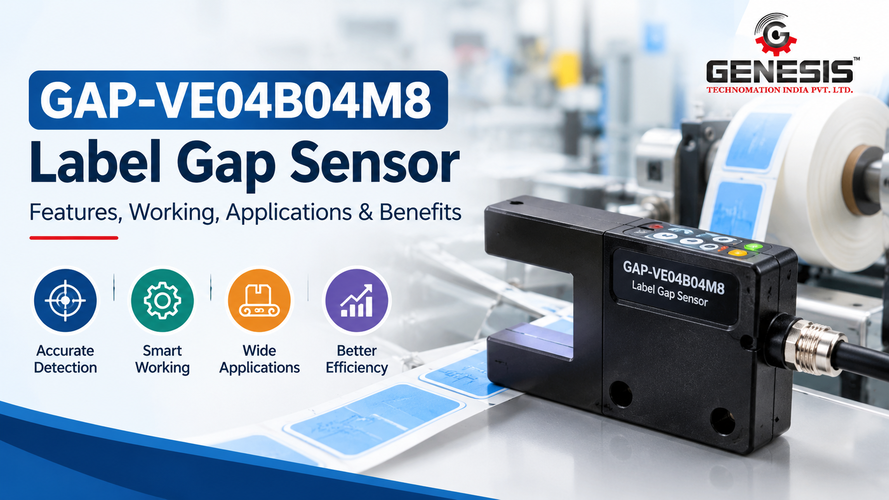
The GAP-VE04B04M8 Label Gap Sensor is an industrial sensing device designed to detect labels and the gaps between consecutive labels on a backing liner. It supports automated operations where a machine needs a reliable signal to position labels, count them, control dispensing, or coordinate material movement. These functions play an important role in packaging, printing, labelling, and label-converting applications.
In an automatic labelling machine, even a small detection error can affect label placement. The machine may dispense a label too early, stop at the wrong position, or count the material incorrectly. A dedicated Label Gap Sensor helps the control system identify transitions between labels and the supporting liner, allowing the machine to respond according to its programmed sequence.
The GAP-VE04B04M8 appears in Genesis Technomation’s product information as a GX Label Gap Sensor for printing, packaging, and labelling machinery. Its listed features include a fork-style sensing arrangement, infrared sensing, dynamic teaching, adjustable switching behaviour, and NPN/PNP outputs. However, available product information contains conflicting specifications for certain parameters, including response time, housing material, protection rating, and fork dimensions. Buyers should confirm these details against the applicable technical datasheet before installation or purchase.
Genesis Technomation India Pvt. Ltd. provides product information and purchasing enquiries for industrial automation components. If you need a label detection solution for a new machine or an existing production line, understanding the sensor’s working principle, electrical requirements, and application limitations can help you make an informed decision.
What Is the GAP-VE04B04M8 Label Gap Sensor?
The GAP-VE04B04M8 Label Gap Sensor is described as a fork-type or slot-type sensor intended for label gap detection. A fork sensor has a sensing area between two opposing sections. The label web passes through this opening, allowing the sensor to monitor changes as labels and gaps move through the detection area.
A typical label roll consists of individual labels attached to a continuous backing liner. A small space may separate one label from the next. During operation, the sensor detects the transition between these regions and generates an output signal for the connected machine controller.
A simplified label sequence looks like this:
Label → Gap → Label → Gap → Label
The sensor’s output can serve as a reference for a PLC, labelling controller, or dispensing mechanism. The controller then uses the signal to trigger the appropriate action, depending on the machine design.
How Is a Label Gap Sensor Different From a Conventional Photoelectric Sensor?
A conventional photoelectric sensor detects an object or surface according to its sensing principle and configured detection conditions. A dedicated label sensor focuses on identifying changes between a label and its carrier material.
This distinction matters because labels may be thin, closely spaced, transparent, reflective, or attached to a liner with similar optical properties. A general-purpose sensor may not reliably distinguish these transitions in every application.
A dedicated Label Gap Sensor offers a sensing arrangement intended for this specific task. Nevertheless, successful detection depends on the label construction, backing material, gap size, web alignment, sensor settings, and production speed. The actual material should always be tested before the machine enters production.
Key Features of the GAP-VE04B04M8 Label Gap Sensor
The available GX product information describes several features for the GAP-VE04B04M8. The practical value of each feature depends on the final confirmed model configuration.
Fork-Style Sensing Design
The fork or slot configuration creates a defined path for the label web. The operator does not need to position a separate sensor and reflector on opposite sides of the material, as some other sensing arrangements require.
This design can simplify mechanical integration when the machine provides enough space for the sensor and the web can pass through the fork without rubbing against its surfaces.
However, the exact fork width and depth matter. Buyers should verify these dimensions before designing mounting brackets or replacing an existing sensor.
Label and Gap Detection
The sensor is intended to identify transitions between labels and the backing liner. The machine controller can use those transitions as references for dispensing, counting, or positioning.
Reliable gap detection depends on the difference the sensor can recognise between the label and its carrier. Label thickness, surface properties, adhesive coverage, liner material, and gap dimensions can all affect the result.
Infrared Sensing
The GX product information identifies an infrared LED light source. Infrared sensing uses light outside the visible spectrum to evaluate the material passing through the sensing area. The sensor’s internal electronics interpret the received signal and determine whether the configured detection condition has occurred.
Do not assume that infrared sensing guarantees compatibility with every transparent, metallic, glossy, or printed label. Test the actual label stock to establish reliable operation.
Dynamic Teaching and Adjustment
The GX product information describes dynamic teaching and adjustment through the sensor’s control buttons. It outlines a setup process in which the sensor learns from passing labels or tags, followed by fine adjustment using the plus and minus buttons.
Teaching helps the sensor establish an appropriate switching threshold for the material being detected. Fine adjustment can help the operator improve signal separation between labels and gaps.
The exact button sequence and teaching procedure should come from the official instructions for the supplied model. Avoid relying on a generic procedure if the manufacturer provides a specific one.
NPN/PNP Switching Output
The available product information describes digital NPN/PNP output options. However, buyers should confirm whether the supplied unit provides both output types, a selectable output, or a particular configuration for the ordered variant.
This distinction is important when connecting the sensor to a programmable logic controller. An output that does not match the PLC input arrangement may require a different sensor configuration or an appropriate interface.
Light/Dark Switching
The GX product information describes light/dark switching through the sensor controls.
This function determines how the output responds to the configured sensing condition. Depending on the selected mode, the output may activate when the sensor detects a gap or when it detects a label.
The required mode depends on the machine’s control logic. Confirm the actual switching behaviour during commissioning rather than assuming the output will activate on a particular part of the label web.
Industrial Construction and Electrical Connection
Available product information disagrees about the housing material and ingress protection rating. One product page describes a metal housing with IP65 protection, while another describes a plastic housing with IP67 protection. The connector and cable descriptions also differ.
These differences are significant for machine builders. Housing material affects mechanical integration, while the protection rating determines the enclosure’s stated resistance to dust and water ingress under specified test conditions. The connection method determines how the installer routes cables and connects the sensor to the control system.
Confirm the precise variant before specifying these characteristics in a machine design.
GAP-VE04B04M8 Technical Specifications
The following table summarises the available model information. Because the product descriptions contain inconsistencies, buyers should distinguish reported values from specifications that still require confirmation.
| Parameter | Available specification |
| Model number | GAP-VE04B04M8 |
| Product type | Label Gap Sensor |
| Sensor configuration | Fork-type / slot-type |
| Operating principle | On-Off level reported; detailed sensing mechanism requires confirmation |
| Light source | Infrared LED, as listed |
| Dimensions | 10 × 25 × 64.3 mm, reported specification |
| Groove / fork width | Conflicting information: 3 mm on one product page and 4 mm in another listing |
| Fork depth | 42 mm on one product page; another listing refers to 40 mm |
| Supply voltage | 10–30 V DC reported; confirm against the supplied datasheet |
| Output configuration | Digital NPN/PNP listed; exact arrangement requires confirmation |
| Switching function | Light/dark switching reported |
| Teaching | Dynamic teaching reported |
| Sensitivity adjustment | Adjustable, with plus/minus buttons described in product information |
| Switching frequency | 10 kHz reported; verify the applicable model revision |
| Response time | Conflicting information: 50 ms and below 1 ms |
| Minimum detectable object | 2 mm reported; application conditions apply |
| Listed label gap range | 2–10 mm reported; confirm the meaning and test conditions |
| Resolution | 0.05 mm reported; requires supplier confirmation |
| Housing material | Conflicting information: metal and plastic |
| Ingress protection | Conflicting information: IP65 and IP67 |
| Electrical connection | M8, four-pin reported on one page; another listing describes a 2 m open-ended cable |
| Operating temperature | −10°C to +60°C reported; confirm for the supplied unit |
| Power consumption | Below 2 W reported; verify before design use |
| Reverse-polarity protection | Mentioned in product information; confirmation required |
| Short-circuit protection | Mentioned in product information; confirmation required |
| Compatible label materials | Paper, foil, and transparent plastic reported; validate with actual materials |
| Certifications | CE/RoHS mentioned in product information; request documentation for the exact supplied model |
Note: Reported values require confirmation wherever the product descriptions conflict or the applicable technical documentation is unavailable.
Why Do the Response-Time Specifications Need Attention?
Response time determines how quickly a sensor can react to a change in its detection condition. Switching frequency describes how often the sensor can change its output under specified operating conditions. These parameters are related, but they are not interchangeable.
The difference between 50 ms and less than 1 ms is substantial. For example, a machine designer who assumes a sub-millisecond response when the installed unit actually takes much longer could encounter missed transitions at higher web speeds.
Before finalising a design, request the official datasheet for GAP-VE04B04M8 and confirm:
- The specified response time and test conditions.
- The maximum switching frequency.
- The minimum detectable label or gap dimensions.
- The precise output configuration and connection diagram.
- The applicable housing material and IP rating.
Do not select a value simply because it appears on a commercial listing. The specification for the exact supplied variant should guide engineering calculations.
How Does the GAP-VE04B04M8 Label Gap Sensor Work?
The GAP-VE04B04M8 is intended to monitor label transitions as material passes through its fork. Available product information identifies an infrared light source and an on-off operating mode, but the detailed internal sensing mechanism and threshold characteristics should be confirmed from the manufacturer’s technical documentation.
A typical operating sequence follows these steps.
The Label Web Enters the Sensing Slot
The machine feeds the label web through the sensor’s fork. The web must follow the intended path and remain within the effective sensing area.
Correct alignment helps the sensor monitor the label and backing liner consistently. Poor positioning or unstable web movement can affect detection.
The Sensor Evaluates Changes in the Material
As labels and gaps pass through the sensing area, the sensor evaluates the resulting signal changes. The electronics use the configured detection threshold to distinguish the relevant conditions.
The actual signal difference depends on the construction of the label and liner. A combination that works with standard paper labels may behave differently with transparent film, metallic foil, or unusually thin materials.
The Sensor Changes Its Output State
When the sensor recognises the configured detection condition, its switching output changes state. The selected light/dark mode determines whether the output corresponds to label detection or gap detection.
The exact output behaviour should be checked during commissioning because it also depends on the output configuration and wiring.
The Controller Processes the Signal
A PLC or labelling controller receives the switching signal and applies the machine’s programmed logic. Depending on the application, the controller may count labels, trigger a dispensing cycle, establish a stop position, or synchronise another process.
The sensor provides the detection signal. The controller determines what action follows that signal.
The Operator Verifies Detection Performance
After setup, the operator should run the actual label material through the sensing slot and observe the sensor output. Testing should include the intended operating speed and normal material variations.
If the output becomes unstable, review alignment, teaching, label construction, web tension, and controller timing before changing machine parameters unnecessarily.
Why Teaching Matters
Teaching establishes the detection conditions for the current label and backing liner. If the material changes, the previous threshold may no longer provide sufficient separation between labels and gaps.
Re-teaching may therefore be necessary after a material changeover. Follow the product-specific instructions and verify the result with representative production material.
Applications of the GAP-VE04B04M8 Label Gap Sensor
A dedicated Label Gap Sensor can support different stages of automated material handling. Its suitability for a particular machine depends on the label dimensions, backing material, production speed, mounting arrangement, and controller interface.
Automatic Labelling Machines
Automatic labelling machines feed labels from a roll and apply them to products, containers, cartons, or packages. The controller needs to determine when a label reaches the appropriate reference position.
A gap sensor can provide a switching signal when the label web passes the detection point. The controller can use that signal to coordinate dispensing and product movement.
For example, a packaging line may require each bottle to receive a label at a consistent position. The sensor helps establish a label reference, while the machine’s mechanical and control systems determine the final application position.
Label Dispensing Systems
Label dispensers separate individual labels from a backing liner. They need to identify the transition between successive labels so that the feed mechanism can advance the material by the required amount.
A label gap sensor can provide a reference for stopping or advancing the web. The machine designer must ensure that the selected sensor can detect the actual label gap at the required feed speed.
Packaging Machinery
Packaging machines often coordinate material movement with filling, sealing, wrapping, or product-transfer operations. Where a label web forms part of the process, the sensor can provide a detection signal to support sequencing.
The sensor does not replace the controller or determine the entire packaging cycle. It supplies an input that the controller combines with other machine signals.
Printing and Label-Converting Equipment
Printing and converting systems may need to track label positions or identify transitions during material processing. A suitable sensor can provide a reference signal for indexing or registration functions.
The precise use depends on the machine architecture. Detecting a label gap is not the same as detecting a printed registration mark, so applications that rely on specific colours or print marks may require a different sensing method.
Label Counting Systems
A label counting system can use the sensor output to register successive label or gap transitions. The PLC or controller increments its count according to the programmed logic.
Reliable counting requires the controller to distinguish valid transitions from noise, repeated signals, or missed detections. The sensor’s response characteristics and the controller’s timing must support the intended production rate.
Label Positioning and Registration
The sensor can provide a repeatable reference point for label movement. The controller can use that reference when calculating feed or stop sequences.
Actual positioning accuracy also depends on mechanical tolerances, web tension, drive performance, slippage, and control timing. A sensor alone cannot guarantee a specific placement tolerance.
Material Indexing and Machine Synchronisation
In suitable systems, label transitions can help coordinate the movement of a web with other machine operations. The controller may use the signal as an indexing reference or to synchronise a label feed cycle with a production sequence.
Engineers should validate the sensor signal at the intended speed before relying on it for timing-critical operations.
Installation and Setup Guide
Correct installation helps establish stable detection and reduces avoidable commissioning problems.
Check the Model and Specifications
Confirm the GAP-VE04B04M8 model number, supply voltage, output type, connection, mounting dimensions, and environmental requirements.
Resolve any differences between the ordered model and the available product documentation before installing the sensor.
Mount the Sensor Securely
Position the sensor so the label web passes through the fork according to the machine design. Secure the mounting arrangement to prevent movement or vibration from changing the detection position.
Allow sufficient space for threading the web and performing maintenance.
Align the Label Web
Ensure that the material follows a stable path through the sensing area. Avoid contact between the moving web and the sensor body unless the product design explicitly permits it.
Incorrect alignment can change the sensor’s view of the material and affect switching consistency.
Perform the Specified Teaching Procedure
Follow the official instructions for teaching and sensitivity adjustment. If the product supports dynamic teaching, use the documented procedure rather than assuming that all fork sensors share the same button sequence.
Use representative labels and backing liner during setup.
Test the Output
Check the sensor’s output using the approved test method. Confirm that the output changes as expected when labels and gaps pass through the detection area.
Verify the signal at the PLC input as well as at the sensor. This helps distinguish a sensing issue from a wiring or controller problem.
Run a Production-Speed Test
Test the sensor at the intended operating speed, including normal acceleration and stopping conditions. Check for missed transitions, duplicate counts, and inconsistent stopping positions.
Repeat the test after material changeovers where the label or backing characteristics differ significantly.
How to Choose the Right Label Gap Sensor
The GAP-VE04B04M8 may suit applications that need dedicated label gap detection, but engineers should assess the following factors before selecting it.
Label and backing materials: Identify whether the labels are paper, film, transparent plastic, foil, or another material. Check the backing liner as well. Do not rely on a general compatibility statement without testing the actual combination.
Label thickness and gap size: Measure both the label dimensions and the distance between consecutive labels. Confirm that the sensor’s documented minimum detectable gap matches the application.
Machine speed: Establish the maximum web speed and the shortest interval between detection events. Compare these requirements with the verified response time and switching frequency.
Fork geometry: Check the fork width, depth, and mounting dimensions. Available product descriptions contain conflicting geometry information, so obtain a dimensioned drawing for the exact variant.
Output and PLC compatibility: Confirm the NPN/PNP configuration and the electrical characteristics of the receiving input. Review the official wiring diagram before installation.
Environmental conditions: Check dust, moisture, temperature, vibration, and cleaning requirements. Confirm the applicable IP rating rather than assuming the product descriptions refer to the same hardware.
Adjustment and support: Determine how the sensor handles teaching, sensitivity adjustment, and changes in label material. Obtain the relevant technical documentation before commissioning.
Transparent, metallic, reflective, and very thin materials deserve particular attention. Their sensing behaviour may differ from that of ordinary paper labels. Where detection is critical, arrange a test with representative material before committing to the machine design.
GAP-VE04B04M8 Label Gap Sensor Price in India
The price of a GAP-VE04B04M8 Label Gap Sensor can vary with supplier quotation, order quantity, taxes, availability, and delivery requirements. Online listings may not reflect the final price for a particular order.
For the latest price, contact Genesis Technomation India Pvt. Ltd. and request a quotation for the exact model.
Before placing an order, confirm:
- The complete model number and supplied variant.
- The verified response time and switching frequency.
- The fork dimensions and minimum detectable gap.
- The supply voltage and output configuration.
- The connector, cable arrangement, and pinout.
- The protection rating and housing material.
- The warranty terms and delivery schedule.
- Any technical support or documentation required for commissioning.
Providing these details with the enquiry can help clarify compatibility before purchase. Buyers comparing the Label Gap Sensor price in India should evaluate the complete specification and application suitability rather than choosing on price alone.
Why Consider Genesis Technomation India Pvt. Ltd. for GAP-VE04B04M Label Gap Sensors?
Genesis Technomation India Pvt. Ltd. provides product information for industrial automation components, including the GAP-VE04B04M8 Label Gap Sensor. Buyers can contact the company to discuss their application and confirm the specifications of the available product.
When evaluating a Label Gap Sensor supplier, focus on the information needed for a successful installation:
- Product details and quotation enquiries.
- Confirmation of model-specific specifications.
- Discussion of label material, gap size, and machine speed.
- Verification of mechanical dimensions and electrical compatibility.
- Access to relevant technical documentation.
These checks are especially important for the GAP-VE04B04M8 because the available product information contains conflicting response times, housing materials, protection ratings, and fork dimensions. Confirming the actual supplied configuration before ordering helps reduce integration risks.
If you are searching for the Best place to Buy Label Gap Sensors, consider the supplier’s ability to clarify the technical requirements and provide accurate information for your application.
Looking for a GAP-VE04B04M8 Label Gap Sensor for your automation application? Contact Genesis Technomation India Pvt. Ltd. to confirm specifications, availability, and pricing. Explore the Label Gap Sensor product range for more information.
You can also visit the Genesis Technomation India Pvt. Ltd. website to explore its industrial automation product range.
Frequently Asked Questions About GAP-VE04B04M8
What Is the GAP-VE04B04M8 Label Gap Sensor Used For?
The GAP-VE04B04M8 is described as a fork-type Label Gap Sensor for detecting label transitions and gaps on a backing liner. Typical applications include automatic labelling machines, label dispensing systems, packaging equipment, and label counting systems.
How Does the GAP-VE04B04M8 Detect Gaps Between Labels?
The sensor monitors changes as the label web passes through its sensing slot. Its electronics evaluate the detected signal and change the output according to the configured switching condition. The exact performance depends on the label material, gap dimensions, settings, and operating speed.
Which Types of Labelling Machines Can Use This Sensor?
Potential applications include automatic label applicators, dispensing equipment, and packaging or printing systems that require label gap detection. Confirm mechanical fit, material compatibility, and electrical requirements before installing the sensor.
What Is the Response Time of the GAP-VE04B04M8?
The available product descriptions conflict. One reports 50 ms, while another reports less than 1 ms. Neither value should be assumed to apply to every supplied variant. Request the official datasheet and confirm the response time before designing a high-speed application.
What Output Configuration Does the Sensor Support?
Available product information lists digital NPN/PNP output. Confirm whether the supplied unit provides a specific output type or a selectable arrangement, then match it to the PLC input circuit.
Can the GAP-VE04B04M8 Connect to a PLC?
Yes, it can be integrated into a compatible control system when the actual sensor’s electrical specifications and output arrangement match the PLC input. Follow the supplied wiring diagram and test the signal during commissioning.
How Do You Adjust or Teach the Sensor?
The available GX product information describes dynamic teaching and adjustment using plus and minus buttons. Use the official instructions for the supplied model and test the setup with the actual label and liner.
What Label Materials Can the Sensor Detect?
Available product information mentions paper, foil, and transparent plastic. However, actual detection depends on the label and backing combination, material thickness, and sensing conditions. Test unusual or challenging materials before relying on the sensor in production.
What Should Buyers Check Before Purchasing This Sensor in India?
Confirm the exact model, response time, switching frequency, fork dimensions, detectable gap, supply voltage, output configuration, connector, protection rating, warranty, and delivery schedule. Request the latest quotation and technical documentation from the supplier.
Where Can Buyers Enquire About the GAP-VE04B04M8 Label Gap Sensor?
Buyers can contact Genesis Technomation India Pvt. Ltd. for product information, application discussions, and a current quotation. Visit the Label Gap Sensor product category to learn more.
Conclusion
The GAP-VE04B04M8 Label Gap Sensor is intended to support label detection in automated labelling, packaging, printing, and dispensing applications. Its fork-style configuration and reported teaching and switching features can help a compatible machine controller identify label transitions and coordinate the required operations.
Successful implementation requires more than selecting a sensor by model number. Engineers must verify the label material, backing liner, minimum gap, web speed, fork dimensions, output configuration, response time, and PLC compatibility. These checks are particularly important because available product information contains conflicting specifications that require supplier confirmation.
For product details, technical clarification, and a current quotation, contact Genesis Technomation India Pvt. Ltd. and discuss your label-detection requirements before ordering.
Related Posts