
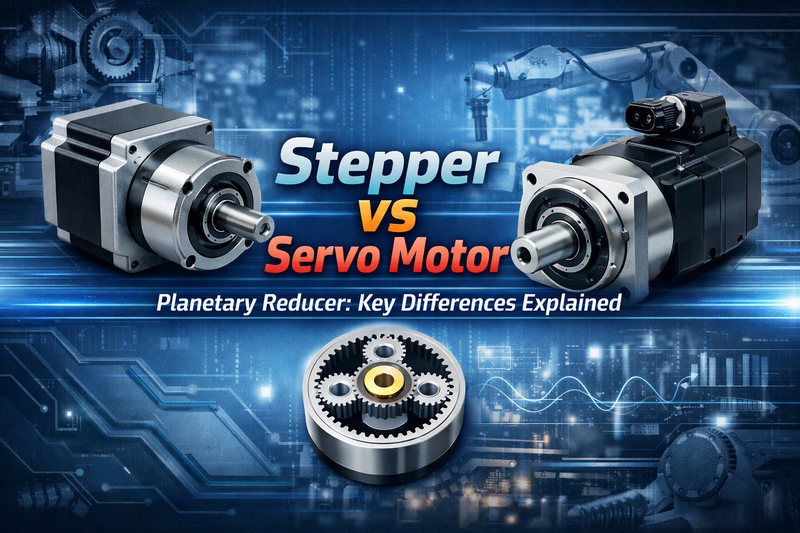
In the world of industrial automation, precision motion control is not optional—it is foundational. From CNC machinery and robotic arms to packaging systems and semiconductor fabrication lines, the interplay between motors and gear reduction systems determines performance, efficiency, and reliability. Among the most frequently compared configurations is the stepper motor planetary reducer versus the servo motor planetary reducer.
At first glance, they may appear similar. Both use planetary gearboxes. Both are designed to increase torque and optimize motion control. Both can be found in precision-driven applications. Yet beneath this surface similarity lies a fundamental difference in how they generate motion, control feedback, and respond to dynamic load conditions.
Understanding these differences is not merely academic. It directly impacts system cost, accuracy, scalability, and long-term operational stability. Let’s examine this comparison in depth.
Understanding the Basics: Motors and Planetary Reducers
Before comparing stepper and servo systems, we must clarify the two core components:
- The motor (stepper or servo)
- The planetary reducer (gearbox)
What Is a Planetary Reducer?
A planetary reducer—also known as a planetary gearbox—uses a central sun gear, multiple planet gears, and an outer ring gear. This configuration distributes load evenly across multiple contact points. The result? High torque density in a compact footprint.
Planetary reducers offer:
- High torque transmission
- Low backlash (when precision-designed)
- Compact form factor
- High efficiency (typically 90–97%)
- Strong load distribution
When paired with either a stepper motor or a servo motor, the gearbox modifies speed and torque output to match application requirements.
The real differentiation, therefore, comes from the motor driving it.
Stepper Motor Planetary Reducer: How It Works
A stepper motor operates in discrete steps. Each electrical pulse rotates the shaft by a fixed angle. Common step angles include 1.8° (200 steps per revolution) and 0.9° (400 steps per revolution). Motion is open-loop by default, meaning it does not rely on feedback to confirm position—although closed-loop stepper systems do exist.
When paired with a planetary reducer, the system gains:
- Increased torque
- Improved resolution
- Reduced output speed
- Enhanced positioning accuracy (mechanically)
For example, a 1.8° stepper motor with a 10:1 planetary gearbox effectively produces 0.18° per output shaft step. That’s mechanical multiplication of resolution.
Simple. Predictable. Cost-effective.
But simplicity comes with trade-offs.
Servo Motor Planetary Reducer: How It Works
Servo motors operate differently. They are closed-loop systems equipped with encoders that continuously monitor position, speed, and sometimes torque. A servo controller adjusts current in real time to achieve commanded motion profiles.
When paired with a planetary reducer, a servo motor system delivers:
- High torque at high speeds
- Continuous positional feedback
- Dynamic load correction
- Smooth acceleration and deceleration curves
- Superior response to varying load conditions
The gearbox in this case enhances torque density while preserving the motor’s closed-loop intelligence.
The result is not just motion—but controlled, adaptive motion.
Core Differences Between Stepper and Servo Motor Planetary Reducers
Now we move into the critical comparative dimensions.
1. Control Architecture: Open-Loop vs Closed-Loop
Stepper System
Traditional stepper motor planetary reducer systems operate open-loop. The controller sends pulses. The motor moves accordingly. No feedback confirms if the motion actually occurred.
If the load exceeds available torque, the motor may skip steps without detection.
Closed-loop steppers exist—but they still differ fundamentally from servo control in responsiveness and precision under dynamic loads.
Servo System
Servo motor planetary reducer systems are inherently closed-loop. An encoder continuously feeds position and velocity data back to the controller.
If a deviation occurs—even microscopic—the system corrects it instantly.
In dynamic environments, this distinction is decisive.
Winner in control sophistication: Servo
2. Torque Characteristics
Torque delivery behavior is dramatically different.
Stepper Motor
- High holding torque at low speed
- Torque drops significantly as speed increases
- Best suited for low-to-moderate speed applications
Adding a planetary reducer increases output torque and improves usable speed range slightly. However, fundamental torque decay remains.
Servo Motor
- Maintains torque across a broader speed range
- High peak torque capability
- Superior performance in high-speed applications
With a planetary reducer, servo systems achieve exceptional torque density while preserving speed capability.
Winner in torque consistency and high-speed performance: Servo
3. Precision and Accuracy
Precision can be deceptive.
Stepper System
Resolution improves with microstepping and gear reduction. However:
- Microstepping reduces torque
- Position accuracy depends on load conditions
- Mechanical resonance can cause oscillation
In low-load static positioning tasks, stepper planetary systems perform well.
Servo System
Servo motors use high-resolution encoders (often 17-bit or 23-bit). Combined with planetary reducers, they achieve:
- Sub-arcminute positioning accuracy
- Minimal positional drift
- Active correction under load
In applications requiring tight tolerance—robotics, medical equipment, semiconductor processing—servo systems dominate.
Winner in real-world precision under load: Servo
4. Speed Capability
Stepper motors struggle at high RPM due to inductance and torque drop-off.
Servo motors, on the other hand, operate efficiently at thousands of RPM.
When paired with planetary reducers:
- Stepper systems excel in low-speed indexing tasks.
- Servo systems handle both low and high-speed demands seamlessly.
If your application requires rapid acceleration, quick reversals, or high throughput, servo planetary combinations are superior.
5. Energy Efficiency
Energy efficiency becomes critical in continuous-duty applications.
Stepper motors draw current continuously—even when holding position. This leads to heat generation and wasted energy.
Servo motors draw current proportional to demand. When idle or lightly loaded, power consumption decreases.
Over long production cycles, servo planetary systems reduce operational costs.
6. Heat Generation and Thermal Stability
Heat affects lifespan, lubrication integrity, and overall system reliability.
Stepper systems tend to run hotter due to constant current draw.
Servo systems are thermally smarter. They regulate current dynamically, reducing unnecessary heat.
In high-duty industrial environments, thermal management often determines equipment longevity.
7. Cost Considerations
Cost is where stepper systems regain ground.
Stepper Motor Planetary Reducer
- Lower upfront cost
- Simpler control electronics
- Easier implementation
- Minimal tuning required
Ideal for budget-conscious applications with moderate precision requirements.
Servo Motor Planetary Reducer
- Higher initial investment
- Requires drive tuning
- More complex control system
- Higher engineering integration effort
However, lifecycle cost may favor servo systems in high-performance environments.
8. Application Suitability
Stepper Planetary Systems Are Ideal For:
- 3D printers
- Small CNC routers
- Labeling machines
- Pick-and-place with limited speed
- Indexing tables
- Light automation systems
Servo Planetary Systems Are Ideal For:
- Industrial robotics
- High-speed packaging lines
- CNC machining centers
- Medical automation
- Aerospace positioning systems
- Semiconductor manufacturing
In essence: Stepper for simplicity. Servo for sophistication.
Performance Under Load Variation
Here lies perhaps the most important distinction.
In static, predictable loads, both systems can perform effectively.
But introduce dynamic load variation—sudden torque spikes, rapid acceleration, inertia shifts—and the gap widens dramatically.
Stepper systems may stall or lose steps.
Servo systems compensate instantly.
For high-inertia systems or vertical lifting applications, servo planetary combinations are typically mandatory.
Backlash and Gearbox Considerations
Planetary reducers can be designed with varying backlash levels:
- Standard: 10–20 arcmin
- Precision: 3–8 arcmin
- Ultra-precision: <3 arcmin
Both stepper and servo systems benefit from low-backlash designs. However, servo systems extract greater value from ultra-precision reducers due to their high-resolution feedback loops.
In high-accuracy systems, gearbox quality matters as much as motor type.
Noise and Smoothness
Stepper motors often produce audible stepping noise, particularly at low speeds.
Servo motors operate more smoothly due to sinusoidal commutation and feedback control.
For environments requiring low noise—laboratories, medical equipment—servo planetary systems are preferable.
Maintenance and Longevity
Stepper systems have fewer electronic components and are often considered rugged and simple.
Servo systems involve more sophisticated electronics but offer self-diagnostics and monitoring.
When properly integrated, both can deliver long service life. However, in demanding industrial settings, servo systems often provide superior long-term reliability due to active error correction.
Decision Framework: How to Choose
To determine whether a stepper motor planetary reducer or servo motor planetary reducer is appropriate, evaluate:
- Required speed range
- Load variability
- Positioning tolerance
- Budget constraints
- Duty cycle
- Energy efficiency requirements
- Environmental conditions
- Future scalability
If the application is straightforward, low-cost, and predictable, stepper planetary systems are efficient and practical.
If the application demands high speed, dynamic response, and precision under changing conditions, servo planetary systems are the correct engineering choice.
Emerging Trends in Motion Control
Modern developments blur traditional boundaries.
Closed-loop stepper systems now integrate encoders to mitigate step loss.
Digital servo drives incorporate AI-based tuning algorithms.
High-efficiency planetary reducers are being engineered with improved materials, advanced lubrication systems, and reduced backlash configurations.
Even so, fundamental physics and control theory continue to distinguish stepper from servo architectures.
Summary Comparison Table of Servo and Stepper Motor Planetary Reducer
| Feature | Stepper + Planetary | Servo + Planetary |
| Control Type | Open-loop (usually) | Closed-loop |
| Torque at Low Speed | High | High |
| Torque at High Speed | Limited | Strong |
| Precision Under Load | Moderate | Excellent |
| Speed Range | Limited | Wide |
| Cost | Lower | Higher |
| Energy Efficiency | Moderate | High |
| Noise | Noticeable | Smooth |
| Dynamic Response | Limited | Excellent |
Final Thoughts
The choice between a stepper vs servo motor planetary reducer is not about which is universally better. It is about alignment—aligning motor characteristics with application demands.
Stepper planetary systems deliver simplicity, cost-effectiveness, and adequate precision for many mid-tier automation tasks.
Servo planetary systems deliver intelligence, adaptability, and high-performance motion control suitable for advanced industrial ecosystems.
Both technologies have their place. Both continue to evolve. But understanding their key differences ensures that you select not merely a motor—but a motion strategy.
In motion control engineering, precision is not accidental. It is designed.
And the design begins with the right motor-reducer combination.
