
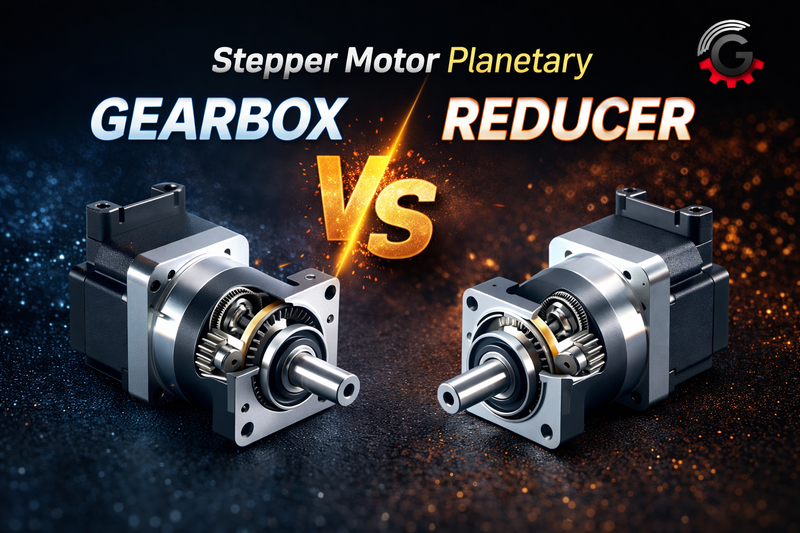
Stepper motors play a crucial role in modern automation, robotics, CNC machinery, and precision control systems. Their ability to move in exact increments makes them ideal for applications where accuracy and repeatability are essential. However, many industrial and engineering applications require more torque, improved control, and reduced speed than a standard stepper motor can provide. This is where gear mechanisms like planetary gearboxes and reducers come into play.
In many motion control systems, a Stepper Motor Planetary Reducer is used to improve torque output, enhance positioning accuracy, and optimize mechanical efficiency. These components allow stepper motors to operate effectively in demanding environments such as automated manufacturing, robotics, medical equipment, and packaging machines. While planetary gearboxes and reducers are sometimes used interchangeably in conversation, they are not exactly the same. Understanding their differences helps engineers and system designers choose the right component for their applications.
This article explains the key differences between stepper motor planetary gearboxes and reducers, how they work, their advantages, and when each should be used.
Understanding Stepper Motors
Before comparing planetary gearboxes and reducers, it is important to understand the fundamentals of stepper motors.
A stepper motor is an electromechanical device that converts electrical pulses into discrete mechanical movement. Unlike traditional motors that rotate continuously, stepper motors move in precise steps. Each pulse sent to the motor results in a specific angular movement.
Key Features of Stepper Motors
- High Precision Control
Stepper motors can move in exact step increments, allowing precise control of position. - Excellent Repeatability
Because the movement is digitally controlled, stepper motors can repeat the same motion with minimal error. - Simple Control System
Stepper motors often operate without feedback systems in many applications. - Cost Efficiency
Compared to servo motors, stepper motors are generally more affordable.
Despite these advantages, stepper motors have some limitations, particularly when it comes to torque at low speeds and load handling. Gearboxes and reducers help overcome these challenges.
What Is a Planetary Gearbox?
A planetary gearbox is a compact and efficient gear system that increases torque while reducing output speed. It is widely used in high-precision mechanical systems.
The name “planetary” comes from the arrangement of gears that resemble a solar system.
Components of a Planetary Gearbox
A planetary gearbox typically consists of three main components:
- Sun Gear
Located at the center, it connects directly to the motor shaft. - Planet Gears
These gears rotate around the sun gear and distribute the load evenly. - Ring Gear
This outer gear encloses the planet gears and helps transfer motion.
Because multiple gears share the load simultaneously, planetary gearboxes are known for their strength and efficiency.
Advantages of Planetary Gearboxes
Planetary gearboxes offer several benefits that make them ideal for precision systems.
1. High Torque Density
Planetary gearboxes can deliver high torque relative to their compact size. Multiple gear contacts allow the load to be distributed evenly.
2. Compact Design
Despite their power, planetary gearboxes are small and lightweight. This makes them suitable for robotics, CNC equipment, and automation systems.
3. High Efficiency
Planetary gear systems typically achieve efficiencies of 90–97%, depending on design and materials.
4. Better Load Distribution
Multiple planet gears share the load evenly, reducing wear and improving durability.
5. High Precision
Planetary gearboxes offer minimal backlash, making them ideal for applications requiring precise motion control.
What Is a Gear Reducer?
A gear reducer, also known as a speed reducer, is a mechanical device that reduces the rotational speed of a motor while increasing torque.
Reducers can come in several forms, including:
- Worm gear reducers
- Helical gear reducers
- Cycloidal reducers
- Planetary reducers
The main purpose of a reducer is to modify the output characteristics of a motor to match the requirements of a machine or application.
Functions of a Gear Reducer
Gear reducers perform several essential functions in mechanical systems:
Speed Reduction
The primary purpose of a reducer is to decrease motor speed to a usable level for machinery.
Torque Amplification
Reducing speed naturally increases torque, allowing the motor to handle heavier loads.
Improved Mechanical Control
Reducers allow better control of motion in equipment like conveyors, lifts, and robotic arms.
Reduced Motor Stress
By lowering speed and increasing torque, reducers reduce the load on the motor itself.
Stepper Motor Planetary Gearbox vs Stepper Motor Planetary Reducer
Although planetary gearboxes can act as reducers, not all reducers are planetary gearboxes. This distinction often causes confusion in engineering discussions.
Below are the major differences between them.
1. Design Structure
Planetary Gearbox
Planetary gearboxes use a central sun gear surrounded by planet gears inside a ring gear. This design allows multiple gears to share the load simultaneously.
Reducer
Reducers come in many different designs, including worm gear, helical gear, and cycloidal systems. The structure varies depending on the application.
Key Difference
Planetary gearboxes are a specific type of reducer with a unique multi-gear configuration.
2. Size and Compactness
Planetary Gearbox
Planetary gearboxes are compact and provide high torque density. Their symmetrical structure allows efficient space utilization.
Reducer
Traditional reducers like worm gear reducers are often larger and heavier compared to planetary systems.
Key Difference
Planetary gearboxes generally provide more torque in a smaller space.
3. Efficiency
Planetary Gearbox
Efficiency levels can reach up to 97%, making them ideal for high-performance machinery.
Reducer
Efficiency varies depending on the type of reducer. For example:
- Worm gear reducers may have efficiencies between 50% and 90%.
- Helical reducers may reach around 90–95%.
Key Difference
Planetary gearboxes usually offer higher efficiency compared to many other reducer types.
4. Precision and Backlash
Planetary Gearbox
Planetary gearboxes provide low backlash, which is critical in applications like robotics and CNC machines.
Reducer
Some reducers, especially worm gear systems, can have higher backlash and less precision.
Key Difference
Planetary gearboxes are preferred for high-precision motion control.
5. Load Capacity
Planetary Gearbox
Because multiple planet gears share the load, planetary gearboxes can handle high torque loads.
Reducer
Load capacity depends on the design. Worm gear reducers may not distribute loads as evenly.
Key Difference
Planetary gearboxes typically offer better load distribution.
6. Noise and Vibration
Planetary Gearbox
These gearboxes operate smoothly with minimal vibration due to balanced gear engagement.
Reducer
Some reducers, particularly older designs, may produce more noise and vibration.
7. Cost Considerations
Planetary Gearbox
Planetary gearboxes are generally more expensive due to precision engineering and complex manufacturing.
Reducer
Standard reducers can be more affordable depending on design and materials.
Key Difference
Planetary gearboxes offer better performance but often come with a higher price.
Applications of Stepper Motor Planetary Gearboxes
Planetary gearboxes are commonly used in industries that require precise control and high torque.
Robotics
Robotic systems rely heavily on planetary gearboxes to achieve precise movement and torque control.
CNC Machines
CNC machines require high accuracy and minimal backlash, making planetary gearboxes an excellent choice.
Medical Equipment
Medical devices such as surgical robots and imaging systems use planetary gearboxes for precision control.
Automation Systems
Industrial automation lines often use planetary gearboxes to ensure reliable motion control.
Aerospace Systems
High-performance aerospace equipment frequently incorporates planetary gear systems.
Applications of Stepper Motor Planetary Reducers
Reducers are widely used across many industrial sectors.
Conveyor Systems
Reducers help control speed and torque in conveyor belts used in manufacturing plants.
Lifting Equipment
Cranes and hoists rely on reducers to increase torque and control lifting speed.
Food Processing Machinery
Reducers are used in mixers, packaging machines, and processing equipment.
Agricultural Machinery
Tractors and harvesting machines often incorporate gear reducers.
Mining Equipment
Heavy-duty reducers are used in crushers, conveyors, and drilling machines.
When to Choose a Planetary Gearbox
Planetary gearboxes are the best option when applications require:
- High precision motion control
- Compact design
- High torque output
- Low backlash
- High efficiency
They are particularly suitable for robotics, CNC machines, and automated manufacturing systems.
When to Choose a Standard Reducer
Standard reducers may be the better choice when:
- Cost is a primary concern
- Precision is not extremely critical
- Large mechanical systems require heavy-duty gear reduction
- Simpler designs are sufficient
Industries like mining, agriculture, and heavy manufacturing often use standard reducers.
How to Choose the Right Gear System for a Stepper Motor
Selecting the right gearbox or reducer depends on several important factors.
1. Torque Requirements
Determine how much torque your application requires.
2. Speed Reduction Ratio
The gear ratio determines how much the motor speed will be reduced.
3. Precision Requirements
Applications like robotics require low backlash gearboxes.
4. Space Constraints
Compact machinery benefits from planetary gearboxes.
5. Efficiency
High efficiency reduces energy consumption and heat generation.
6. Budget
Balance performance needs with budget constraints.
Future Trends in Stepper Motor Gear Systems
The demand for advanced motion control systems continues to grow. As industries adopt automation, robotics, and smart manufacturing, gear technology is also evolving.
Some key trends include:
Smart Gear Systems
Sensors and monitoring technologies are being integrated into gearboxes.
Lightweight Materials
Advanced alloys and composites are improving strength while reducing weight.
Higher Precision Manufacturing
Modern CNC manufacturing techniques allow extremely precise gear production.
Integration with Automation
Gear systems are increasingly designed for compatibility with automated control systems.
Final Thoughts
Stepper motors are widely used in industries that require precise control and repeatable motion. However, many applications demand higher torque and reduced speed than a standard stepper motor can provide. This is where gear systems like planetary gearboxes and reducers become essential.
Planetary gearboxes are a specialized type of reducer known for their compact design, high efficiency, and exceptional precision. On the other hand, reducers represent a broader category of gear mechanisms designed primarily for speed reduction and torque amplification.
Choosing between a stepper motor planetary gearbox and a standard reducer depends on the specific requirements of your application. If precision, compactness, and efficiency are critical, planetary gearboxes are often the best choice. For heavy-duty industrial applications where cost and simplicity are more important, traditional reducers may be more suitable.
Understanding these differences allows engineers, designers, and manufacturers to select the right solution, ensuring optimal performance and reliability in their mechanical systems.
