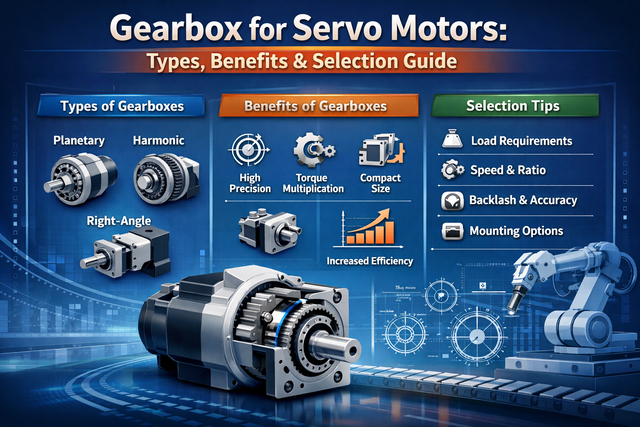
Gearbox for Servo Motors plays a critical role in modern automation systems where precision, torque control, and motion accuracy are essential. In today’s rapidly advancing industrial landscape, automation is no longer optional — it is a necessity. From robotics and CNC machinery to packaging systems and conveyor automation, servo motors combined with gearboxes create powerful motion control solutions that drive productivity and efficiency.
Servo motors are known for their high-speed performance, precision positioning, and responsiveness. However, many industrial applications require higher torque at lower speeds, improved stability, and better load-handling capabilities. This is where a gearbox for servo motors becomes indispensable.
By integrating a gearbox with a servo motor, engineers can optimize speed, multiply torque, enhance positioning accuracy, and improve overall machine performance. The result is a more efficient, reliable, and long-lasting automation system.
In this comprehensive expert guide, we will cover everything you need to know about Gearbox for Servo Motors, including:
- What is Gearbox for Servo Motors
- Why Servo Motors Need Gearboxes
- Types of Gearboxes for Servo Motors
- Benefits of Servo Motor Gearboxes
- Selection Guide
- Industrial Applications
- Common Mistakes to Avoid
- Maintenance Tips
- Future Trends
Let’s start with the fundamentals.
What is a Gearbox for Servo Motors?
A gearbox for servo motors is a mechanical device used to modify torque, speed, and direction of a servo motor output. It connects directly to the servo motor shaft and adjusts performance characteristics based on application needs.
Servo motors are known for:
- High speed rotation
- Precise position control
- Fast acceleration and deceleration
- Closed-loop feedback systems
However, many industrial applications require:
- Higher torque
- Lower speed
- Increased load capacity
- Improved positioning accuracy
This is where the gearbox becomes essential.
By introducing gear reduction, the gearbox:
- Reduces motor speed
- Increases torque
- Enhances motion control
- Improves system efficiency
For example:
A servo motor rotating at 3000 RPM may not be suitable for a robotic arm requiring slow, controlled movement. By adding a 10:1 gearbox, the speed reduces to 300 RPM, while torque increases by approximately 10 times.
This simple yet powerful principle makes gearboxes indispensable in automation systems.
Why Use a Gearbox with Servo Motors?
Many engineers ask — why not use a larger servo motor instead of adding a gearbox?
The answer lies in efficiency, cost, and performance.
Using a gearbox with a servo motor offers several advantages:
1. Increased Torque Output
Servo motors generate limited torque at high speeds. Gearboxes multiply torque, allowing smaller motors to handle heavier loads.
This results in:
- Reduced motor size
- Lower cost
- Better efficiency
2. Improved Positioning Accuracy
Gearboxes, especially planetary gearboxes, reduce the impact of inertia mismatch. This leads to:
- Better motion control
- Higher accuracy
- Smoother operation
Precision industries such as robotics and CNC machines rely heavily on this advantage.
3. Reduced Motor Load
When servo motors operate under heavy loads without gear reduction, they experience:
- Higher current draw
- Increased heat
- Reduced lifespan
A gearbox distributes load efficiently, increasing motor life.
4. Lower Energy Consumption
Using the correct gearbox reduces energy waste. Smaller motors consume less electricity, improving operational efficiency.
5. Better System Stability
Gearboxes reduce vibrations and improve machine stability, particularly in high-speed applications.
Types of Gearboxes for Servo Motors
There are several types of gearboxes used with servo motors. Each has unique characteristics suited for specific applications.
Let’s explore them in detail.
1. Planetary Gearbox
Planetary gearboxes are the most commonly used gearboxes in servo motor applications.
How Planetary Gearboxes Work
A planetary gearbox consists of:
- Sun gear (center)
- Planet gears (surrounding gears)
- Ring gear (outer gear)
- Carrier (holds planet gears)
This compact design distributes load evenly across multiple gears.
Advantages of Planetary Gearboxes
- High torque density
- Compact size
- High efficiency
- Low backlash
- High precision
- Smooth operation
Applications
- Robotics
- CNC machines
- Packaging machines
- Printing machines
- Automation systems
Planetary gearboxes are ideal for applications requiring precision and compact design.
2. Helical Gearbox
Helical gearboxes use angled gears that provide smooth and quiet operation.
Features
- High load capacity
- Smooth operation
- Low noise
- High efficiency
Advantages
- Better power transmission
- Longer lifespan
- Less vibration
Applications
- Conveyor systems
- Material handling
- Heavy-duty machines
- Industrial automation
Helical gearboxes are ideal for continuous operation environments.
3. Harmonic Drive Gearbox
Harmonic gearboxes offer extremely high precision with minimal backlash.
How Harmonic Drives Work
They consist of:
- Wave generator
- Flex spline
- Circular spline
This design allows extremely precise motion control.
Advantages
- Zero backlash
- High precision
- Compact design
- Lightweight
Applications
- Robotics
- Semiconductor machines
- Medical automation
- Aerospace
Harmonic drives are preferred where micron-level accuracy is required.
4. Bevel Gearbox
Bevel gearboxes change the direction of motion, typically at 90 degrees.
Features
- Angular motion transfer
- High efficiency
- Compact design
Applications
- Packaging machines
- Assembly lines
- Automation systems
Bevel gearboxes are useful where space constraints exist.
5. Worm Gearbox
Worm gearboxes provide high reduction ratios in compact sizes.
Advantages
- High torque output
- Compact design
- Self-locking capability
Disadvantages
- Lower efficiency
- Higher heat generation
Applications
- Lifting systems
- Packaging machines
- Conveyor systems
Worm gearboxes are best suited for low-speed, high-torque applications.
Key Benefits of Gearboxes for Servo Motors
1. High Torque Performance
Gearboxes multiply torque, allowing servo motors to handle heavier loads.
2. Improved Precision
Low backlash gearboxes enhance positioning accuracy.
3. Reduced Motor Size
Smaller motors reduce system cost.
4. Better Load Handling
Gearboxes distribute mechanical load efficiently.
5. Increased Machine Life
Reduced stress increases component lifespan.
6. Higher Efficiency
Optimized power transmission improves efficiency.
7. Reduced Noise
Helical and planetary gearboxes reduce operational noise.
Understanding Gearbox Ratio
Gear ratio is one of the most important factors when selecting a gearbox.
Gear ratio defines how many times motor rotation reduces.
Example:
- 5:1 Ratio = Motor rotates 5 times → Output rotates once
- 10:1 Ratio = Motor rotates 10 times → Output rotates once
Higher ratio:
- Lower speed
- Higher torque
Lower ratio:
- Higher speed
- Lower torque
Selecting the correct ratio is critical for system performance.
What is Backlash in Servo Gearboxes?
Backlash refers to small movement between gears when direction changes.
High backlash results in:
- Reduced accuracy
- Poor positioning
- Vibration
Low backlash gearboxes provide:
- Higher precision
- Better motion control
- Smooth performance
Typical Backlash Values:
- Planetary gearbox: 3–10 arc-min
- Harmonic gearbox: Near zero
- Helical gearbox: Moderate backlash
How to Select the Right Gearbox for Servo Motors
Selecting the right gearbox requires careful evaluation.
Step 1: Determine Torque Requirement
Calculate required torque based on:
- Load weight
- Acceleration
- Application type
Step 2: Select Gear Ratio
Choose ratio based on:
- Required speed
- Required torque
Step 3: Check Backlash Requirement
High precision applications require:
- Low backlash gearboxes
Step 4: Consider Mounting Configuration
Common mounting options:
- Inline
- Right angle
- Flange mount
Step 5: Check Efficiency
Higher efficiency reduces energy consumption.
Step 6: Evaluate Application Environment
Consider:
- Temperature
- Dust
- Humidity
- Vibration
Applications of Servo Motor Gearboxes
Servo motor gearboxes are widely used across industries.
Robotics
- Robotic arms
- Pick and place systems
- Welding robots
CNC Machines
- Precision cutting
- Milling
- Turning
Packaging Machines
- Labeling machines
- Filling machines
- Wrapping machines
Material Handling
- Conveyor systems
- Automated storage systems
Printing Machines
- High-speed printing
- Precision alignment
Semiconductor Industry
- Chip manufacturing
- Precision handling
Common Mistakes When Selecting Gearboxes for Servo Motor
Choosing Wrong Gear Ratio
Incorrect ratio causes:
- Overheating
- Poor performance
Ignoring Backlash
Precision applications require low backlash.
Not Considering Load Type
Shock loads require stronger gearboxes.
Ignoring Efficiency
Low efficiency increases operating costs.
Maintenance Tips for Servo Gearboxes
Regular maintenance increases lifespan.
Lubrication
Use recommended lubricants.
Temperature Monitoring
Avoid overheating.
Vibration Monitoring
Detect early wear.
Regular Inspection
Check for noise and wear.
Future Trends in Servo Motor Gearboxes
Automation is evolving, and servo gear technology is advancing.
Smart Gearboxes
- Sensor integration
- Predictive maintenance
Compact Designs
- Smaller size
- Higher torque density
Lightweight Materials
- Aluminum alloys
- Composite materials
High Precision Gearboxes
- Zero backlash designs
Conclusion
Gearboxes for servo motors are essential components in modern automation systems. They enhance torque, improve accuracy, and increase efficiency. Choosing the right gearbox ensures optimal performance, longer lifespan, and reduced operational costs.
Whether you’re designing robotics, CNC machines, or packaging systems, understanding gearbox types, benefits, and selection criteria is crucial.
By carefully evaluating torque requirements, gear ratio, backlash, and application needs, engineers can build reliable and high-performance automation systems.
As industries move toward smarter automation, servo motor gearboxes will continue to play a critical role in achieving precision, efficiency, and productivity.
Related Posts