Stepper motors are everywhere. Quietly powering 3D printers, guiding CNC machines, driving robotics, controlling automation systems, and moving industrial equipment with precise accuracy. Yet, when it comes to selecting the right motor, many engineers, buyers, and machine builders face the same question:
Which stepper motor should I choose — NEMA 17, NEMA 23, NEMA 34, NEMA 42, or NEMA 43?
At first glance, these numbers may seem confusing. But once you understand how they differ — in torque, size, power consumption, and applications — the decision becomes much clearer.
This comprehensive guide explains everything you need to know about NEMA 17 vs NEMA 23 vs NEMA 34 vs NEMA 42 vs NEMA 43 stepper motors, including specifications, differences, applications, advantages, disadvantages, and selection tips.
Let’s begin.
What Is a NEMA Stepper Motor?
Before diving into comparisons, it’s important to understand what NEMA actually means.
NEMA stands for National Electrical Manufacturers Association. It is a standard that defines the physical mounting dimensions of motors — not their electrical performance.
This means:
- NEMA size defines faceplate dimensions
- Torque and current can still vary between manufacturers
- Two motors with the same NEMA size may have different power ratings
For example:
- NEMA 17 motor = 1.7 x 1.7 inches faceplate
- NEMA 23 motor = 2.3 x 2.3 inches faceplate
- NEMA 34 motor = 3.4 x 3.4 inches faceplate
- NEMA 42 motor = 4.2 x 4.2 inches faceplate
- NEMA 43 motor = 4.3 x 4.3 inches faceplate
As the size increases, torque and power capacity typically increase as well.
However, bigger is not always better. Choosing the wrong motor can lead to:
- Excessive power consumption
- Overheating
- Higher cost
- Reduced efficiency
That’s why understanding differences matters.
Quick Comparison: NEMA 17 vs NEMA 23 vs NEMA 34 vs NEMA 42 vs NEMA 43
| Motor Type | Frame Size | Torque Range | Current Range | Weight | Applications |
| NEMA 17 | 1.7 x 1.7 in | 0.2 – 0.8 Nm | 0.5 – 2A | Light | 3D printers, small CNC |
| NEMA 23 | 2.3 x 2.3 in | 1 – 3 Nm | 2 – 4A | Medium | CNC routers, automation |
| NEMA 34 | 3.4 x 3.4 in | 4 – 12 Nm | 4 – 6A | Heavy | Industrial CNC machines |
| NEMA 42 | 4.2 x 4.2 in | 10 – 25 Nm | 5 – 8A | Very Heavy | Industrial automation |
| NEMA 43 | 4.3 x 4.3 in | 15 – 30+ Nm | 6 – 10A | Ultra Heavy | Heavy machinery |
NEMA 17 Stepper Motor Overview
NEMA 17 stepper motors are compact, lightweight, and widely used in precision applications that require moderate torque and high accuracy.
These motors are especially popular in 3D printers, small CNC machines, and DIY electronics projects.
Key Features of NEMA 17
- Compact design
- Low power consumption
- High precision movement
- Easy to integrate
- Affordable pricing
Typical Specifications
- Frame Size: 42mm
- Torque: 0.2 – 0.8 Nm
- Current: 0.5 – 2A
- Step Angle: 1.8°
- Holding Torque: Up to 80 Ncm
Applications
- 3D Printers
- Laser engravers
- Small CNC machines
- Robotics
- Camera sliders
- Medical equipment
Advantages
Small footprint makes them ideal for compact machines. They consume less power, generate minimal heat, and are cost-effective.
Limitations
They are not suitable for heavy-duty industrial applications. If used in high-load environments, they may stall or lose steps.
NEMA 23 Stepper Motor Overview
NEMA 23 stepper motors offer more torque and power compared to NEMA 17 motors. These motors are widely used in mid-sized automation systems and CNC machinery.
They provide a strong balance between size and performance.
Key Features
- Higher torque output
- Strong durability
- Moderate size
- Good speed performance
- Reliable industrial performance
Typical Specifications
- Frame Size: 57mm
- Torque: 1 – 3 Nm
- Current: 2 – 4A
- Step Angle: 1.8°
- Holding Torque: Up to 300 Ncm
Applications
- CNC routers
- Pick and place machines
- Textile machinery
- Packaging machines
- Automated systems
- 3D printer upgrades
Advantages
NEMA 23 motors offer significantly more torque while maintaining reasonable size and cost.
Limitations
They require stronger drivers and higher power supply compared to NEMA 17 motors.
NEMA 34 Stepper Motor Overview
NEMA 34 stepper motors are industrial-grade motors designed for heavy-duty applications.
These motors are commonly used in CNC machines, robotics, industrial automation, and large manufacturing equipment.
Key Features
- High torque output
- Heavy-duty construction
- Industrial performance
- Long service life
- Strong shaft design
Typical Specifications
- Frame Size: 86mm
- Torque: 4 – 12 Nm
- Current: 4 – 6A
- Step Angle: 1.8°
- Holding Torque: Up to 1200 Ncm
Applications
- CNC plasma cutting machines
- CNC routers
- Milling machines
- Industrial automation
- Printing machines
- Packaging machines
Advantages
Extremely powerful and reliable. Ideal for continuous operation.
Limitations
Heavier and more expensive than NEMA 17 and NEMA 23.
NEMA 42 Stepper Motor Overview
NEMA 42 stepper motors are built for high-load industrial automation.
These motors are used where high torque and precision movement are required simultaneously.
Key Features
- Very high torque
- Industrial grade performance
- Heavy load handling
- High current operation
Typical Specifications
- Frame Size: 110mm
- Torque: 10 – 25 Nm
- Current: 5 – 8A
- Step Angle: 1.8°
Applications
- Heavy CNC machines
- Industrial robotics
- Manufacturing equipment
- Conveyor systems
- Automation lines
Advantages
Capable of handling large loads without losing steps.
Limitations
Higher cost and larger size require strong mounting.
NEMA 43 Stepper Motor Overview
NEMA 43 stepper motors are ultra heavy-duty motors designed for extreme industrial applications.
These motors deliver maximum torque and industrial reliability.
Key Features
- Ultra high torque
- Industrial heavy-duty build
- High precision movement
- Long operational life
Typical Specifications
- Frame Size: 110mm+
- Torque: 15 – 30+ Nm
- Current: 6 – 10A
- Step Angle: 1.8°
Applications
- Heavy CNC machines
- Industrial manufacturing
- Aerospace equipment
- Metal cutting machines
- Large automation systems
Advantages
Exceptional torque output for large machines.
Limitations
High power requirement and higher cost.
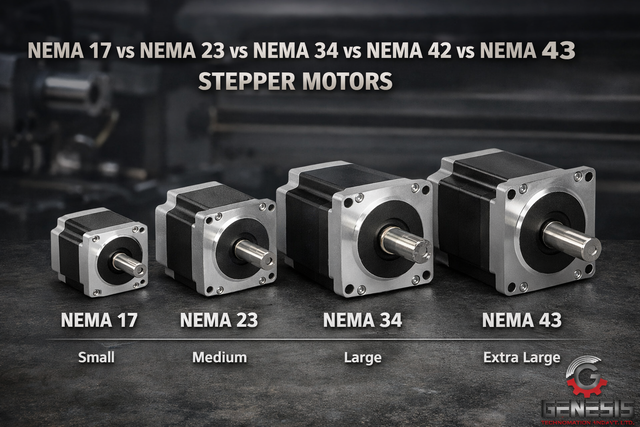
NEMA 17 vs NEMA 23 vs NEMA 34 vs NEMA 42 vs NEMA 43 Differences
1. Size Difference
Size increases progressively:
- NEMA 17 – Small
- NEMA 23 – Medium
- NEMA 34 – Large
- NEMA 42 – Very Large
- NEMA 43 – Extra Large
Larger motors produce more torque but require more space.
2. Torque Comparison
Torque increases with size:
- NEMA 17 – Low torque
- NEMA 23 – Medium torque
- NEMA 34 – High torque
- NEMA 42 – Very high torque
- NEMA 43 – Ultra high torque
3. Power Consumption
Higher torque motors consume more power:
- NEMA 17 – Low power
- NEMA 23 – Moderate power
- NEMA 34 – High power
- NEMA 42 – Very high power
- NEMA 43 – Ultra high power
4. Weight Comparison
Weight increases:
- NEMA 17 – Lightweight
- NEMA 23 – Medium weight
- NEMA 34 – Heavy
- NEMA 42 – Very heavy
- NEMA 43 – Ultra heavy
5. Cost Comparison
Cost increases with size:
- NEMA 17 – Cheapest
- NEMA 23 – Affordable
- NEMA 34 – Expensive
- NEMA 42 – More expensive
- NEMA 43 – Most expensive
Applications Comparison
| Motor | Best Use Case |
| NEMA 17 | 3D printers |
| NEMA 23 | CNC routers |
| NEMA 34 | Industrial CNC |
| NEMA 42 | Heavy automation |
| NEMA 43 | Heavy machinery |
How to Choose the Right Stepper Motor
Selecting the right motor depends on:
Load Requirement
Heavy load → Choose NEMA 34, 42, 43
Light load → Choose NEMA 17, 23
Speed Requirement
High speed → NEMA 23
Heavy load slow speed → NEMA 34+
Budget
Low budget → NEMA 17
High performance → NEMA 34+
Machine Size
Compact machines → NEMA 17
Industrial machines → NEMA 34+
Advantages of Stepper Motors
- High precision
- Reliable
- Low maintenance
- No feedback required
- Easy control
Common Industries Using Stepper Motors
- Automation industry
- CNC industry
- Robotics
- Packaging
- Textile industry
- Medical equipment
- Printing industry
Why Choose the Right NEMA Motor Size
Choosing the wrong motor can cause:
- Motor overheating
- Loss of steps
- Reduced efficiency
- Machine failure
Choosing correctly ensures:
- Smooth operation
- Long life
- Better performance
Final Comparison Summary
| Feature | NEMA 17 | NEMA 23 | NEMA 34 | NEMA 42 | NEMA 43 |
| Size | Small | Medium | Large | Very Large | Extra Large |
| Torque | Low | Medium | High | Very High | Ultra High |
| Cost | Low | Medium | High | Higher | Highest |
| Applications | Small machines | Medium machines | Industrial machines | Heavy automation | Heavy machinery |
Conclusion
Choosing between NEMA 17 vs NEMA 23 vs NEMA 34 vs NEMA 42 vs NEMA 43 depends on your application, load requirements, and performance expectations.
- Choose NEMA 17 for compact precision machines
- Choose NEMA 23 for medium-duty automation
- Choose NEMA 34 for industrial machines
- Choose NEMA 42 for heavy-duty applications
- Choose NEMA 43 for extreme industrial environments
Each motor has its place. Each solves a different engineering challenge. And when selected correctly, stepper motors deliver unmatched precision, reliability, and performance.
If you are planning a CNC machine, automation system, or industrial project, selecting the right stepper motor size is the first step toward success.
Frequently Asked Questions (FAQs
What does NEMA mean in stepper motors?
NEMA stands for National Electrical Manufacturers Association. It defines the standard mounting dimensions and faceplate size of stepper motors. The NEMA number does not directly indicate torque or power but helps identify the motor size.
What is the main difference between NEMA 17, NEMA 23, NEMA 34, NEMA 42, and NEMA 43 stepper motors?
The main differences include:
- Frame size
- Torque output
- Power consumption
- Weight
- Applications
As the NEMA size increases, the motor becomes larger, more powerful, and suitable for heavier applications.
Which is better: NEMA 17 or NEMA 23 stepper motor?
It depends on your application:
- NEMA 17 is best for 3D printers and small machines
- NEMA 23 is better for CNC routers and medium automation
If you need more torque and strength, NEMA 23 is better.
When should I use a NEMA 34 stepper motor?
You should use a NEMA 34 stepper motor for:
- Industrial CNC machines
- Plasma cutting machines
- Automation systems
- Heavy-duty equipment
These motors provide high torque and reliable performance.
What applications use NEMA 42 stepper motors?
NEMA 42 stepper motors are commonly used in:
- Heavy CNC machines
- Industrial automation
- Conveyor systems
- Robotics
- Manufacturing machinery
These motors handle large loads and demanding environments.
What is NEMA 43 stepper motor used for?
NEMA 43 stepper motors are used in extreme heavy-duty industrial applications such as:
- Metal cutting machines
- Large automation systems
- Aerospace machinery
- Industrial manufacturing equipment
They provide maximum torque and performance.
Does a larger NEMA size mean more torque?
Yes, generally larger NEMA motors produce more torque. However, torque also depends on:
- Motor length
- Current rating
- Manufacturer design
So always check specifications before choosing.
Which stepper motor is best for CNC machines?
It depends on machine size:
- Small CNC machine → NEMA 17
- Medium CNC router → NEMA 23
- Industrial CNC machine → NEMA 34
- Heavy-duty CNC → NEMA 42 or NEMA 43
Which stepper motor is best for 3D printers?
NEMA 17 stepper motors are the most commonly used motors in 3D printers because they are:
- Compact
- Lightweight
- Cost-effective
- Accurate
What is the torque range of different NEMA stepper motors?
Typical torque ranges:
- NEMA 17 → 0.2 – 0.8 Nm
- NEMA 23 → 1 – 3 Nm
- NEMA 34 → 4 – 12 Nm
- NEMA 42 → 10 – 25 Nm
- NEMA 43 → 15 – 30+ Nm
These values vary depending on the manufacturer.
Can I replace a NEMA 17 with a NEMA 23 stepper motor?
Yes, but you must consider:
- Mounting size
- Power supply
- Driver compatibility
- Space availability
NEMA 23 motors require more power and larger mounting space.
Which stepper motor consumes more power?
Power consumption increases with size:
- NEMA 17 → Low power
- NEMA 23 → Medium power
- NEMA 34 → High power
- NEMA 42 → Very high power
- NEMA 43 → Ultra high power
Which stepper motor is best for industrial automation?
For industrial automation:
- Medium load → NEMA 23
- Heavy load → NEMA 34
- Very heavy load → NEMA 42 or NEMA 43
Choose based on load and application.
Are NEMA stepper motors accurate?
Yes, stepper motors are highly accurate. Most stepper motors offer:
- 1.8° step angle
- Microstepping capability
- High precision movement
They are ideal for precision motion control applications.
What factors should I consider before choosing a stepper motor?
Consider these factors:
- Load requirement
- Speed requirement
- Torque requirement
- Power supply
- Application type
- Budget
Selecting the right motor improves performance and efficiency.
Which stepper motor is best for heavy-duty applications?
For heavy-duty applications:
- NEMA 34 → Heavy-duty
- NEMA 42 → Very heavy-duty
- NEMA 43 → Extreme heavy-duty
Choose according to load requirements.
Are stepper motors suitable for continuous operation?
Yes, stepper motors are designed for continuous operation, especially industrial-grade models like:
- NEMA 34
- NEMA 42
- NEMA 43
These motors are built for long operating hours.
What industries use NEMA stepper motors?
Stepper motors are used in:
- CNC industry
- Robotics
- Automation
- Medical equipment
- Packaging industry
- Textile machinery
- Printing industry
Which stepper motor is most commonly used?
The most commonly used stepper motors are:
- NEMA 17 → 3D printers
- NEMA 23 → CNC machines
- NEMA 34 → Industrial automation
How do I choose between NEMA 34 and NEMA 42 stepper motors?
Choose NEMA 34 if:
- Medium-heavy load
- Moderate machine size
Choose NEMA 42 if:
- Very heavy load
- Large industrial machines
Related Posts